Tertiary educational attainment among adults
- Eurostat dataset
- edat_lfse_03
- Reference period
- 2025
- Unit of measure
- % of population aged 25-64
Key estimates
- EU aggregate (2025): 36.9 % of population aged 25-64.
- Highest value: Ireland at 58.7 % of population aged 25-64; lowest: Bosnia and Herzegovina at 18.4 % of population aged 25-64.
- Cross-country mean 38.6 % of population aged 25-64, standard deviation 10.1, coefficient of variation 26.2% across 34 reporting countries.
- Aggregate change 2014→2025: +30.7% on a constant panel of 33 countries.
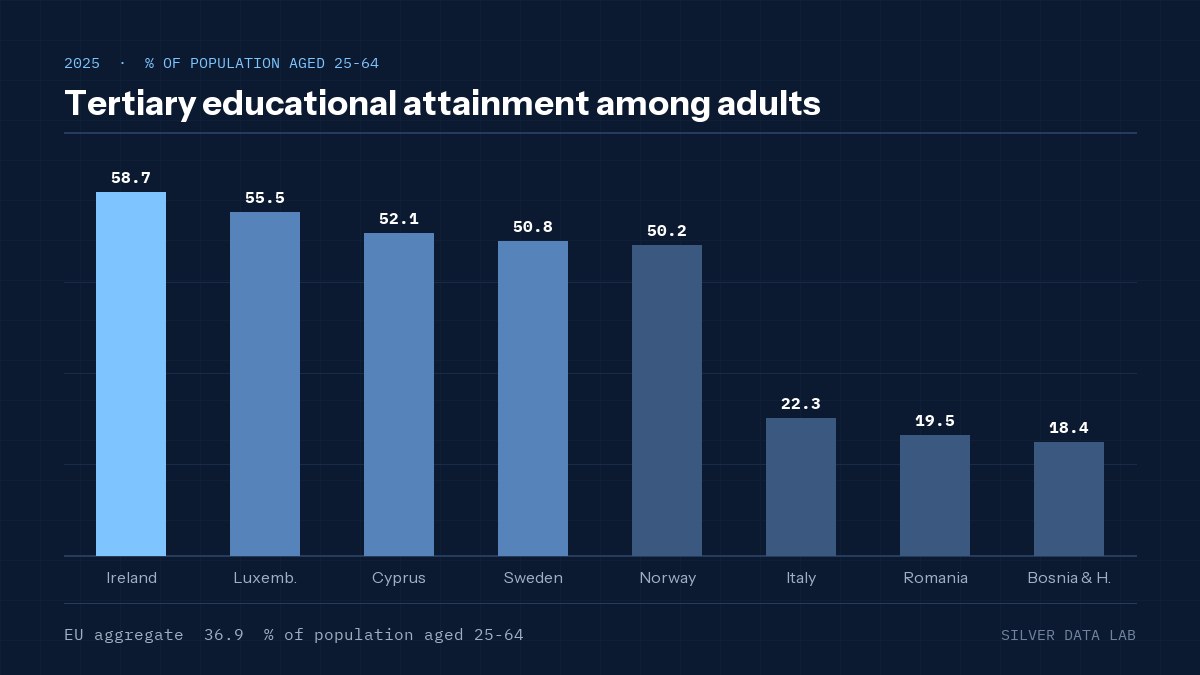
How qualified is the European adult population? Eurostat dataset edat_lfse_03 reports tertiary educational attainment among adults for 34 reporting countries, with 2025 as the most recent period carrying broad coverage. The European aggregate stands at 36.9 % of population aged 25-64. Stock measures of attainment move slowly and therefore reveal decades of past education policy.
The five highest values in 2025 are recorded by Ireland (58.7), Luxembourg (55.5), Cyprus (52.1), Sweden (50.8), Norway (50.2), all expressed in % of population aged 25-64. At the opposite end of the distribution sit Bosnia and Herzegovina (18.4), Romania (19.5), Italy (22.3), North Macedonia (25.1), Türkiye (26.8). The ratio between the highest and the lowest observation is 3.19, while the median country reports 38.9 % of population aged 25-64 against a mean of 38.6 % of population aged 25-64.
Dispersion is moderate: the standard deviation across countries is 10.1 % of population aged 25-64, giving a coefficient of variation of 26.2%. The mean sits below the median, which indicates that the distribution is pulled by the lower tail rather than being symmetric. Any European average quoted for this indicator therefore describes a synthetic country that few Member States resemble.
Between 2014 and 2025 the summed value across the 33 countries reporting in both periods moved by +30.7%. The largest relative increases are observed in Malta (+77.8%), Türkiye (+75.2%), Portugal (+50.7%); the largest decreases, or the smallest increases, in Finland (+2.2%), Estonia (+12.0%), Norway (+18.7%). Because the panel is held constant, this change is not an artefact of countries entering or leaving the sample.
Higher values are the policy-preferred direction for this indicator, so the countries listed at the bottom of the distribution mark the effective size of the European gap: closing it to the level of the fifth-ranked country would require the lowest performer to move by 31.8 % of population aged 25-64. The estimates above are reproducible: the dataset identifier, filter dimensions and reference period are stated in the methodological note, and the series can be re-downloaded from the Eurostat dissemination API at any time.
Methodological note
Source: Eurostat, dataset edat_lfse_03 ('Population in private households by educational attainment level'), extracted from the Eurostat dissemination API (JSON-stat 2.0) on the dataset update of 2026-06-11. Filter dimensions: sex=T; age=Y25-64; isced11=ED5-8; unit=PC. Unit of measure: % of population aged 25-64. Reference period: 2025. Geographic perimeter: national reporting units with two-character geo codes (34 countries with a non-missing observation); European and euro-area aggregates are excluded from the cross-country statistics and reported separately. Descriptive statistics (mean, median, population standard deviation, coefficient of variation) are computed unweighted over reporting countries. Change over time is computed on a constant panel: only countries with a non-missing observation in both the base and the reference period enter the calculation, which removes composition effects but may differ from the officially published aggregate. No imputation, seasonal adjustment or re-scaling has been applied beyond what Eurostat performs at source. Flagged provisional and estimated observations are retained as published.
Source data
The underlying series can be inspected and re-downloaded from the Eurostat data browser.