94.6% of Overnight Stays on Crete Are by Foreign Visitors, the EU's Highest
Silver Data Lab Research Desk · Statistical analysis · Published on 08 October 2026
This study is open to members only
Its sources, filters and extraction date are declared above, as they are for every study. Sign in to read the analysis in full.
- Data source
- Eurostat
- Reference period
- 2025
- Last updated
- 11 October 2026
Re-checked against the source on 21 October 2026. 9 values in its datasets moved between snapshots; none is a figure stated on this page. Every revision we have observed →
Key estimates
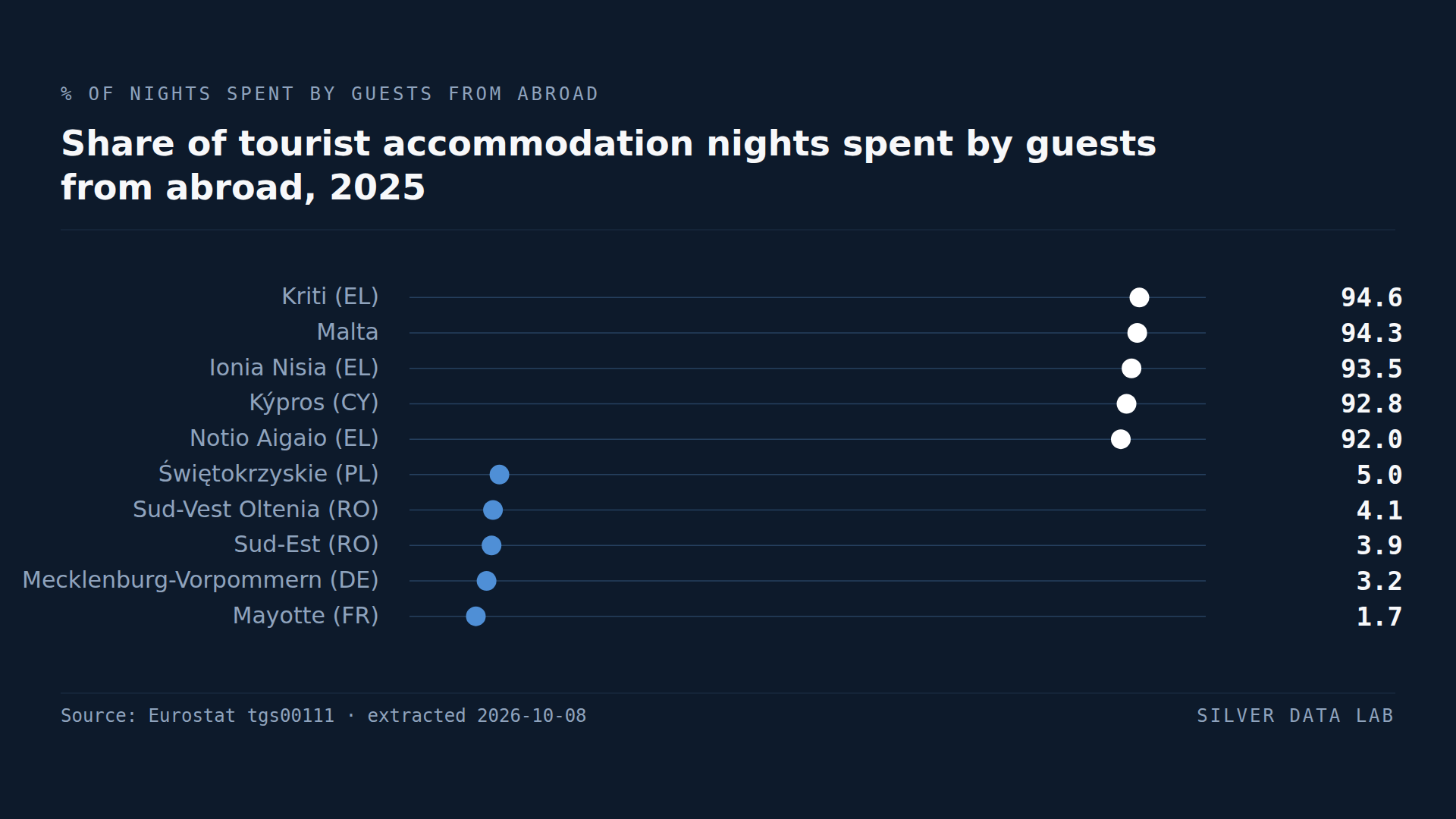
- In 2025 guests living outside Greece spent 94.6% of the nights at tourist accommodation on Kriti, the Greek island region: the highest share among the 244 regions of the EU. Every share on this page is derived by Silver Data Lab from Eurostat's counts of nights.
- All five regions at the top are islands: Kriti, Malta at 94.3%, Ionia Nisia, the Greek Ionian Islands, at 93.5%, Cyprus at 92.8% and Notio Aigaio, the Greek South Aegean, at 92.0%.
- Mayotte, the French department in the Indian Ocean, records the lowest share at 1.7%. Mecklenburg-Vorpommern, on Germany's Baltic coast, is next at 3.2% of 30.0 million nights.
- Inside Greece the share falls to 14.5% in Dytiki Makedonia, in the north-west: 80.1 points below Kriti, the widest gap between two regions of one Member State. Spain's, at 76.3 points, is second.
- In 14 of the 22 Member States made up of more than one region, the region containing the capital has the highest share. Germany, Poland and Sweden have no region where guests from abroad account for half the nights.
Nights filed by where the guest lives
The table behind this page counts nights spent at tourist accommodation establishments: hotels, holiday and other short-stay accommodation, and campsites, including parks for caravans and motor homes. Each night is recorded in the region where the establishment stands and filed under the guest's country of residence, which is either the country the region belongs to or any other. Residence decides, not passport: a Greek citizen who lives in Germany is a foreign guest on Kriti, and a German citizen settled in Athens is a domestic one.
The regions are NUTS 2 regions, the middle level of the three into which Eurostat divides the Union's territory for regional statistics. In Spain they are the autonomous communities plus the cities of Ceuta and Melilla, in Greece the thirteen administrative regions, and Estonia, Cyprus, Latvia, Luxembourg and Malta are each counted as a single region. For 2025 the table carries both the foreign and the total count for 244 regions, covering all 27 Member States.
The figure used throughout is the foreign count divided by the total. Eurostat's regional table publishes the two counts but not that ratio, so every share quoted here is derived by Silver Data Lab, and so is every gap between two shares.
Islands at the top
Kriti, the Greek island region, has the highest share in the Union: of its 35.2 million nights in 2025, 33.3 million were spent by guests who live outside Greece, or 94.6%. Malta follows at 94.3%, then Ionia Nisia, the Ionian Islands off Greece's western coast, at 93.5%. Cyprus, which the table labels Kýpros, records 92.8%, and Notio Aigaio, the South Aegean islands that include the Cyclades and the Dodecanese, 92.0%. All five are islands or groups of islands, and three of them are Greek.
Three more regions clear 90%: Jadranska Hrvatska, the Adriatic coast and islands of Croatia, at 91.6%, and two regions at 90.9%, Tirol, the Austrian Alpine state, and Illes Balears, Spain's Balearic Islands. Guests from abroad account for more than half of all nights in 66 of the 244 regions; in the other 178 the majority belongs to residents of the region's own country.
Large holiday regions that host their own country
The foot of the ranking is not a list of places tourists pass by. Mecklenburg-Vorpommern, the German state on the Baltic coast, hosted 30.0 million nights in 2025, the third-largest total among Germany's 38 regions and more than the 20.4 million of the Ionian Islands. Fewer than one million of those nights were spent by guests from abroad, a share of 3.2%. Schleswig-Holstein, Germany's northernmost state, between the North Sea and the Baltic, hosted 34.8 million nights with a foreign share of 5.7%.
Two Romanian regions come next to it. Sud-Est, the south-eastern region that includes the country's Black Sea coast, records 3.9%, and Sud-Vest Oltenia, in the south-west of Romania, 4.1%. Świętokrzyskie, the province around Kielce in south-central Poland, completes the five lowest at 5.0%. Below all of them is Mayotte, the French department in the Indian Ocean, at 1.7%, a share resting on 2,367 foreign nights out of 135,824.
Twenty-one regions are below 10%. Eleven are German, five Polish and three Romanian, and the remaining two are French overseas departments, Mayotte and La Réunion.
The widest gaps run inside countries
Greece shows how far apart two regions of one country can sit. Ten of its thirteen regions host more foreign than domestic nights, among them Attiki, the Athens region, at 75.4%. In Dytiki Makedonia, the inland region of north-western Greece, guests from abroad account for 14.5% of 0.37 million nights. Kriti and Dytiki Makedonia are 80.1 percentage points apart, the widest spread between the highest and the lowest region of any Member State.
Spain has the second widest, 76.3 points. The Balearic Islands record 90.9% and the Canary Islands 87.7%, against 14.6% in Castilla-La Mancha, in the centre of the country. Czechia, Austria and Hungary follow, each with a spread of between 66 and 74 points: Praha at 86.1% against Střední Morava, in central Moravia, at 13.1%; Tirol at 90.9% against Burgenland, Austria's easternmost state, at 21.1%; and Budapest at 84.2% against Észak-Magyarország, the north of Hungary, at 17.4%.
The narrowest spreads are Sweden's and Ireland's. In Sweden, 21.4 points separate Stockholm, at 35.9%, from Östra Mellansverige, the east-central region, at 14.5%. In Ireland, 22.6 points separate Eastern and Midland, the region around Dublin, at 71.5%, from Southern, the south of the country, at 48.9%.
The capital usually leads its country
Twenty-two Member States are divided into more than one region, and in fourteen of them the region containing the capital has the highest foreign share in the country. In some the lead is large. Bucureşti-Ilfov, Bucharest and the county around it, records 60.8%, and no other Romanian region reaches 16%: Centru, in central Romania, comes second at 15.8%, 45.0 points behind. Praha's 86.1% is 35.6 points ahead of Czechia's second region, Severozápad, in the north-west, at 50.5%.
In the other eight the leader is an island, a coast or an Alpine region. Kriti leads Greece, where Attiki is seventh, and the Balearic Islands lead Spain, where the Comunidad de Madrid is fourth at 57.5%. Tirol is ahead of Vienna, which records 82.8%. Bolzano, the mainly German-speaking province in the Italian Alps, records 72.1%, just ahead of Lazio, the Rome region, at 71.6%. Madeira, the Portuguese island in the Atlantic, also records 82.8%, ahead of Grande Lisboa, the Lisbon region, at 80.8%. Adriatic Croatia is ahead of the City of Zagreb at 79.9%. Severoiztochen, on Bulgaria's Black Sea coast, records 75.2%, with Yugozapaden, the region of Sofia, third at 49.5%. And Åland, the autonomous Finnish islands between Finland and Sweden, records 50.4% against 45.6% in Helsinki-Uusimaa.
The table records where guests live, not why they came. Business travel, conferences and air connections may weigh on a capital region as much as holidays do, and nothing in these counts separates one purpose from another.
Where no region has a foreign majority
Germany, Poland and Sweden have no region where guests from abroad account for half the nights. Germany's highest share is Berlin's, 41.4%; Sweden's is Stockholm's, 35.9%; and Poland's is that of Warszawski stołeczny, the Warsaw capital region, at 32.4%. France is one region away from the same position: Ile de France, the Paris region, reaches 54.2%, and the other 26 French regions are all below half.
At the opposite end, every region of Croatia and of Slovenia is above half. Sjeverna Hrvatska, in the north of Croatia, has the lowest share of the four Croatian regions at 56.0%, which is higher than the top share of any region in Germany, Poland or Sweden.
The same extremes a year earlier
The ranking is not one year's accident. In 2024 the same five regions led, in the same order, with Kriti then at 94.4%. Four of the five lowest were also the same. The fifth was Kujawsko-pomorskie, in north-central Poland, which is sixth lowest in 2025.
Share of tourist accommodation nights spent by guests from abroad, 2025
| Country | % of nights |
|---|---|
| Kriti (EL) | 94.6 |
| Malta | 94.3 |
| Ionia Nisia (EL) | 93.5 |
| Kýpros (CY) | 92.8 |
| Notio Aigaio (EL) | 92.0 |
| Świętokrzyskie (PL) | 5.0 |
| Sud-Vest Oltenia (RO) | 4.1 |
| Sud-Est (RO) | 3.9 |
| Mecklenburg-Vorpommern (DE) | 3.2 |
| Mayotte (FR) | 1.7 |
This table as data: CSV · JSON
Every Member State for this indicator+
Members see every Member State for this indicator here, not only the rows the ranking prints. Become a Member
What these figures cannot tell you
- Residence decides, however long the journey
- Guests are classified by country of residence, so a resident of mainland Spain staying in the Canary Islands, or a resident of mainland France staying in La Réunion, is a domestic guest. Island and overseas regions nonetheless end up far apart: the Canary Islands record 87.7%, Madeira 82.8% and the Azores 65.0%, while in the five French overseas departments, from Martinique at 16.2% to Mayotte at 1.7%, every visitor from mainland France counts as domestic. A low share there does not mean the visitors travelled a short way.
- Paid accommodation only
- The counts cover hotels, holiday and other short-stay accommodation, and campsites. Nights spent with friends or relatives, or in a guest's own second home, are outside them. Eurostat's metadata also note that Member States may leave the smallest establishments, below a threshold of bed places, out of the survey, and that stays booked through online platforms are published as a separate series. Where a country applies such a threshold, the share describes the establishments above it.
- Regions of every size count once
- A NUTS 2 region can be as small as Mayotte, with 135,824 nights in 2025, or as large as the Canary Islands, with 102.3 million. Every region counts once in the counts and the ranking on this page, so Mayotte's place at the bottom is decided by 2,367 nights. Melilla and Ceuta, the two Spanish cities on the North African coast, have the next smallest totals, 138,504 and 144,453. In the five Member States that form a single region, the regional share is in effect the national one.
- No EU figure, and no flags in the years used
- The regional table publishes no EU aggregate, so this page states no EU share: adding up the regions would produce a Silver Data Lab figure in the place of the source's. No 2024 or 2025 value used here carries a Eurostat status flag; for EU regions, the estimated, low-reliability and confidential cells in the table all fall in 2021 or earlier. Regions listed under retired codes, which the table carries with values for earlier years only, are left out.
Frequently asked questions
- Which EU region depends most on guests from abroad?
- Kriti, the Greek island region: guests who live outside Greece spent 94.6% of the nights at its tourist accommodation in 2025. Malta, at 94.3%, and Ionia Nisia, the Ionian Islands, at 93.5%, come next. The shares are derived by Silver Data Lab from Eurostat's counts of nights.
- Where are foreign guests rarest?
- In Mayotte, the French department in the Indian Ocean, at 1.7%, on a very small total of nights. Next come Mecklenburg-Vorpommern, on Germany's Baltic coast, at 3.2% of 30.0 million nights, and Sud-Est, in south-eastern Romania, at 3.9%.
- Which country has the widest gap between its own regions?
- Greece. The 94.6% of Kriti and the 14.5% of Dytiki Makedonia, in north-western Greece, are 80.1 percentage points apart, the widest spread between the highest and lowest region of any Member State. Spain follows at 76.3 points, between the Balearic Islands and Castilla-La Mancha.
- Does a foreign guest mean a foreign national?
- No. Eurostat classifies guests by country of residence, not citizenship. A citizen living abroad who comes home on holiday is a foreign guest, while a foreign national living in the country is a domestic one, and so is a resident of mainland France or Spain visiting that country's overseas or island regions.
Methodological note
The table measures the number of nights spent by guests at tourist accommodation establishments in each NUTS 2 region, split by the guest's country of residence into residents of the reporting country, residents of other countries and the total of the two. The establishments are those of three groups of the NACE classification of economic activities: hotels and similar accommodation; holiday and other short-stay accommodation; and camping grounds, recreational vehicle parks and trailer parks. This page uses the foreign and total counts for 2024 and 2025 in the 244 regions of the 27 Member States that carry both values in both years.
2025 is the latest year in the table and the reference year of the ranking. 2024 is used only to check that the extremes of the ranking hold from one year to the next.
Silver Data Lab derived the following from the published counts: the share of nights spent by guests from abroad, foreign nights divided by total nights, for every region in 2024 and 2025, which includes every value in the ranking; the gaps in percentage points between the highest and lowest region of each Member State, and between a country's first and second regions; the counts of regions at or above 90%, above half and below 10%, and their split by country; the counts of Member States whose capital region, or no region, or every region, stands at a given position; the rank positions described in the text; and the rounding of night counts to millions. All other figures are published by Eurostat as they stand.
Source data
The underlying series can be inspected and re-downloaded from the Eurostat data browser. The filters below are the ones applied.
Nights spent at tourist accommodation establishments by NUTS 2 region
tgs00111
- Filters applied:
- freq=A · c_resid=FOR, TOTAL · unit=NR · nace_r2=I551-I553 · time=2024, 2025
- Extracted:
- 2026-10-21
- Source last updated:
- 2026-10-20
Download the data
The data the study you have just read is built on, exactly as it was downloaded and archived.
Yours as a Member.
Data downloadable by Members
How to cite
Record the vintage as well as the study: the figures on this page are the ones extracted on the dates below.
Silver Data Lab Research Desk (2026). 94.6% of Overnight Stays on Crete Are by Foreign Visitors, the EU's Highest. Silver Data Lab, published 08 October 2026, last updated 11 October 2026. https://www.silverdatalab.com/studies/foreign-guests-by-region-in-the-eu
- Data: Eurostat, Nights spent at tourist accommodation establishments by NUTS 2 region (tgs00111), filters freq=A, c_resid=FOR, TOTAL, unit=NR, nace_r2=I551-I553, time=2024, 2025; extracted 2026-10-21; source last updated 2026-10-20. https://doi.org/10.2908/tgs00111
Silver Data Lab's analysis is licensed CC BY 4.0. The statistics remain their publisher's and keep its terms of reuse.
Ask the research desk
A question about this study — a definition, a filter, a break in the series, what the figures can and cannot support — answered by the desk that made the extraction.
Members can write to the research desk