Germany Has the EU's Second-Worst School Dropout Rate
Silver Data Lab Research Desk · Statistical analysis · Published on 14 June 2026
- Data source
- Eurostat
- Reference period
- 2025
- Last updated
- 14 June 2026
Re-checked against the source on 11 September 2026. No value in its datasets has moved between the snapshots we hold. Every revision we have observed →
Key estimates
- 9.1% of people aged 18 to 24 in the EU had left education with at most lower secondary schooling in 2025.
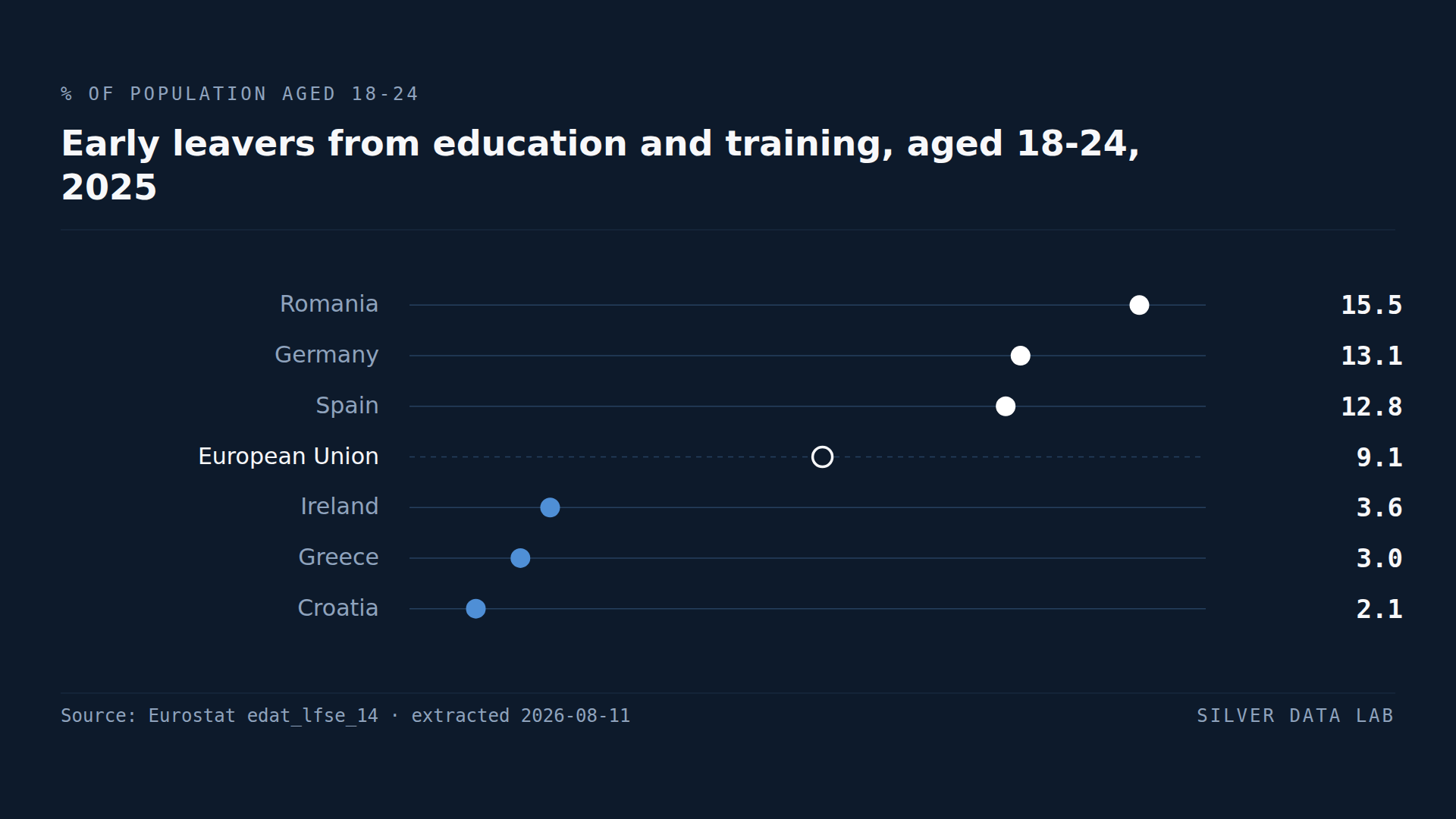
- Romania records 15.5%, Germany 13.1% and Spain 12.8%.
- Croatia records 2.1%, Greece 3.0% and Ireland 3.6%.
- Germany's rate is seven times Croatia's and above the EU figure by four points.
- Data cover 26 of 27 Member States for this year.
An indicator that measures the present, unlike most education statistics
Early school leaving counts people aged 18 to 24 who have completed at most lower secondary education and are not in any further education or training. The age band is narrow and recent, which makes this one of the few education indicators that describes a school system's current output rather than its history.
Across the EU, 9.1% of that age group had left education early in 2025.
The unexpected second place
Romania records the highest rate at 15.5%. Germany records 13.1%.
Germany in second place is the result that does not follow from its reputation. It has the Union's most developed dual vocational system, a strong apprenticeship tradition, and one of its highest-performing economies — and it produces a larger share of early leavers than every Member State except Romania.
Spain follows at 12.8%, Estonia at 10.2%, and Austria and Denmark at 10.0%.
Where almost nobody leaves early
Croatia records 2.1%, the lowest in the Union by a clear margin. Greece follows at 3.0%, Ireland at 3.6% and Poland at 4.0%.
Croatia and Greece are the observations that most clearly break any link between this indicator and national income. Both sit below the EU average on GDP per capita — Croatia at 78, Greece at 68 — and both keep young people in education more successfully than any wealthy Member State.
What high performance here does and does not mean
A low early leaving rate means young people stay in education to at least upper secondary level. It does not mean the education is good, that qualifications lead to work, or that young people are employed afterwards.
Greece is the clearest illustration. It has the Union's third-lowest early leaving rate at 3.0% and one of its highest rates of young people not in employment, education or training at 13.6%. Staying in school and finding work afterwards are separate outcomes, and a country can succeed at the first while failing at the second.
Early leavers from education and training, aged 18-24, 2025
| Country | % of population aged 18-24 | Gap to EU averagepercentage points, derived |
|---|---|---|
| Romania | 15.5 | +6.4 |
| Germany | 13.1 | +4.0 |
| Spain | 12.8d | +3.7 |
| European Unionaggregate | 9.1 | — |
| Ireland | 3.6 | −5.5 |
| Greece | 3.0 | −6.1 |
| Croatia | 2.1u | −7.0 |
Flags carried by the source on these values: d definition differs · u low reliability
This table as data: CSV · JSON
Every Member State for this indicator+
Members see every Member State for this indicator here, not only the rows the ranking prints. Become a Member
Embed this chart
Paste this code into a page. The frame carries the source and the extraction date, and links back to the study.
What these figures cannot tell you
- A narrow age band
- The indicator covers 18 to 24 year olds only, so it is sensitive to cohort size and to the timing of qualifications. A country where qualifications are typically completed at 19 rather than 18 will show a different figure for reasons of scheduling.
- Lower secondary is the threshold
- Anyone who has completed upper secondary education, however briefly they then studied, is not an early leaver. The measure identifies a specific educational floor rather than the general level of achievement.
- Not in training either
- People are counted only if they are also not currently in education or training. Someone who left school early and later returned does not appear, which is appropriate for the concept and means the rate is not a count of everyone who ever left early.
- One Member State missing
- Coverage is 26 of 27 for 2025. The absent country is missing from the source rather than recorded at zero.
Frequently asked questions
- What is early school leaving?
- Leaving education with at most lower secondary schooling and not being in any further education or training. Eurostat measures it among people aged 18 to 24, where it stood at 9.1% across the EU in 2025.
- Which EU country has the worst dropout rate?
- Romania, at 15.5% in 2025, followed by Germany at 13.1% and Spain at 12.8%. Germany's position is notable given its well-developed vocational and apprenticeship system.
- Which EU country has the lowest dropout rate?
- Croatia, at 2.1% in 2025, followed by Greece at 3.0% and Ireland at 3.6%. Both Croatia and Greece sit below the EU average on GDP per capita, so the ranking does not track income.
- Does a low dropout rate mean young people do well?
- Not necessarily. Greece has the third-lowest early leaving rate in the Union and one of its highest shares of young people not in employment, education or training. Staying in school and finding work afterwards are different outcomes.
Methodological note
Early leavers from education and training is published by Eurostat as the share of people aged 18 to 24 whose highest completed level is at most lower secondary education and who were not in education or training in the four weeks before the survey.
Values are for 2025, covering 26 of the 27 Member States at the extraction date.
The comparison with Greece's NEET rate draws on the companion study in the children and youth category, and the GDP per capita figures come from the economy and finance category. Both use separate extractions.
Source data
The underlying series can be inspected and re-downloaded from the Eurostat data browser. The filters below are the ones applied.
Early leavers from education and training
edat_lfse_14
- Filters applied:
- freq=A · sex=T · wstatus=POP · age=Y18-24 · unit=PC · time=2025
- Extracted:
- 2026-09-11
- Source last updated:
- 2026-09-10
Download the data
The data the study you have just read is built on, exactly as it was downloaded and archived.
Yours as a Member.
Data downloadable by Members
How to cite
Record the vintage as well as the study: the figures on this page are the ones extracted on the dates below.
Silver Data Lab Research Desk (2026). Germany Has the EU's Second-Worst School Dropout Rate. Silver Data Lab, published 14 June 2026, last updated 14 June 2026. https://www.silverdatalab.com/studies/early-school-leaving-in-the-eu
- Data: Eurostat, Early leavers from education and training (edat_lfse_14), filters freq=A, sex=T, wstatus=POP, age=Y18-24, unit=PC, time=2025; extracted 2026-09-11; source last updated 2026-09-10. https://doi.org/10.2908/edat_lfse_14
Silver Data Lab's analysis is licensed CC BY 4.0. The statistics remain their publisher's and keep its terms of reuse.
Ask the research desk
A question about this study — a definition, a filter, a break in the series, what the figures can and cannot support — answered by the desk that made the extraction.
Members can write to the research desk
Studies where the same country leads or trails
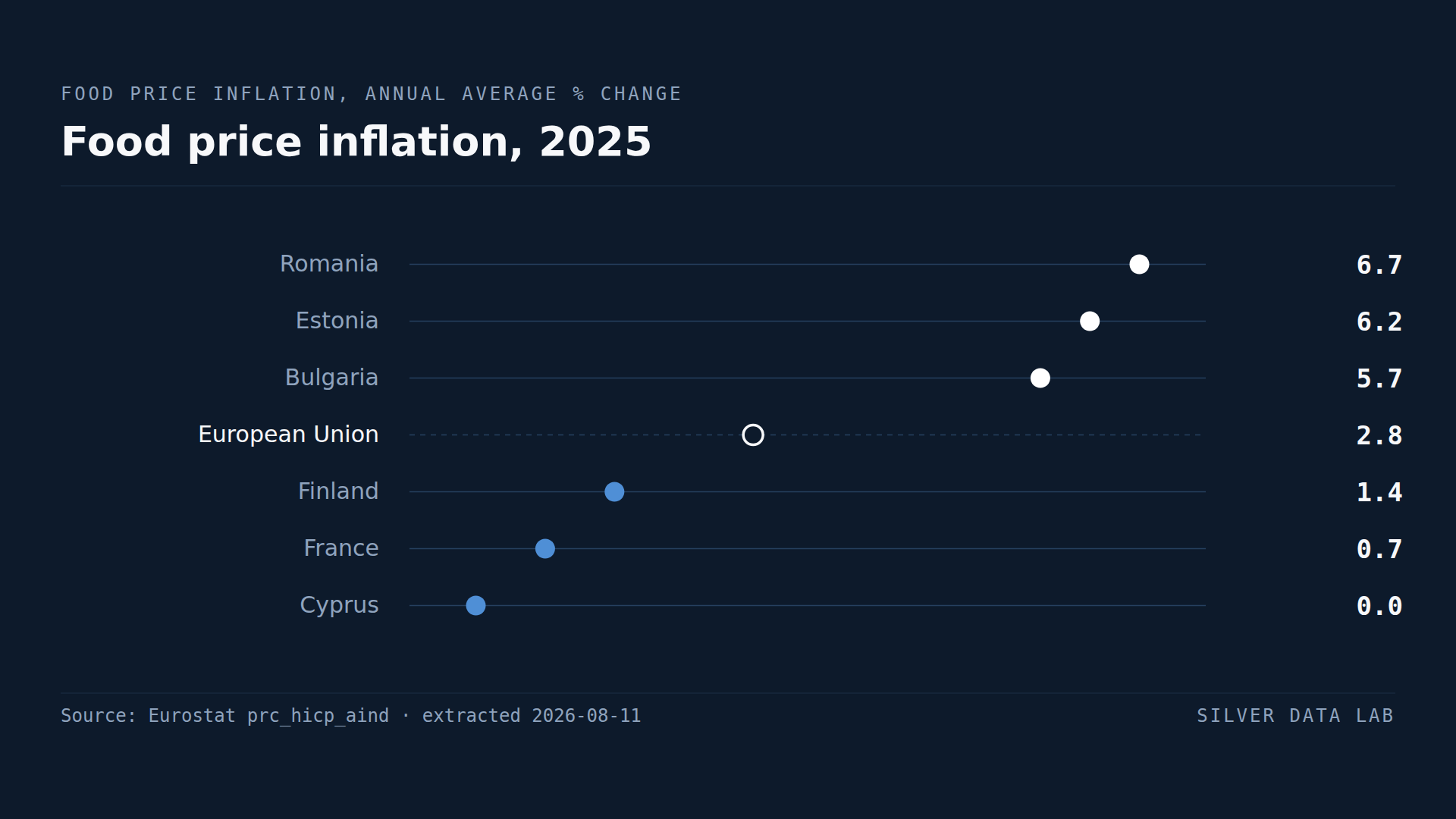
Food Prices Rose 6.7% in Romania and Not at All in Cyprus
Food prices in the EU rose 2.8% on average in 2025.
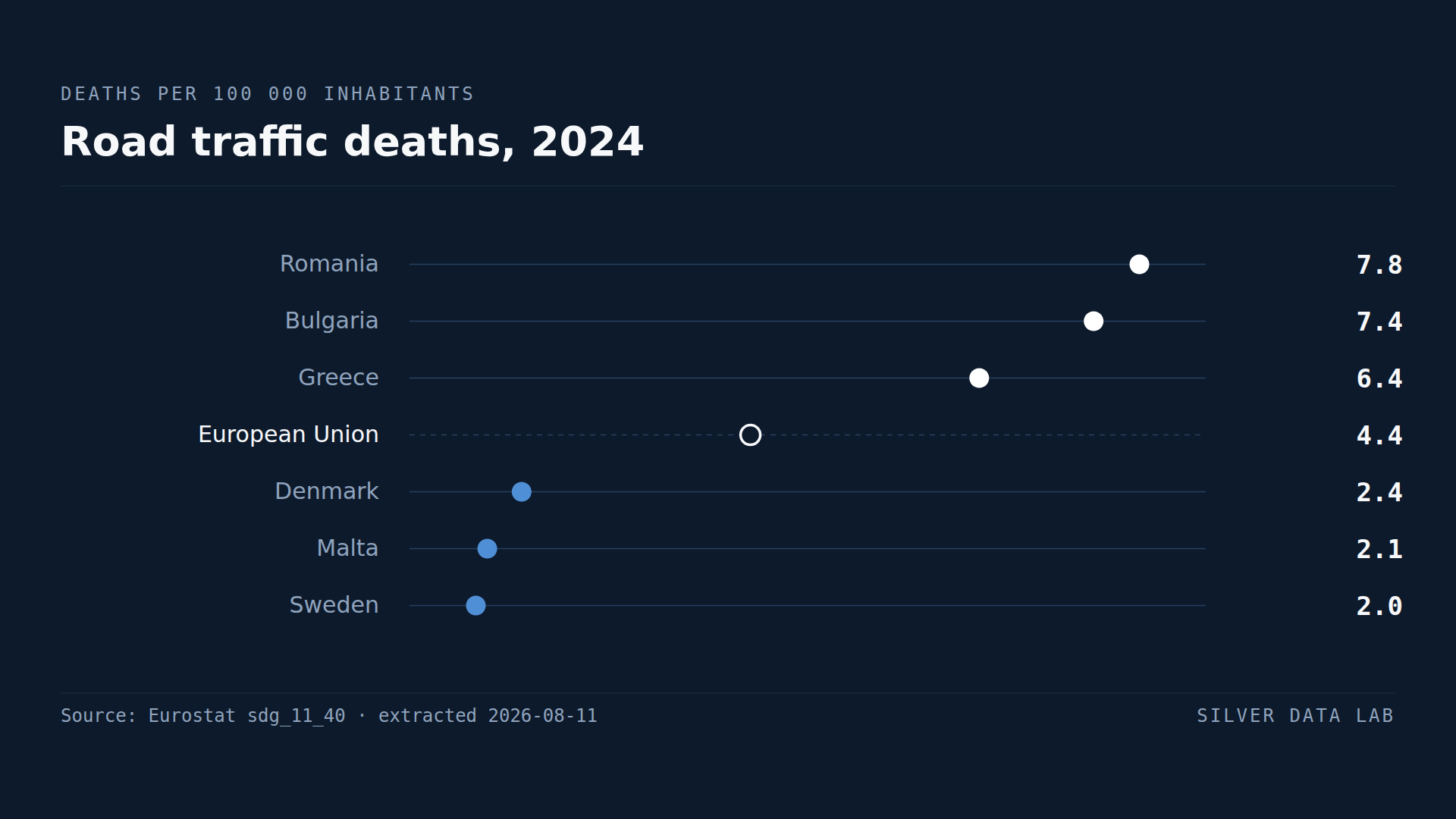
In Romania the Risk of Dying on the Road Is Nearly Four Times Sweden's
19,933 people were killed on the roads of the European Union in 2024: 4.4 deaths per 100,000 inhabitants.
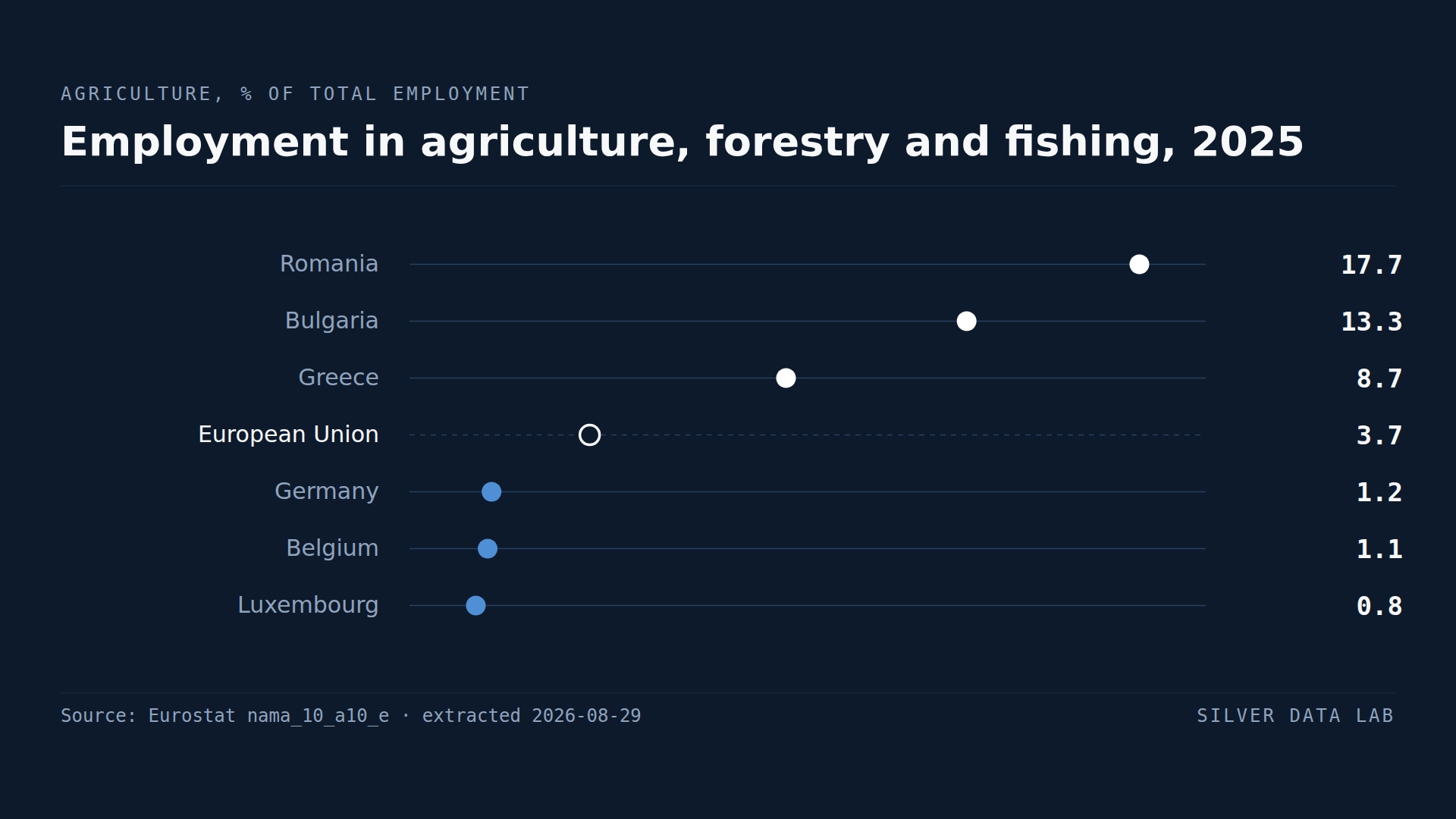
More Than One Romanian Worker in Six Works in Agriculture
Agriculture, forestry and fishing employed 3.8% of workers in the EU in 2025 and produced 1.8% of its gross value added.