Young Croatians Leave the Parental Home at 31.5, Young Finns at 21.3
Silver Data Lab Research Desk · Statistical analysis · Published on 17 September 2026
- Data source
- Eurostat
- Reference period
- 2025
- Last updated
- 17 September 2026
Re-checked against the source on 17 September 2026. No value in its datasets has moved between the snapshots we hold. Every revision we have observed →
Key estimates
- Across the EU, young people left the parental household at an estimated average age of 26.3 in 2025.
- Croatia records 31.5, Greece and Slovakia 30.9, Spain and Italy 30.2: five Member States at or above 30.
- Finland records 21.3, Denmark 21.8, Estonia and Lithuania 22.7 and Sweden 23.1; seven Member States are below 24.
- Men leave later than women in every Member State except Malta: 27.2 against 25.5 across the EU, a gap of 1.7 years derived from the two published ages.
- The distance between Croatia and Finland is 10.2 years, derived from the two extremes.
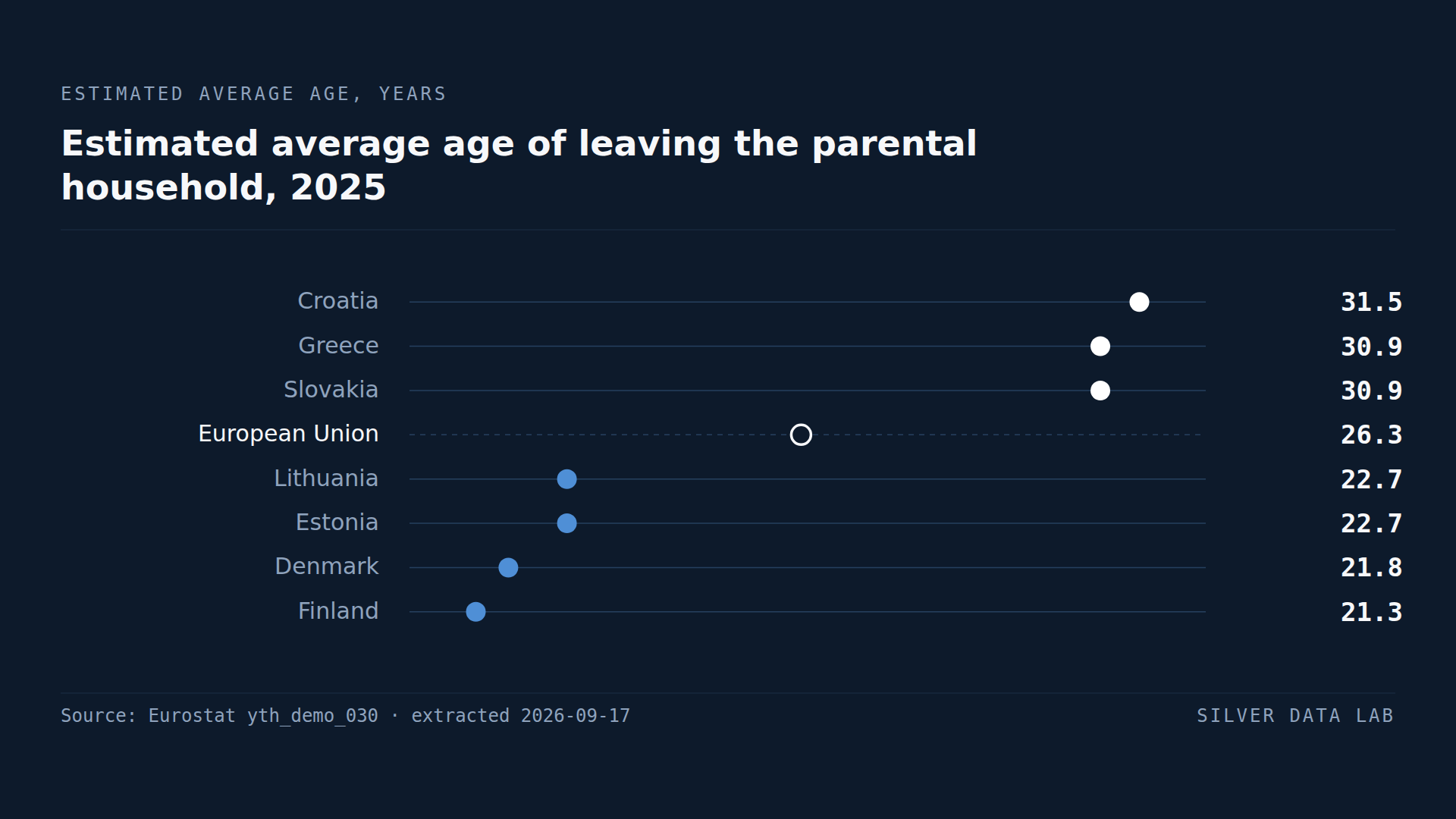
A decade between the two ends of the Union
Eurostat estimates, for each country, the average age at which young people stop living in their parents' household. For the EU as a whole in 2025 that age was 26.3.
The national figures run from 21.3 in Finland to 31.5 in Croatia, a span of 10.2 years. A young Finn typically leaves in the early twenties; a young Croat typically leaves after turning thirty. No other headline indicator about young Europeans separates the Member States this widely.
Where leaving comes late
Croatia at 31.5 is followed by Greece and Slovakia at 30.9, then Spain and Italy at 30.2. Five Member States sit at or above 30. Portugal and Slovenia at 28.8, Bulgaria at 27.9, Malta at 27.5, Romania at 27.4 and Hungary at 27.3 come next.
Fifteen Member States are above the EU average, and the list has a shape: the Mediterranean, the Balkans and much of central Europe. It also includes Ireland at 26.9, Poland at 26.8 and Luxembourg at 26.6, which do not fit either label.
Where it comes early
Finland at 21.3, Denmark at 21.8, Estonia and Lithuania at 22.7, Sweden at 23.1, the Netherlands at 23.4 and France at 23.8 are the seven Member States below 24. Germany at 24.1 and Austria at 25.2 follow.
The Nordic countries, the Baltic states, the Netherlands and France form a group that is not obviously one: incomes, housing markets and student support differ widely between Helsinki, Vilnius and Paris. What they share is that a young adult living apart from parents in their early twenties is the ordinary arrangement.
Men and women
Women leave earlier than men everywhere but Malta. Across the EU the estimated age is 25.5 for women and 27.2 for men, a difference of 1.7 years computed here from the two published figures.
The gap is widest in Romania, where men leave at 29.4 and women at 25.3, a difference of 4.1 years, and in Bulgaria at 3.7 years. Croatia, Greece, Czechia and Latvia all record 2.8. It is narrowest in Denmark at 0.5 years and Luxembourg at 0.6. Malta is the one reversal: women there leave at 27.8 and men at 27.3.
The pattern is consistent with women partnering earlier than men, and with the age difference inside couples, but the indicator records the age of leaving and says nothing about where people go.
What an average age cannot say
A late average can reflect housing costs, long studies, unemployment, or a preference for living with family; an early one can reflect cheap student housing or a culture that expects independence. The indicator does not distinguish between them. It records an outcome, and the countries at either end of the ranking arrive there for reasons this measure cannot separate.
Estimated average age of leaving the parental household, 2025
| Country | age in years | Gap to EU averagepercentage points, derived |
|---|---|---|
| Croatia | 31.5 | +5.2 |
| Greece | 30.9 | +4.6 |
| Slovakia | 30.9 | +4.6 |
| European Unionaggregate | 26.3 | — |
| Lithuania | 22.7 | −3.6 |
| Estonia | 22.7 | −3.6 |
| Denmark | 21.8 | −4.5 |
| Finland | 21.3 | −5.0 |
This table as data: CSV · JSON
Every Member State for this indicator+
Members see every Member State for this indicator here, not only the rows the ranking prints. Become a Member
Embed this chart
Paste this code into a page. The frame carries the source and the extraction date, and links back to the study.
Difference between men's and women's age of leaving home, 2025
| Country | years, men minus women | Gap to EU averagepercentage points, derived |
|---|---|---|
| Romania | 4.1 | +2.4 |
| Bulgaria | 3.7 | +2.0 |
| European Unionaggregate | 1.7 | — |
| Luxembourg | 0.6 | −1.1 |
| Denmark | 0.5 | −1.2 |
| Malta | -0.5 | −2.2 |
This table as data: CSV · JSON
Every Member State for this indicator+
Members see every Member State for this indicator here, not only the rows the ranking prints. Become a Member
Embed this chart
Paste this code into a page. The frame carries the source and the extraction date, and links back to the study.
What these figures cannot tell you
- An estimate, not a recorded event
- Nobody is asked when they left home. Eurostat estimates the average age from the household data of the EU Labour Force Survey, which records who lives with their parents at each age. The figure is a statistical construction and carries sampling uncertainty, more so in small countries.
- Living with parents is not the same as dependence
- A young adult in work who lives in the family home counts as not having left, and one supported by parents in a rented flat counts as having left. The indicator measures cohabitation, not financial independence.
- The gender gap is derived
- Eurostat publishes the estimated age for men and women separately. The differences quoted here are computed by Silver Data Lab by subtraction and are labelled as derived wherever they appear.
- A survey year, not a cohort
- The figure for 2025 describes the living arrangements of young people in that year across all ages, not the experience of a single generation followed over time. Changes from one year to the next can reflect the housing market as much as any change in behaviour.
Frequently asked questions
- At what age do young Europeans leave home?
- At an estimated 26.3 years on average across the EU in 2025: 27.2 for men and 25.5 for women. The national figures range from 21.3 in Finland to 31.5 in Croatia.
- In which EU country do young people leave home latest?
- Croatia, at an estimated 31.5 years in 2025, followed by Greece and Slovakia at 30.9 and Spain and Italy at 30.2. Those five are the only Member States at or above 30.
- Where do they leave earliest?
- Finland at 21.3, Denmark at 21.8, Estonia and Lithuania at 22.7, Sweden at 23.1, the Netherlands at 23.4 and France at 23.8, the seven Member States below 24.
- Do women leave home earlier than men?
- In every Member State but Malta. The EU difference is 1.7 years, derived from the published ages of 27.2 for men and 25.5 for women. Romania has the widest gap at 4.1 years; in Malta women leave at 27.8 and men at 27.3.
Methodological note
The estimated average age of young people leaving the parental household is published by Eurostat, for the total population and separately for men and women, from the household data of the EU Labour Force Survey. Values are for 2025 and cover all 27 Member States.
The EU average is Eurostat's own aggregate and is used as published. The difference between men's and women's ages, the span between the highest and lowest Member State, and the counts of Member States above or below a given age are computed by Silver Data Lab from the published figures and labelled as derived.
Source data
The underlying series can be inspected and re-downloaded from the Eurostat data browser. The filters below are the ones applied.
Estimated average age of young people leaving the parental household
yth_demo_030
- Filters applied:
- freq=A · unit=AVG · sex=T, M, F · time=2025
- Extracted:
- 2026-09-17
- Source last updated:
- 2026-04-16
Download the data
The data the study you have just read is built on, exactly as it was downloaded and archived.
Yours as a Member.
Data downloadable by Members
How to cite
Record the vintage as well as the study: the figures on this page are the ones extracted on the dates below.
Silver Data Lab Research Desk (2026). Young Croatians Leave the Parental Home at 31.5, Young Finns at 21.3. Silver Data Lab, published 17 September 2026, last updated 17 September 2026. https://www.silverdatalab.com/studies/leaving-the-parental-home-in-the-eu
- Data: Eurostat, Estimated average age of young people leaving the parental household (yth_demo_030), filters freq=A, unit=AVG, sex=T, M, F, time=2025; extracted 2026-09-17; source last updated 2026-04-16. https://doi.org/10.2908/yth_demo_030
Silver Data Lab's analysis is licensed CC BY 4.0. The statistics remain their publisher's and keep its terms of reuse.
Ask the research desk
A question about this study — a definition, a filter, a break in the series, what the figures can and cannot support — answered by the desk that made the extraction.
Members can write to the research desk
Studies where the same country leads or trails
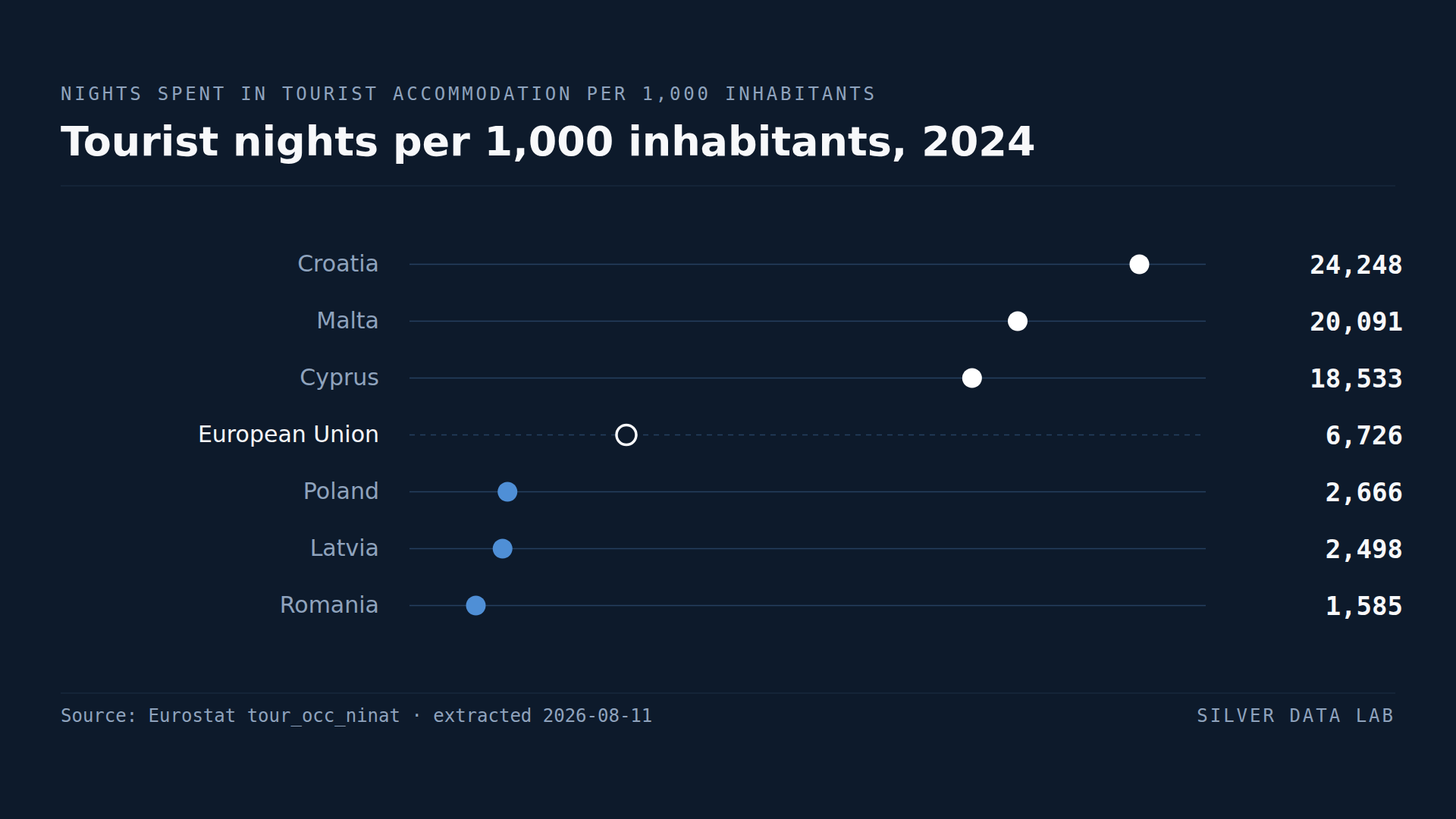
Croatia Hosts Fifteen Times as Many Tourist Nights per Person as Romania
The EU recorded 6,726 tourist nights per 1,000 inhabitants in 2024 — about 6.7 nights per resident.
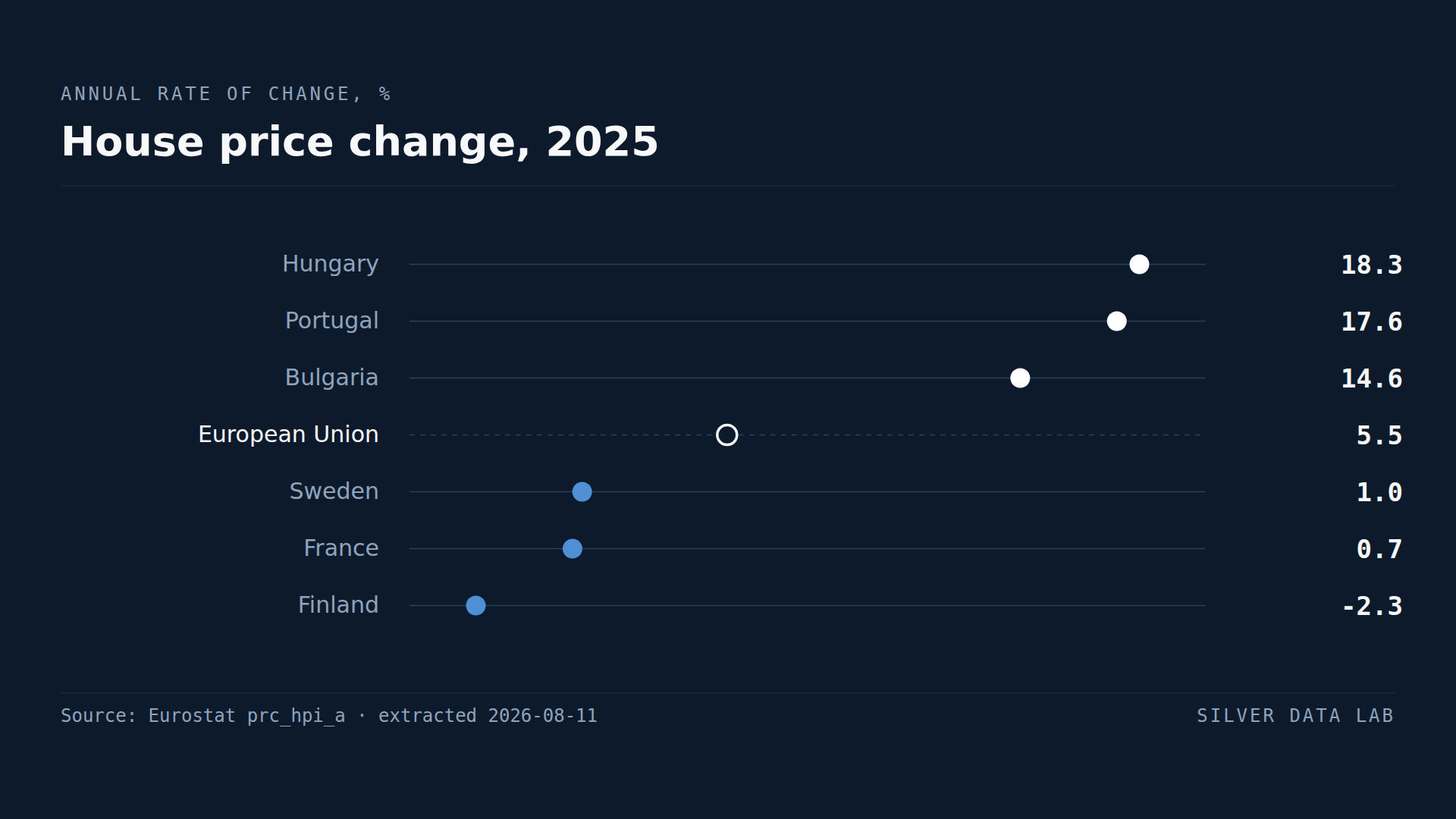
House Prices Rose 18% in Hungary and Fell in Finland
House prices across the EU rose 5.5% on annual average in 2025.
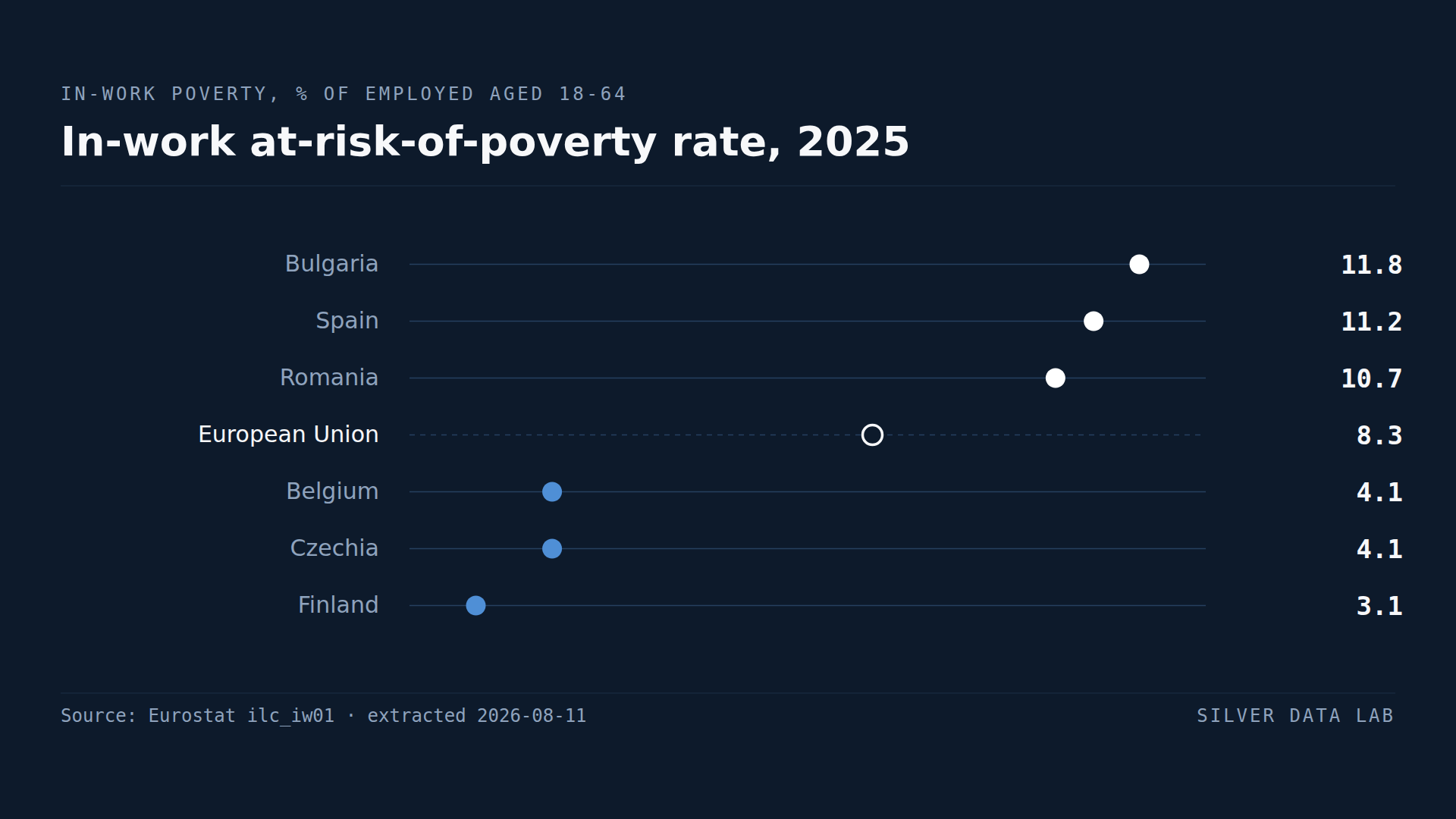
One Working Bulgarian in Nine Is Still Poor
8.3% of employed people aged 18 to 64 in the EU lived below the at-risk-of-poverty line in 2025.