11.8% of Bulgarians With a Job Are Poor, the Highest Share in the EU
Silver Data Lab Research Desk · Statistical analysis · Published on 11 June 2026
- Data source
- Eurostat
- Reference period
- 2025
- Last updated
- 11 October 2026
Re-checked against the source on 21 October 2026. No value in its datasets has moved between the snapshots we hold. Every revision we have observed →
Key estimates
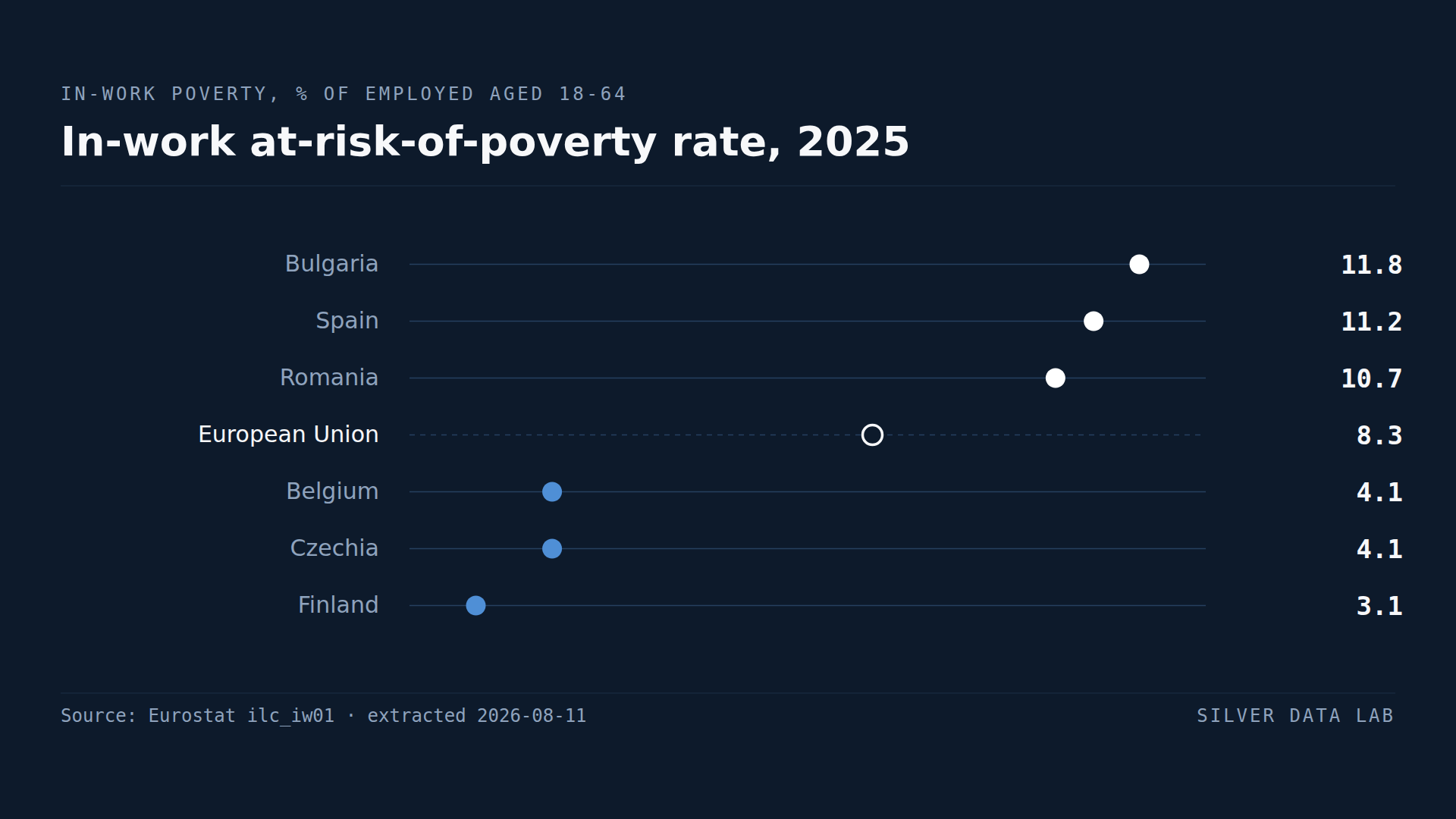
- 8.3% of employed people aged 18 to 64 in the EU lived below the at-risk-of-poverty line in 2025.
- Bulgaria records 11.8%, Spain 11.2% and Romania 10.7%.
- Finland records 3.1%, the lowest in the Union, with Belgium and Czechia at 4.1%.
- Fourteen Member States are above the EU rate, twelve are below it, and Hungary sits exactly on it.
- Every Member State records some in-work poverty: the lowest rate in the Union is still one worker in thirty-two.
Employment as an incomplete defence
The at-risk-of-poverty line is 60% of a country's median equivalised income. The in-work rate counts people who are employed and still fall below it.
Across the EU in 2025 it was 8.3%. One employed person in twelve.
This is the indicator that tests the assumption underneath most European labour market policy — that moving someone into work moves them out of poverty. It does so for most people. For roughly one in twelve it does not.
Where it is highest
Bulgaria records 11.8%, Spain 11.2%, Romania 10.7% and Estonia 10.5%.
Spain in second place is the finding that separates this ranking from a ranking of national income. It is a high-income Member State with a large economy, and it records a higher in-work poverty rate than Greece, Croatia or Latvia.
Spain also has the Union's highest unemployment among large economies, a high involuntary part-time rate, and until recently the widest use of temporary contracts. The combination points at the same underlying condition from several directions: work that is available but fragmented, short-term or part-time, and that does not add up to an income above the line.
Where it is lowest
Finland records 3.1%, the lowest in the Union. Belgium and Czechia record 4.1%, the Netherlands 5.2% and Slovenia 5.5%.
Finland's position here is worth setting beside its position elsewhere on this site: it has the Union's highest life satisfaction, one of its lowest counts of healthy life years, and one of its widest unemployment gaps between nationals and non-EU citizens. A single country can occupy opposite ends of different European indicators, and reading any one of them as a summary judgement is a mistake.
The floor
The important feature of this distribution is not its top but its bottom. No Member State is near zero. The lowest rate in the Union is 3.1%, which is one employed person in thirty-two living below the poverty line in the country with the best result.
In-work poverty is therefore not a problem confined to particular Member States. It is a feature of every labour market in the Union, differing in degree.
Why the measure is a household measure
The trap in this indicator is that it is calculated at household level while being reported per employed person. Someone is counted as in-work poor if they are employed and their household income falls below the threshold — which can happen because they earn little, or because they support several people who earn nothing.
A well-paid single earner supporting four dependants can be counted; a low-paid worker in a household with two other incomes may not be. The measure captures poverty among people who work rather than poverty caused by low pay, and those are different things.
In-work at-risk-of-poverty rate, 2025
| Country | % of employed aged 18-64 | Gap to EU averagepercentage points, derived |
|---|---|---|
| Bulgaria | 11.8 | +3.5 |
| Spain | 11.2 | +2.9 |
| Romania | 10.7 | +2.4 |
| European Unionaggregate | 8.3 | — |
| Belgium | 4.1 | −4.2 |
| Czechia | 4.1 | −4.2 |
| Finland | 3.1 | −5.2 |
This table as data: CSV · JSON
Every Member State for this indicator+
Members see every Member State for this indicator here, not only the rows the ranking prints. Become a Member
Embed this chart
Paste this code into a page. The frame carries the source and the extraction date, and links back to the study.
What these figures cannot tell you
- A household measure reported per worker
- Poverty is assessed on total household income adjusted for composition, so a person's own earnings are only part of what determines their status. This is a measure of employed people who are poor, not of people who are poor because their wages are low.
- The threshold is national
- At risk of poverty means below 60% of each country's own median income. Rates are therefore not comparable as absolute living standards: a Bulgarian and a Finn below their national lines have very different incomes.
- Employment status at a point in time
- A person is classified by their main activity over the reference year. Someone who worked for part of it and not the rest may be classified either way depending on the balance, which affects Member States with seasonal labour markets.
- Survey data
- Figures come from EU-SILC, a sample survey. Differences of a few tenths of a point between Member States should not be treated as meaningful.
Frequently asked questions
- How many working Europeans are poor?
- 8.3% of employed people aged 18 to 64 in the EU lived below the at-risk-of-poverty line in 2025 — roughly one in twelve.
- Which EU country has the most in-work poverty?
- Bulgaria, at 11.8% in 2025, followed by Spain at 11.2% and Romania at 10.7%. Spain is the case that separates this from a ranking of national income: it is a high-income Member State recording a higher rate than Greece, Croatia or Latvia.
- Which EU country has the least?
- Finland, at 3.1% in 2025, with Belgium and Czechia at 4.1%. No Member State is close to zero — even the best result means one employed person in thirty-two lives below the poverty line.
- Does having a job protect against poverty?
- Mostly, but not reliably. In-work poverty exists in every Member State, and the measure is calculated on household income, so a person can be counted because their own pay is low or because they support others who have no income at all.
Methodological note
The in-work at-risk-of-poverty rate is published by Eurostat from EU-SILC as the share of employed persons living in households with equivalised disposable income below 60% of the national median. This study uses persons aged 18 to 64, both sexes, classified as employed.
Values are for 2025 and cover all 27 Member States.
The counts of Member States above and below the EU rate are derived by Silver Data Lab. The comparisons with unemployment, temporary contracts and involuntary part-time work draw on companion studies on this site, each with its own extraction.
Source data
The underlying series can be inspected and re-downloaded from the Eurostat data browser. The filters below are the ones applied.
In-work at-risk-of-poverty rate
ilc_iw01
- Filters applied:
- freq=A · age=Y18-64 · sex=T · wstatus=EMP · unit=PC · time=2025
- Extracted:
- 2026-10-21
- Source last updated:
- 2026-10-20
Download the data
The data the study you have just read is built on, exactly as it was downloaded and archived.
Yours as a Member.
Data downloadable by Members
How to cite
Record the vintage as well as the study: the figures on this page are the ones extracted on the dates below.
Silver Data Lab Research Desk (2026). 11.8% of Bulgarians With a Job Are Poor, the Highest Share in the EU. Silver Data Lab, published 11 June 2026, last updated 11 October 2026. https://www.silverdatalab.com/studies/in-work-poverty-in-the-eu
- Data: Eurostat, In-work at-risk-of-poverty rate (ilc_iw01), filters freq=A, age=Y18-64, sex=T, wstatus=EMP, unit=PC, time=2025; extracted 2026-10-21; source last updated 2026-10-20. https://doi.org/10.2908/ilc_iw01
Silver Data Lab's analysis is licensed CC BY 4.0. The statistics remain their publisher's and keep its terms of reuse.
Ask the research desk
A question about this study — a definition, a filter, a break in the series, what the figures can and cannot support — answered by the desk that made the extraction.
Members can write to the research desk
Studies where the same country leads or trails
Air Travel in the EU Is Back Above Its Pre-Pandemic Level
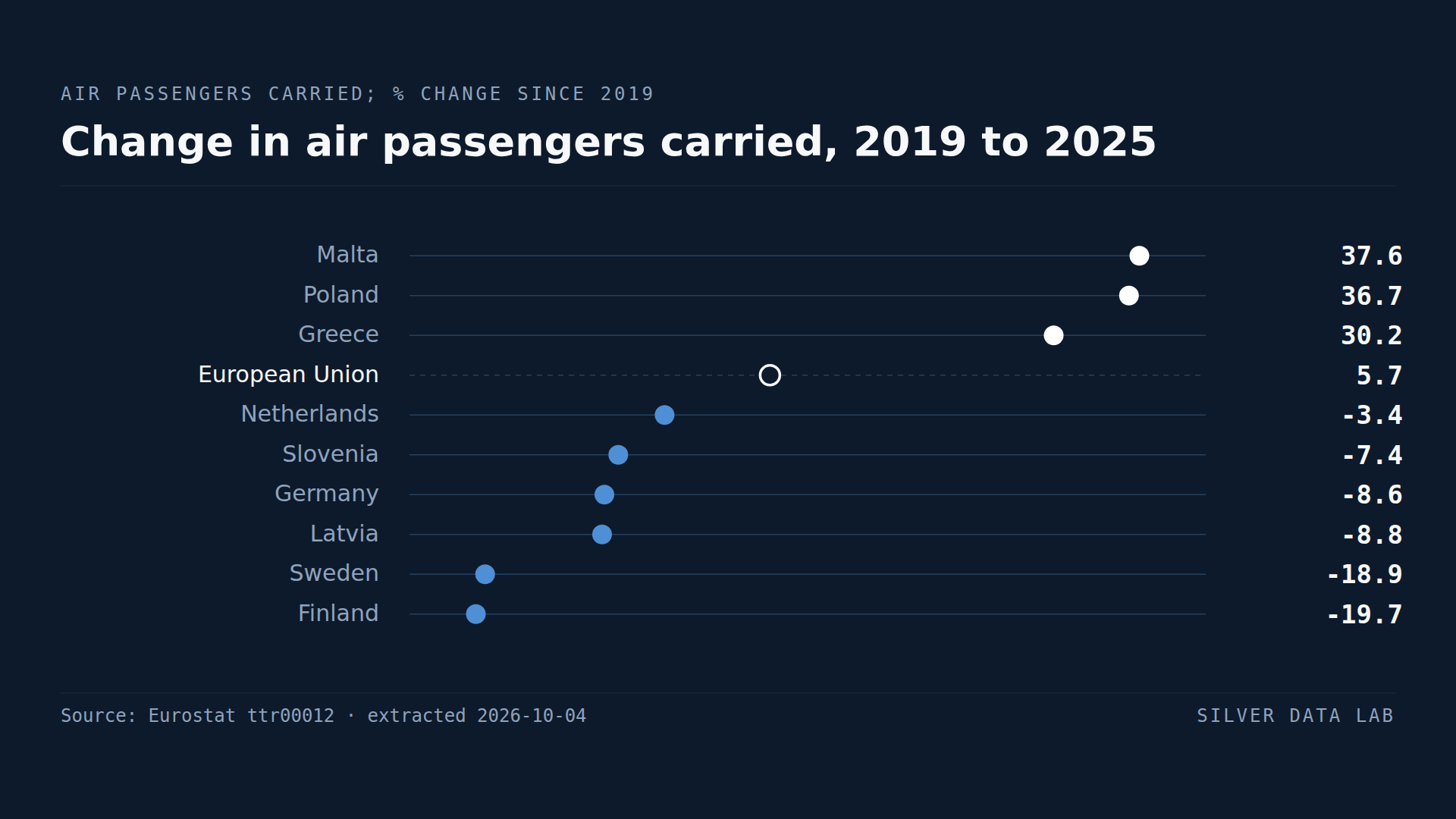
Air passengers carried in the EU reached 1,093.6 million in 2025, 5.7% more than in 2019; the total first passed its 2019 level in 2024, by 0.7%.
Among EU Children, Family Incomes Are Most Unequal in Bulgaria
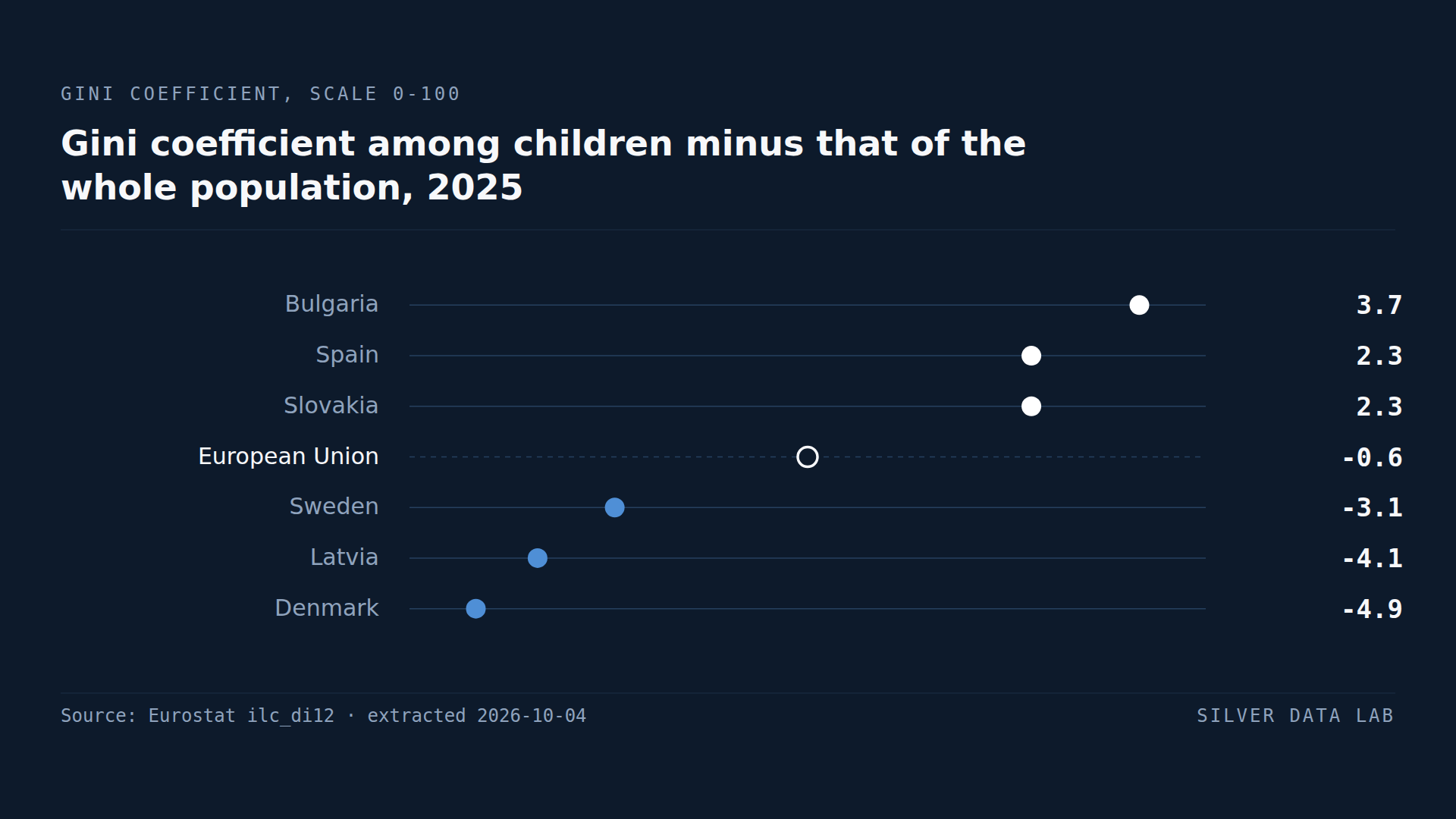
Across the EU the Gini coefficient of disposable income among children under 18 was 28.6 in 2025, against 29.2 for the population as a whole.
Deaths Outnumber Births in Twenty-One EU Countries
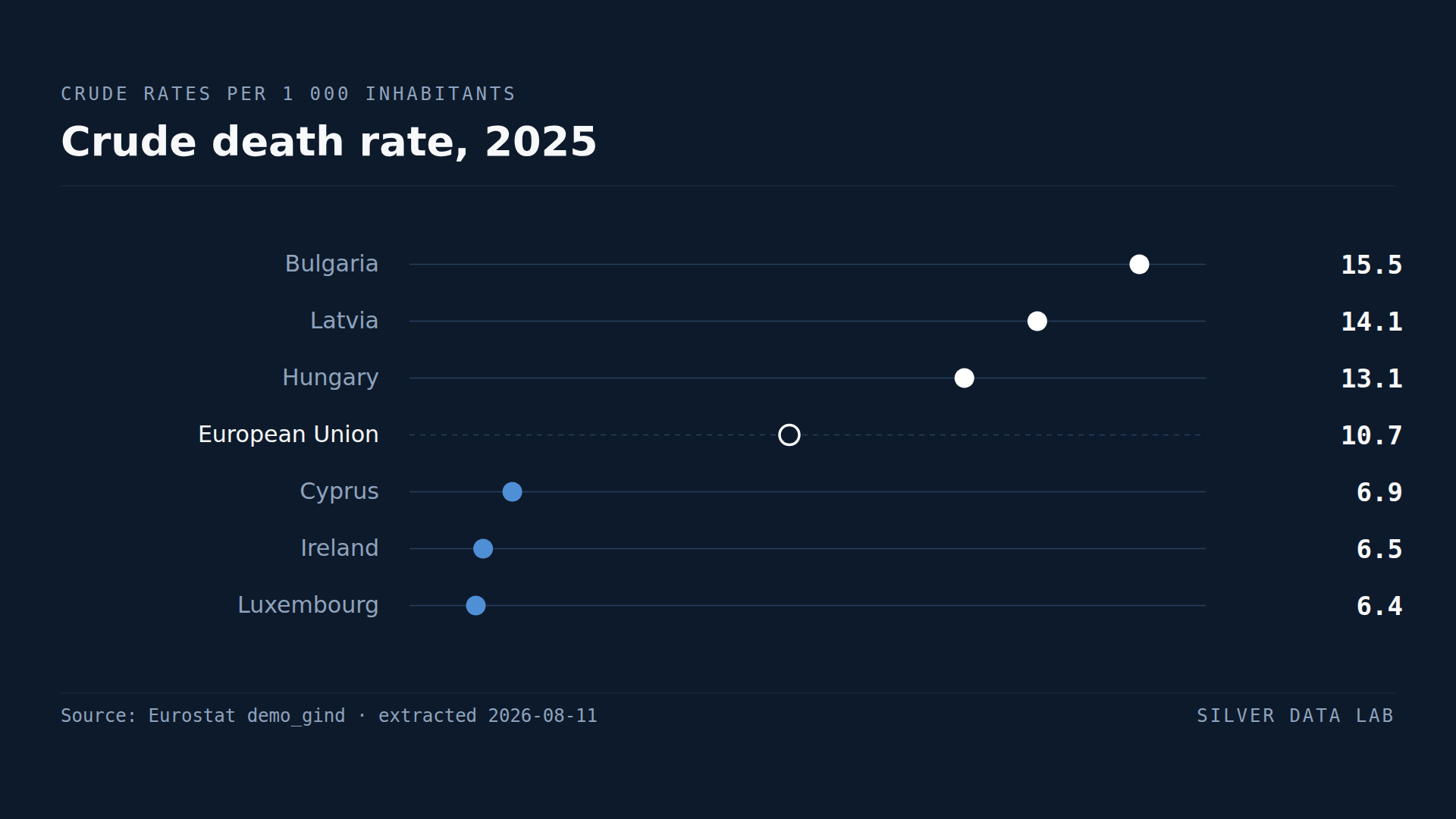
The EU recorded 7.7 births and 10.7 deaths per thousand inhabitants in 2025: a natural change of −3.0.