Deaths Outnumber Births in Twenty-One EU Countries
Silver Data Lab Research Desk · Statistical analysis · Published on 24 July 2026
- Data source
- Eurostat
- Reference period
- 2025
- Last updated
- 11 October 2026
Re-checked against the source on 01 October 2026. No value in its datasets has moved between the snapshots we hold. Every revision we have observed →
Key estimates
- The EU recorded 7.7 births and 10.7 deaths per thousand inhabitants in 2025: a natural change of −3.0.
- Net migration added 4.6 per thousand, which is why the Union's population grew by 705,756 people rather than falling.
- In 21 of 27 Member States deaths exceeded births. Only Ireland, Luxembourg, Cyprus, Sweden, Denmark and Malta recorded natural growth.
- Malta records net migration of 23.9 per thousand, five times the EU rate and the highest in the Union.
- Only Estonia and Latvia recorded net emigration, at −2.1 and −0.7 per thousand.
A continent that has stopped replacing itself
In 2025 the European Union recorded 7.7 births per thousand inhabitants and 10.7 deaths. The difference, three people per thousand, is the natural change of the Union's population, and it is negative.
The population nevertheless grew, by 705,756 people over the year. Every one of them, and more, arrived through migration: net migration added 4.6 per thousand, comfortably offsetting the natural deficit.
This is the central demographic fact about the European Union today, and it is stated here as arithmetic rather than as argument. Without net inward migration in 2025, the Union's population would have fallen.
Where deaths exceed births, and where they do not
Twenty-one of the twenty-seven Member States recorded more deaths than births in 2025.
The six exceptions are Ireland at +3.4 per thousand, Luxembourg at +3.0, Cyprus at +2.4, Sweden at +0.5, and Denmark and Malta at +0.2. Four of the six are among the Union's smallest populations, and none of them clears +3.5.
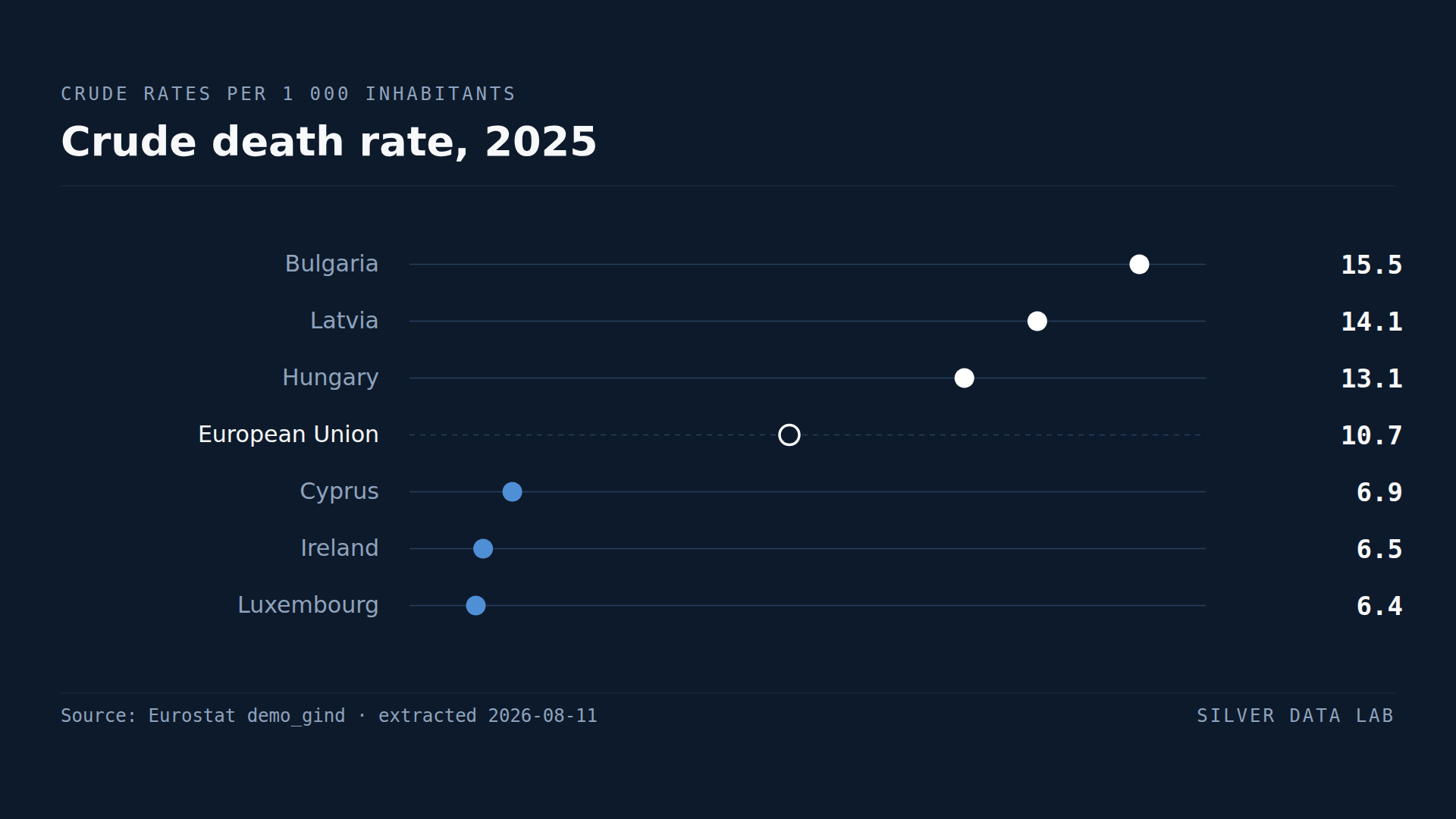
Bulgaria records the highest death rate in the Union at 15.5 per thousand, ahead of Latvia at 14.1 and Hungary at 13.1. Italy records the lowest birth rate at 6.0, below Lithuania at 6.1 and Greece at 6.3. Denmark and Ireland lead on births at 9.9.
Migration is doing the work almost everywhere
Only two Member States recorded net emigration in 2025: Estonia at −2.1 per thousand and Latvia at −0.7. The other twenty-five gained population through migration.
Malta records 23.9 per thousand, five times the EU rate and by a wide margin the highest in the Union. Spain follows at 11.8 and Cyprus at 11.3.
Spain's position is the one that shows up in absolute numbers rather than rates. It accounted for 461,802 of the Union's 705,756 population increase — roughly two thirds of the total growth of a Union of twenty-seven countries, in one Member State.
Where the totals fall
Eleven Member States lost population outright in 2025, nine of them despite positive net migration. The largest falls were Poland by 164,730, Germany by 110,023 and Hungary by 51,074: in each case a natural deficit larger than the migration gain.
That combination is the situation the natural-change figure points towards for the rest of the Union. A negative natural change can be offset by migration only for as long as the migration continues at a sufficient rate, and the size of the offset now required is visible in the Union's own accounts: 4.6 per thousand arriving to cover 3.0 per thousand lost.
Crude death rate, 2025
| Country | Deaths per 1,000 inhabitants | Gap to EU averagederived |
|---|---|---|
| Bulgaria | 15.5 | +4.8 |
| Latvia | 14.1 | +3.4 |
| Hungary | 13.1 | +2.4 |
| European Unionaggregate | 10.7ep | — |
| Cyprus | 6.9p | −3.8 |
| Ireland | 6.5 | −4.2 |
| Luxembourg | 6.4 | −4.3 |
Flags carried by the source on these values: ep estimated, provisional · p provisional
This table as data: CSV · JSON
Every Member State for this indicator+
Members see every Member State for this indicator here, not only the rows the ranking prints. Become a Member
Embed this chart
Paste this code into a page. The frame carries the source and the extraction date, and links back to the study.
Net migration rate, 2025
| Country | Per 1,000 inhabitants | Gap to EU averagederived |
|---|---|---|
| Malta | 23.9 | +19.3 |
| Spain | 11.8p | +7.2 |
| Cyprus | 11.3p | +6.7 |
| European Unionaggregate | 4.6ep | — |
| Poland | 0.1 | −4.5 |
| Latvia | -0.7 | −5.3 |
| Estonia | -2.1 | −6.7 |
Flags carried by the source on these values: ep estimated, provisional · p provisional
This table as data: CSV · JSON
Every Member State for this indicator+
Members see every Member State for this indicator here, not only the rows the ranking prints. Become a Member
Embed this chart
Paste this code into a page. The frame carries the source and the extraction date, and links back to the study.
What these figures cannot tell you
- Net migration here is a residual, not a count
- Eurostat's crude rate of net migration is computed as the difference between total population change and natural change, so it absorbs statistical adjustments and any imprecision in the population stock. It is labelled net migration plus statistical adjustment for that reason, and should not be read as a measured count of arrivals minus departures.
- Crude rates are not adjusted for age structure
- A country with an old population will record a high death rate and a low birth rate largely because of who lives there, not because of mortality or fertility conditions. Crude rates are appropriate for describing what happened to a population and inappropriate for comparing underlying demographic behaviour, for which standardised rates and fertility indicators are the correct measures.
- One year of a slow process
- Demographic change accumulates over decades. A single year establishes the current arithmetic and cannot establish a trajectory, and 2025 sits close enough to the pandemic mortality years that its death rates should not be treated as a settled baseline.
- Population totals are estimates between censuses
- Member States estimate population between censuses using registers of varying completeness. Both the denominators of these rates and the residual that becomes net migration inherit that uncertainty, particularly where cross-border mobility inside the Union is high.
Frequently asked questions
- Is the EU population growing or shrinking?
- Growing, but only through migration. In 2025 the Union recorded 7.7 births and 10.7 deaths per thousand inhabitants, a natural change of −3.0, while net migration added 4.6 per thousand. The population rose by 705,756 people over the year.
- How many EU countries have more deaths than births?
- Twenty-one of twenty-seven in 2025. The six exceptions were Ireland, Luxembourg, Cyprus, Sweden, Denmark and Malta, and none of them recorded natural growth above 3.5 per thousand.
- Which EU countries lost population in 2025?
- Eleven Member States did. The largest falls were Poland by 164,730 people, Germany by 110,023 and Hungary by 51,074, each with a natural deficit larger than the gain from net migration.
- Which EU country receives the most migration?
- Relative to its size, Malta, at 23.9 per thousand inhabitants in 2025 — five times the EU rate. In absolute terms Spain accounted for 461,802 of the Union's total increase of 705,756. Only Estonia and Latvia recorded net emigration.
Methodological note
All figures come from Eurostat's demographic balance, for 2025. Crude birth, death and net migration rates are expressed per thousand inhabitants of the average population for the year; total population change is an absolute count of people.
Natural change is derived by Silver Data Lab as the crude birth rate minus the crude death rate. Eurostat publishes the two rates; the difference and the count of Member States for which it is negative are computed here.
Net migration is Eurostat's crude rate of net migration plus statistical adjustment, which is obtained as a residual rather than measured directly. That construction is why the term "plus statistical adjustment" appears in the source and why it is flagged in the limitations above rather than dropped for readability.
Source data
The underlying series can be inspected and re-downloaded from the Eurostat data browser. The filters below are the ones applied.
Population change — demographic balance and crude rates at national level
demo_gind
- Filters applied:
- freq=A · indic_de=GBIRTHRT, GDEATHRT, CNMIGRATRT, GROW · time=2025
- Extracted:
- 2026-10-01
- Source last updated:
- 2026-09-30
Download the data
The data the study you have just read is built on, exactly as it was downloaded and archived.
Yours as a Member.
Data downloadable by Members
How to cite
Record the vintage as well as the study: the figures on this page are the ones extracted on the dates below.
Silver Data Lab Research Desk (2026). Deaths Outnumber Births in Twenty-One EU Countries. Silver Data Lab, published 24 July 2026, last updated 11 October 2026. https://www.silverdatalab.com/studies/population-change-in-the-eu
- Data: Eurostat, Population change — demographic balance and crude rates at national level (demo_gind), filters freq=A, indic_de=GBIRTHRT, GDEATHRT, CNMIGRATRT, GROW, time=2025; extracted 2026-10-01; source last updated 2026-09-30. https://doi.org/10.2908/demo_gind
Silver Data Lab's analysis is licensed CC BY 4.0. The statistics remain their publisher's and keep its terms of reuse.
Ask the research desk
A question about this study — a definition, a filter, a break in the series, what the figures can and cannot support — answered by the desk that made the extraction.
Members can write to the research desk
Other studies on the same dataset
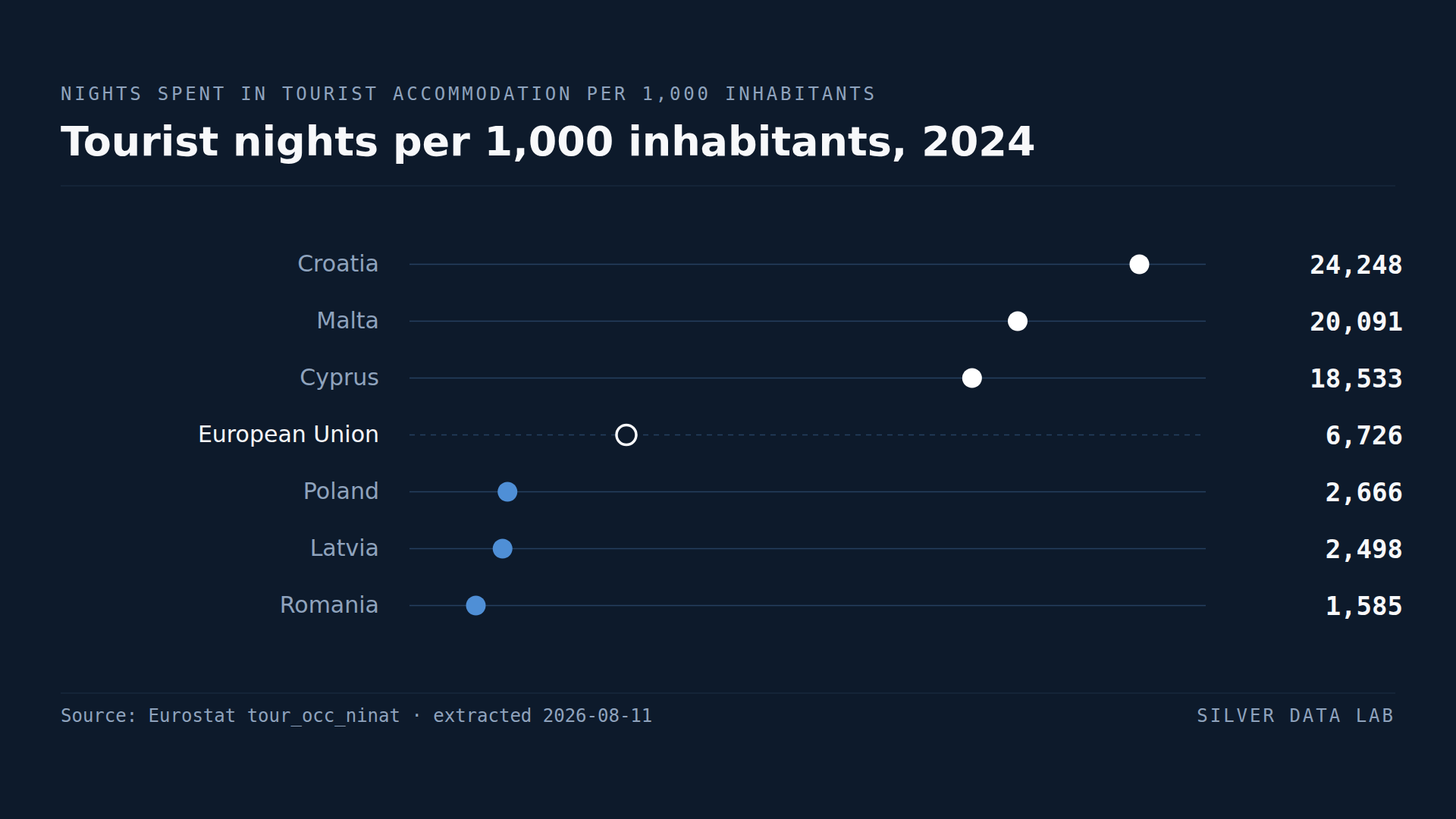
For Its Population, Croatia Has the Most Tourist Overnight Stays in the EU
The EU recorded 6,978 tourist nights per 1,000 inhabitants in 2025, about 7.0 nights per resident.
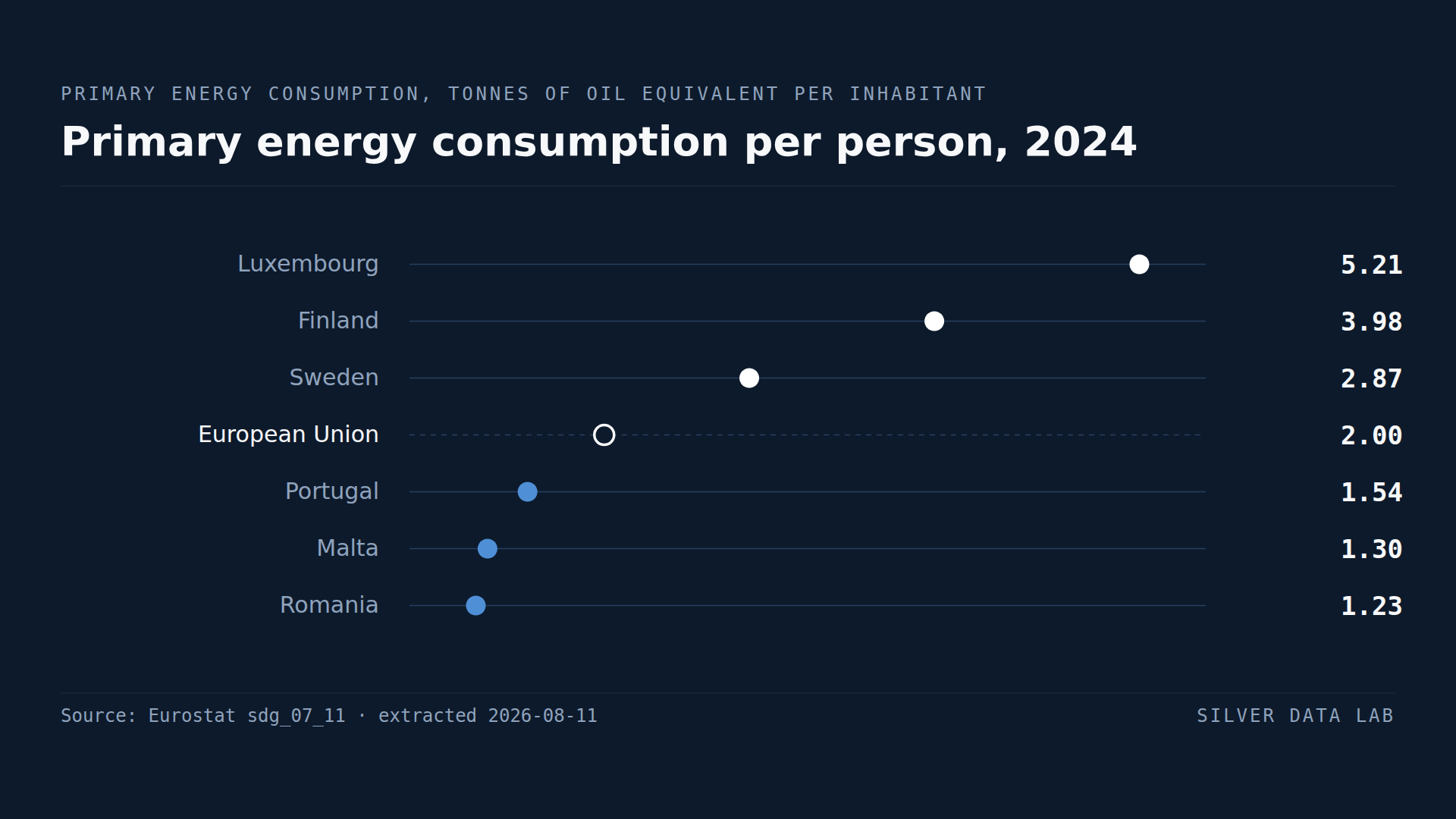
Romania Uses Less Energy per Person Than Any Other EU Country
The EU consumed 2.0 tonnes of oil equivalent per inhabitant in final energy in 2024.
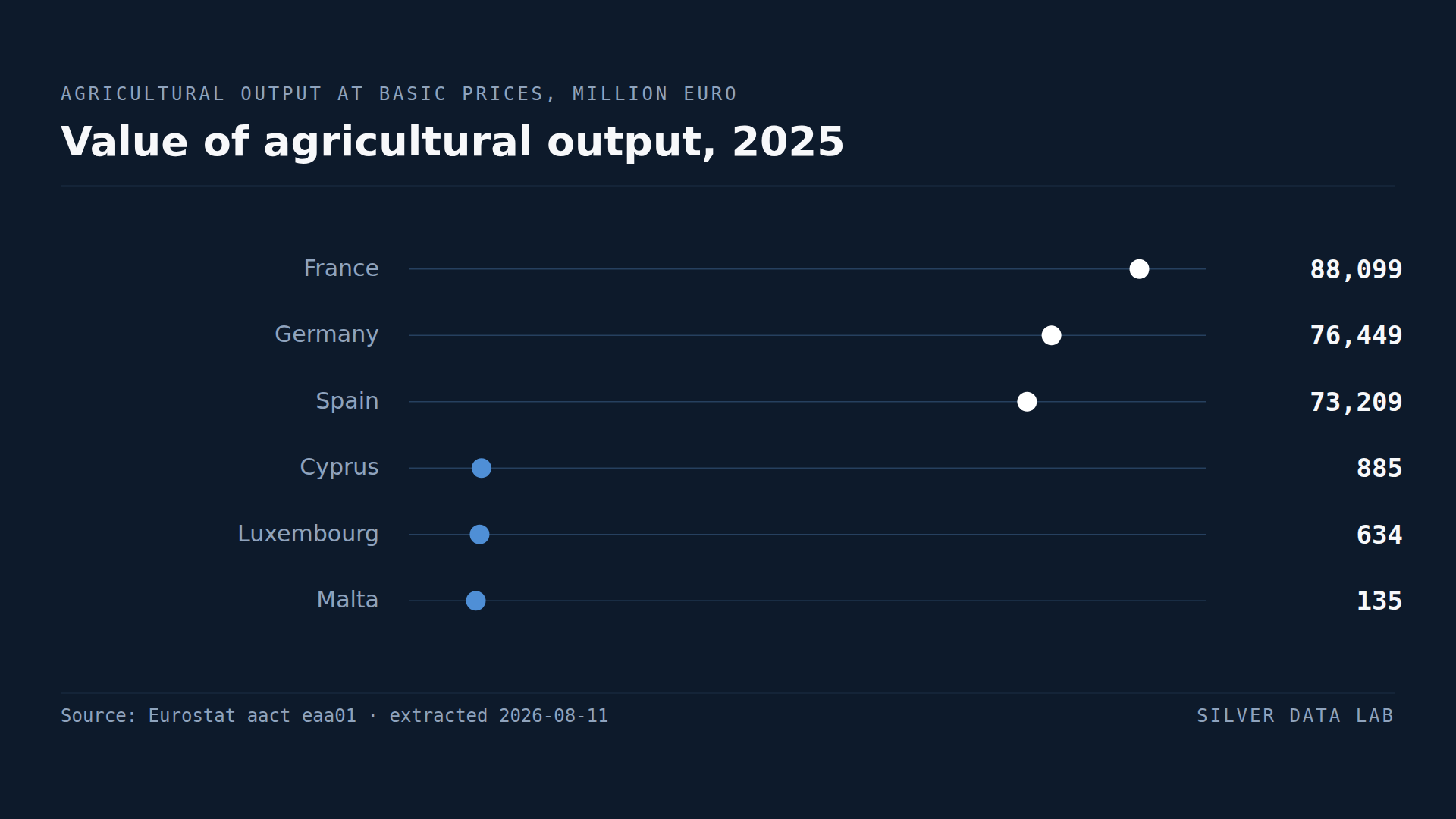
Four Countries Produce More Than Half of the EU's Farm Output
EU agricultural output was worth 541.7 billion euro at basic prices in 2025.
Studies where the same country leads or trails
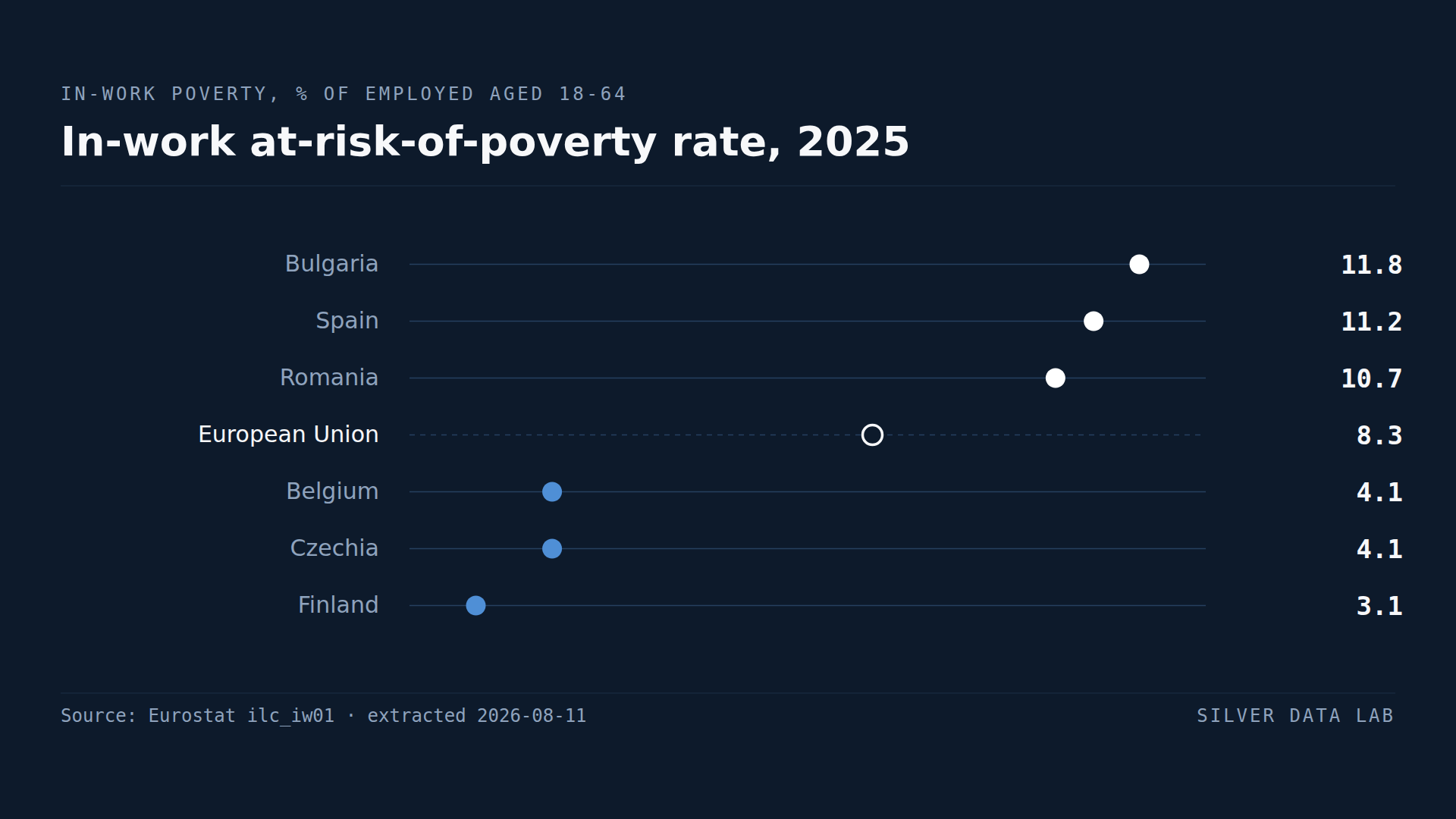
11.8% of Bulgarians With a Job Are Poor, the Highest Share in the EU
8.3% of employed people aged 18 to 64 in the EU lived below the at-risk-of-poverty line in 2025.
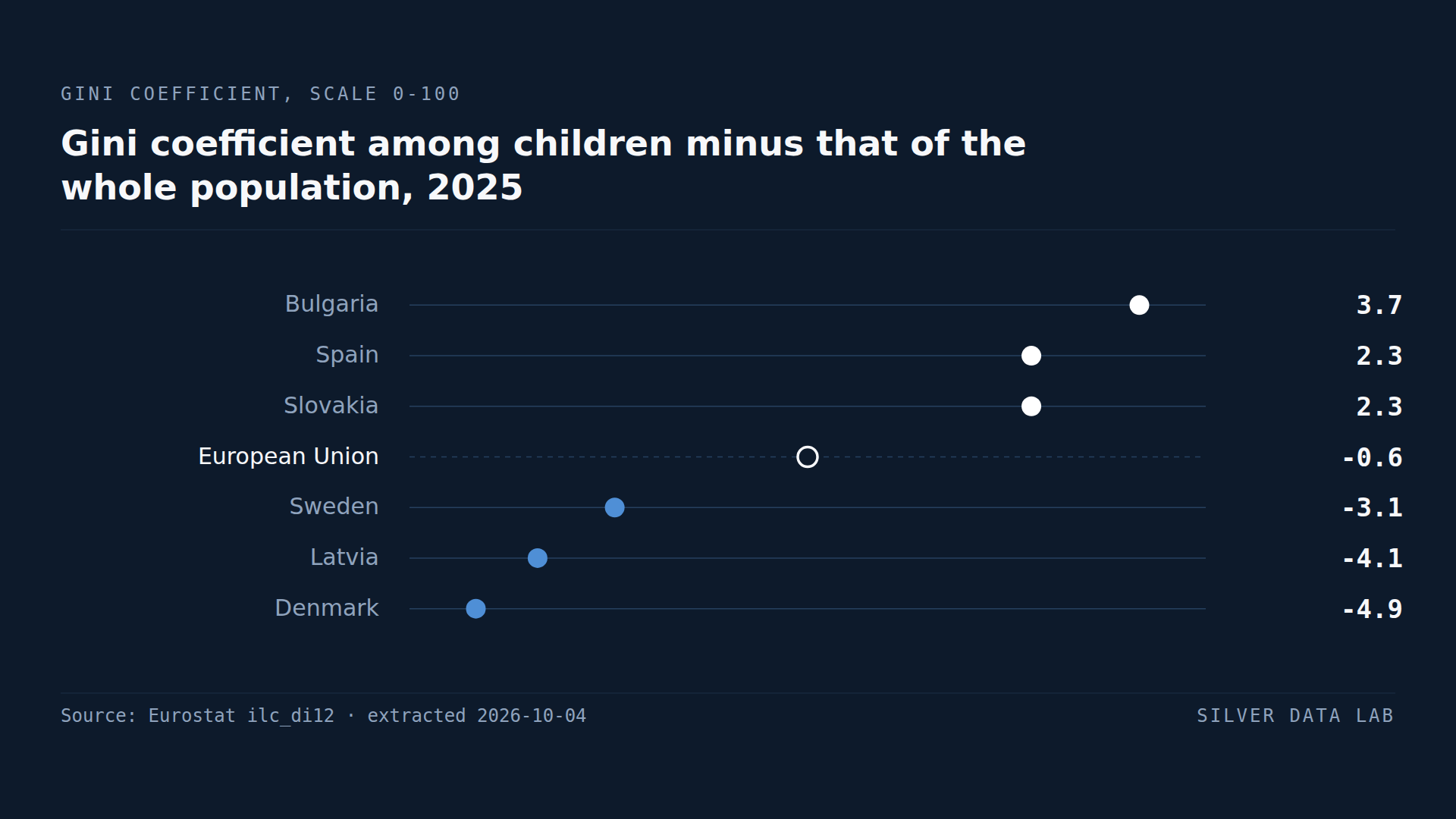
Among EU Children, Family Incomes Are Most Unequal in Bulgaria
Across the EU the Gini coefficient of disposable income among children under 18 was 28.6 in 2025, against 29.2 for the population as a whole.
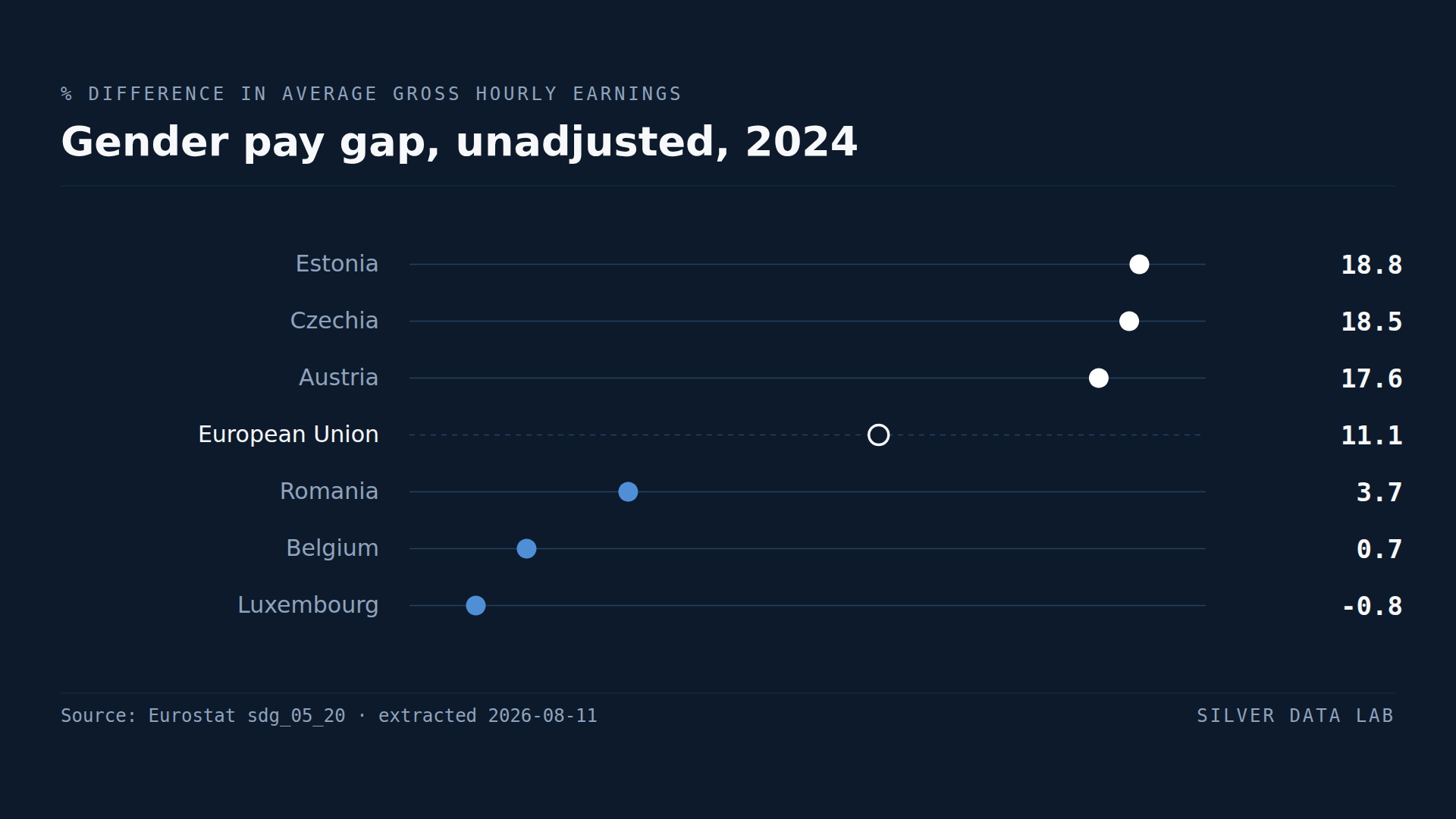
In Luxembourg, Women Are Paid More Than Men
Women in the EU earned 11.1% less per hour than men in 2024, before any adjustment for occupation or hours.