In Luxembourg, Women Are Paid More Than Men
Silver Data Lab Research Desk · Statistical analysis · Published on 01 March 2026
- Data source
- Eurostat
- Reference period
- 2024
- Last updated
- 04 October 2026
Re-checked against the source on 11 August 2026. No value in its datasets has moved between the snapshots we hold. Every revision we have observed →
Key estimates
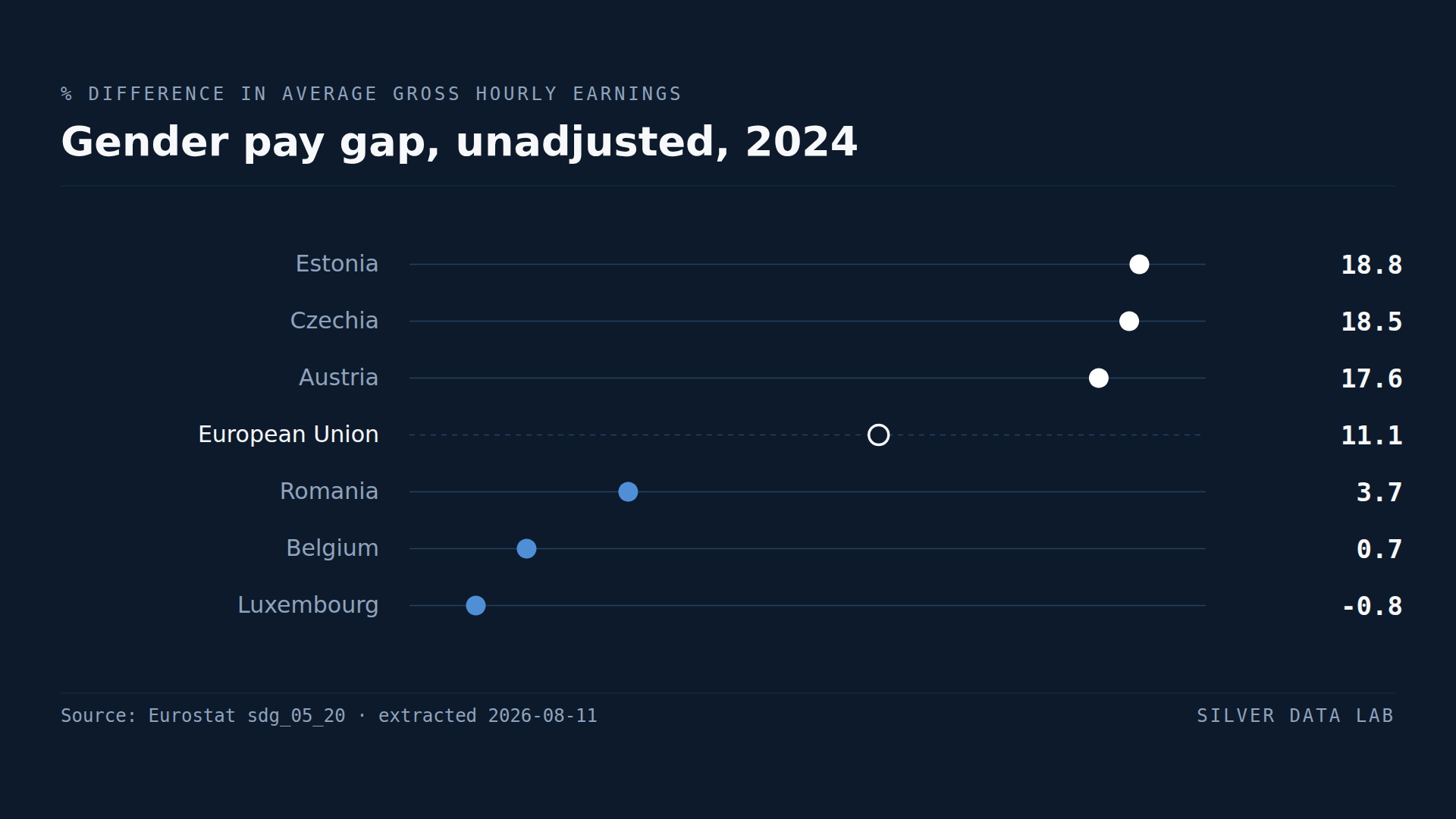
- Women in the EU earned 11.1% less per hour than men in 2024, before any adjustment for occupation or hours.
- Estonia records 18.8%, Czechia 18.5% and Austria 17.6%.
- Luxembourg records −0.8%: women's average hourly earnings exceed men's.
- Belgium at 0.7% and Romania at 3.7% are the next narrowest.
- A narrow gap is not by itself good news — it can reflect low female employment concentrated in higher-paid roles.
An unadjusted number, deliberately
The gender pay gap published here is the unadjusted gap: the difference between average gross hourly earnings of men and of women, with no correction for occupation, sector, seniority, experience or hours worked.
That construction is a choice, and an argued one. An adjusted gap answers whether men and women are paid differently for the same work. The unadjusted gap answers whether men and women are paid differently, which includes the effect of women being concentrated in lower-paid occupations and sectors.
Across the EU, women earned 11.1% less per hour than men in 2024.
The widest gaps
Estonia records 18.8%, the widest in the Union, followed by Czechia at 18.5%, Austria at 17.6%, Hungary at 16.9% and Finland at 16.3%.
Czechia's figure is the one in that group not measured on the same population as the rest. Eurostat flags it as differing in definition: alone among the Member States it covers public administration and firms with fewer than ten employees, which the other twenty-six leave out. Its place immediately behind Estonia rests on that difference as much as on pay.
Finland in that group is the result that most resists expectation. It has a female employment rate above the EU figure and one of the Union's narrowest gender employment gaps at 1.3 points, and it records the fifth-widest pay gap. High female participation and equal pay are separate achievements, and Finland has one without the other.
The reversed gap
Luxembourg records −0.8%. Women's average gross hourly earnings there exceed men's.
Belgium at 0.7% and Romania at 3.7% follow, then Poland at 4.0% and Malta at 4.9%.
This is where the unadjusted measure requires the most care. Romania's narrow gap sits alongside the Union's second-widest gender employment gap at 18.7 points: far fewer Romanian women work, and those who do are not concentrated in low-paid roles. A small gap among a small and selected group of working women is a different fact from equal pay across a labour market.
Why the two gender indicators must be read together
Italy records a 5.3% pay gap alongside a 19.1 point employment gap, the widest employment gap in the Union. Among the larger Member States only Poland at 4.0% and Romania at 3.7% record a narrower pay gap, and Romania is the selection case described above.
Estonia records the opposite: an 18.8% pay gap and a 0.5 point employment gap.
Neither country is more equal than the other in any simple sense. One keeps women out of the labour market and pays those who enter it comparatively well; the other brings almost all women into work and pays them substantially less. A single indicator would rank them, and the ranking would mean nothing.
Gender pay gap, unadjusted, 2024
| Country | % below male hourly earnings | Gap to EU averagepercentage points, derived |
|---|---|---|
| Estonia | 18.8p | +7.7 |
| Czechia | 18.5dp | +7.4 |
| Austria | 17.6p | +6.5 |
| European Unionaggregate | 11.1p | — |
| Romania | 3.7e | −7.4 |
| Belgium | 0.7p | −10.4 |
| Luxembourg | -0.8p | −11.9 |
Flags carried by the source on these values: dp definition differs, provisional · e estimated · p provisional
This table as data: CSV · JSON
Every Member State for this indicator+
Members see every Member State for this indicator here, not only the rows the ranking prints. Become a Member
Embed this chart
Paste this code into a page. The frame carries the source and the extraction date, and links back to the study.
What these figures cannot tell you
- Unadjusted by design
- No correction is made for occupation, sector, working time, seniority or experience. The figure includes the effect of occupational segregation rather than isolating unequal pay for equal work.
- Selection effects distort narrow gaps
- Where female employment is low, the women who do work are not a random sample of women. A narrow pay gap in such a country can reflect that selection rather than pay equality, which is why the employment gap must be read alongside it.
- Coverage excludes small firms and some sectors
- The measure covers industry, construction and services excluding public administration, defence and compulsory social security, and only enterprises with ten employees or more. Employees of smaller firms are outside the statistical population altogether, so a Member State whose work is concentrated in small businesses is described by a narrower slice of its labour market than one whose is not.
- Czechia is measured on a wider population
- Eurostat flags the Czech value as differing in definition, and its metadata gives the reason: Czechia alone covers public administration and enterprises with fewer than ten employees. Its 18.5% is therefore computed over a broader population than Estonia's 18.8%, and the 0.3 points between them do not establish an order.
- Hourly, not annual
- The gap is measured per hour worked. Because women work part time more often, the difference in annual earnings is substantially larger than the hourly gap in most Member States.
Frequently asked questions
- What is the gender pay gap in the EU?
- Women earned 11.1% less per hour than men in 2024, measured without adjusting for occupation, sector, seniority or hours. It is a gap in average pay, not a measure of unequal pay for identical work.
- Which EU country has the widest gender pay gap?
- Estonia, at 18.8% in 2024, followed by Czechia at 18.5% and Austria at 17.6%. Finland at 16.3% is fifth, despite having one of the Union's narrowest gender employment gaps.
- Is there an EU country where women earn more than men?
- Yes. Luxembourg records −0.8% for 2024, meaning women's average gross hourly earnings exceed men's. Belgium at 0.7% is close to parity.
- Does a narrow pay gap mean a country is more equal?
- Not on its own. Romania records a 3.7% pay gap alongside an 18.7 point gender employment gap: few women work, and those who do are not concentrated in low-paid roles. The pay gap and the employment gap have to be read together.
Methodological note
The gender pay gap in unadjusted form is published by Eurostat as the difference between average gross hourly earnings of male and female employees as a percentage of male earnings, covering NACE sections B to S excluding O and restricted to enterprises with ten employees or more.
Values are for 2024, the most recent year with complete coverage of the 27 Member States at the extraction date.
The gender employment gap figures quoted for comparison are derived by Silver Data Lab from the male and female employment rates in lfsi_emp_a for 2025, and come from a separate extraction with a different reference year.
Source data
The underlying series can be inspected and re-downloaded from the Eurostat data browser. The filters below are the ones applied.
Gender pay gap in unadjusted form
sdg_05_20
- Filters applied:
- freq=A · nace_r2=B-S_X_O · unit=PC · time=2024
- Extracted:
- 2026-08-11
- Source last updated:
- 2026-02-26
Download the data
The data the study you have just read is built on, exactly as it was downloaded and archived.
Yours as a Member.
Data downloadable by Members
How to cite
Record the vintage as well as the study: the figures on this page are the ones extracted on the dates below.
Silver Data Lab Research Desk (2026). In Luxembourg, Women Are Paid More Than Men. Silver Data Lab, published 01 March 2026, last updated 04 October 2026. https://www.silverdatalab.com/studies/gender-pay-gap-in-the-eu
- Data: Eurostat, Gender pay gap in unadjusted form (sdg_05_20), filters freq=A, nace_r2=B-S_X_O, unit=PC, time=2024; extracted 2026-08-11; source last updated 2026-02-26. https://doi.org/10.2908/sdg_05_20
Silver Data Lab's analysis is licensed CC BY 4.0. The statistics remain their publisher's and keep its terms of reuse.
Ask the research desk
A question about this study — a definition, a filter, a break in the series, what the figures can and cannot support — answered by the desk that made the extraction.
Members can write to the research desk
Studies where the same country leads or trails
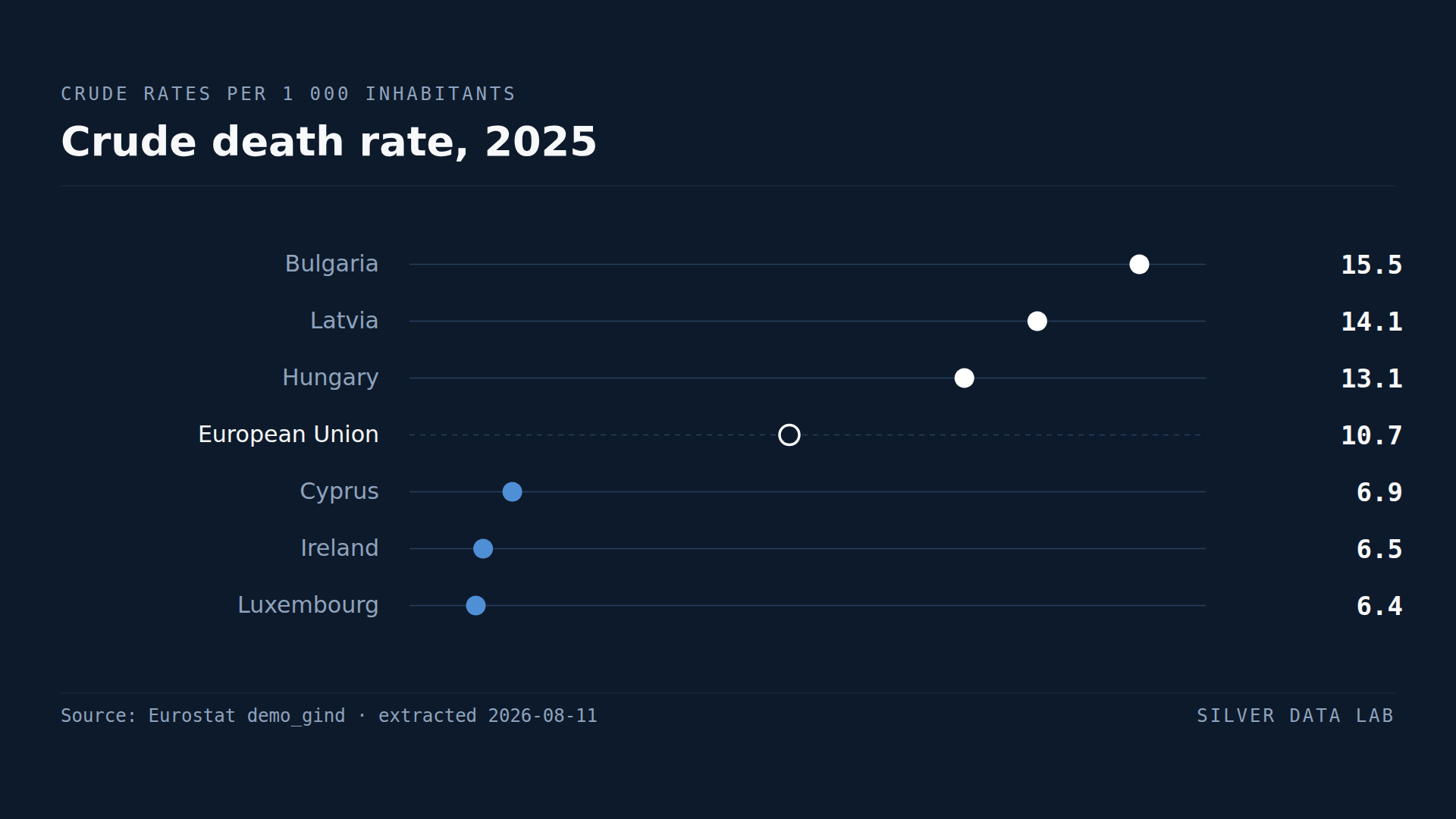
Deaths Outnumber Births in Twenty-One EU Countries
The EU recorded 7.7 births and 10.7 deaths per thousand inhabitants in 2025: a natural change of −3.0.
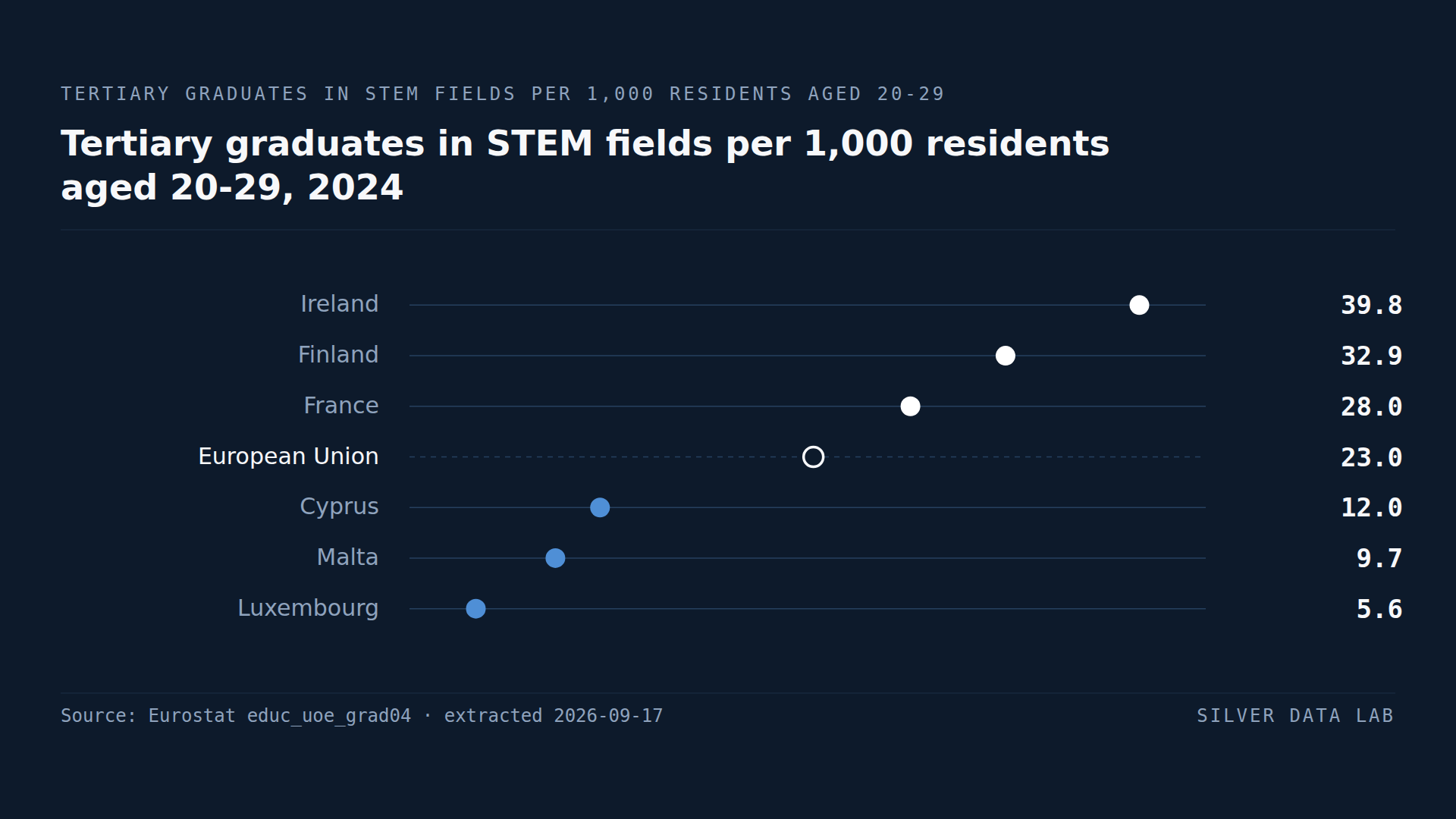
In No EU Country Do Women Graduate in STEM as Often as Men
In 2024 the EU produced 23.0 tertiary graduates in science, mathematics, computing, engineering, manufacturing and construction for every 1,000 residents aged 20 to 29.
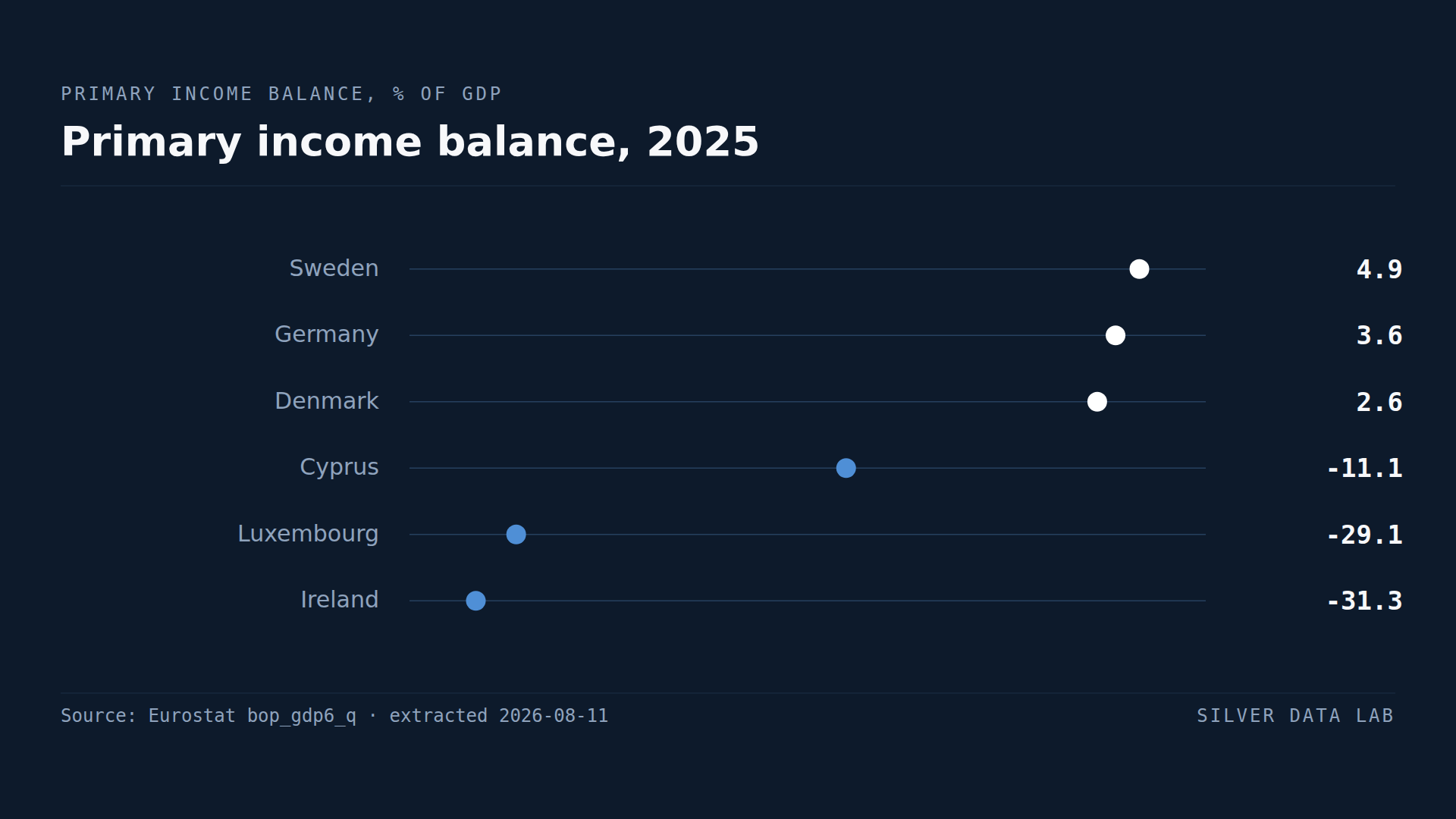
Ireland Pays Out More Income Abroad Than It Receives, a Net 28.6% of GDP
Ireland's net primary income outflow was 28.6% of GDP in 2025, second only to Luxembourg's 29.3%.