For Its Population, Croatia Has the Most Tourist Overnight Stays in the EU
Silver Data Lab Research Desk · Statistical analysis · Published on 05 July 2026
- Data source
- Eurostat
- Reference period
- 2025
- Last updated
- 11 October 2026
Re-checked against the source on 13 October 2026. 3 values in its datasets moved between snapshots, 1 of them figures stated on this page. Every revision we have observed →
Key estimates
- The EU recorded 6,978 tourist nights per 1,000 inhabitants in 2025, about 7.0 nights per resident.
- Croatia records 24,465 per 1,000, or 24.5 nights per inhabitant, the highest in the Union.
- Romania records 1,561 per 1,000, fewer than 1.6 nights per inhabitant.
- The ratio between Croatia and Romania is almost 16 to one.
- Foreign visitors account for more than 90% of nights in Croatia, Cyprus and Malta, and under 20% in Germany, Poland and Romania.
Measuring tourism against the population that hosts it
Counting tourist nights in absolute terms produces a ranking of large countries: Spain, France, Italy and Germany host the most because they are big. Dividing by resident population asks a different question — how much tourism a country absorbs relative to its own size — and produces a different ranking.
Across the EU there were 6,978 nights spent in tourist accommodation per 1,000 inhabitants in 2025, about 7.0 nights per resident per year.
The Adriatic and the islands
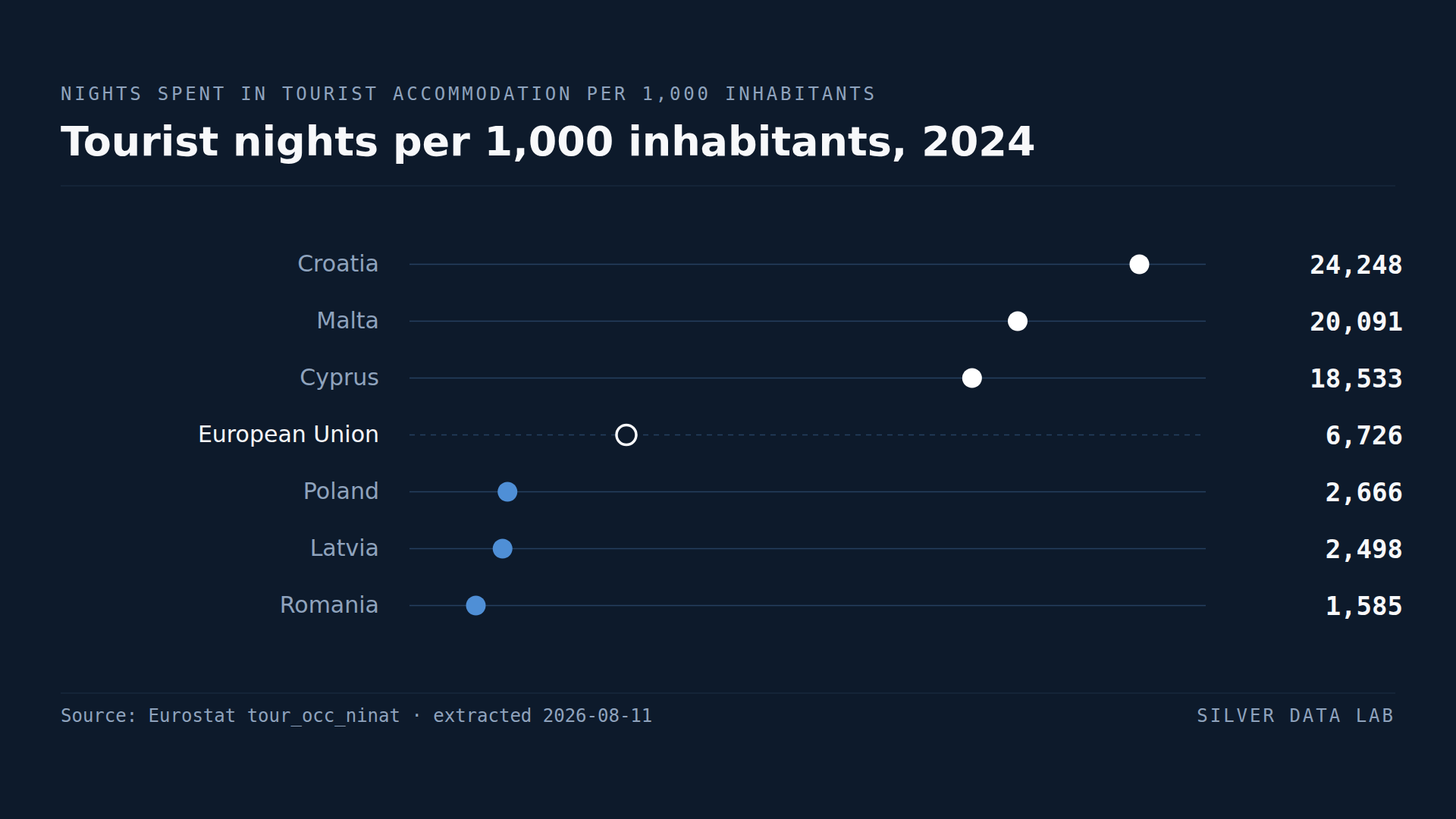
Croatia records 24,465 nights per 1,000 inhabitants: 24.5 nights for every person living there. Malta follows at 21,714 and Cyprus at 19,409, then Greece at 15,073 and Austria at 14,619.
Croatia's position is not a matter of hosting the most visitors. Spain and France host far more people. It is that Croatia has 3.9 million residents and a coastline that receives a large share of the Adriatic's summer traffic, so the same volume lands on a much smaller population.
Austria in fifth is the entry that breaks the coastal pattern. It has no coast and a winter season rather than a summer one, and reaches nearly the same intensity by a different route.
The low end
Romania records 1,561 nights per 1,000 inhabitants, Latvia 2,675, Poland 2,868, Slovakia 2,875 and Lithuania 3,264.
Romania is a country of 19 million people with recognised tourism assets, and it registers under a tenth of Croatia's intensity. The distance between the two is a factor of almost sixteen.
Who the visitors are
The composition matters as much as the volume. Foreign visitors account for 90.3% of nights in Croatia, 92.8% in Cyprus and 94.3% in Malta — these are export industries in the strict sense, earning money from outside the country.
At the other end, foreign visitors account for 18.9% of nights in Germany, 19.3% in Poland and 17.9% in Romania. Most tourism in those countries is domestic: residents travelling within their own borders, which redistributes spending rather than bringing it in.
That distinction is why tourism intensity and tourism as an export are not the same ranking. Germany hosts a very large number of nights and earns comparatively little foreign currency from them, which is consistent with its position as one of the five Member States running a services trade deficit.
Tourist nights per 1,000 inhabitants, 2025
| Country | nights per 1,000 inhabitants | Gap to EU averagederived |
|---|---|---|
| Croatia | 24,465 | +17,486.7 |
| Malta | 21,714 | +14,736.1 |
| Cyprus | 19,409 | +12,431.1 |
| European Unionaggregate | 6,978 | — |
| Poland | 2,868 | −4,109.7 |
| Latvia | 2,675 | −4,303.1 |
| Romania | 1,561 | −5,417.6 |
This table as data: CSV · JSON
Every Member State for this indicator+
Members see every Member State for this indicator here, not only the rows the ranking prints. Become a Member
Embed this chart
Paste this code into a page. The frame carries the source and the extraction date, and links back to the study.
What these figures cannot tell you
- Registered accommodation only
- The indicator counts nights in hotels, holiday accommodation and campsites that report to statistical authorities. Stays with friends and relatives, second homes and unregistered lets are excluded, and the size of that gap differs between Member States.
- Nights are not spending
- A night in a campsite and a night in a city hotel count the same. This measure says nothing about what visitors spend, so it is not a ranking of what tourism is worth to an economy.
- Population as denominator
- Dividing by resident population is what makes small countries rank high. That is the intended comparison, but it means the ranking partly reflects country size and should not be read as a measure of tourism industry scale.
- A single season can move a country
- For the Mediterranean Member States, most nights fall in a few summer months, making the annual figure sensitive to weather, exchange rates and events in that one season.
Frequently asked questions
- Which EU country has the most tourism per inhabitant?
- Croatia, with 24,465 nights per 1,000 inhabitants in 2025: 24.5 nights for every resident. Malta at 21,714 and Cyprus at 19,409 follow.
- How many tourist nights does the EU record per person?
- About 7.0 per inhabitant per year, or 6,978 nights per 1,000 inhabitants in 2025. Eleven Member States are above that figure and sixteen below it.
- Which EU country has the least tourism per inhabitant?
- Romania, at 1,561 nights per 1,000 inhabitants in 2025: under 1.6 per resident, and about a sixteenth of Croatia's intensity. Latvia and Poland follow.
- Where does tourism bring in the most foreign money?
- Foreign visitors account for over 90% of nights in Malta, Cyprus and Croatia, making tourism an export industry there. In Germany, Poland and Romania under 20% of nights are foreign, so most tourism is domestic travel that redistributes spending within the country rather than bringing it in.
Methodological note
Eurostat publishes nights spent at tourist accommodation establishments covering hotels, holiday and other short-stay accommodation, and campsites. This study uses the figure per 1,000 inhabitants for all visitors, and separately the share of nights accounted for by non-residents.
Values are for 2025, the most recent year with complete coverage of the 27 Member States at the extraction date.
Nights per inhabitant, the ratio between Croatia and Romania, and the counts of Member States above and below the EU figure are derived by Silver Data Lab from the published values. The two population figures, for Croatia and Romania, are 2025 annual averages from Eurostat's demographic balance, declared below. The comparison with the services trade balance draws on the companion study in the international trade category.
Source data
This study draws on 3 datasets from Eurostat. Each can be inspected and re-downloaded from its catalogue, and the filters below are the ones applied.
Nights spent at tourist accommodation establishments
tour_occ_ninat
- Filters applied:
- freq=A · c_resid=TOTAL · unit=P_THAB · nace_r2=I551-I553 · time=2025
- Extracted:
- 2026-10-13
- Source last updated:
- 2026-10-12
Nights spent at tourist accommodation establishments
tour_occ_ninat
- Filters applied:
- freq=A · c_resid=FOR · unit=PC_TOT · nace_r2=I551-I553 · time=2025
- Extracted:
- 2026-10-13
- Source last updated:
- 2026-10-12
Population change — demographic balance, average population
demo_gind
- Filters applied:
- freq=A · indic_de=AVG · time=2025
- Extracted:
- 2026-10-04
- Source last updated:
- 2026-09-30
Download the data
The data the study you have just read is built on, exactly as it was downloaded and archived.
Yours as a Member.
Data downloadable by Members
How to cite
Record the vintage as well as the study: the figures on this page are the ones extracted on the dates below.
Silver Data Lab Research Desk (2026). For Its Population, Croatia Has the Most Tourist Overnight Stays in the EU. Silver Data Lab, published 05 July 2026, last updated 11 October 2026. https://www.silverdatalab.com/studies/tourism-intensity-in-the-eu
- Data: Eurostat, Nights spent at tourist accommodation establishments (tour_occ_ninat), filters freq=A, c_resid=TOTAL, unit=P_THAB, nace_r2=I551-I553, time=2025; extracted 2026-10-13; source last updated 2026-10-12. https://doi.org/10.2908/tour_occ_ninat
- Data: Eurostat, Nights spent at tourist accommodation establishments (tour_occ_ninat), filters freq=A, c_resid=FOR, unit=PC_TOT, nace_r2=I551-I553, time=2025; extracted 2026-10-13; source last updated 2026-10-12. https://doi.org/10.2908/tour_occ_ninat
- Data: Eurostat, Population change — demographic balance, average population (demo_gind), filters freq=A, indic_de=AVG, time=2025; extracted 2026-10-04; source last updated 2026-09-30. https://doi.org/10.2908/demo_gind
Silver Data Lab's analysis is licensed CC BY 4.0. The statistics remain their publisher's and keep its terms of reuse.
Ask the research desk
A question about this study — a definition, a filter, a break in the series, what the figures can and cannot support — answered by the desk that made the extraction.
Members can write to the research desk
Other studies on the same dataset
Deaths Outnumber Births in Twenty-One EU Countries
The EU recorded 7.7 births and 10.7 deaths per thousand inhabitants in 2025: a natural change of −3.0.
Romania Uses Less Energy per Person Than Any Other EU Country
The EU consumed 2.0 tonnes of oil equivalent per inhabitant in final energy in 2024.
Four Countries Produce More Than Half of the EU's Farm Output
EU agricultural output was worth 541.7 billion euro at basic prices in 2025.
Studies where the same country leads or trails
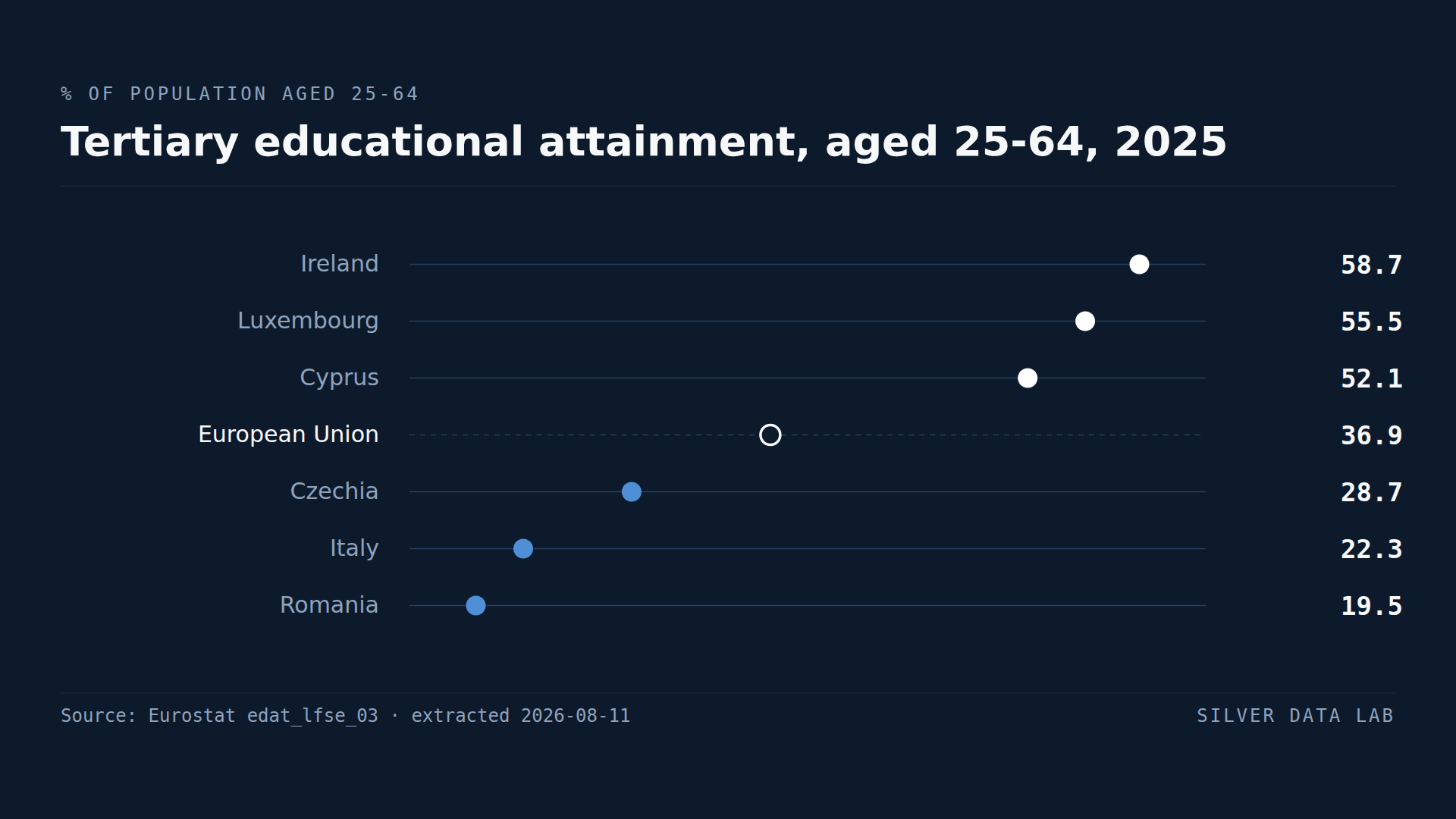
A Degree Is Three Times as Common Among Adults in Ireland as in Romania
36.9% of people aged 25 to 64 in the EU held a tertiary qualification in 2025.
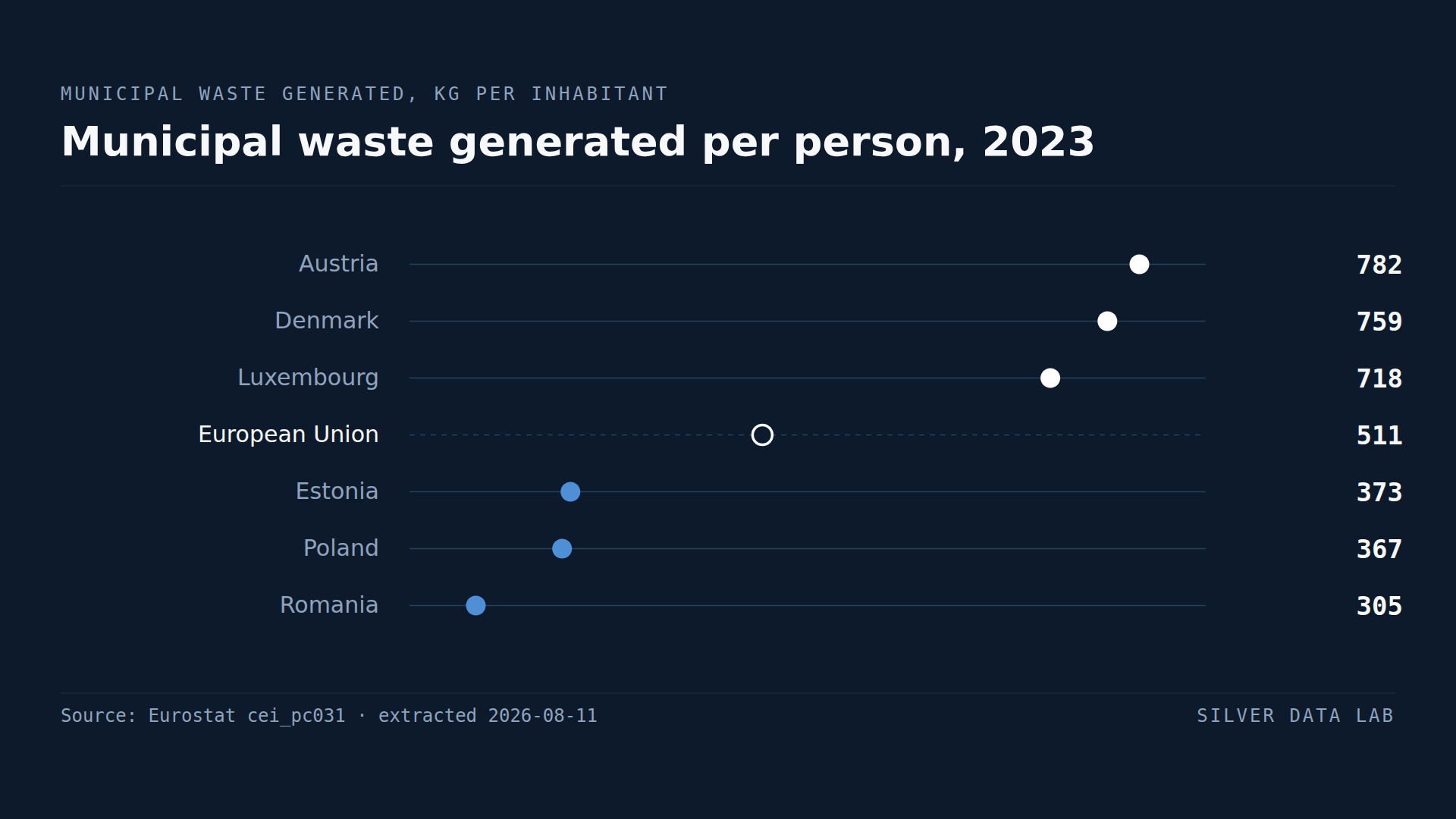
Austria Produces More Rubbish per Person Than Any Other EU Country
The EU generated 510 kg of municipal waste per inhabitant in 2023 — about 1.4 kg per person per day.
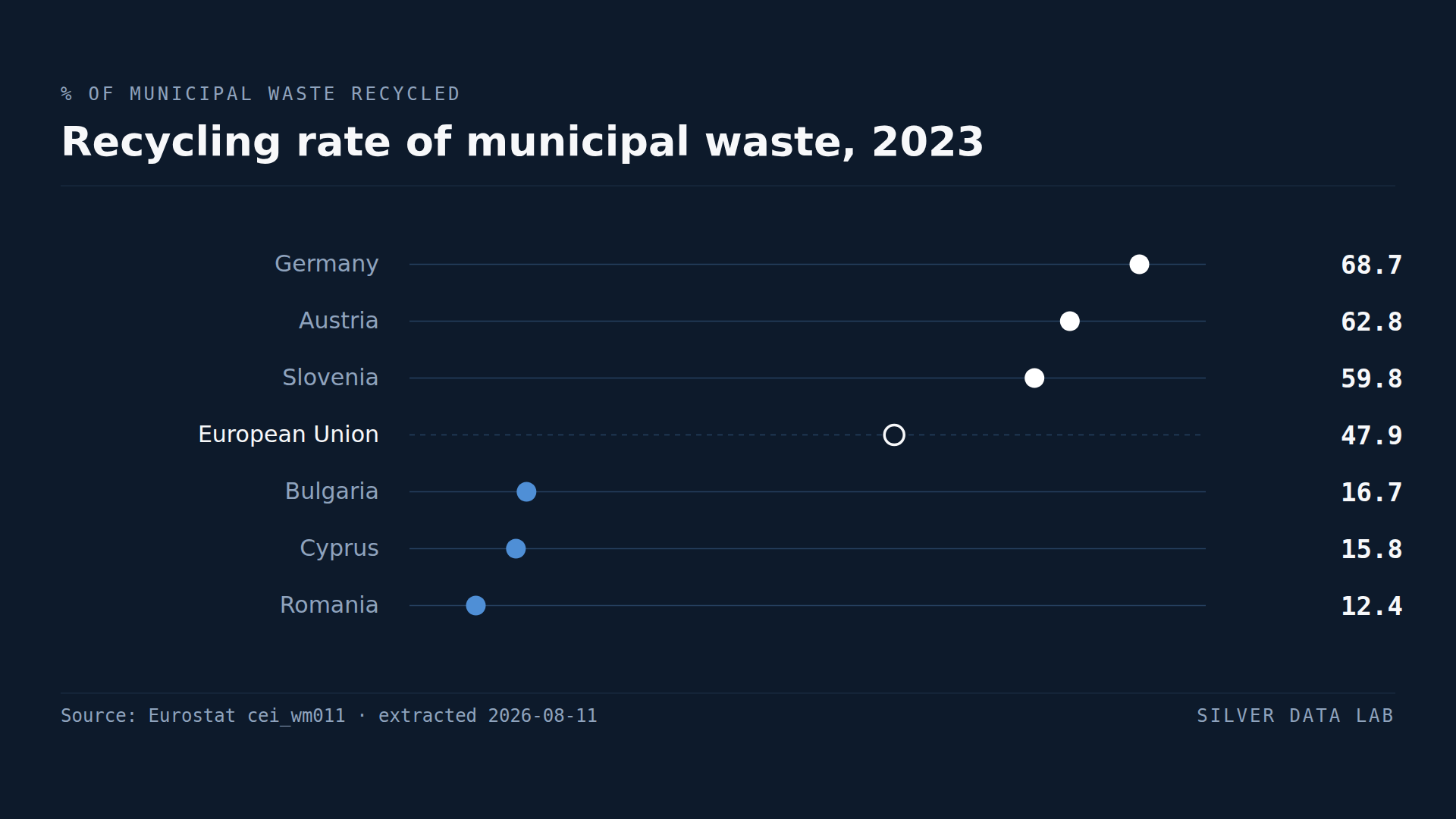
Germany's Recycling Rate Is 5.5 Times Romania's
The EU recycled 47.9% of its municipal waste in 2023, slightly under half.