Germany's Recycling Rate Is 5.5 Times Romania's
Silver Data Lab Research Desk · Statistical analysis · Published on 02 April 2026
- Data source
- Eurostat
- Reference period
- 2023
- Last updated
- 21 October 2026
Re-checked against the source on 21 October 2026. 18 values in its datasets moved between snapshots; none is a figure stated on this page. Every revision we have observed →
Key estimates
- The EU recycled 47.9% of its municipal waste in 2023, slightly under half.
- Germany records 68.7%, ahead of Austria at 62.8% and Slovenia at 59.8%.
- Romania records 12.4%, followed by Cyprus at 15.8% and Bulgaria at 16.7%.
- The German rate is 5.5 times the Romanian one.
- Six Member States sit above 55%; five sit below 20%.
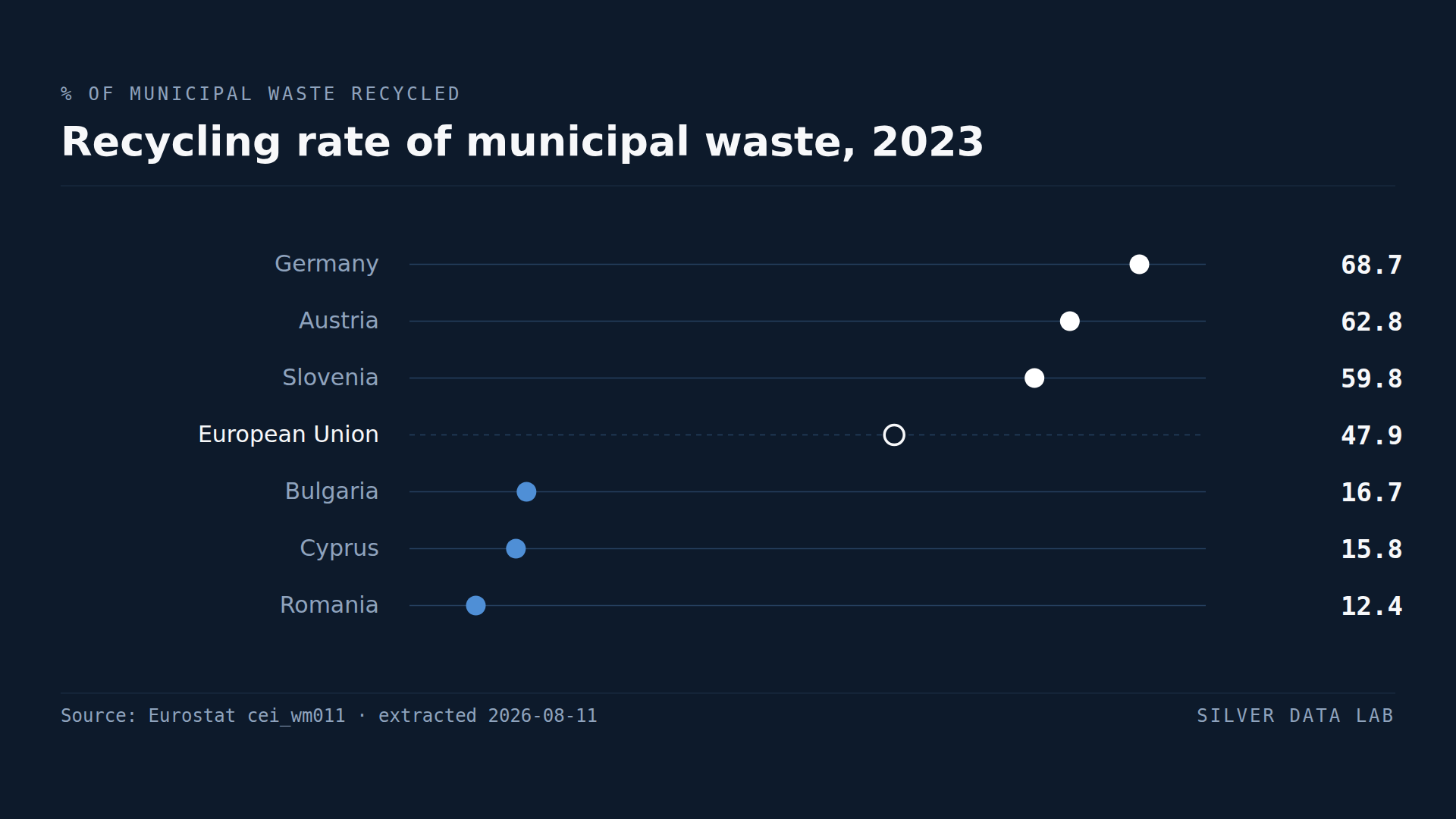
Half of Europe's household rubbish is still not recycled
The recycling rate for municipal waste covers what households and similar small producers throw away: the bins outside homes rather than the output of industry. Across the European Union, 47.9% of it was recycled in 2023.
The Union as a whole therefore does not recycle slightly more than half of its household waste. Where that half goes — landfill, incineration, other treatment — is not in this indicator, which publishes the recycled share and nothing else. That is the headline, and the distribution behind it is much wider than the average suggests.
The top of the ranking
Germany records 68.7%, the highest in the Union. Austria follows at 62.8%, Slovenia at 59.8%, the Netherlands at 57.9%, Luxembourg at 56.5% and Belgium at 55.8%.
Six Member States therefore recycle more than 55% of municipal waste, and all six are in western or central Europe.
Slovenia's position is the one that resists the simple reading. It is neither among the Union's wealthiest Member States nor one of its earliest adopters, and it sits third. Whatever explains the ranking, it is not income alone.
The bottom, and the size of the gap
Romania records 12.4%, the lowest in the Union. Cyprus follows at 15.8%, Bulgaria at 16.7%, and Greece and Malta at 17.4% each.
Germany's rate is 5.5 times Romania's. For comparison, and on 2025 readings rather than these 2023 ones, the renewable share of gross final energy consumption runs about four to one between the highest and lowest Member State, and the share of people unable to keep their home adequately warm about seven to one; both series are declared below. That last measures a household's circumstances, while this measures a public service.
That distinction is the reason this ranking is more interpretable than most. Whether a household's waste is recycled depends first on whether a separate collection system exists to collect it, and that is a decision taken by a municipality or a national government rather than by the household.
What the indicator does not settle
A recycling rate measures what enters the recycling stream, and countries differ in where they measure it. Material collected separately and subsequently rejected at a sorting facility may or may not be excluded depending on the point of measurement, and definitions have been tightened over time.
Comparisons between Member States are therefore sound at the scale of the gaps described here — a factor of five is not a definitional artefact — and much weaker at close range than a point or two would suggest. Eurostat flags the years in which a country changed how it measures, and at 15 of those breaks the published rate moved by more than five points from one year to the next: Slovenia's by 18.1 points in 2015, Poland's by 13.3 between 2022 and 2023.
Recycling rate of municipal waste, 2023
| Country | % of municipal waste | Gap to EU averagepercentage points, derived |
|---|---|---|
| Germany | 68.7 | +20.8 |
| Austria | 62.8 | +14.9 |
| Slovenia | 59.8 | +11.9 |
| European Unionaggregate | 47.9 | — |
| Bulgaria | 16.7 | −31.2 |
| Cyprus | 15.8 | −32.1 |
| Romania | 12.4 | −35.5 |
This table as data: CSV · JSON
Every Member State for this indicator+
Members see every Member State for this indicator here, not only the rows the ranking prints. Become a Member
Embed this chart
Paste this code into a page. The frame carries the source and the extraction date, and links back to the study.
What these figures cannot tell you
- The measurement point differs between countries
- Recycling rates can be measured at the point of collection or after sorting, and material rejected during sorting is treated differently depending on national practice. The definition has been harmonised progressively, so large differences between Member States are meaningful while small ones may not be.
- Municipal waste is not all waste
- This indicator covers household and similar waste only. It excludes construction, mining, industrial and agricultural waste, which together account for the large majority of material discarded in the Union. A country with a high municipal recycling rate is not necessarily recycling most of its waste.
- A rate says nothing about the quantity generated
- Recycling 47.9% of a large volume and 47.9% of a small one are different environmental outcomes. This study measures the share recycled, not waste generated per head, which is a separate indicator with a different ranking.
- 2023, not 2025
- Waste statistics are reported with a longer lag than most indicators on this site. 2023 is the most recent year with complete coverage of the 27 Member States, so these figures are not directly comparable with the 2025 readings published elsewhere here. A 2024 reading does exist for twenty-six of them, but Romania — the lowest in this ranking — is not among them and the EU figure for that year is imputed, so the page stays on the last complete year.
Frequently asked questions
- How much municipal waste does the EU recycle?
- 47.9% in 2023, slightly under half. What happened to the rest is not in this indicator, which publishes the recycled share only. National rates ranged from 68.7% in Germany to 12.4% in Romania.
- Which EU country recycles the most?
- Germany, at 68.7% of municipal waste in 2023, ahead of Austria at 62.8% and Slovenia at 59.8%. Six Member States recycle more than 55%.
- Which EU country recycles the least?
- Romania, at 12.4% in 2023, followed by Cyprus at 15.8% and Bulgaria at 16.7%. The German rate is 5.5 times the Romanian one.
- Does municipal waste cover all recycling?
- No. Municipal waste is household and similar waste — the bins outside homes. Construction, mining, industrial and agricultural waste are excluded, and together they account for the large majority of material discarded in the Union.
Methodological note
The indicator is Eurostat's recycling rate of municipal waste, published as the share of municipal waste generated that is recycled, where recycling includes material recycling, composting and anaerobic digestion.
Values are for 2023, the most recent year with complete coverage of the 27 Member States at the extraction date.
The ratio between the highest and lowest Member State, and the counts above 55% and below 20%, are derived by Silver Data Lab from the published rates. So are the two spreads quoted for comparison, each computed from the highest and lowest Member State in the further extraction declared below for that series; both are 2025 readings and are described as such, because this study's own year is 2023.
Source data
This study draws on 3 datasets from Eurostat. Each can be inspected and re-downloaded from its catalogue, and the filters below are the ones applied.
Recycling rate of municipal waste
cei_wm011
- Filters applied:
- freq=A · wst_oper=RCY · unit=PC · time=2023
- Extracted:
- 2026-10-16
- Source last updated:
- 2026-10-15
Main indicators — share of renewable energy
nrg_ind_ren
- Filters applied:
- freq=A · nrg_bal=REN · unit=PC · time=2025
- Extracted:
- 2026-09-16
- Source last updated:
- 2026-09-15
Inability to keep home adequately warm by poverty status
ilc_mdes01
- Filters applied:
- freq=A · hhcomp=TOTAL · rskpovth=TOTAL · unit=PC · time=2025
- Extracted:
- 2026-10-21
- Source last updated:
- 2026-10-20
Download the data
The data the study you have just read is built on, exactly as it was downloaded and archived.
Yours as a Member.
Data downloadable by Members
How to cite
Record the vintage as well as the study: the figures on this page are the ones extracted on the dates below.
Silver Data Lab Research Desk (2026). Germany's Recycling Rate Is 5.5 Times Romania's. Silver Data Lab, published 02 April 2026, last updated 21 October 2026. https://www.silverdatalab.com/studies/municipal-waste-recycling-in-the-eu
- Data: Eurostat, Recycling rate of municipal waste (cei_wm011), filters freq=A, wst_oper=RCY, unit=PC, time=2023; extracted 2026-10-16; source last updated 2026-10-15. https://doi.org/10.2908/cei_wm011
- Data: Eurostat, Main indicators — share of renewable energy (nrg_ind_ren), filters freq=A, nrg_bal=REN, unit=PC, time=2025; extracted 2026-09-16; source last updated 2026-09-15. https://doi.org/10.2908/nrg_ind_ren
- Data: Eurostat, Inability to keep home adequately warm by poverty status (ilc_mdes01), filters freq=A, hhcomp=TOTAL, rskpovth=TOTAL, unit=PC, time=2025; extracted 2026-10-21; source last updated 2026-10-20. https://doi.org/10.2908/ilc_mdes01
Silver Data Lab's analysis is licensed CC BY 4.0. The statistics remain their publisher's and keep its terms of reuse.
Ask the research desk
A question about this study — a definition, a filter, a break in the series, what the figures can and cannot support — answered by the desk that made the extraction.
Members can write to the research desk
Other studies on the same dataset
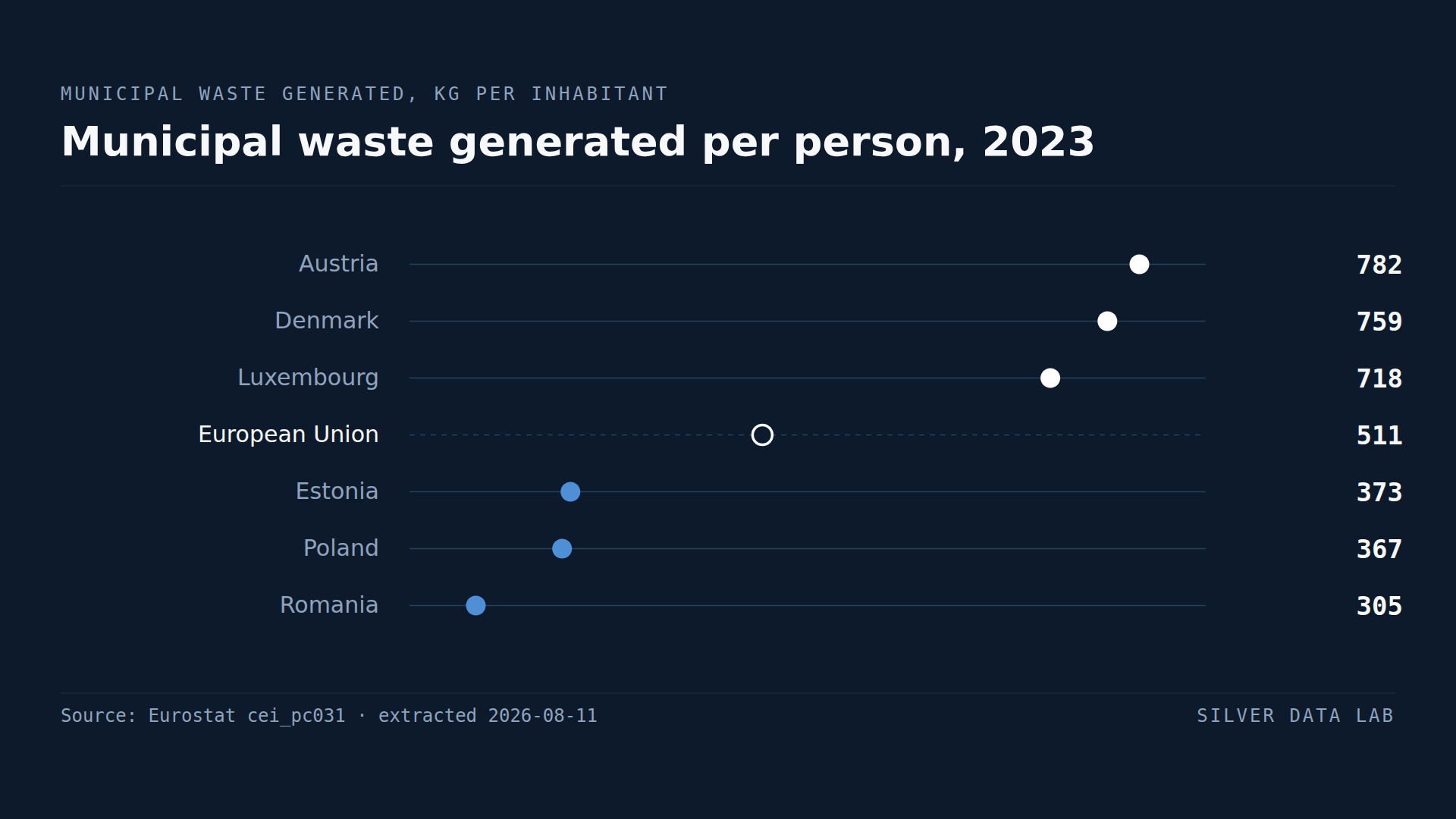
Austria Produces More Rubbish per Person Than Any Other EU Country
The EU generated 510 kg of municipal waste per inhabitant in 2023 — about 1.4 kg per person per day.
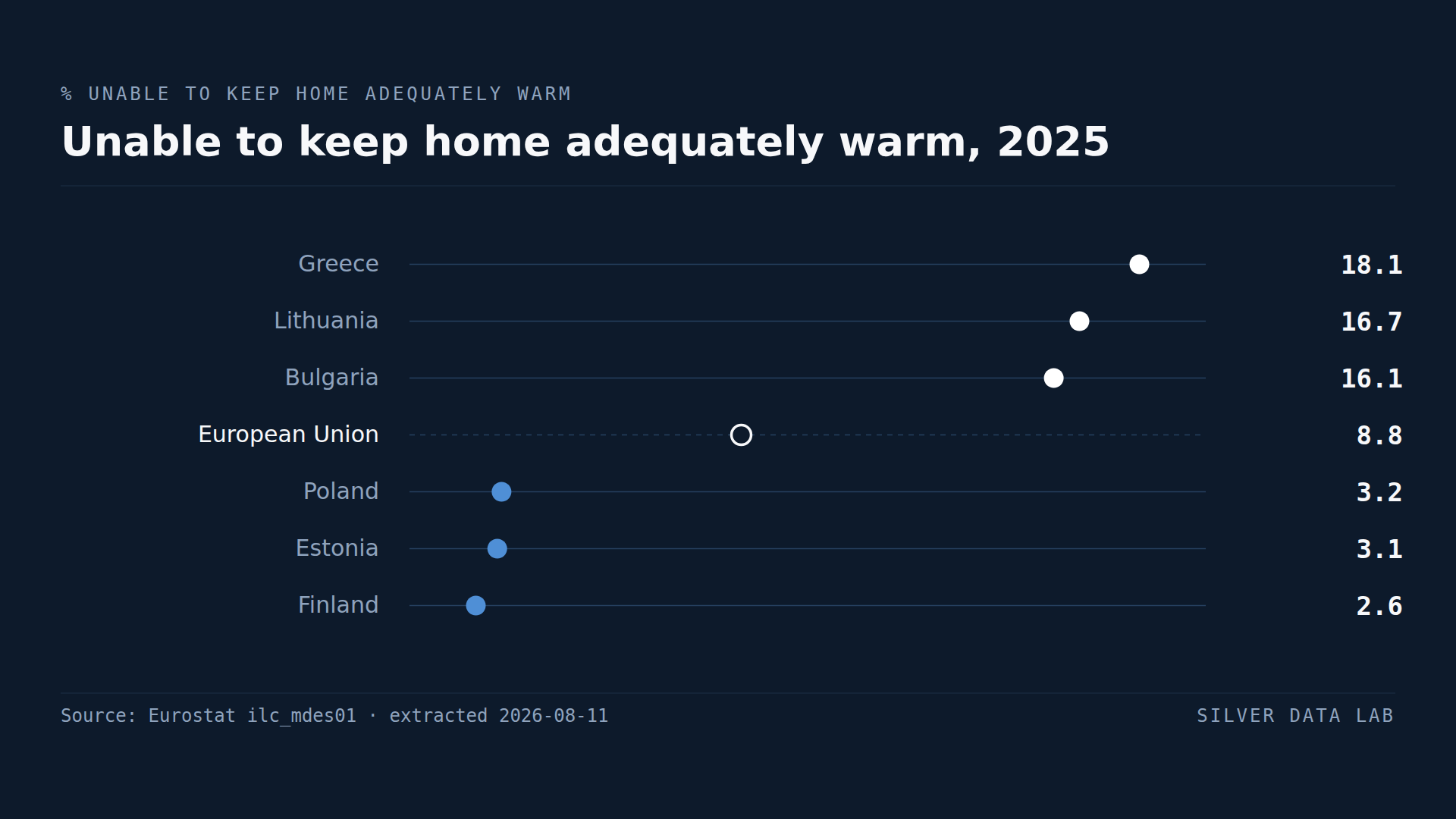
Greece Has the EU's Highest Share of People Who Cannot Afford Heating
8.8% of the EU population could not keep their home adequately warm in 2025.
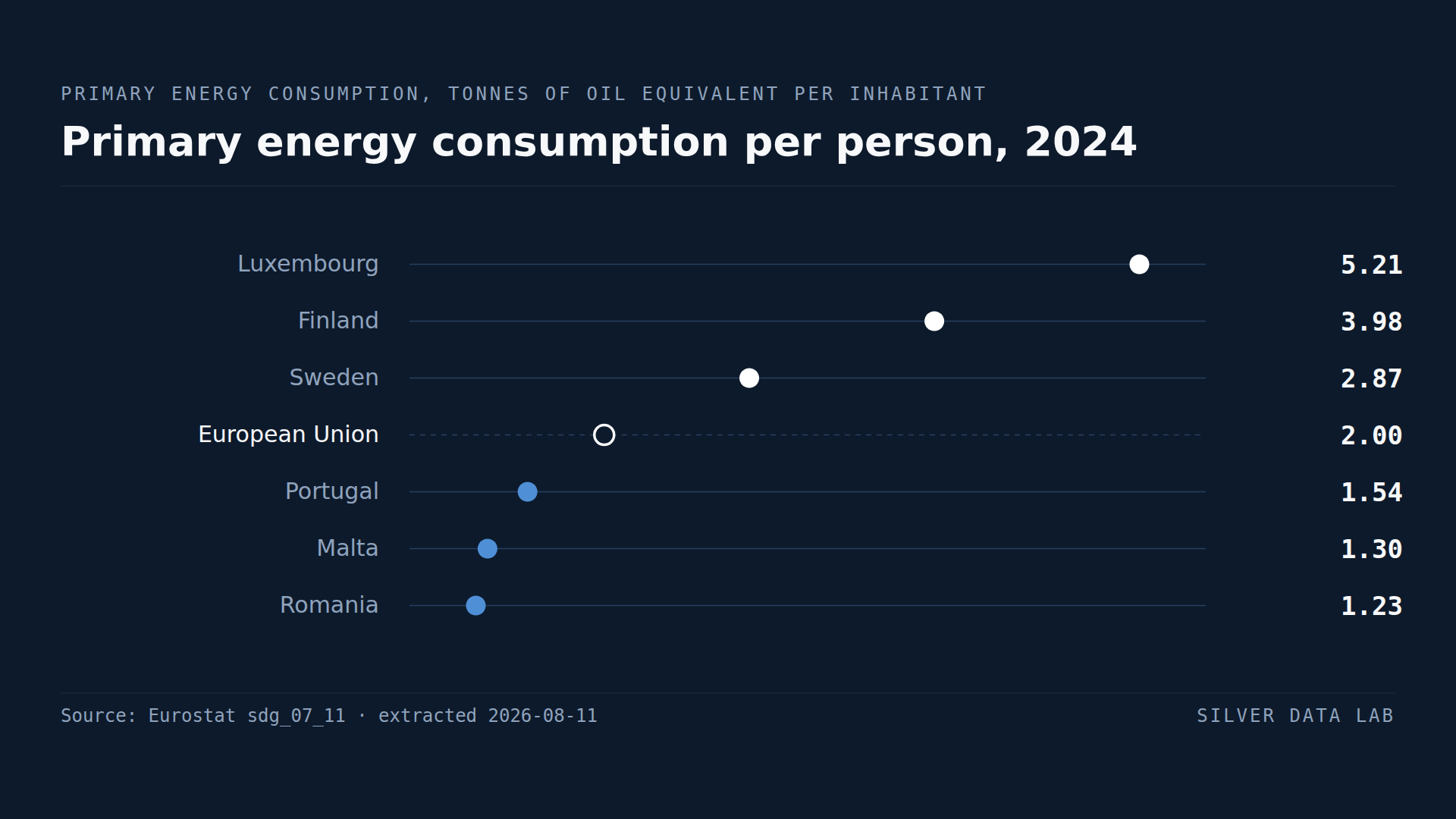
Romania Uses Less Energy per Person Than Any Other EU Country
The EU consumed 2.0 tonnes of oil equivalent per inhabitant in final energy in 2024.
Studies where the same country leads or trails
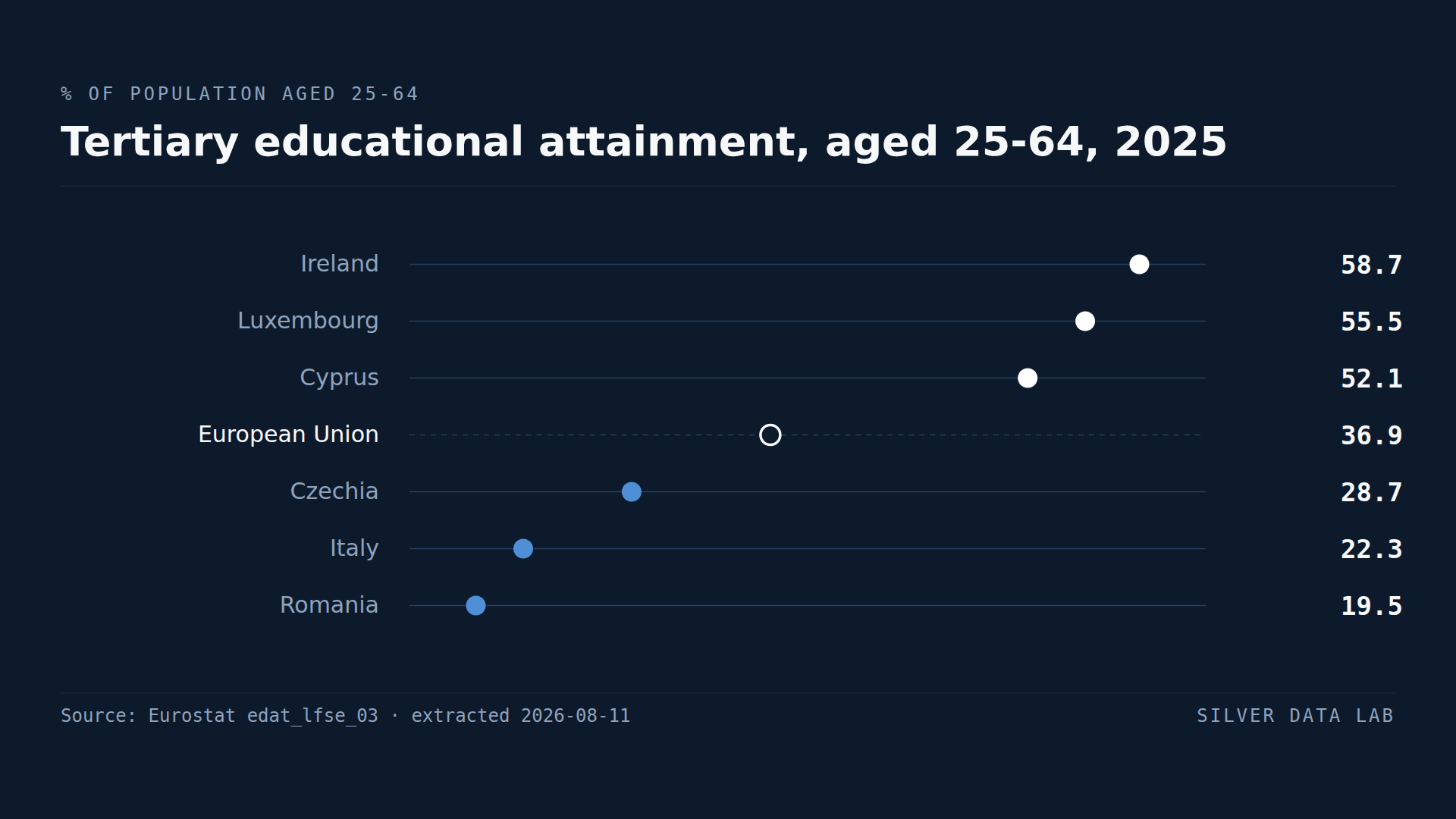
A Degree Is Three Times as Common Among Adults in Ireland as in Romania
36.9% of people aged 25 to 64 in the EU held a tertiary qualification in 2025.
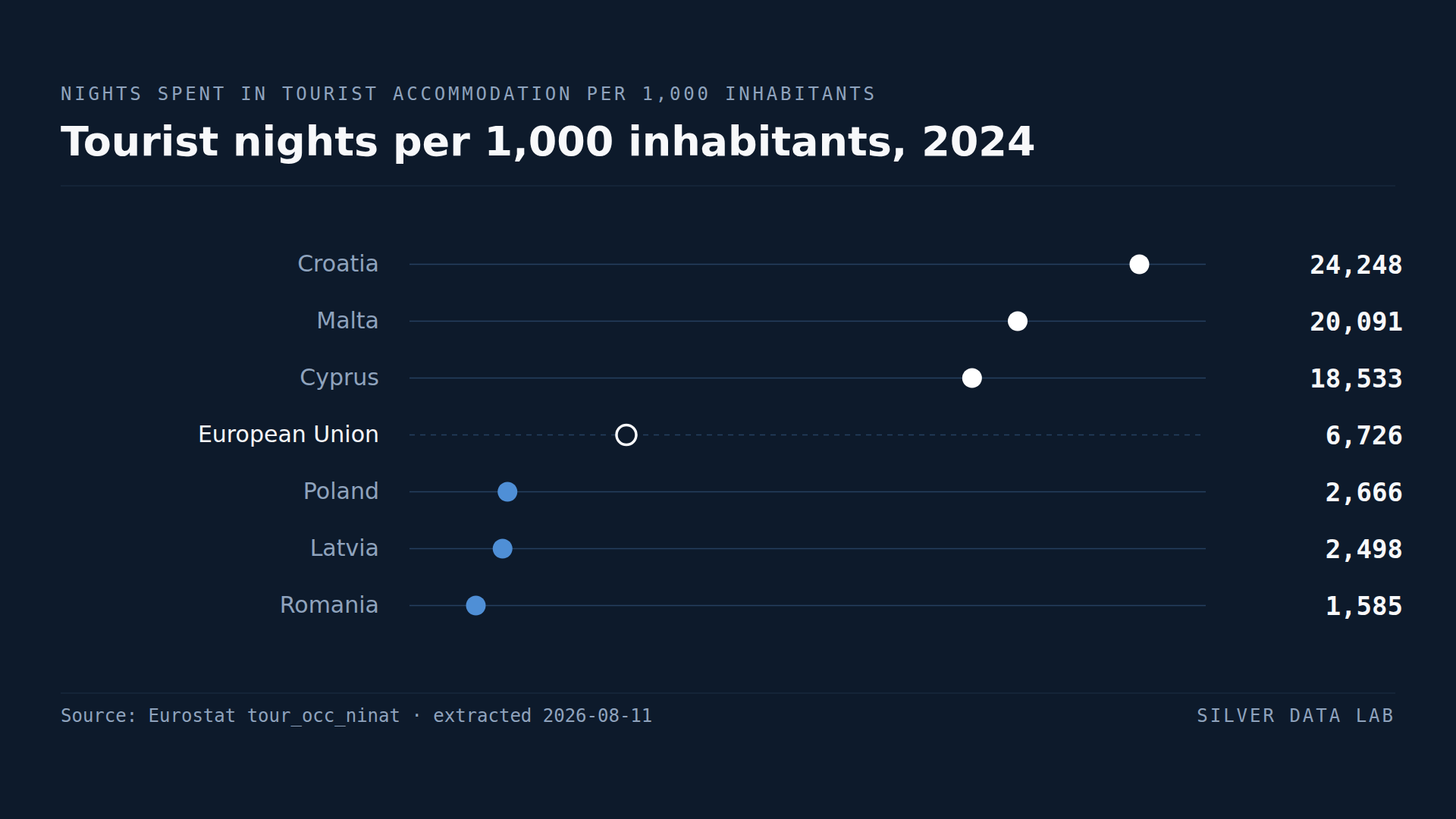
For Its Population, Croatia Has the Most Tourist Overnight Stays in the EU
The EU recorded 6,978 tourist nights per 1,000 inhabitants in 2025, about 7.0 nights per resident.
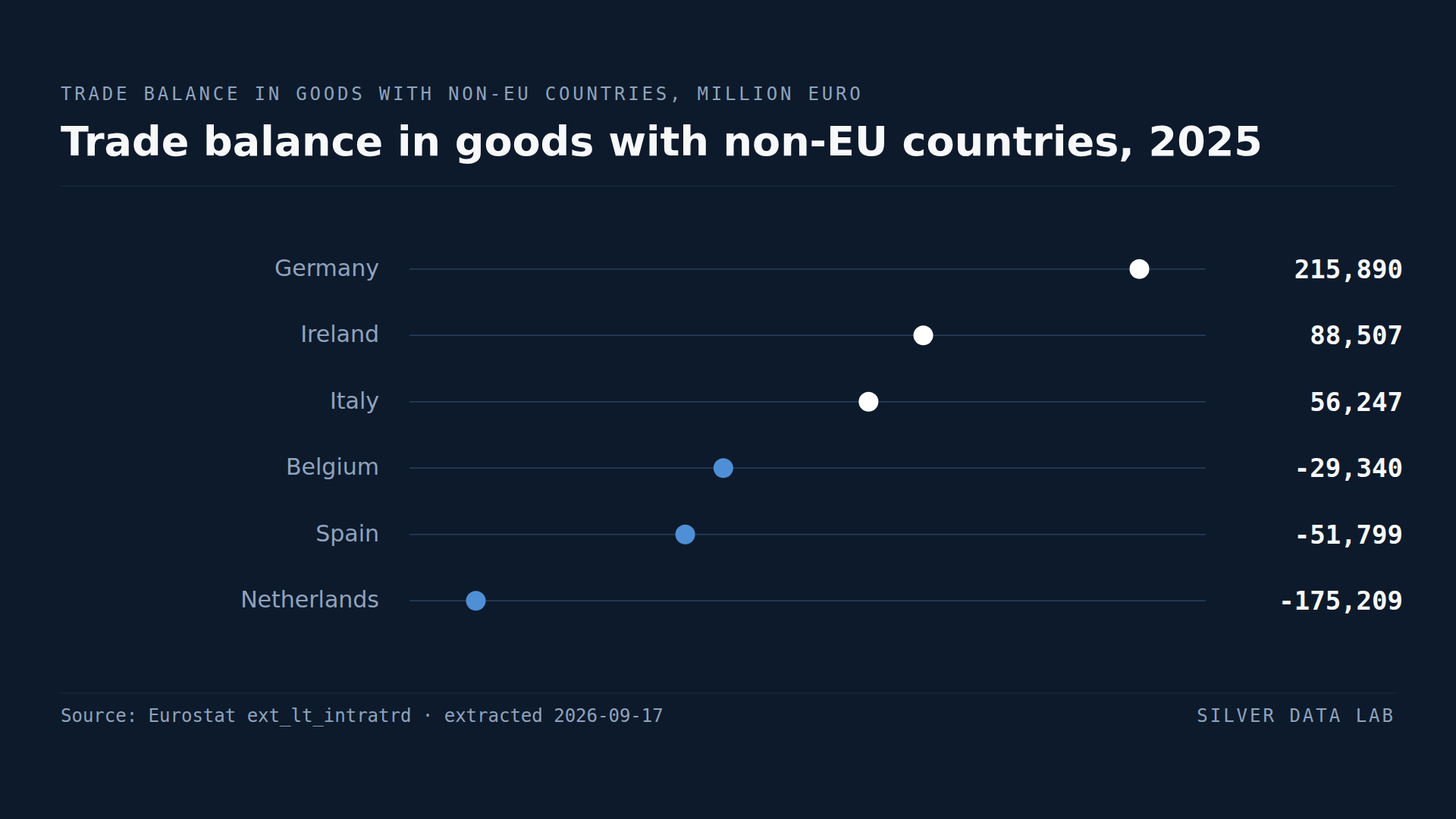
Germany Has the EU's Biggest Trade Surplus in Goods With Non-EU Countries
EU Member States together ran a goods trade surplus of 113.9 billion euro with countries outside the Union in 2025.