Immigrants' Children in the EU Run Twice the Poverty Risk of Other Children
Silver Data Lab Research Desk · Statistical analysis · Published on 15 October 2026
This study is open to members only
Its sources, filters and extraction date are declared above, as they are for every study. Sign in to read the analysis in full.
- Data source
- Eurostat
- Reference period
- 2025
- Last updated
- 15 October 2026
Re-checked against the source on 15 October 2026. No value in its datasets has moved between the snapshots we hold. Every revision we have observed →
Key estimates
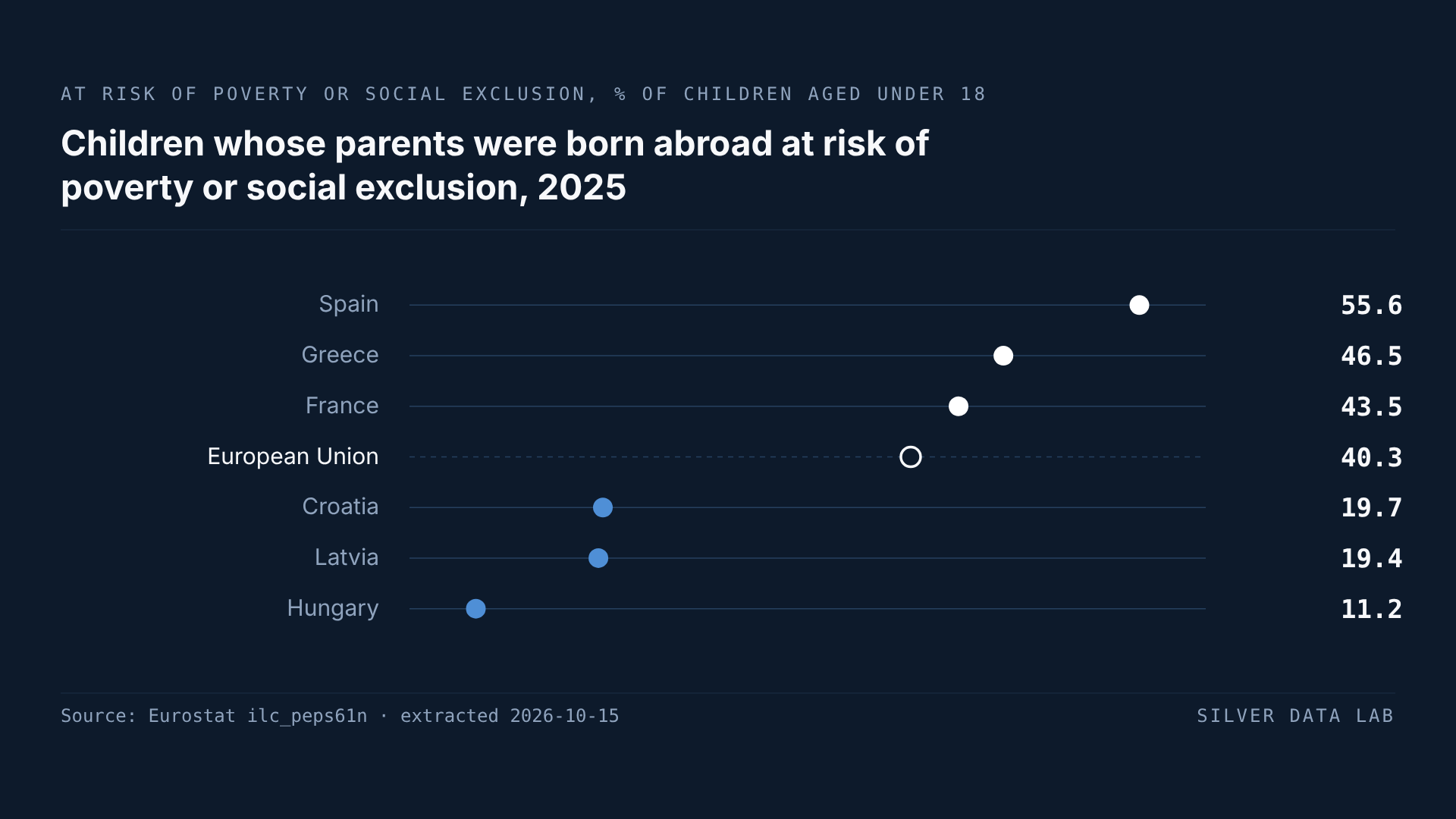
- In 2025, 40.3% of children in the EU whose parents were born abroad were at risk of poverty or social exclusion, against 18.5% of children whose parents were born in the country where they live: more than twice the rate, a derived gap of 21.8 points.
- Spain records both the highest rate for children with parents born abroad, 55.6%, and the widest derived gap, 34.1 points above children with Spanish-born parents.
- Hungary is the only Member State where children whose parents were born abroad are at lower risk than children with native-born parents: 11.2% against 23.4%.
- The risk is highest when the parents were born outside the EU: 44.6% of their children were at risk, against 23.6% of children whose parents were born in another Member State, both EU figures estimated by Eurostat.
- Since 2015 the EU rate for children with native-born parents has fallen from 24.3% to 18.5%, while the rate for children with parents born abroad has moved from 41.5% to 40.3%.
Where a child's parents were born
Eurostat's survey of income and living conditions classifies children under 18 by the country where their parents were born. That lets it publish the share of children at risk of poverty or social exclusion for two groups: children whose parents were born in the country they now live in, and children whose parents were born abroad, the children of immigrants in everyday language. The second group is split again by whether the parents were born in another EU Member State or outside the Union. The table does not separate children born in the country from children who arrived with their parents.
At risk of poverty or social exclusion, shortened to AROPE, is the EU's broad poverty measure, and for a child it is a reading of the household. A child is counted when the household's income, adjusted for its size, falls below 60% of the national median; when the household cannot afford a range of basic items and activities; or when the adults in it did very little paid work in the previous year. A child to whom more than one of these applies is counted once.
More than twice the risk
In 2025, 40.3% of children in the EU whose parents were born abroad were at risk of poverty or social exclusion. Among children whose parents were born in the country where they live, the figure was 18.5%. The first rate is more than twice the second and stands 21.8 percentage points above it, both comparisons derived here from the two published rates. Eurostat marks the EU figure for children with parents born abroad as an estimate; the figure for children with native-born parents carries no flag.
Twenty-four Member States publish both rates for 2025. In 23 of them children with parents born abroad are at higher risk, and in 14 their rate is more than double the native one. Bulgaria and Romania publish no figure for children with parents born abroad that year, and Lithuania publishes no 2025 value in the table at all.
Where the gap is widest
Spain records both the highest rate and the widest gap. There, 55.6% of children whose parents were born abroad are at risk, against 21.5% of children with Spanish-born parents, a difference of 34.1 points. On the rate, Greece follows at 46.5%, then France at 43.5% and Italy at 42.9%.
On the gap, Sweden is second at 29.5 points and Austria third at 27.4. Both start from low rates for children with native-born parents, 11.6% and 12.7%, so the distance is large in proportion as well: in Sweden the rate for children with parents born abroad, 41.1%, is more than three and a half times the native figure, the largest ratio of the 24. Germany at 23.4 points, France at 22.4 and Italy at 22.0 complete the six Member States whose gap is wider than the EU's. The Netherlands has a smaller gap, 19.0 points, but there children with native-born parents record 7.9%, the lowest such rate of the 26 Member States that publish it, so the rate for children with parents born abroad is still more than three times theirs.
Greece reads differently. Its gap of 20.0 points is close to the EU's, but there children with native-born parents record 26.5%, the third highest such rate in the Union after Romania and Bulgaria, so a gap of ordinary size sits on top of a high rate for both groups.
Where the gap is small, or reversed
Hungary is the only Member State where children whose parents were born abroad are at lower risk than children with native-born parents: 11.2% against 23.4%. The 11.2% is also the lowest rate for that group in the Union, and the pattern holds when the parents were born outside the EU, at 16.1%, which no other Member State shows. In every year since 2019, the year Hungary's series breaks, the rate for children with parents born abroad has stayed below the native one.
Malta, at 2.2 points, Latvia, at 2.7, and Croatia, at 4.8, record the narrowest gaps that run the usual way. In Malta both groups sit close together at 24.3% and 22.1%, the second of which is one of the higher rates for children with native-born parents; in Latvia and Croatia children with parents born abroad record 19.4% and 19.7%, the second and third lowest rates for that group after Hungary.
Born elsewhere in the EU, or outside it
The two groups of children with parents born abroad are far apart. Across the EU, 44.6% of children whose parents were born outside the Union were at risk in 2025, against 23.6% of children whose parents were born in another Member State, both figures estimated by Eurostat. The second group stands 5.1 points above children with native-born parents; the first stands 26.1 points above them.
Twenty Member States publish both of those rates without a low-reliability flag. In 19 of them children whose parents were born outside the EU are at higher risk than children whose parents came from elsewhere in the Union; Croatia, at 19.5% against 21.1%, is the exception. In six of the 20 — Greece, France, Hungary, Malta, the Netherlands and Portugal — children whose parents were born in another Member State are at lower risk than children with native-born parents. Italy sits at the other end, with 39.0% of children whose parents were born in another Member State at risk, the highest such rate of the 20. In Spain 59.7% of children whose parents were born outside the EU are at risk, close to six in ten and the highest such rate in the Union.
What changed since 2015
The EU series starts in 2015. Since then the rate for children with native-born parents has fallen from 24.3% to 18.5%, while the rate for children with parents born abroad has moved from 41.5% to 40.3%, so the gap between them has widened from 17.2 to 21.8 points.
Most of that widening falls in a single year. Between 2019 and 2020 the EU gap went from 18.3 to 21.7 points, and 2020 is a year of breaks in five national series. Germany's is one of them: there the rate for children with parents born abroad went from 17.1% to 35.6% in the year the series changed. Since 2021 the EU gap has stayed between 21.1 and 22.1 points. The widening is in the published figures, but how much of it describes children's lives rather than a change in how countries measure them is something the table cannot settle.
Spain's series carries no flag in any year, and it shows the same divergence without that complication: the rate for children with parents born abroad was 55.5% in 2015 and 55.6% in 2025, while the rate for children with Spanish-born parents fell from 27.4% to 21.5%. Greece, whose series is also unflagged, moved the other way. In 2015 it had the widest gap of any Member State, 35.3 points; by 2025 the rate for children with parents born abroad had fallen from 66.8% to 46.5%, and the gap to 20.0.
Children whose parents were born abroad at risk of poverty or social exclusion, 2025
| Country | % of children under 18 | Gap to EU figurepercentage points, derived |
|---|---|---|
| Spain | 55.6 | +15.3 |
| Greece | 46.5 | +6.2 |
| France | 43.5 | +3.2 |
| European Unionaggregate | 40.3e | — |
| Croatia | 19.7 | −20.6 |
| Latvia | 19.4 | −20.9 |
| Hungary | 11.2 | −29.1 |
Flags carried by the source on these values: e estimated
This table as data: CSV · JSON
Every Member State for this indicator+
Members see every Member State for this indicator here, not only the rows the ranking prints. Become a Member
Gap between children whose parents were born abroad and children with native-born parents, 2025
| Country | percentage points (derived) | Gap to EU figurepercentage points, derived |
|---|---|---|
| Spain | 34.1 | +12.3 |
| Sweden | 29.5 | +7.7 |
| Austria | 27.4 | +5.6 |
| European Unionaggregate | 21.8 | — |
| Latvia | 2.7 | −19.1 |
| Malta | 2.2 | −19.6 |
| Hungary | -12.2 | −34.0 |
This table as data: CSV · JSON
Every Member State for this indicator+
Members see every Member State for this indicator here, not only the rows the ranking prints. Become a Member
What these figures cannot tell you
- The parents' birthplace, not anyone's citizenship
- Children are grouped by the country where their parents were born. This site's study of migrant poverty groups adults aged 18 and over by their own citizenship, and its study of the migrant employment gap groups adults by their own country of birth: three different populations, whose figures must never be read side by side as if they described the same people. The table does not state how a child whose two parents were born in different countries is assigned, and the archived file carries no link to a metadata page for the table that would say.
- Few respondents in several countries
- The figures are estimates from EU-SILC, a household sample survey. Eurostat flags an estimate as of low reliability when it rests on few respondents, and withholds it when they are fewer still or too many did not answer. For 2025 it flags the rate for children whose parents were born in another Member State in Estonia, Latvia, Poland and Slovakia, and the Slovak rate for children whose parents were born outside the EU; none of those cells enters a ranking or a count here. Bulgaria and Romania publish no 2025 rate for children with parents born abroad, and Lithuania no 2025 value in this table at all, so the national comparisons cover 24 Member States.
- Estimates and breaks in series
- Eurostat marks the 2025 EU figures for children with parents born abroad, in total and by where abroad, as estimated; the EU figure for children with native-born parents is not flagged. Luxembourg's and Slovakia's 2025 values carry a break in series, as do Germany's, Denmark's, Ireland's, France's and Luxembourg's in 2020 and several countries' in other years, so changes between years in a national series are compared here only for Spain and Greece, whose series carry no flag at all; Germany's 2020 figures are quoted to show the size of a break, not as a change. Eurostat also revised Hungary's survey data for 2019 to 2024 in October 2025, drawing on the 2022 census and, for 2019 to 2022, a revised method of imputing income.
- One definition throughout, describing households
- The table applies the definition Eurostat adopted in 2021 for the EU's 2030 poverty target to every year from 2015, so that change does not split the series, and the EU row carries no break flag. Children have no income of their own: every condition the measure tests belongs to the household, and the income test is set against each country's own median. Nothing is held constant either. Parents born abroad differ from native-born parents in age, education, household size and length of residence, and the rates here are raw comparisons, not estimates of what being born abroad does.
- The table's own total is not the headline child rate
- The table also publishes a rate for all children. In most countries and years it differs by small amounts from Eurostat's main child poverty series, which the site's study of child poverty uses, and the table does not explain why. This study quotes no all-children figure, and its rates should not be set against that study's.
Frequently asked questions
- How likely are children of immigrants in the EU to be at risk of poverty or social exclusion?
- 40.3% of children under 18 whose parents were born abroad were at risk in 2025, against 18.5% of children whose parents were born in the country where they live, so their rate is more than twice as high by a derived ratio. The EU figure for children with parents born abroad is a Eurostat estimate.
- Which EU country has the widest gap?
- Spain, where 55.6% of children whose parents were born abroad are at risk against 21.5% of children with Spanish-born parents, a derived gap of 34.1 points. Sweden follows at 29.5 points and Austria at 27.4.
- Is there an EU country where children of immigrants are at lower risk?
- Hungary, and it is the only one: 11.2% of children whose parents were born abroad are at risk, against 23.4% of children with Hungarian-born parents. The rate for the first group has been below the native one in every year since 2019.
- Does it matter whether the parents were born inside the EU?
- Yes. 44.6% of children whose parents were born outside the EU were at risk in 2025, against 23.6% of those whose parents were born in another Member State and 18.5% of children with native-born parents. The first two are Eurostat estimates.
- Has the gap grown over time?
- In the published figures it has, from 17.2 points in 2015 to 21.8 in 2025, as the rate for children with native-born parents fell and the rate for children with parents born abroad barely moved. Most of the change falls in 2020, a year of breaks in several national series, so its size should be read with care.
Methodological note
Eurostat publishes, from the EU statistics on income and living conditions (EU-SILC), the share of children aged under 18 living in private households who are at risk of poverty or social exclusion, by the country of birth of their parents. This study uses four of the published groups: parents born in the reporting country, parents born abroad, and within the second, parents born in another EU Member State and parents born outside the EU. It covers every Member State and the EU aggregate from 2015 to 2025; the national comparisons are for 2025 unless another year is named, and the EU series is read across the whole period.
The rates are used exactly as published, and the EU aggregate is Eurostat's own. Silver Data Lab derived the gaps between groups, each as one published rate minus another for the same country and year; the ratios of the rate for children with parents born abroad to the native rate, for the EU, Sweden and the Netherlands, and the count of Member States where that ratio exceeds two; the changes in the EU rates and in the EU gap between 2015 and 2025 and between 2019 and 2020, and the range of the EU gap since 2021; and every count and ordering of Member States, each taken over all Member States with a published value and leaving out cells Eurostat flags as of low reliability. Nothing else is computed.
Source data
The underlying series can be inspected and re-downloaded from the Eurostat data browser. The filters below are the ones applied.
Children at risk of poverty or social exclusion by country of birth of their parents
ilc_peps61n
- Filters applied:
- freq=A · unit=PC · c_birth=NAT, FOR, EU27_2020_FOR, NEU27_2020_FOR
- Extracted:
- 2026-10-15
- Source last updated:
- 2026-10-15
Download the data
The data the study you have just read is built on, exactly as it was downloaded and archived.
Yours as a Member.
Data downloadable by Members
How to cite
Record the vintage as well as the study: the figures on this page are the ones extracted on the dates below.
Silver Data Lab Research Desk (2026). Immigrants' Children in the EU Run Twice the Poverty Risk of Other Children. Silver Data Lab, published 15 October 2026, last updated 15 October 2026. https://www.silverdatalab.com/studies/child-poverty-by-parents-birthplace-in-the-eu
- Data: Eurostat, Children at risk of poverty or social exclusion by country of birth of their parents (ilc_peps61n), filters freq=A, unit=PC, c_birth=NAT, FOR, EU27_2020_FOR, NEU27_2020_FOR; extracted 2026-10-15; source last updated 2026-10-15. https://doi.org/10.2908/ilc_peps61n
Silver Data Lab's analysis is licensed CC BY 4.0. The statistics remain their publisher's and keep its terms of reuse.
Ask the research desk
A question about this study — a definition, a filter, a break in the series, what the figures can and cannot support — answered by the desk that made the extraction.
Members can write to the research desk
Studies where the same country leads or trails
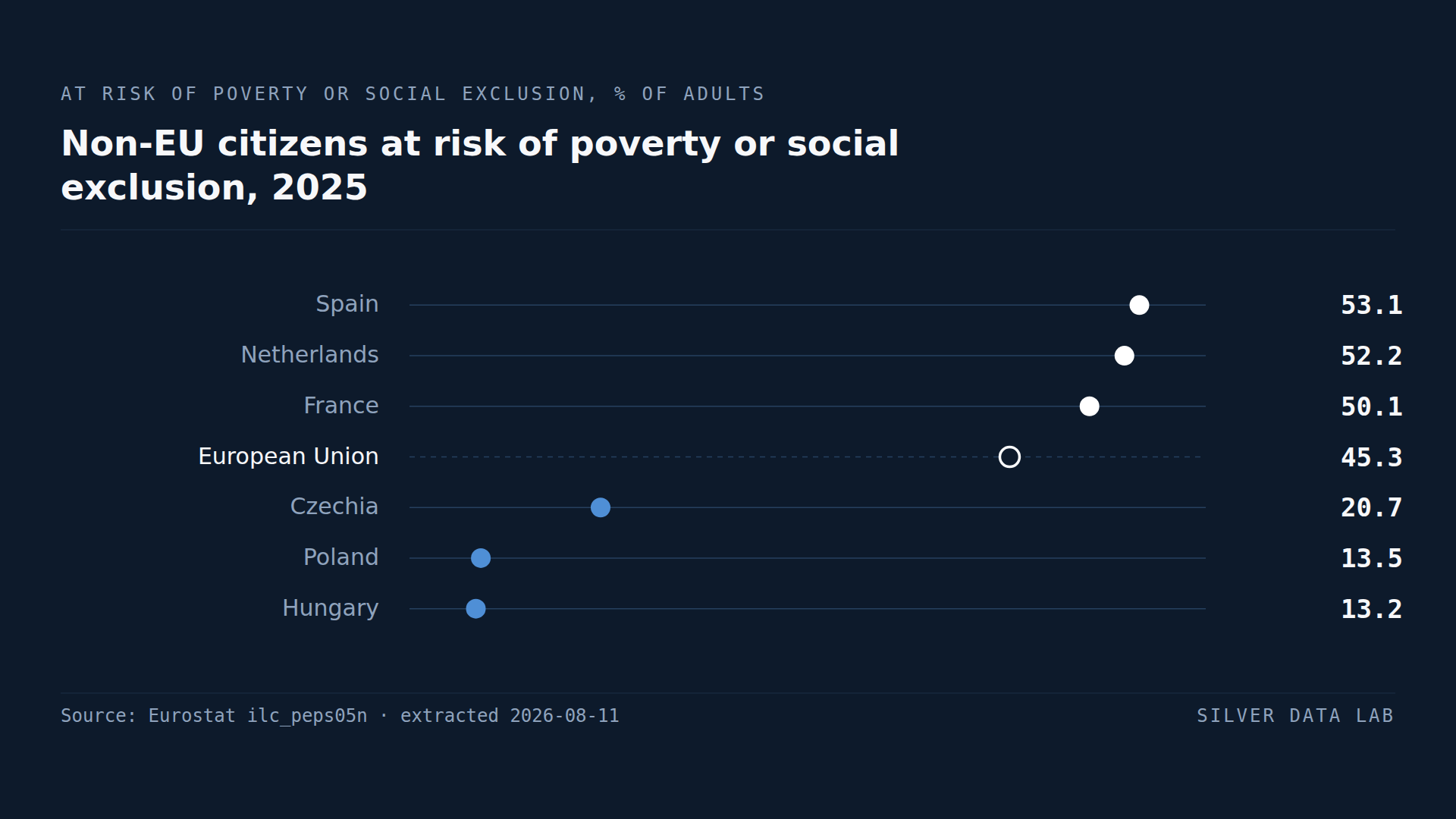
52.2% of Adult Non-EU Citizens in the Netherlands Risk Poverty or Exclusion
45.3% of non-EU citizens aged 18 and over in the EU were at risk of poverty or social exclusion in 2025, against 18.2% of nationals.
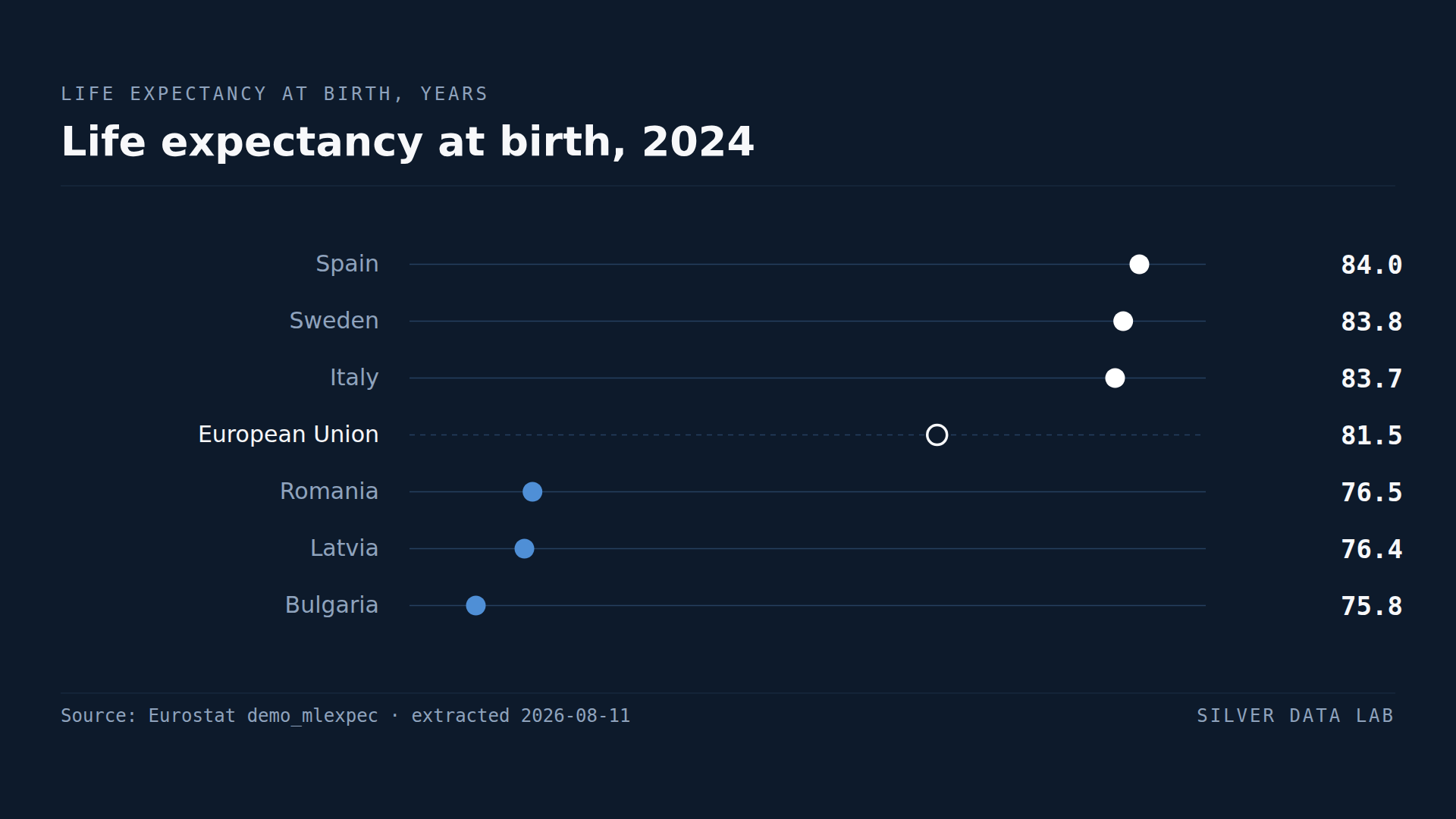
Latvian Women Outlive Latvian Men by 9.8 Years, the Widest Gap in the EU
Life expectancy at birth across the EU was 81.5 years in 2024: 84.1 for women and 78.9 for men.
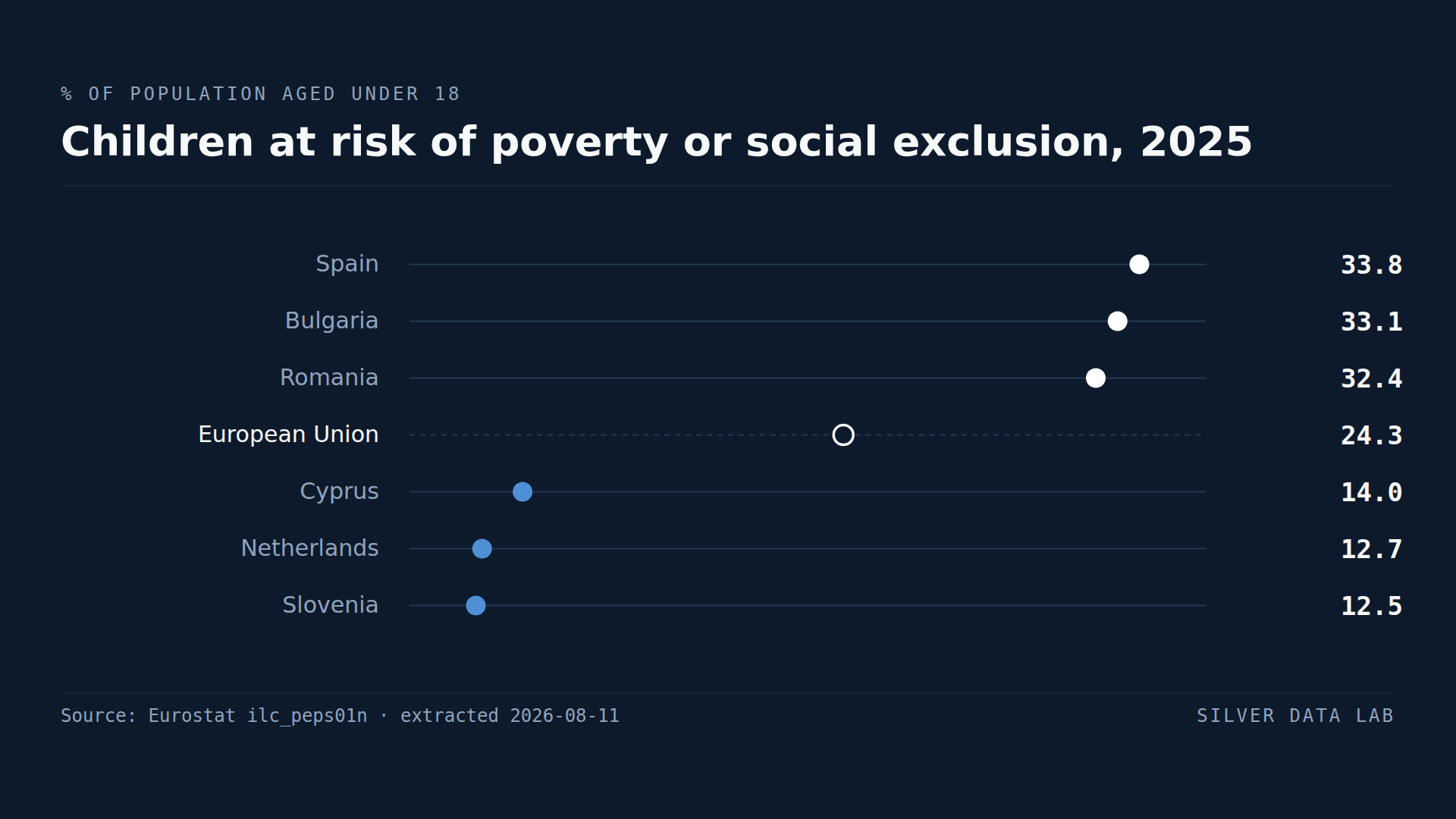
Spain's Children Face the EU's Highest Risk of Poverty or Social Exclusion
24.3% of children in the EU were at risk of poverty or social exclusion in 2025, against 20.9% for the population as a whole.