More Than One Latvian in Nine Lives in a Crowded, Run-Down Home
Silver Data Lab Research Desk · Statistical analysis · Published on 24 May 2026
- Data source
- Eurostat
- Reference period
- 2023
- Last updated
- 11 October 2026
Re-checked against the source on 11 August 2026. No value in its datasets has moved between the snapshots we hold. Every revision we have observed →
Key estimates
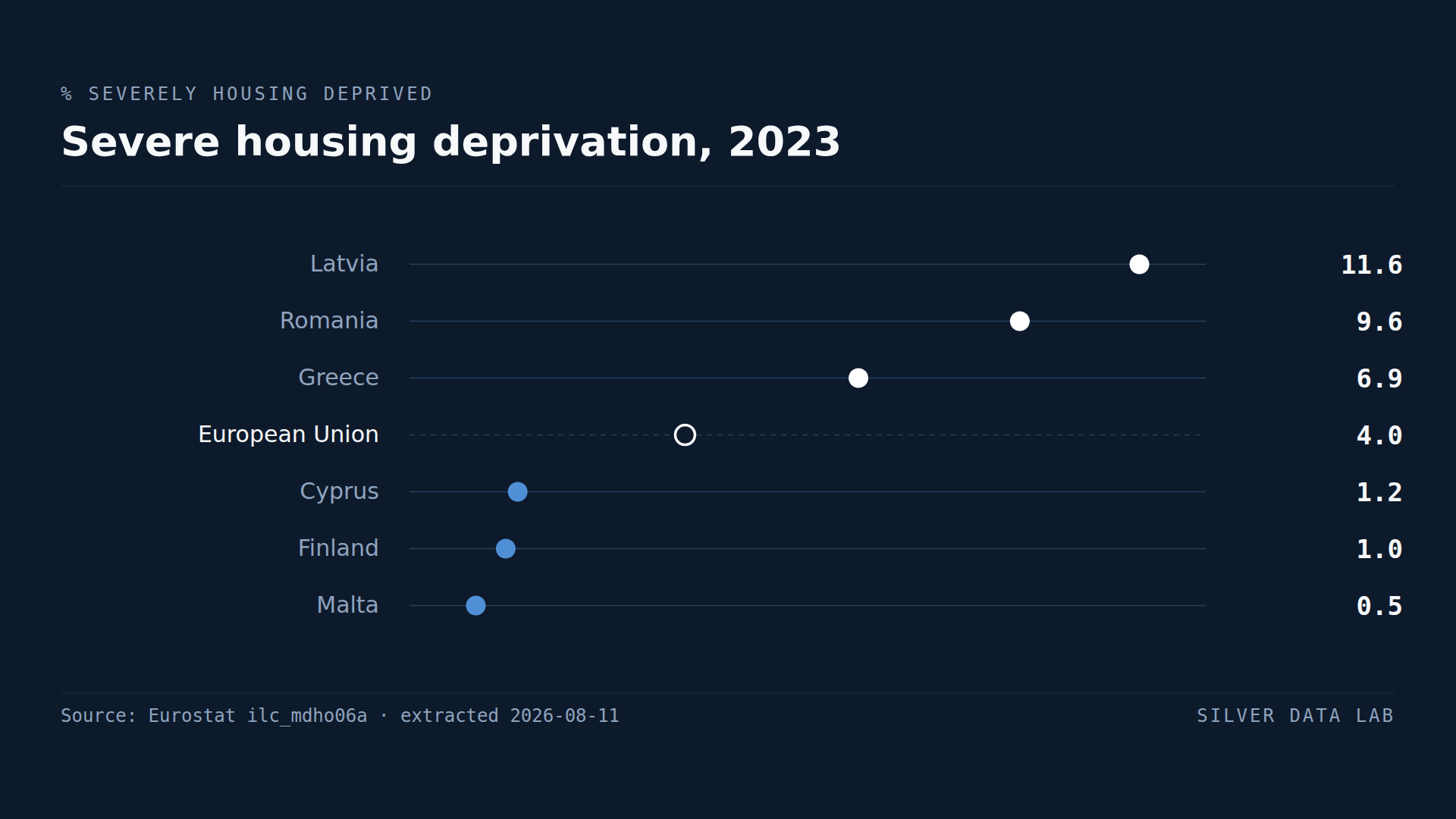
- 4.0% of the EU population lived in severely deprived housing in 2023.
- Latvia records 11.6%, Romania 9.6%, and Greece and Bulgaria and Portugal between 6.0% and 6.9%.
- Malta records 0.5%, Finland 1.0% and Cyprus 1.2%.
- The measure requires overcrowding and at least one structural problem at the same time, which is why it is a quarter the size of the overcrowding rate.
- Data cover 26 of 27 Member States; one does not report for this year.
The strictest housing measure the EU publishes
Severe housing deprivation is a compound condition. A household qualifies only if it is overcrowded and its dwelling has at least one of a specific set of structural problems: a leaking roof, damp walls or floors, rot in window frames, no bath or shower, no indoor flushing toilet, or a dwelling considered too dark.
Both conditions must hold. That is why the rate is 4.0% across the EU while the overcrowding rate alone is 16.8%: three quarters of overcrowded European households live in dwellings without those structural faults.
The narrowness is the point. This indicator identifies housing that fails on space and on condition simultaneously, which is a much smaller and much clearer category than either failure alone.
Where it concentrates
Latvia records 11.6%, the highest in the Union — roughly one person in nine. Romania follows at 9.6%, Greece at 6.9%, and Bulgaria and Portugal at 6.0%.
Latvia's position is the one that separates this ranking from the overcrowding one. On overcrowding Latvia is second, close behind Romania; on severe deprivation it is clearly first, and by a wider margin. Latvian housing fails the structural test more often than Romanian housing of similar occupancy.
Portugal at 6.0% is the western European entry in this group, sitting above Italy at 5.8% and well above Spain at 2.9%.
Where housing holds up
Malta records 0.5%, the lowest in the Union, with Finland at 1.0%, Cyprus at 1.2% and the Netherlands at 1.3%.
Finland's position is worth noting alongside its performance on energy poverty, where it ranks best in the Union at 2.6%. A housing stock built for a severe climate appears to perform on both measures, which is consistent but not demonstrated by these figures.
A note on Greece
Greece records 6.9% here, 30.1% on material and social deprivation, and 18.1% on the inability to keep a home warm — the worst or near-worst in the Union on all three.
Housing deprivation, material deprivation and energy poverty are separate indicators from separate questions, and Greece appears at the top of each. That convergence across independent measures is a stronger signal than any of them alone.
Severe housing deprivation, 2023
| Country | % of population | Gap to EU averagepercentage points, derived |
|---|---|---|
| Latvia | 11.6 | +7.6 |
| Romania | 9.6 | +5.6 |
| Greece | 6.9 | +2.9 |
| European Unionaggregate | 4.0 | — |
| Cyprus | 1.2e | −2.8 |
| Finland | 1.0e | −3.0 |
| Malta | 0.5 | −3.5 |
Flags carried by the source on these values: e estimated
This table as data: CSV · JSON
Every Member State for this indicator+
Members see every Member State for this indicator here, not only the rows the ranking prints. Become a Member
Embed this chart
Paste this code into a page. The frame carries the source and the extraction date, and links back to the study.
What these figures cannot tell you
- Both conditions must hold simultaneously
- A household in a structurally poor dwelling with enough rooms does not appear here, and neither does an overcrowded household in a sound dwelling. The rate is much smaller than either component and is not a general measure of bad housing.
- 2023, not 2025
- This indicator is published with a longer lag than the overcrowding rate it is compared against here. The two reference years differ, so the comparison between them is indicative rather than exact.
- One Member State does not report
- Coverage is 26 of 27 for this year. The missing country is absent from the source rather than recorded at zero, and the EU aggregate is computed on those that report.
- Structural problems are reported by the household
- The presence of damp, leaks or rot is recorded from the respondent's answer rather than from an inspection, so thresholds for what counts as a problem may differ between countries.
Frequently asked questions
- What is severe housing deprivation?
- Living in a dwelling that is both overcrowded and has at least one structural problem: a leaking roof, damp, rot in window frames, no bath or shower, no indoor flushing toilet, or insufficient light. Both conditions must apply at once.
- How many Europeans live in severely deprived housing?
- 4.0% of the EU population in 2023. The overcrowding rate alone is 16.8%, so roughly three quarters of overcrowded households live in dwellings without structural faults.
- Which EU country has the worst housing deprivation?
- Latvia, at 11.6% in 2023 — about one person in nine — followed by Romania at 9.6% and Greece at 6.9%.
- Which EU country has the best housing conditions?
- On this measure Malta, at 0.5% in 2023, followed by Finland at 1.0% and Cyprus at 1.2%.
Methodological note
Severe housing deprivation is published by Eurostat from EU-SILC as the share of the population living in a dwelling that is overcrowded and has at least one of a defined set of structural problems: a leaking roof, damp, rot, no bath or shower, no indoor flushing toilet, or a dwelling considered too dark.
Values are for 2023, the most recent year available at the extraction date, covering 26 of 27 Member States.
The comparisons with overcrowding, material deprivation and energy poverty draw on companion studies published on this site, each from its own extraction, and are reported as agreement between separate indicators rather than combined into one measure.
Source data
The underlying series can be inspected and re-downloaded from the Eurostat data browser. The filters below are the ones applied.
Severe housing deprivation rate by age, sex and poverty status
ilc_mdho06a
- Filters applied:
- freq=A · age=TOTAL · sex=T · rskpovth=TOTAL · unit=PC · time=2023
- Extracted:
- 2026-08-11
- Source last updated:
- 2026-05-21
Download the data
The data the study you have just read is built on, exactly as it was downloaded and archived.
Yours as a Member.
Data downloadable by Members
How to cite
Record the vintage as well as the study: the figures on this page are the ones extracted on the dates below.
Silver Data Lab Research Desk (2026). More Than One Latvian in Nine Lives in a Crowded, Run-Down Home. Silver Data Lab, published 24 May 2026, last updated 11 October 2026. https://www.silverdatalab.com/studies/housing-deprivation-in-the-eu
- Data: Eurostat, Severe housing deprivation rate by age, sex and poverty status (ilc_mdho06a), filters freq=A, age=TOTAL, sex=T, rskpovth=TOTAL, unit=PC, time=2023; extracted 2026-08-11; source last updated 2026-05-21. https://doi.org/10.2908/ilc_mdho06a
Silver Data Lab's analysis is licensed CC BY 4.0. The statistics remain their publisher's and keep its terms of reuse.
Ask the research desk
A question about this study — a definition, a filter, a break in the series, what the figures can and cannot support — answered by the desk that made the extraction.
Members can write to the research desk
Other studies on the same dataset
Studies where the same country leads or trails
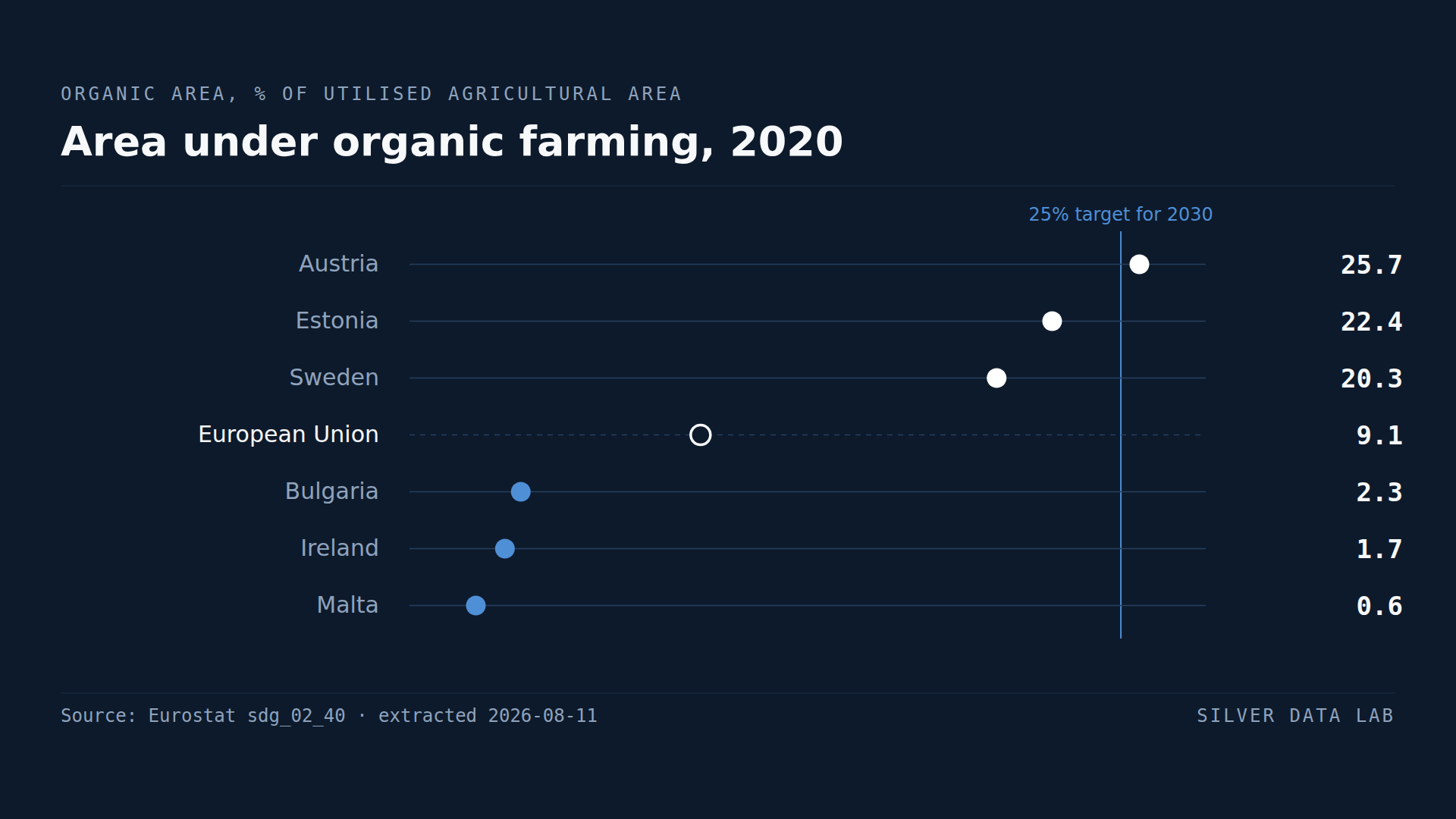
Austria Already Farms a Quarter of Its Farmland Organically
9.1% of the EU's utilised agricultural area was under organic management in 2020, against a target of 25% by 2030.
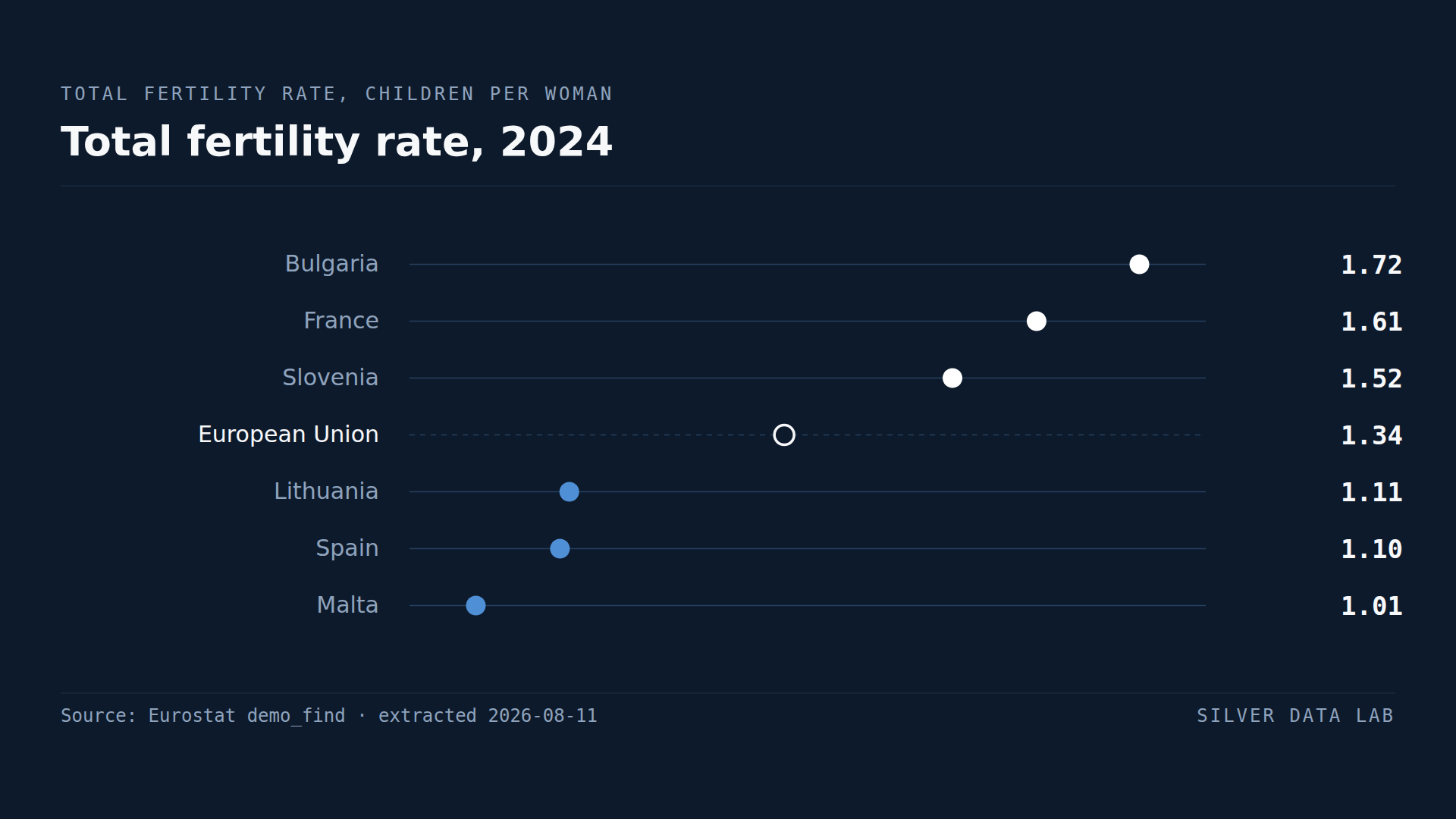
In No EU Country Are Enough Babies Born to Replace Their Parents
The EU total fertility rate was 1.34 children per woman in 2024, against the 2.1 conventionally taken as replacement level.
This Decade, Most EU States' Imports Got Dearer Faster Than Their Exports
In 2025 the terms of trade of 19 of the 27 Member States stood below 100: since 2021, the average price of the goods each of them sells abroad has risen less than the average price of the goods it buys from abroad.