One in Five Europeans Is at Risk of Poverty or Exclusion
Silver Data Lab Research Desk · Statistical analysis · Published on 11 June 2026
- Data source
- Eurostat
- Reference period
- 2025
- Last updated
- 21 August 2026
Re-checked against the source on 21 October 2026. No value in its datasets has moved between the snapshots we hold. Every revision we have observed →
Key estimates
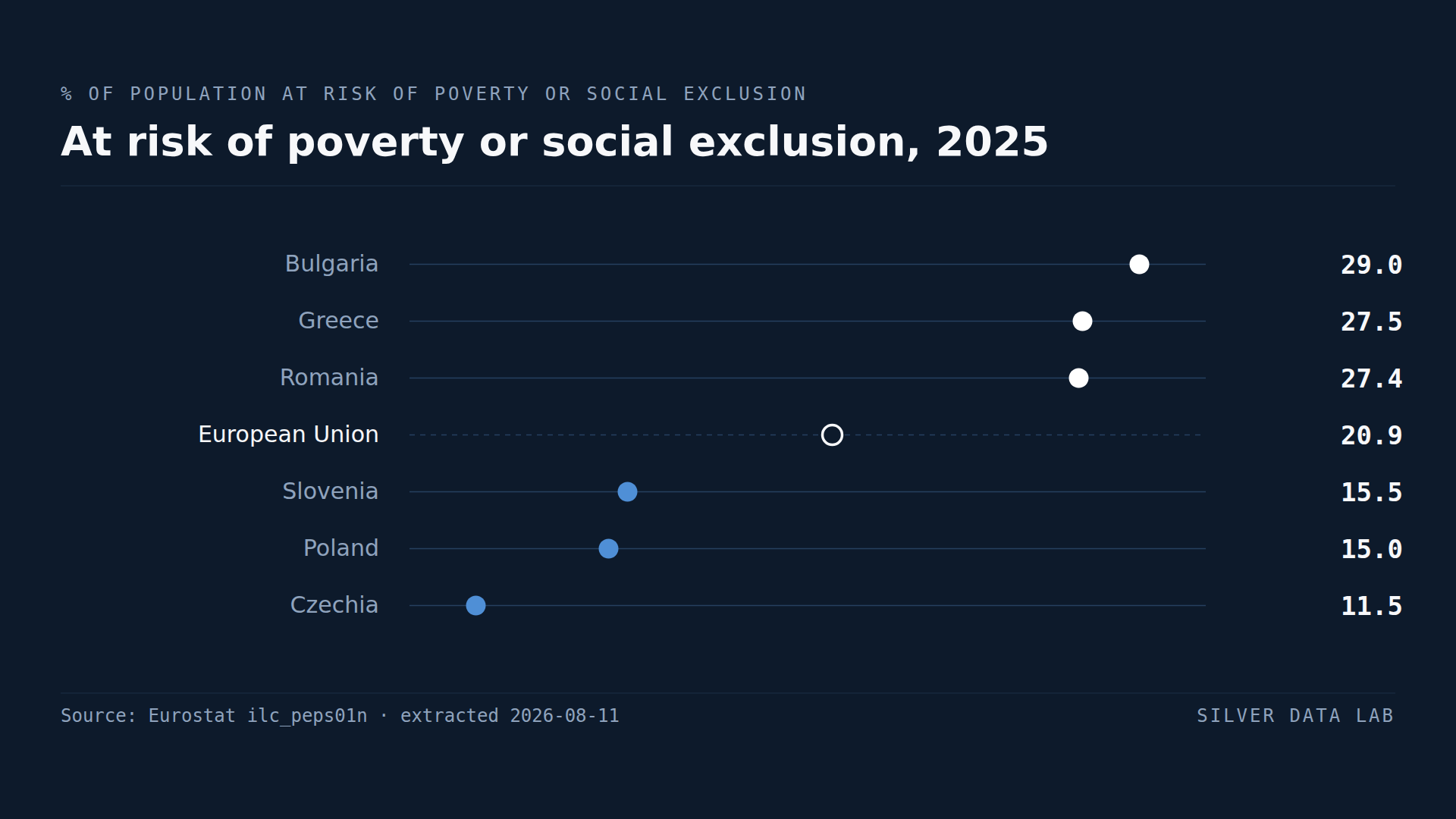
- 20.9% of the EU population was at risk of poverty or social exclusion in 2025 — roughly one person in five.
- Bulgaria records the highest rate at 29.0%, ahead of Greece at 27.5% and Romania at 27.4%.
- Czechia records the lowest at 11.5%, followed by Poland at 15.0% and Slovenia at 15.5%.
- The measure combines three separate conditions, and a person counts once if any one of them applies.
- Its income component is relative to each country's own median, so the same income can count as poverty in one Member State and not in another.
A composite that answers three questions at once
At risk of poverty or social exclusion (AROPE) is the European Union's headline social indicator, the one against which its poverty reduction targets are set. In 2025 it stood at 20.9% of the EU population: about one person in five.
It is a composite. A person is counted if any one of three conditions applies: an equivalised disposable income below 60% of the national median, severe material and social deprivation, or living in a household with very low work intensity. Meeting two or three conditions does not count twice.
That construction is what makes the indicator useful and what makes it easy to misread. It captures three different kinds of disadvantage in one number, and the number does not say which one is driving a country's result.
The range across the Union
Bulgaria records the highest rate at 29.0%, followed by Greece at 27.5% and Romania at 27.4%. At the other end Czechia records 11.5%, Poland 15.0% and Slovenia 15.5%.
The distance between Bulgaria and Czechia is 17.5 percentage points. A resident of the Union is roughly two and a half times more likely to fall inside this measure in Sofia than in Prague.
The relative threshold, and what it does to comparisons
The income component of the measure is defined against each country's own median income, not against a European standard. Sixty per cent of the median in Luxembourg and sixty per cent of the median in Bulgaria are very different sums of money.
This is a deliberate choice rather than a flaw. Poverty in the European statistical framework is understood as exclusion from the normal standard of living of the society a person lives in, and that standard is national. But it has a consequence that matters for reading the ranking: a country can reduce this indicator by becoming more equal without anyone becoming better off, and a country whose incomes all rise together will see no improvement at all.
Czechia at 11.5% is the clearest illustration. It is the lowest rate in the Union, and it is a statement about the distribution of Czech incomes rather than about their level.
Why a second measure is needed
Because the threshold moves with each country's median, the indicator cannot answer whether people in one Member State are materially worse off than those in another. For that question the deprivation component has to be read separately, and it produces a different ranking — which is the subject of the companion study on material and social deprivation.
The two measures agree at the extremes and disagree in the middle, and the disagreements are where the interesting cases sit.
At risk of poverty or social exclusion, 2025
| Country | % of population | Gap to EU averagepercentage points, derived |
|---|---|---|
| Bulgaria | 29.0 | +8.1 |
| Greece | 27.5 | +6.6 |
| Romania | 27.4 | +6.5 |
| European Unionaggregate | 20.9 | — |
| Slovenia | 15.5 | −5.4 |
| Poland | 15.0 | −5.9 |
| Czechia | 11.5 | −9.4 |
This table as data: CSV · JSON
Every Member State for this indicator+
Members see every Member State for this indicator here, not only the rows the ranking prints. Become a Member
Embed this chart
Paste this code into a page. The frame carries the source and the extraction date, and links back to the study.
What these figures cannot tell you
- The income threshold is national, not European
- The at-risk-of-poverty component uses 60% of each country's own median equivalised income. The monetary value of that threshold differs by a factor of several between the richest and poorest Member States, so the indicator measures relative position within a society and not a common living standard.
- A composite does not say which component fired
- A person counts once whether they meet one, two or all three conditions. Two countries with identical headline rates can have entirely different compositions — one driven by low income, another by low work intensity — and the headline figure cannot distinguish them.
- Survey data, with the uncertainty that implies
- These figures come from EU-SILC, a household survey conducted by national statistical institutes. They are estimates from samples, not counts, and small differences between countries or between years should not be over-interpreted. Silver Data Lab publishes the estimates as released and does not recompute their precision.
- Income data lag the survey year
- The income component of EU-SILC generally refers to the calendar year before the survey, while deprivation and work intensity refer to the survey period itself. The reference periods inside the composite are therefore not perfectly aligned.
Frequently asked questions
- What does at risk of poverty or social exclusion mean?
- It is the EU's headline social indicator. A person is counted if any one of three conditions applies: an income below 60% of their country's median, severe material and social deprivation, or living in a household with very low work intensity. Meeting more than one does not count twice.
- How many people in the EU are at risk of poverty?
- 20.9% of the population in 2025, roughly one person in five. National rates ranged from 11.5% in Czechia to 29.0% in Bulgaria.
- Which EU country has the highest poverty risk?
- Bulgaria, at 29.0% in 2025, ahead of Greece at 27.5% and Romania at 27.4%. The lowest are Czechia at 11.5%, Poland at 15.0% and Slovenia at 15.5%.
- Is the poverty threshold the same across the EU?
- No. The income component is set at 60% of each country's own median income, so the monetary threshold differs substantially between Member States. The indicator measures relative position within a society rather than a common European standard of living.
Methodological note
The indicator is Eurostat's at-risk-of-poverty-or-social-exclusion rate for the total population, published as a percentage. A person is counted once if at least one of three conditions applies: equivalised disposable income below 60% of the national median, severe material and social deprivation, or living in a household with very low work intensity.
Values are for 2025, the most recent year with complete coverage of the 27 Member States at the extraction date.
The 17.5 point distance between the highest and lowest Member State is derived by Silver Data Lab by subtraction from the two published rates.
Source data
The underlying series can be inspected and re-downloaded from the Eurostat data browser. The filters below are the ones applied.
Persons at risk of poverty or social exclusion by age and sex
ilc_peps01n
- Filters applied:
- freq=A · age=TOTAL · sex=T · unit=PC · time=2025
- Extracted:
- 2026-10-21
- Source last updated:
- 2026-10-20
Download the data
The data the study you have just read is built on, exactly as it was downloaded and archived.
Yours as a Member.
Data downloadable by Members
How to cite
Record the vintage as well as the study: the figures on this page are the ones extracted on the dates below.
Silver Data Lab Research Desk (2026). One in Five Europeans Is at Risk of Poverty or Exclusion. Silver Data Lab, published 11 June 2026, last updated 21 August 2026. https://www.silverdatalab.com/studies/poverty-risk-in-the-eu
- Data: Eurostat, Persons at risk of poverty or social exclusion by age and sex (ilc_peps01n), filters freq=A, age=TOTAL, sex=T, unit=PC, time=2025; extracted 2026-10-21; source last updated 2026-10-20. https://doi.org/10.2908/ilc_peps01n
Silver Data Lab's analysis is licensed CC BY 4.0. The statistics remain their publisher's and keep its terms of reuse.
Ask the research desk
A question about this study — a definition, a filter, a break in the series, what the figures can and cannot support — answered by the desk that made the extraction.
Members can write to the research desk
Other studies on the same dataset
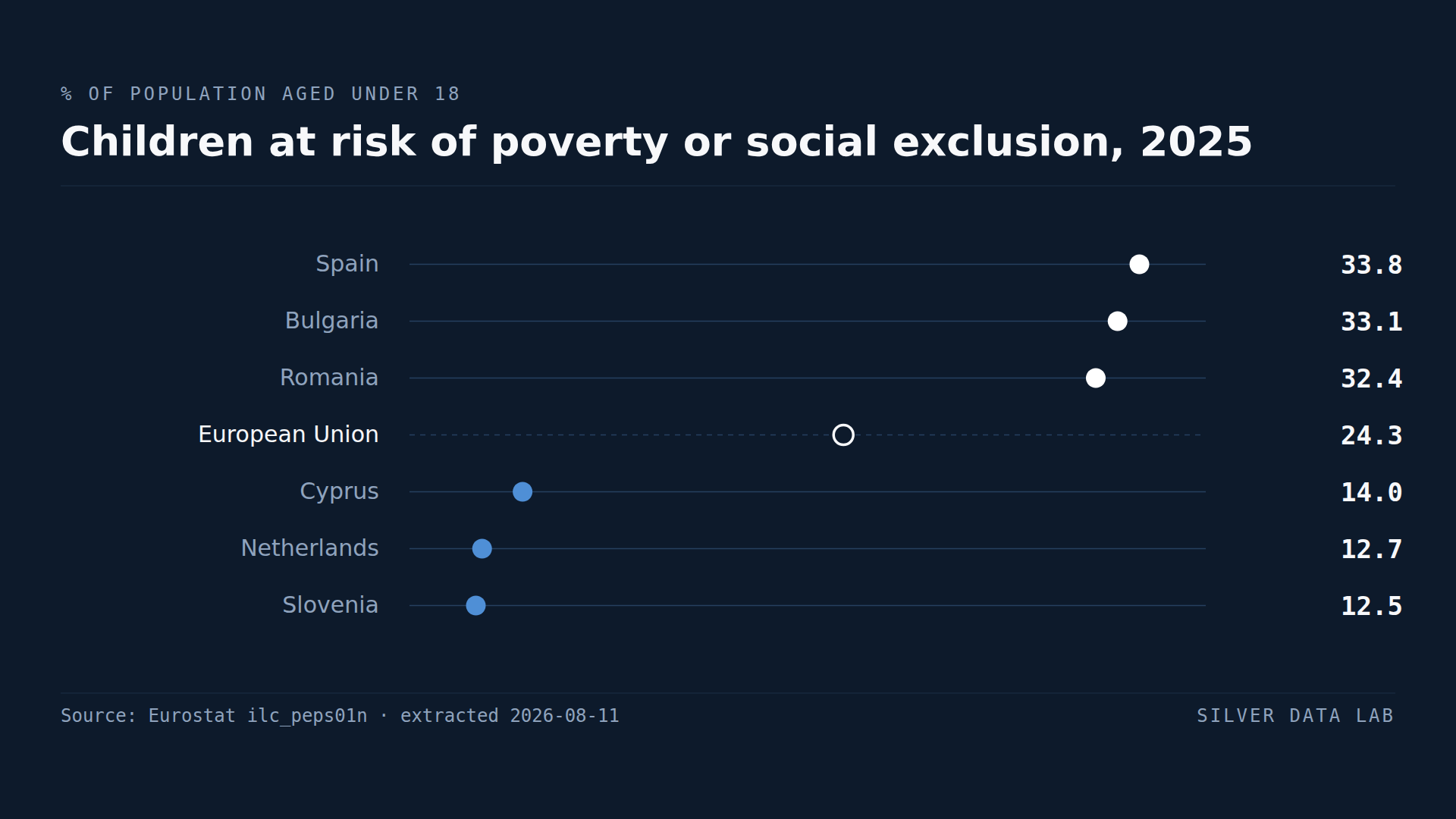
Spain's Children Face the EU's Highest Risk of Poverty or Social Exclusion
24.3% of children in the EU were at risk of poverty or social exclusion in 2025, against 20.9% for the population as a whole.
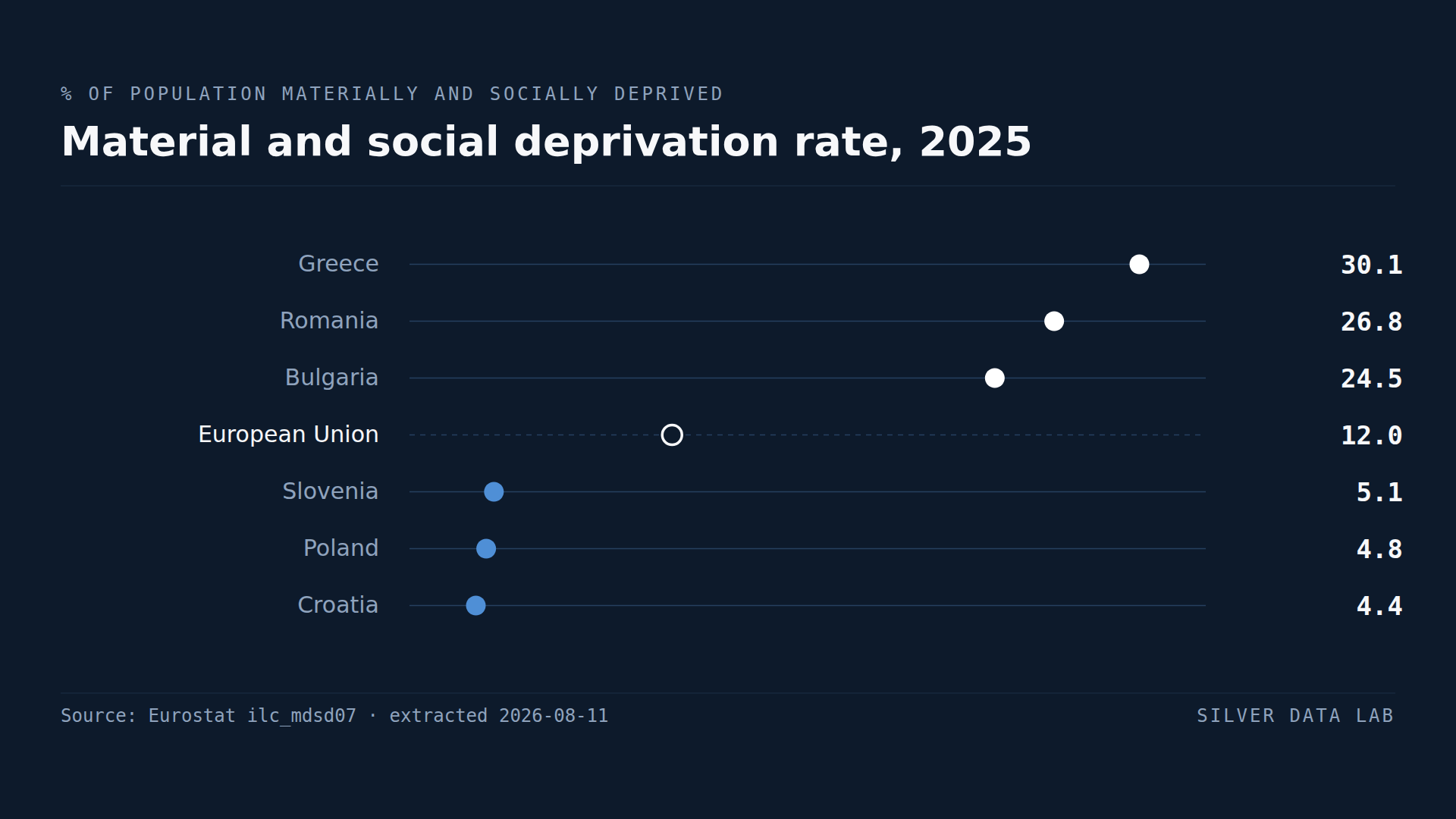
Croatians Are the Least Likely in the EU to Go Without Essentials
12.0% of the EU population was materially and socially deprived in 2025, against 20.9% at risk of poverty or social exclusion.
Studies where the same country leads or trails
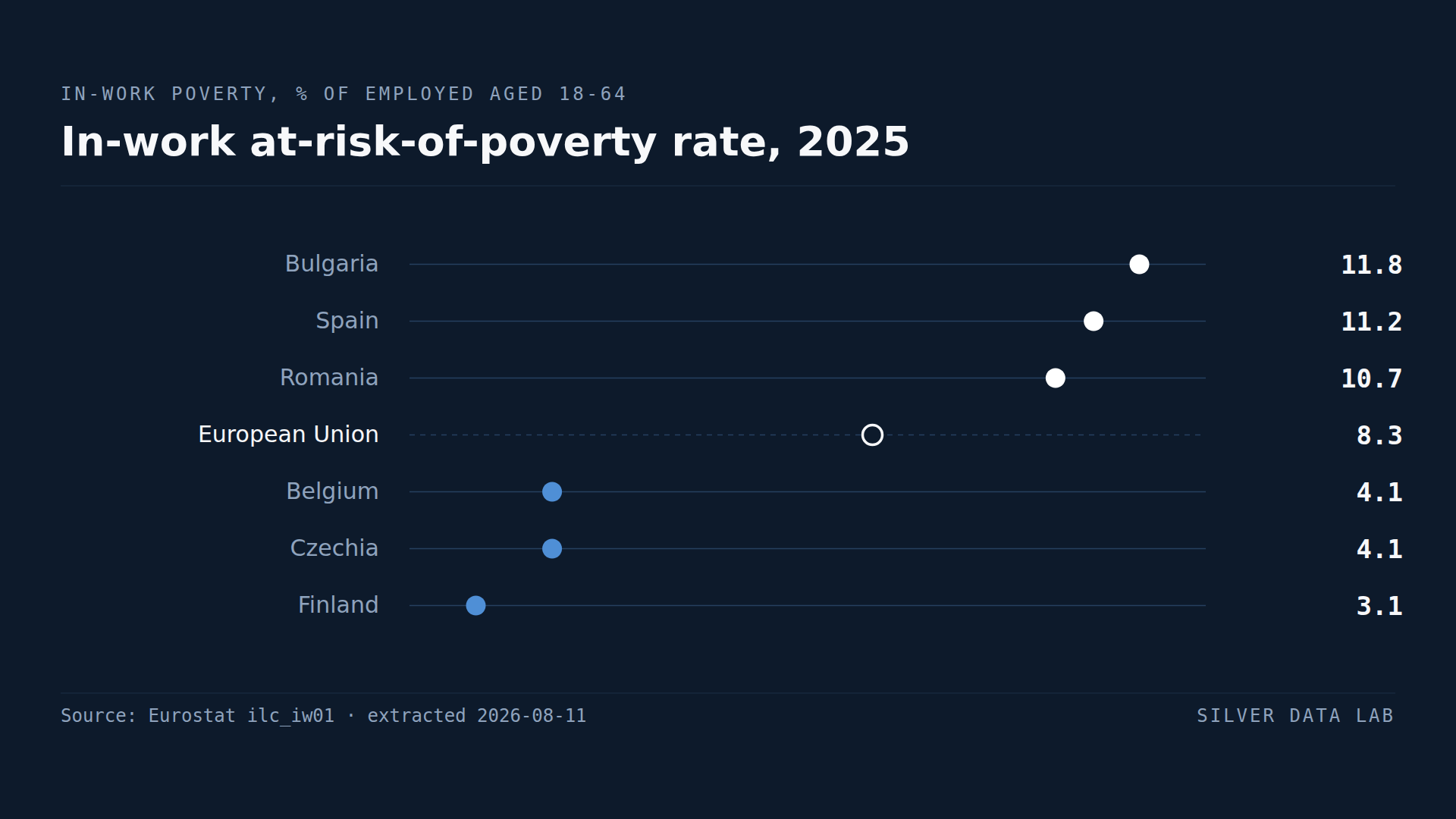
11.8% of Bulgarians With a Job Are Poor, the Highest Share in the EU
8.3% of employed people aged 18 to 64 in the EU lived below the at-risk-of-poverty line in 2025.
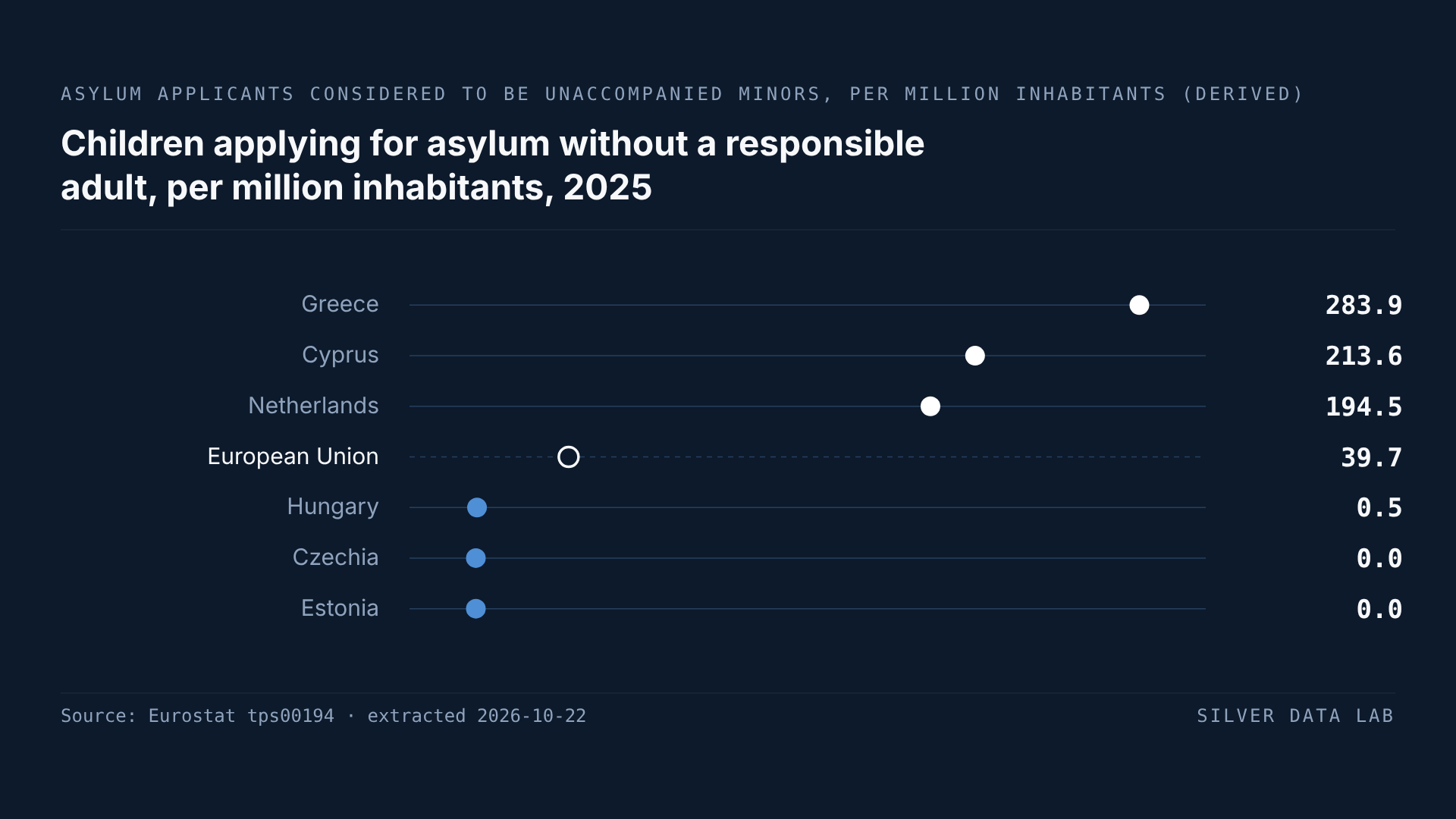
45.9% Fewer Children Sought Asylum Alone in the EU Than a Year Earlier
In 2025, 17,930 children applied for asylum in the EU without a parent or another adult responsible for them, against 33,160 in 2024: a derived fall of 45.9%, to the lowest figure since 2020.
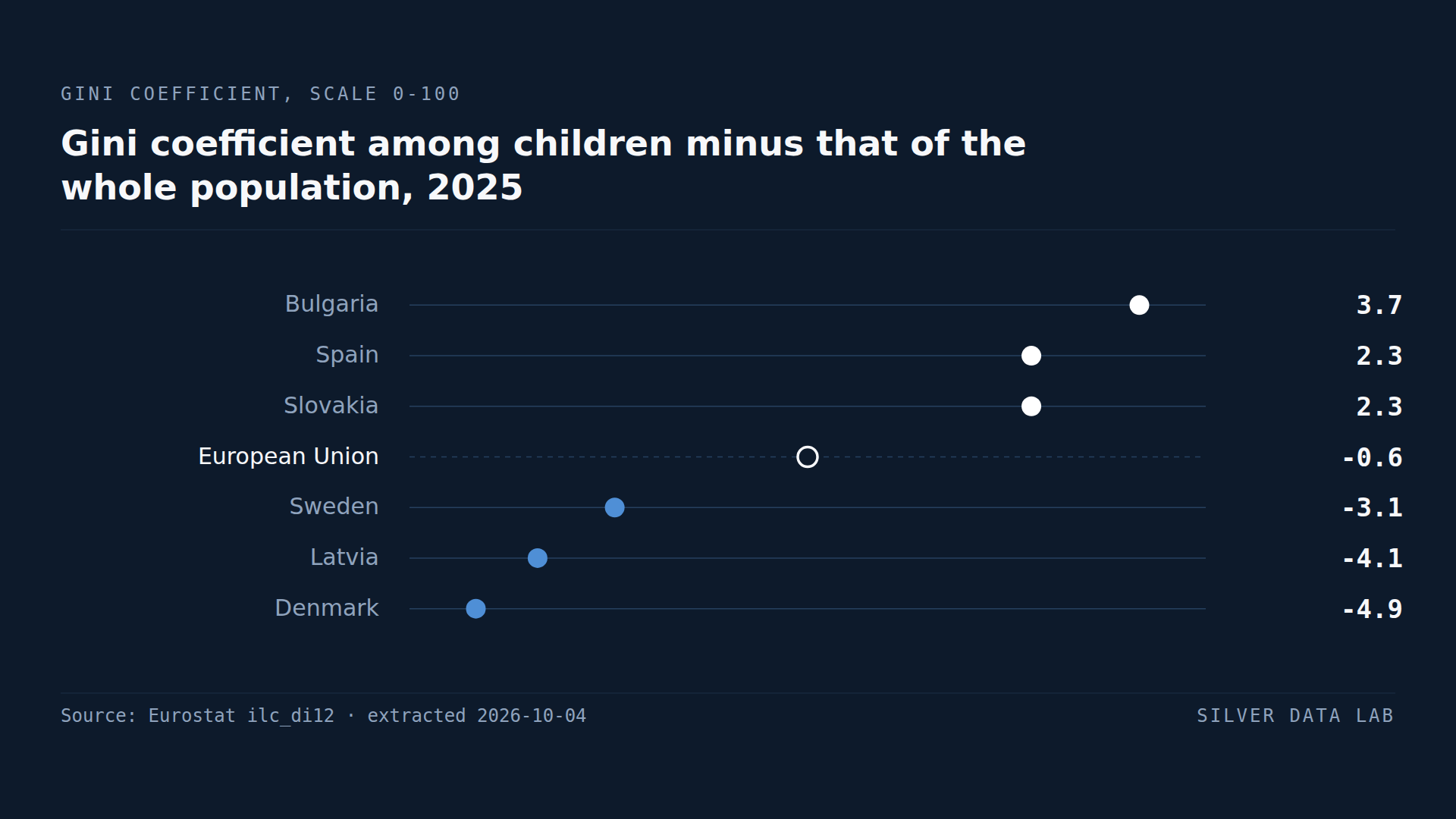
Among EU Children, Family Incomes Are Most Unequal in Bulgaria
Across the EU the Gini coefficient of disposable income among children under 18 was 28.6 in 2025, against 29.2 for the population as a whole.