Swedish Adults Are Seven Times as Likely as Greeks to Be Taking a Course
Silver Data Lab Research Desk · Statistical analysis · Published on 14 June 2026
This study is open to members only
Its sources, filters and extraction date are declared above, as they are for every study. Sign in to read the analysis in full.
- Data source
- Eurostat
- Reference period
- 2025
- Last updated
- 11 October 2026
Re-checked against the source on 11 September 2026. No value in its datasets has moved between the snapshots we hold. Every revision we have observed →
Key estimates
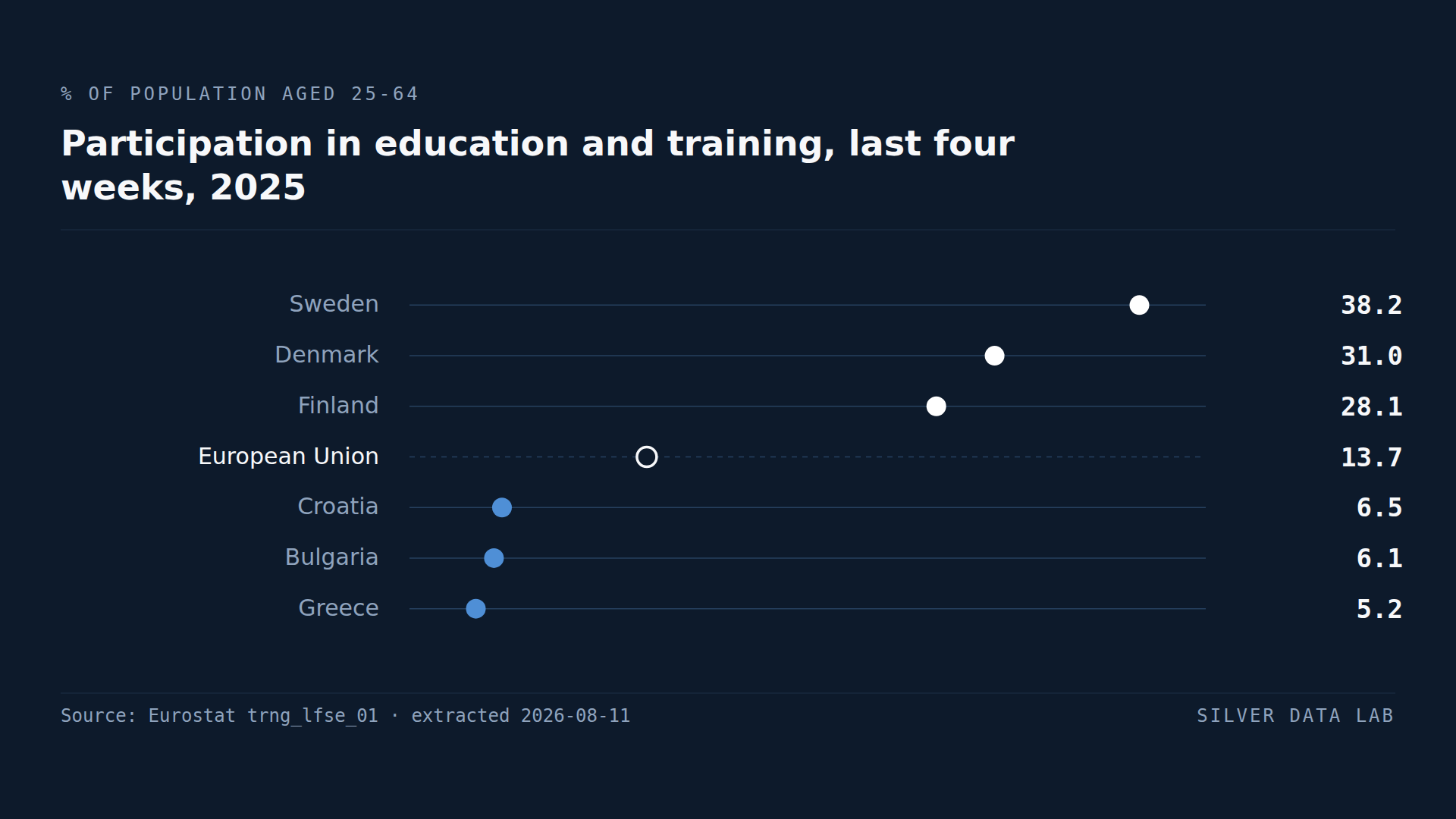
- 13.7% of adults aged 25 to 64 in the EU took part in education or training in the four weeks before the survey.
- Sweden records 38.2%, Denmark 31.0% and Finland 28.1%.
- Greece records 5.2%, Bulgaria 6.1% and Croatia 6.5%.
- A Swedish adult is 7.3 times more likely to be in training than a Greek one.
- Germany records 9.3%, below the EU figure and below Romania at 10.2%.
The widest behavioural gap in European statistics
Adult learning measures the share of people aged 25 to 64 who participated in any education or training — formal or informal, work-related or not — in the four weeks before being surveyed.
Across the EU that was 13.7% in 2025. Sweden records 38.2% and Greece 5.2%, a ratio of more than seven to one.
Few indicators produce a spread of that size on a question about what people did in the past month. It is not a difference in circumstances so much as a difference in what a working month contains.
The Nordic block
Sweden at 38.2%, Denmark at 31.0% and Finland at 28.1% occupy the top three positions, with the Netherlands at 25.9% and Estonia at 23.8% behind them.
The gap between third and fourth place is small, but the gap between this group and the EU average is not: Sweden's rate is nearly three times the Union figure.
Where training is rare
Greece records 5.2%, Bulgaria 6.1%, Croatia 6.5% and Poland 8.8%. Germany at 9.3% is the entry in this group that does not belong to it on any other measure.
Germany's position is worth stating precisely: it records a lower adult participation rate than Romania at 10.2%, Lithuania at 10.4% and Hungary at 10.6%, despite having among the Union's strongest institutions for initial vocational training. Strong initial training and weak continuing training are different things, and Germany appears to combine them.
Why the four-week window matters
The indicator asks about a four-week reference period, which is short. A country where training is concentrated in intensive annual courses will record a lower figure than one where it is spread continuously, even if the annual hours are identical.
That construction penalises episodic training and rewards habitual training. It is a reasonable design choice for measuring whether learning is part of ordinary working life, and a poor one for measuring total training volume — and the ranking should be read as the first rather than the second.
Participation in education and training, last four weeks, 2025
| Country | % of population aged 25-64 | Gap to EU averagepercentage points, derived |
|---|---|---|
| Sweden | 38.2 | +24.5 |
| Denmark | 31.0b | +17.3 |
| Finland | 28.1 | +14.4 |
| European Unionaggregate | 13.7 | — |
| Croatia | 6.5 | −7.2 |
| Bulgaria | 6.1 | −7.6 |
| Greece | 5.2 | −8.5 |
Flags carried by the source on these values: b break in time series
This table as data: CSV · JSON
Every Member State for this indicator+
Members see every Member State for this indicator here, not only the rows the ranking prints. Become a Member
What these figures cannot tell you
- A four-week window
- The question covers participation in the four weeks before the interview, so it measures how habitual training is rather than how much of it happens annually. Countries with concentrated, intensive training programmes score lower than their annual hours would suggest.
- Formal and non-formal learning are combined
- The measure includes everything from a degree course to a short workplace seminar. Two countries with the same rate can have very different intensities of learning behind it.
- Self-reported
- Figures come from the labour force survey. Whether a respondent counts a brief workplace briefing as training is a judgement, and that judgement may differ systematically between countries.
- Participation is not outcome
- The indicator counts whether people trained, not whether their skills improved. It measures activity, not effect.
Frequently asked questions
- How many Europeans take part in adult learning?
- 13.7% of people aged 25 to 64 participated in education or training in the four weeks before the 2025 survey. National rates ran from 38.2% in Sweden to 5.2% in Greece.
- Which EU country trains its adults the most?
- Sweden, at 38.2% in 2025, ahead of Denmark at 31.0% and Finland at 28.1%. A Swedish adult is 7.3 times more likely to be in training than a Greek one.
- Why does Germany score below Romania on adult learning?
- Germany records 9.3% against Romania's 10.2%. Strong initial vocational training, which Germany has, and strong continuing training for adults already in work are different systems, and this indicator measures only the second.
- Does a four-week window understate training?
- It understates concentrated training and captures habitual training well. A country running intensive annual courses will score lower than one spreading the same hours across the year, so the measure describes how routine learning is rather than its total volume.
Methodological note
Participation in education and training is published by Eurostat from the labour force survey as the share of people aged 25 to 64 who report having participated in formal or non-formal education or training in the four weeks preceding the interview.
Values are for 2025, the most recent year with complete coverage of the 27 Member States at the extraction date.
The Sweden-to-Greece ratio is derived by Silver Data Lab from the two published rates.
Source data
The underlying series can be inspected and re-downloaded from the Eurostat data browser. The filters below are the ones applied.
Participation rate in education and training (last 4 weeks)
trng_lfse_01
- Filters applied:
- freq=A · sex=T · age=Y25-64 · unit=PC · time=2025
- Extracted:
- 2026-09-11
- Source last updated:
- 2026-09-10
Download the data
The data the study you have just read is built on, exactly as it was downloaded and archived.
Yours as a Member.
Data downloadable by Members
How to cite
Record the vintage as well as the study: the figures on this page are the ones extracted on the dates below.
Silver Data Lab Research Desk (2026). Swedish Adults Are Seven Times as Likely as Greeks to Be Taking a Course. Silver Data Lab, published 14 June 2026, last updated 11 October 2026. https://www.silverdatalab.com/studies/adult-learning-in-the-eu
- Data: Eurostat, Participation rate in education and training (last 4 weeks) (trng_lfse_01), filters freq=A, sex=T, age=Y25-64, unit=PC, time=2025; extracted 2026-09-11; source last updated 2026-09-10. https://doi.org/10.2908/trng_lfse_01
Silver Data Lab's analysis is licensed CC BY 4.0. The statistics remain their publisher's and keep its terms of reuse.
Ask the research desk
A question about this study — a definition, a filter, a break in the series, what the figures can and cannot support — answered by the desk that made the extraction.
Members can write to the research desk
Studies where the same country leads or trails
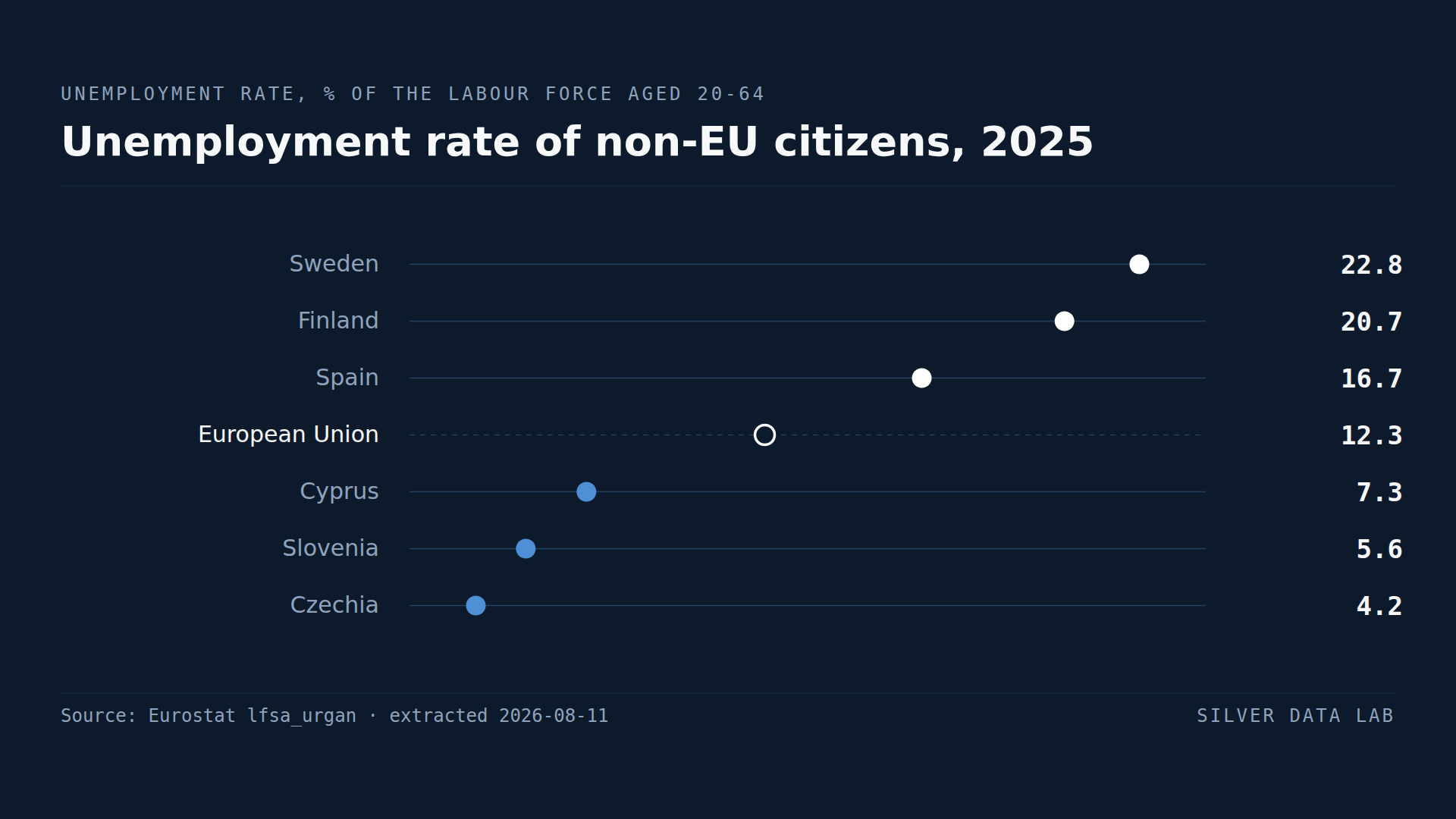
In Sweden, Non-EU Citizens Are Unemployed at 3.5 Times the Rate of Swedes
Non-EU citizens aged 20 to 64 faced 12.3% unemployment in the EU in 2025, against 5.2% for nationals.
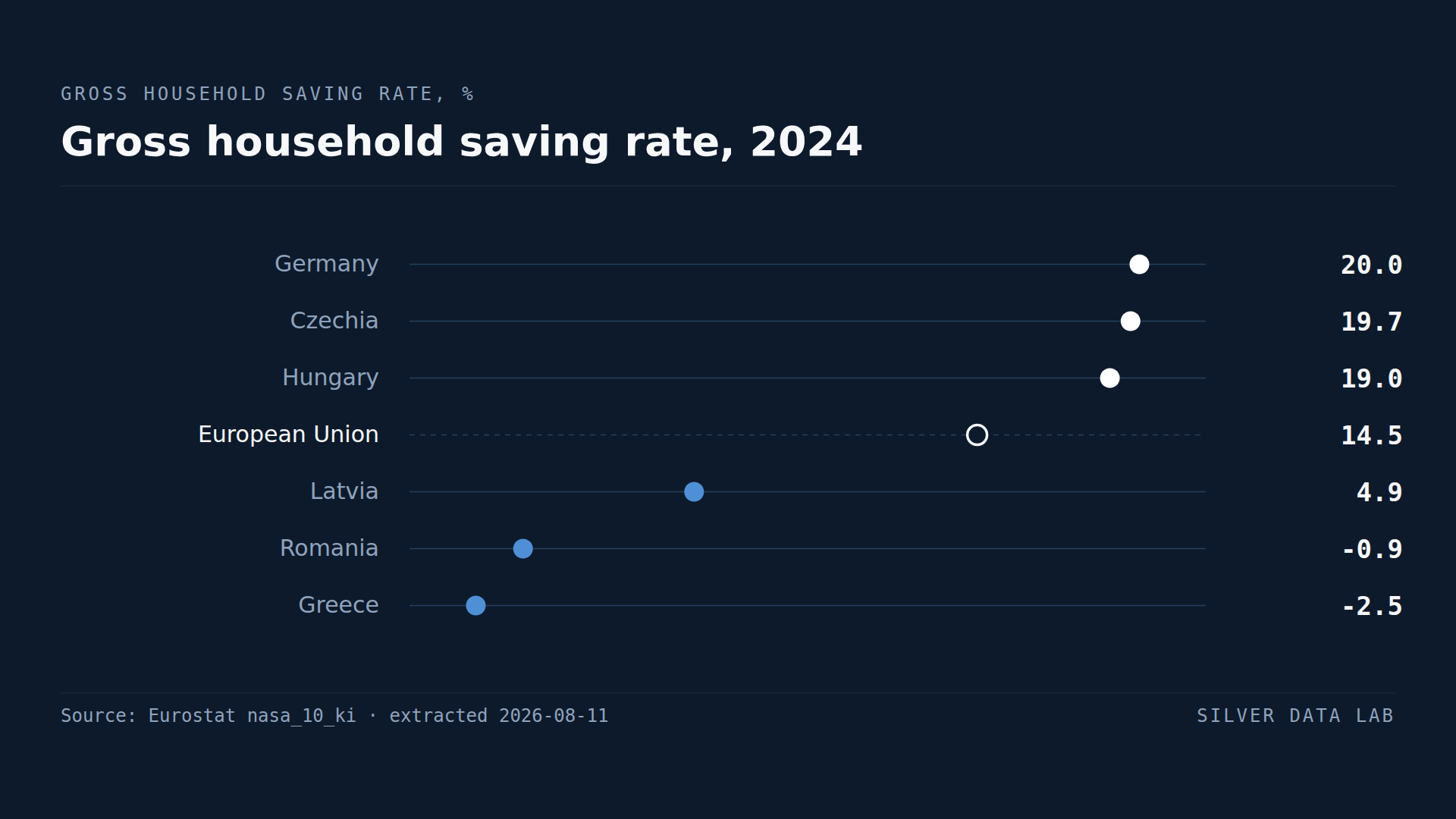
In Two EU Countries, Households Spend More Than They Earn
EU households saved 14.5% of their gross disposable income in 2024.
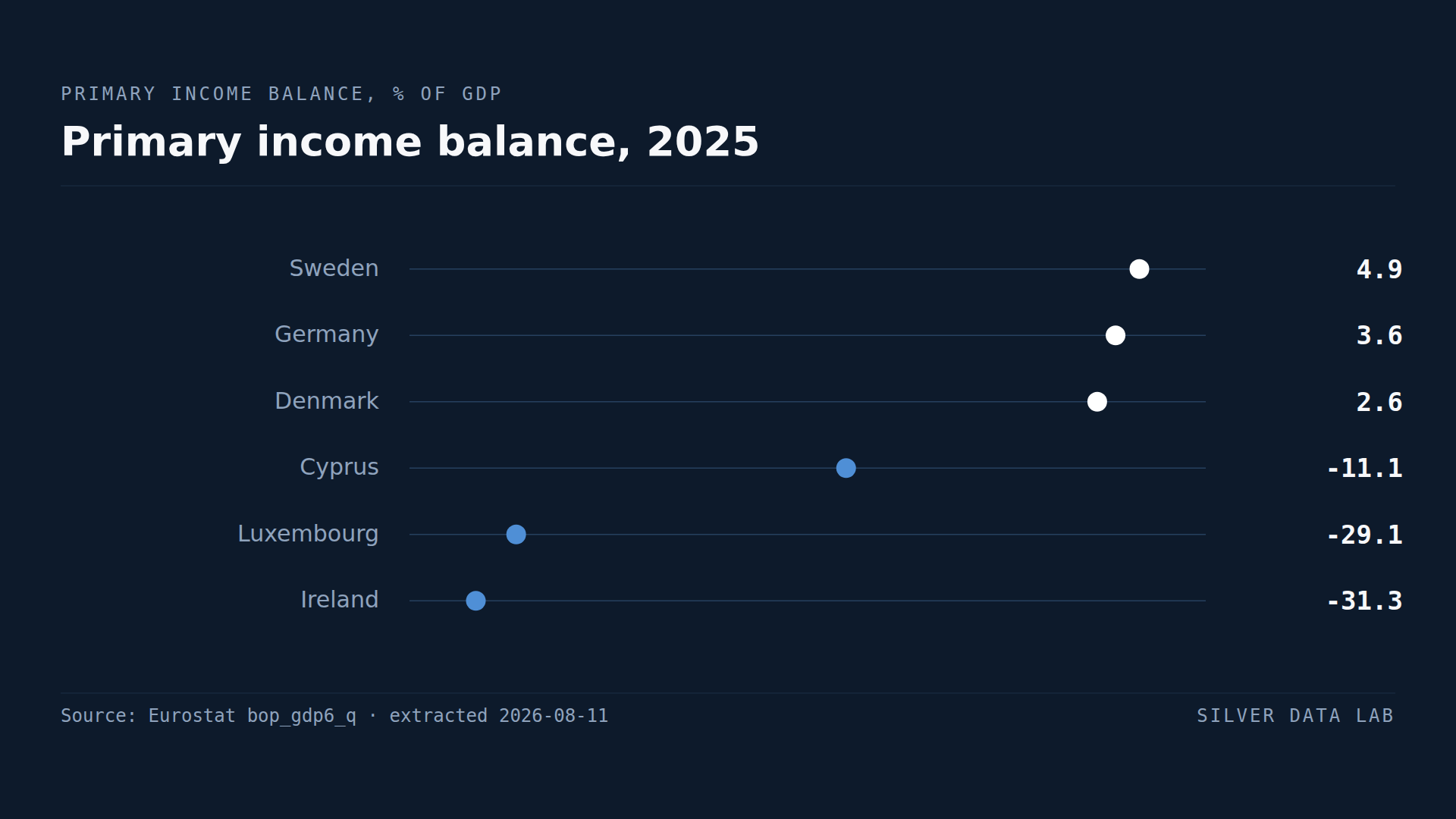
Ireland Pays Out More Income Abroad Than It Receives, a Net 28.6% of GDP
Ireland's net primary income outflow was 28.6% of GDP in 2025, second only to Luxembourg's 29.3%.