Luxembourg's Residents Spend Nearly All Their Holiday Nights Abroad
Silver Data Lab Research Desk · Statistical analysis · Published on 07 October 2026
- Data source
- Eurostat
- Reference period
- 2025
- Last updated
- 11 October 2026
Re-checked against the source on 09 October 2026. 146 values in its datasets moved between snapshots, 106 of them figures stated on this page. Every revision we have observed →
Key estimates
- In 2025, 46.2% of the nights EU residents spent away from home on personal trips were spent in a country other than their own, against 42.3% in 2019. Both shares are derived by Silver Data Lab from Eurostat's counts of nights.
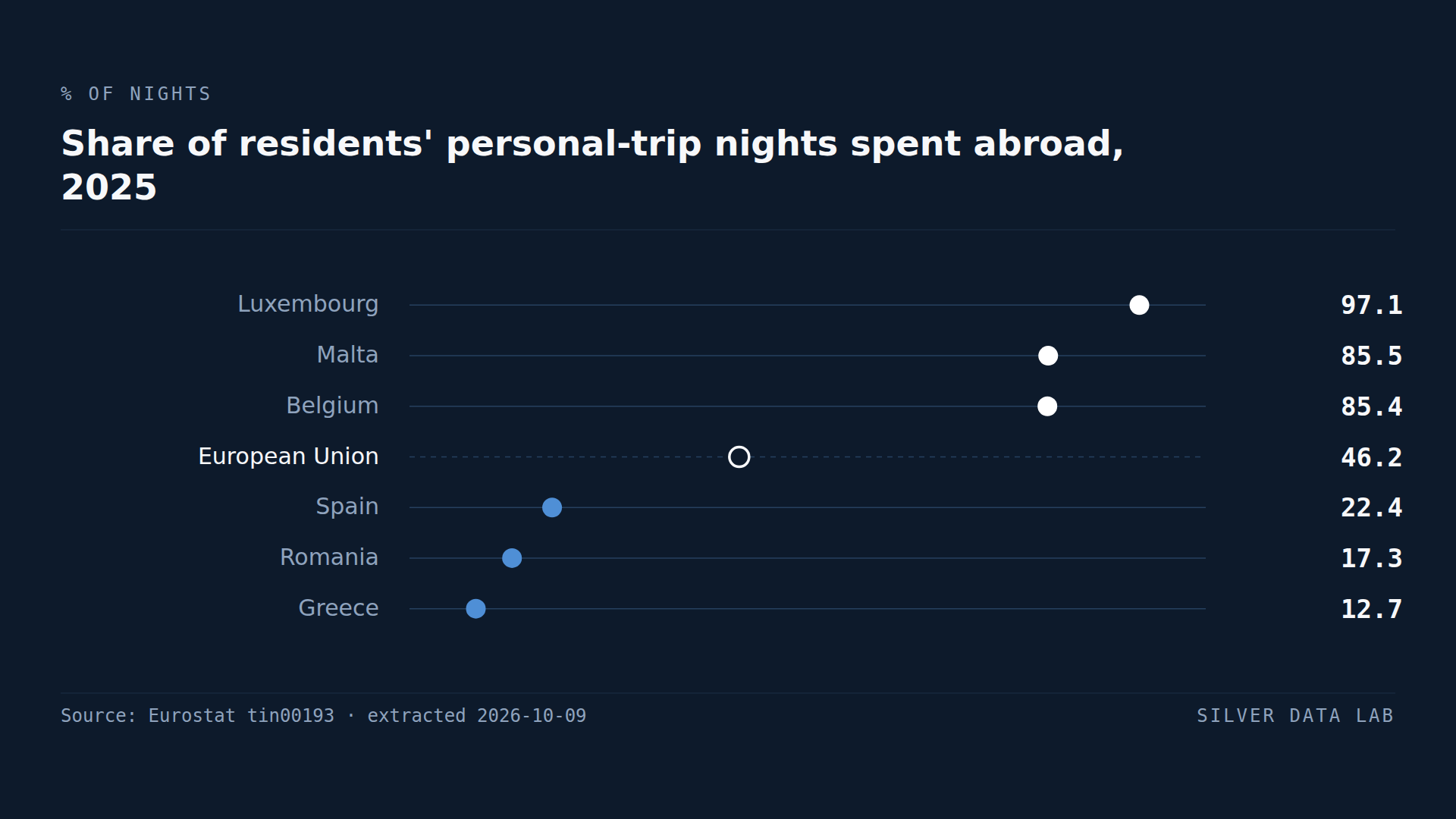
- Luxembourg's residents spent 97.1% of those nights abroad, Malta's 85.5% and Belgium's 85.4%.
- At the other end, Greece's residents spent 12.7% of their nights abroad, Romania's 17.3%, Spain's 22.4% and France's 23.0%.
- Sixteen Member States sit above the EU share and eleven below it; fifteen send more than half their nights abroad.
- Between 2019 and 2025 the share rose in 17 Member States, fell in 9 and held at 35.2% in Poland. Denmark gained 20.9 points and Lithuania lost 7.4.
Counting nights rather than people
The table behind this page counts nights: every night a resident of a Member State spent away from home on a trip lasting at least one night, taken for personal reasons. Personal reasons cover holidays, visits to friends and relatives and other private travel, as opposed to business trips. Each night is filed under the country of the trip's main destination, and that destination can be the traveller's own country.
Among its destinations, the table includes three totals for every reporting country: nights spent at home, nights spent abroad and nights spent anywhere in the world. The share used on this page is the second divided by the third. The table does not publish that ratio; Silver Data Lab derives it from the two counts, and it is labelled as derived wherever it appears.
In 2025 the residents of the 27 Member States together spent about 5.70 billion nights on such trips, and about 2.63 billion of them outside their own country. That gives the EU share of 46.2%, up from 42.3% in 2019, the last year before the pandemic. Because the EU share pools every night of every resident, it leans towards the countries whose residents record the most nights. By Silver Data Lab's derivation from the same counts, Germany, France and Spain, the three with the most nights, account for 52.5% of all the nights in the 2025 total, and German residents alone for 32.4% of the nights spent abroad.
Small countries at the top
Luxembourg leads at 97.1%. Its residents spent 19.8 million nights on personal trips in 2025 and only about 0.6 million of them inside the Grand Duchy. Malta follows at 85.5% and Belgium at 85.4%, then Denmark at 76.3%, Slovenia and the Netherlands at 75.3% each, and Cyprus at 72.1%.
A plausible reading, which the table itself cannot test, is that the size of a country limits how far its residents can travel without crossing a border. A trip of a few hours from Luxembourg or most of Belgium ends in France, Germany or the Netherlands, and an island the size of Malta offers a resident little that is new for a week away. Cyprus is an island state too, and so is Ireland, which comes just after it. None of this is measured here: the data record where nights were spent, not why. Denmark has joined the leaders since 2019, when its share was 55.4%, and the section on change below shows which of its counts moved.
Fewer than one night in four abroad
Greece has the lowest share, 12.7%, or roughly one night in eight. Of the 73.3 million nights its residents spent on personal trips in 2025, 64.0 million were spent in Greece. Romania follows at 17.3%, Spain at 22.4% and France at 23.0%: four Member States where fewer than one night in four was spent abroad. Portugal and Italy, both at 25.4%, come next.
One possible reading is that most of these countries offer their own residents long coastlines, islands or mountains within reach. That is an interpretation rather than a finding: the table offers no measure of what a home destination has to offer, and income, the cost of travel and habits passed down within families could each contribute to the pattern.
How the shares changed since 2019
Compared at one decimal place, the share rose in 17 Member States between 2019 and 2025, fell in 9 and stayed at 35.2% in Poland. Denmark gained by far the most, 20.9 points, rising from 55.4% to 76.3%: its residents' nights at home fell from 55.0 million to 24.1 million while their nights abroad grew from 68.5 million to 77.6 million. The Netherlands came next, from 66.0% to 75.3%, then Czechia, from 30.9% to 40.1%. Spain moved from 18.2% to 22.4%. Estonia and Greece changed by two tenths of a point or less.
The largest fall was Lithuania's, from 64.8% to 57.4%, followed by Italy's, from 30.7% to 25.4%, Cyprus's, from 75.6% to 72.1%, and Belgium's, from 88.8% to 85.4%, so that Belgium now sits behind Malta. Luxembourg slipped from 99.4% to 97.1%. Each of these changes is a difference between two derived shares, so it can come from nights abroad, from nights at home or from both; the counts quoted for Denmark show both moving in the direction that raises its share.
Where the nights abroad go
Of the 2.63 billion nights EU residents spent outside their own country in 2025, 64.8% were spent in another Member State and the rest outside the Union, against 62.9% in 2019. That split is derived from the table's own destination totals.
The companion study on tourism intensity looks at the same activity from the other side: the nights that each country hosts per inhabitant, which is where foreign visitors land rather than where residents go. Read together, the two measure different things, and a country can rank high on one and low on the other.
Share of residents' personal-trip nights spent abroad, 2025
| Country | % of nights | Gap to EU sharepercentage points, derived |
|---|---|---|
| Luxembourg | 97.1 | +50.9 |
| Malta | 85.5 | +39.3 |
| Belgium | 85.4 | +39.2 |
| European Unionaggregate | 46.2 | — |
| Spain | 22.4 | −23.8 |
| Romania | 17.3 | −28.9 |
| Greece | 12.7 | −33.5 |
This table as data: CSV · JSON
Every Member State for this indicator+
Members see every Member State for this indicator here, not only the rows the ranking prints. Become a Member
Embed this chart
Paste this code into a page. The frame carries the source and the extraction date, and links back to the study.
What these figures cannot tell you
- A survey of residents, counted in nights
- The figures come from the household surveys each Member State runs on its residents' travel, so they describe where residents went, not who visited a country. They count nights, which gives a fortnight on a beach fourteen times the weight of a weekend away, and they say nothing about spending: a night abroad and a night at home count the same whatever either costs.
- The share is derived
- Eurostat publishes the number of nights spent abroad and the number spent anywhere in the world; the share on this page is the first divided by the second, computed by Silver Data Lab. Because the reporting country is itself among the destinations, a destination ranking taken from the same table would mix nights at home with nights abroad, which is why only the ratio is ranked here.
- Personal trips of one night or more only
- Business trips and same-day excursions are outside the series used here. A resident who crosses a border for a day and returns home at night adds nothing to it, which may matter most for small mainland Member States such as Luxembourg, where a border is never far.
- Two countries whose counts moved sharply
- Sweden's residents are recorded with 225.1 million nights on personal trips in 2019 and 511.7 million in 2025, more than twice as many, while the EU total went from 5.30 billion to 5.70 billion. Denmark's nights at home fell by more than half over the same years, from 55.0 million to 24.1 million. No break in the series is flagged for either country and the table gives no reason for either movement; survey results can change when a sample or a questionnaire changes, not only when travel does. Sweden's count also weighs on the EU share: with Sweden left out of both years, a derived calculation, the EU share would rise from 41.9% to 45.0% rather than from 42.3% to 46.2%.
- The 2025 values and Eurostat's flags
- Eurostat completed 2025 on 8 October 2026, adding Bulgaria, Luxembourg, Sweden and the EU aggregate to the 24 Member States it had already published, and this page uses that release. None of the four totals it relies on, nights in all countries, abroad, at home and in other Member States, carries a Eurostat status flag in 2019 or 2025. In both years every Member State and the EU aggregate has at least one cell for some other destination flagged as of low reliability; the page uses none of those cells. On those same four totals, elsewhere in the series, the EU aggregate is estimated for 2023, breaks are flagged for Italy, Malta and Poland in 2014, Spain in 2015 and Belgium in 2017, and Luxembourg's nights at home are flagged as of low reliability for 2016, all outside the two years compared here.
Frequently asked questions
- What share of their holiday nights do EU residents spend abroad?
- 46.2% in 2025, counting nights on trips of one night or more for personal reasons, up from 42.3% in 2019. The share is derived by Silver Data Lab from Eurostat's counts of nights abroad and nights in all destinations.
- Which EU country's residents holiday abroad the most?
- Luxembourg's: 97.1% of their personal-trip nights in 2025 were spent outside the country. Malta followed at 85.5% and Belgium at 85.4%.
- Which EU country's residents mostly holiday at home?
- Greece's, who spent 12.7% of their personal-trip nights abroad in 2025 and the rest in Greece. Romania, at 17.3%, Spain, at 22.4%, and France, at 23.0%, follow.
- Is this the same as how many tourists a country receives?
- No. This page follows residents of each country wherever they travel. How many nights a country hosts, including those of foreign visitors, is the subject of the companion study on tourism intensity, which measures nights hosted per inhabitant.
Methodological note
The table measures the number of nights spent by residents of each Member State, and of the EU as a whole, on trips of one night or more taken for personal reasons, broken down by the country or world region of the trip's main destination. This page uses four of those destination totals for 2019 and 2025: all countries of the world, foreign countries, the residents' own country, and EU countries other than the reporting one.
The headline ranking is for 2025, the latest year in the table, which Eurostat completed for every Member State and the EU aggregate in its release of 8 October 2026. 2019 is the comparison year because it is the last full year before the pandemic interrupted travel.
Silver Data Lab derived the following from the published counts: the share of nights spent abroad, nights in foreign countries divided by nights in all countries, for each Member State and the EU in 2019 and 2025, which includes every value in the ranking; the change in that share between the two years, in percentage points, taken as the difference between the two shares as shown to one decimal; the share of the EU's nights abroad spent in another Member State, in both years; Germany's share of the EU's nights abroad and the combined share of Germany, France and Spain, the three Member States whose residents record the most nights, in the EU's total nights, both for 2025; the EU share with Sweden left out, obtained by subtracting Sweden's counts from the EU totals in each year; the counts of Member States above or below the EU share, above 50% or below 25%, and rising, falling or unchanged between the two years, with those last three judged on shares rounded to one decimal; the rank positions described in the text; the proportions stated in words, such as one night in eight, more than twice or more than half; and the rounding of night counts to millions or billions. All remaining figures are published by Eurostat as they stand.
Source data
The underlying series can be inspected and re-downloaded from the Eurostat data browser. The filters below are the ones applied.
Nights spent by detailed country/world region of the main destination
tin00193
- Filters applied:
- freq=A · purpose=PER · duration=N_GE1 · unit=NR · c_dest=FOR, WORLD, DOM, EU27_2020_FOR · time=2019, 2025
- Extracted:
- 2026-10-09
- Source last updated:
- 2026-10-08
Download the data
The data the study you have just read is built on, exactly as it was downloaded and archived.
Yours as a Member.
Data downloadable by Members
How to cite
Record the vintage as well as the study: the figures on this page are the ones extracted on the dates below.
Silver Data Lab Research Desk (2026). Luxembourg's Residents Spend Nearly All Their Holiday Nights Abroad. Silver Data Lab, published 07 October 2026, last updated 11 October 2026. https://www.silverdatalab.com/studies/holidays-abroad-in-the-eu
- Data: Eurostat, Nights spent by detailed country/world region of the main destination (tin00193), filters freq=A, purpose=PER, duration=N_GE1, unit=NR, c_dest=FOR, WORLD, DOM, EU27_2020_FOR, time=2019, 2025; extracted 2026-10-09; source last updated 2026-10-08. https://doi.org/10.2908/tin00193
Silver Data Lab's analysis is licensed CC BY 4.0. The statistics remain their publisher's and keep its terms of reuse.
Ask the research desk
A question about this study — a definition, a filter, a break in the series, what the figures can and cannot support — answered by the desk that made the extraction.
Members can write to the research desk
Studies where the same country leads or trails
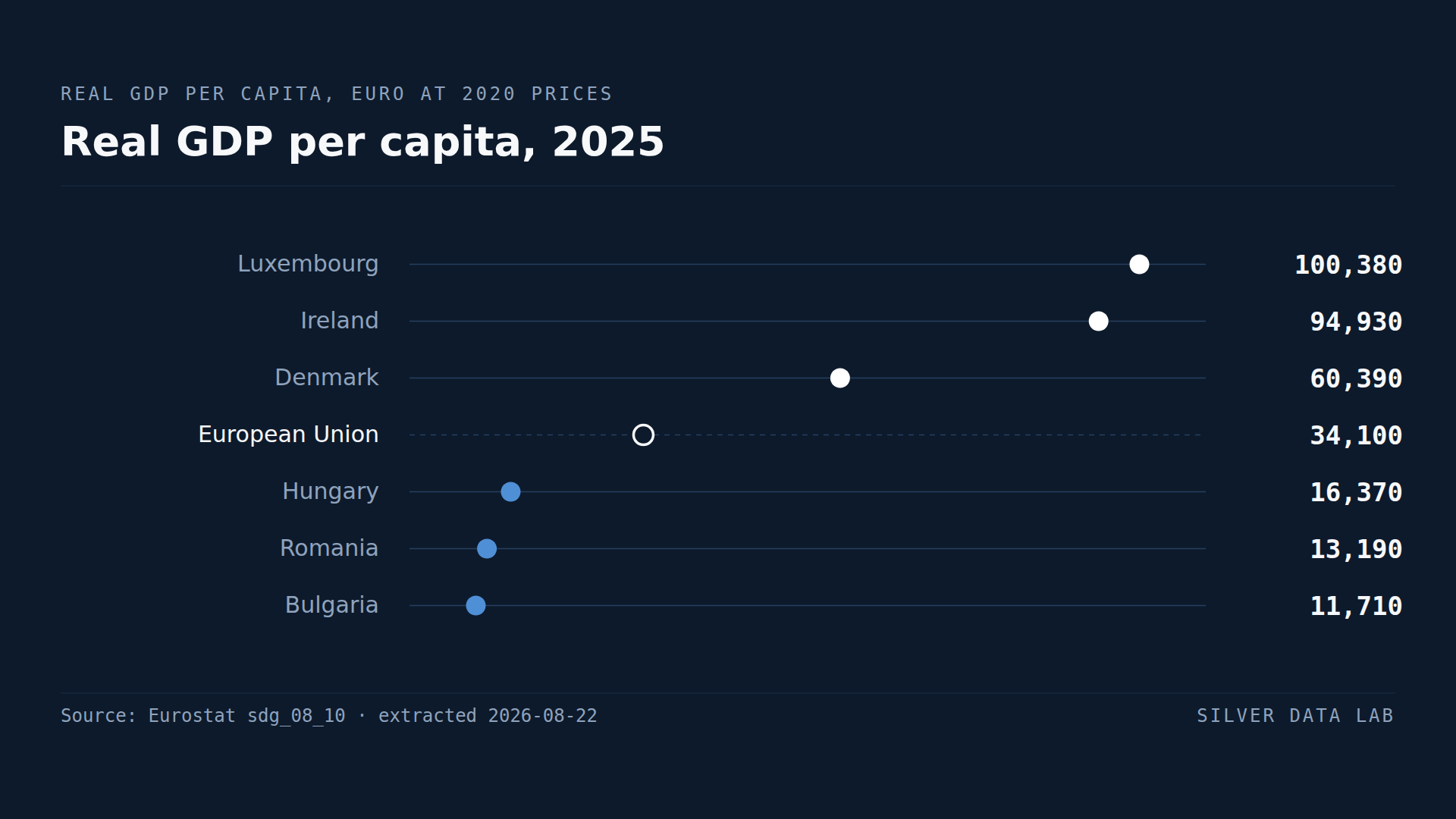
Bulgaria's GDP per Person Is About a Third of the EU Average
EU real GDP per capita was 34,250 euro in 2025, at 2020 prices.
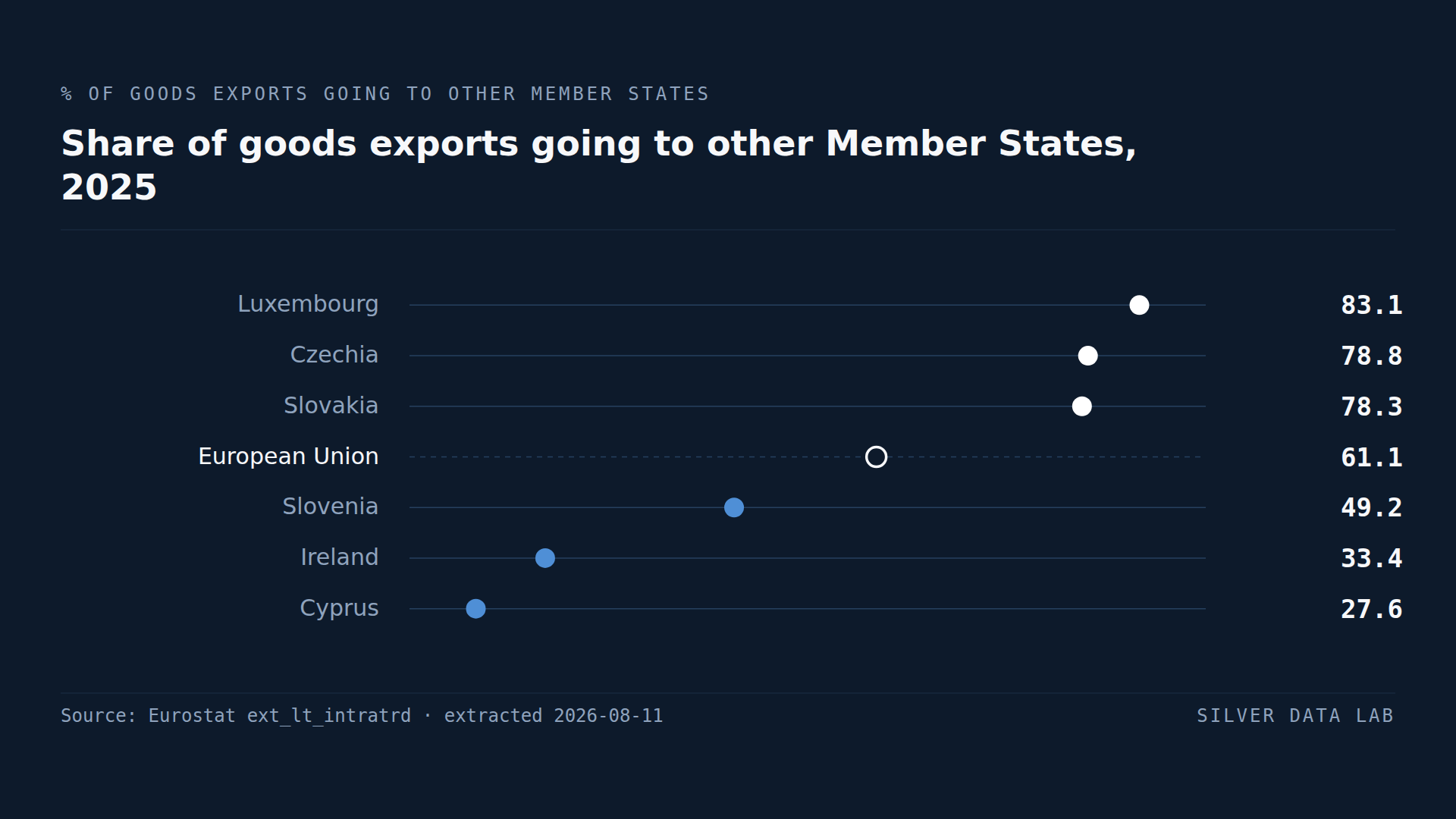
EU Countries Sell 61.1% of Their Goods Exports to Each Other
61.1% of the goods exported by EU Member States in 2025 went to other Member States.
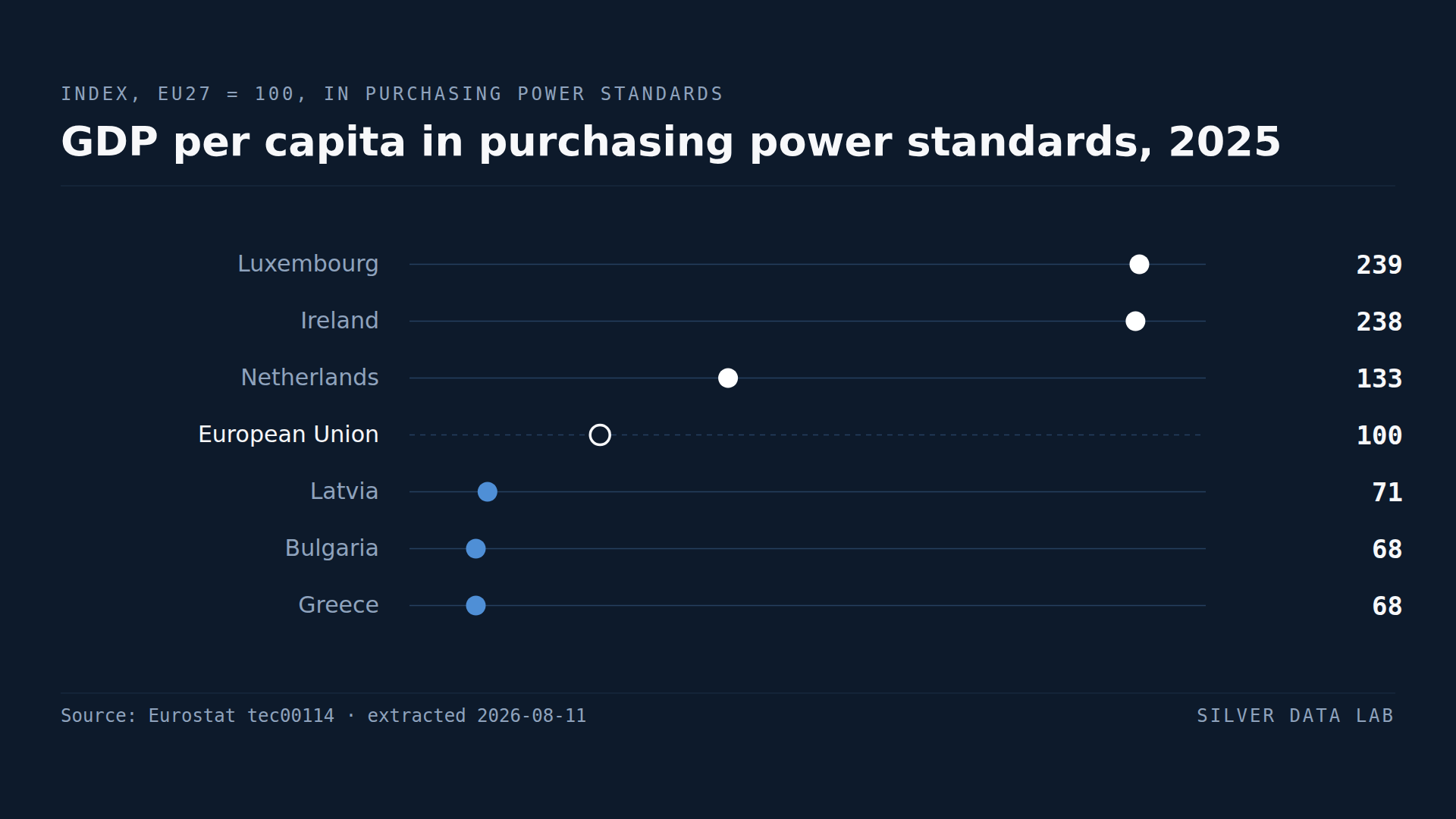
GDP per Head Makes Luxembourg and Ireland Look Richer Than They Are
Luxembourg records 239 and Ireland 238 against an EU average of 100 — more than double the Union's output per head.