Two in Five Romanians Live in an Overcrowded Home
Silver Data Lab Research Desk · Statistical analysis · Published on 14 June 2026
- Data source
- Eurostat
- Reference period
- 2025
- Last updated
- 17 September 2026
Re-checked against the source on 21 October 2026. No value in its datasets has moved between the snapshots we hold. Every revision we have observed →
Key estimates
- 16.8% of the EU population lived in overcrowded housing in 2025 — roughly one person in six.
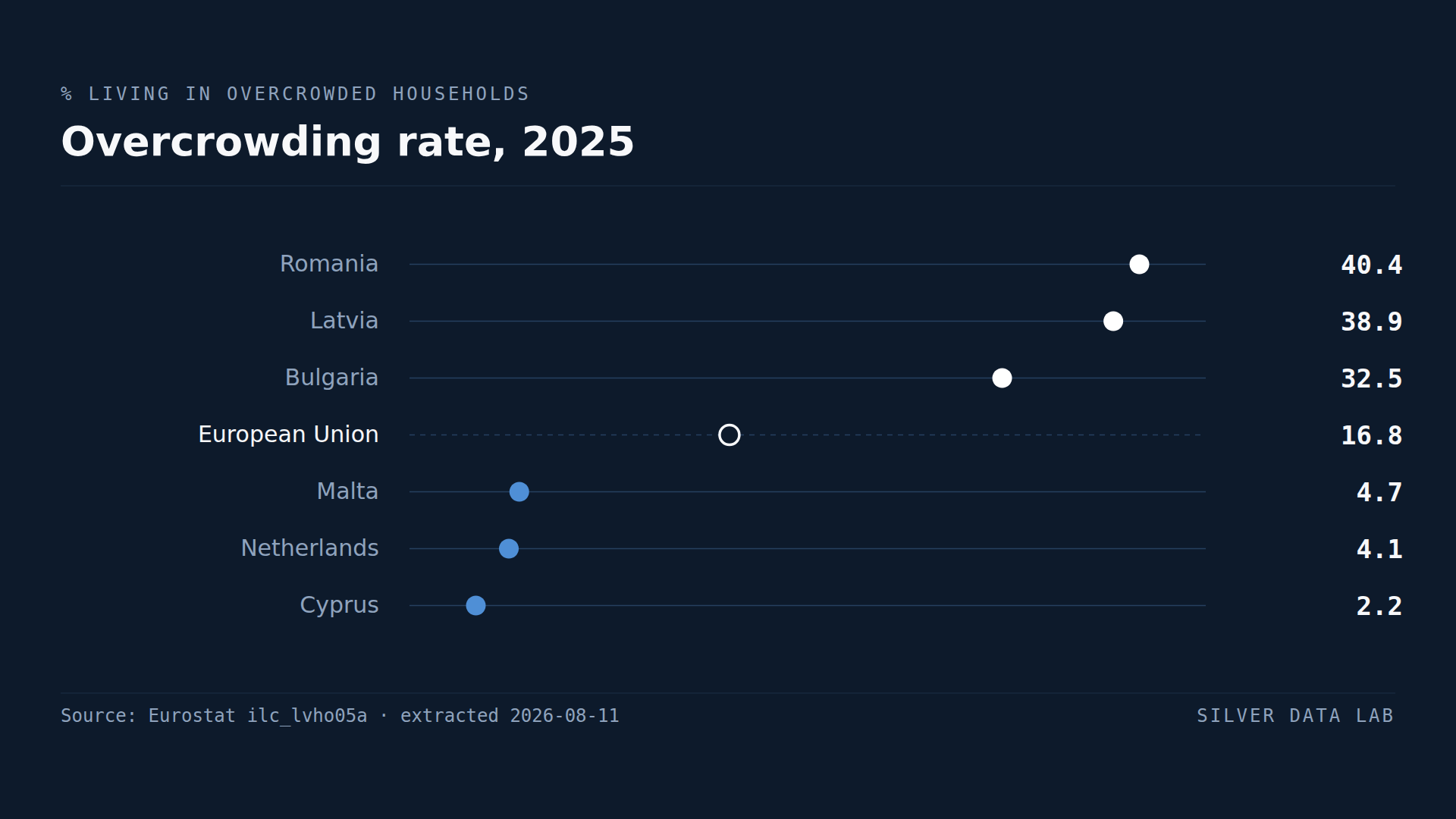
- Romania records 40.4%, Latvia 38.9% and Bulgaria 32.5%.
- Cyprus records 2.2%, the Netherlands 4.1% and Malta 4.7%.
- The Romanian rate is 18 times the Cypriot one — and severe housing deprivation, on this site and in this domain, runs wider still.
- Italy at 24.3% is the only large western economy above the EU figure.
A room-based definition, applied identically everywhere
Overcrowding is defined by a room count rather than by floor area or by opinion. A household is overcrowded if it lacks a minimum number of rooms: one for the household, one per couple, one per single adult over eighteen, one per pair of same-sex teenagers, and one per pair of children under twelve.
The rule is arithmetic and applies identically in every Member State, which makes this indicator unusually comparable. It also makes it insensitive to space: a household in a large flat with too few separate rooms counts as overcrowded, and one in a small flat with enough rooms does not.
Across the EU, 16.8% of people lived in overcrowded housing in 2025.
The eastern concentration
Romania records 40.4%, the highest in the Union: two people in five. Latvia follows at 38.9%, Bulgaria at 32.5%, Croatia at 31.8% and Poland at 30.9%.
Six of the seven highest rates are in central and eastern Europe, and they coincide almost exactly with the countries at the top of the home ownership ranking. Slovakia, Romania and Croatia lead the Union on ownership and appear among its most overcrowded.
That combination is the finding. The housing privatisations of the 1990s produced very high ownership of a housing stock that was small, and owning a home is not the same as having enough room in it. A ranking on tenure and a ranking on overcrowding describe the same countries in opposite terms.
Where overcrowding is rare
Cyprus records 2.2%, the lowest in the Union, with the Netherlands at 4.1%, Malta at 4.7% and Ireland at 5.4%.
The Romanian rate is eighteen times the Cypriot one. That is a wide range for a definition applied identically everywhere, and it is not the widest this site publishes: severe housing deprivation, which counts the same rooms alongside a leaking roof or no indoor toilet, runs from 11.6% to 0.5% — a factor of twenty-three, in the same domain and largely the same countries. Room shortage is the milder of the two measures, and the harsher one separates the Union more sharply.
The one large western exception
Italy records 24.3%, 7.5 points above the EU figure and the only one of the Union's four largest economies above it. Germany records 11.7%, France 10.8% and Spain 9.5%.
Italy also has one of the Union's higher home ownership rates at 77.1%, which places it closer to the eastern pattern than to its western neighbours on both indicators at once.
Overcrowding rate, 2025
| Country | % of population | Gap to EU averagepercentage points, derived |
|---|---|---|
| Romania | 40.4 | +23.6 |
| Latvia | 38.9 | +22.1 |
| Bulgaria | 32.5 | +15.7 |
| European Unionaggregate | 16.8 | — |
| Malta | 4.7 | −12.1 |
| Netherlands | 4.1 | −12.7 |
| Cyprus | 2.2 | −14.6 |
This table as data: CSV · JSON
Every Member State for this indicator+
Members see every Member State for this indicator here, not only the rows the ranking prints. Become a Member
Embed this chart
Paste this code into a page. The frame carries the source and the extraction date, and links back to the study.
What these figures cannot tell you
- Rooms, not space
- The definition counts rooms against household composition and ignores floor area entirely. A spacious open-plan home can register as overcrowded and a cramped one with partitions can register as adequate.
- Survey data
- Figures come from EU-SILC, a household sample survey. They are estimates rather than counts, and small differences between Member States should not be over-interpreted.
- Housing norms differ
- The room standard is common across the Union, while expectations about shared sleeping arrangements are not. The indicator measures distance from a single European norm rather than from each society's own.
- Overcrowding is not deprivation
- A household can be overcrowded while its dwelling is in good condition, and severely deprived while having enough rooms. The two are measured separately and rank Member States differently.
Frequently asked questions
- How many Europeans live in overcrowded homes?
- 16.8% of the EU population in 2025, roughly one person in six. National rates ran from 40.4% in Romania to 2.2% in Cyprus.
- What counts as an overcrowded home?
- A household lacking a minimum number of rooms for its composition: one for the household, one per couple, one per adult over eighteen, one per pair of same-sex teenagers and one per pair of young children. The definition counts rooms, not floor area.
- Which EU country is most overcrowded?
- Romania, at 40.4% in 2025, followed by Latvia at 38.9% and Bulgaria at 32.5%. Six of the seven highest rates are in central and eastern Europe.
- Why do countries with high home ownership also have high overcrowding?
- Because owning a home and having enough room in it are different things. The Member States with the highest ownership rates acquired much of their housing stock through 1990s privatisations, and that stock was small. Slovakia, Romania and Croatia lead the Union on ownership and are among its most overcrowded.
Methodological note
The overcrowding rate is published by Eurostat from EU-SILC as the share of the population living in a household without a minimum number of rooms, defined against household composition: one room for the household, one per couple, one per single person over eighteen, one per pair of same-sex people aged twelve to seventeen, and one per pair of children under twelve.
Values are for the total population in 2025, the most recent year with complete coverage of the 27 Member States at the extraction date.
The ratio between Romania and Cyprus, and the comparison with the home ownership ranking, are derived by Silver Data Lab from the published rates and from the companion tenure study. The severe housing deprivation figures quoted beside them are that study's own, from its own extraction; the statement that its range is the wider of the two was checked against every ranking this site publishes rather than assumed.
Source data
The underlying series can be inspected and re-downloaded from the Eurostat data browser. The filters below are the ones applied.
Overcrowding rate by age, sex and poverty status
ilc_lvho05a
- Filters applied:
- freq=A · age=TOTAL · sex=T · rskpovth=TOTAL · unit=PC · time=2025
- Extracted:
- 2026-10-21
- Source last updated:
- 2026-10-20
Download the data
The data the study you have just read is built on, exactly as it was downloaded and archived.
Yours as a Member.
Data downloadable by Members
How to cite
Record the vintage as well as the study: the figures on this page are the ones extracted on the dates below.
Silver Data Lab Research Desk (2026). Two in Five Romanians Live in an Overcrowded Home. Silver Data Lab, published 14 June 2026, last updated 17 September 2026. https://www.silverdatalab.com/studies/overcrowding-in-the-eu
- Data: Eurostat, Overcrowding rate by age, sex and poverty status (ilc_lvho05a), filters freq=A, age=TOTAL, sex=T, rskpovth=TOTAL, unit=PC, time=2025; extracted 2026-10-21; source last updated 2026-10-20. https://doi.org/10.2908/ilc_lvho05a
Silver Data Lab's analysis is licensed CC BY 4.0. The statistics remain their publisher's and keep its terms of reuse.
Ask the research desk
A question about this study — a definition, a filter, a break in the series, what the figures can and cannot support — answered by the desk that made the extraction.
Members can write to the research desk
Studies where the same country leads or trails
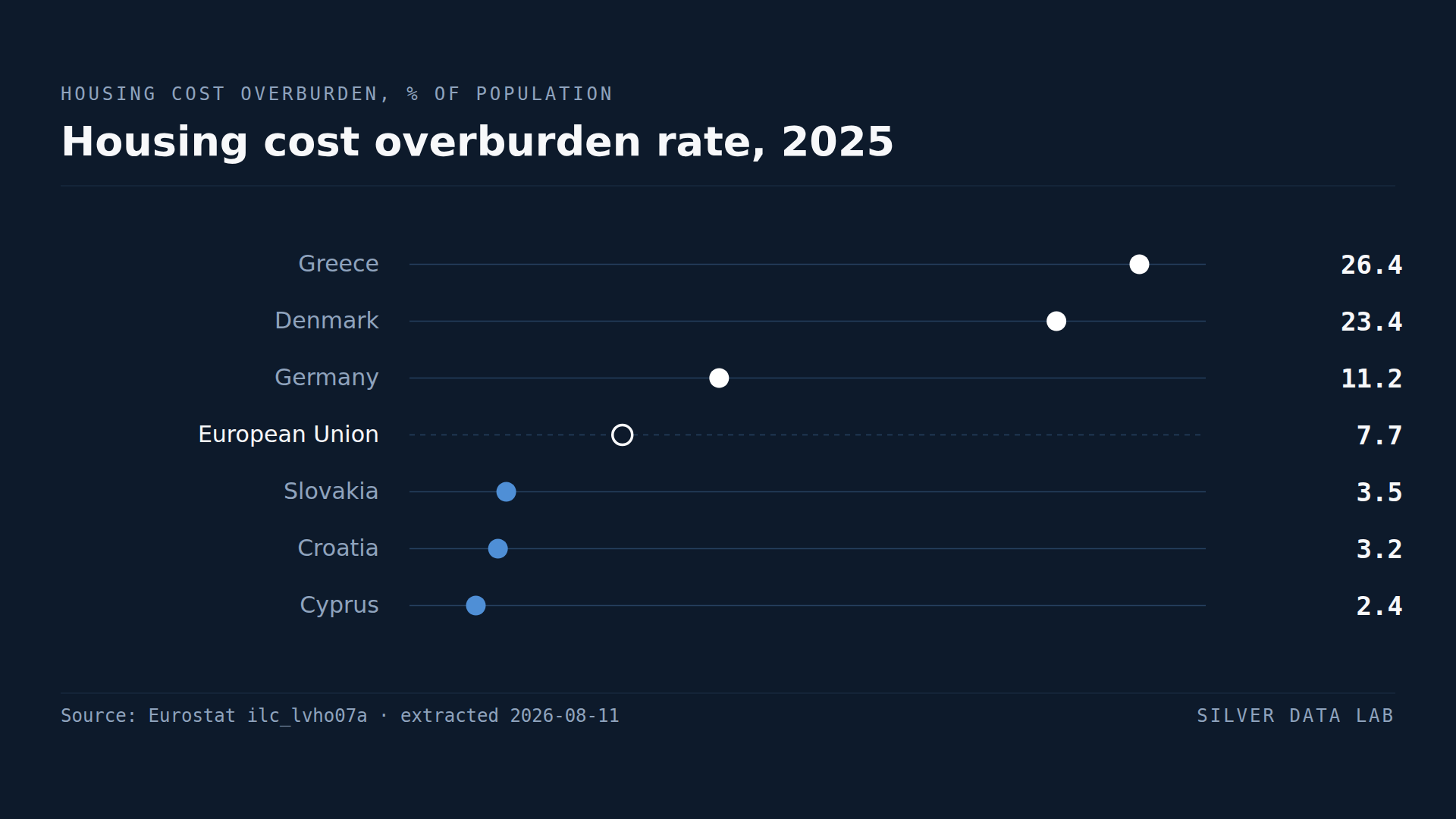
A Quarter of Greeks Spend More Than 40% of Income on Housing
7.7% of the EU population spent more than 40% of disposable income on housing in 2025.
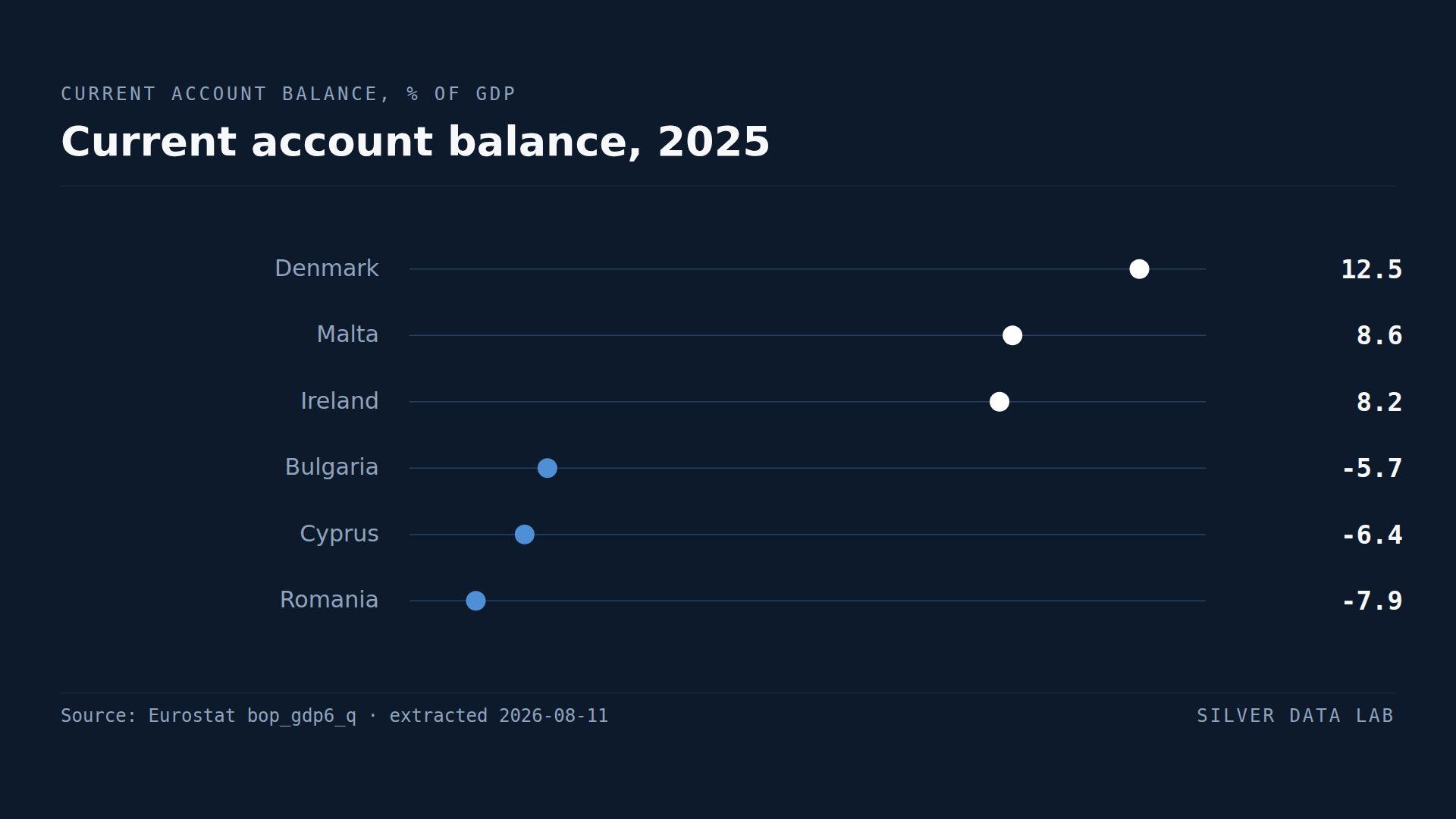
Denmark Has the EU's Biggest Surplus With the World, at 12.3% of GDP
Denmark ran a current account surplus worth 12.3% of GDP in 2025, the largest in the Union.
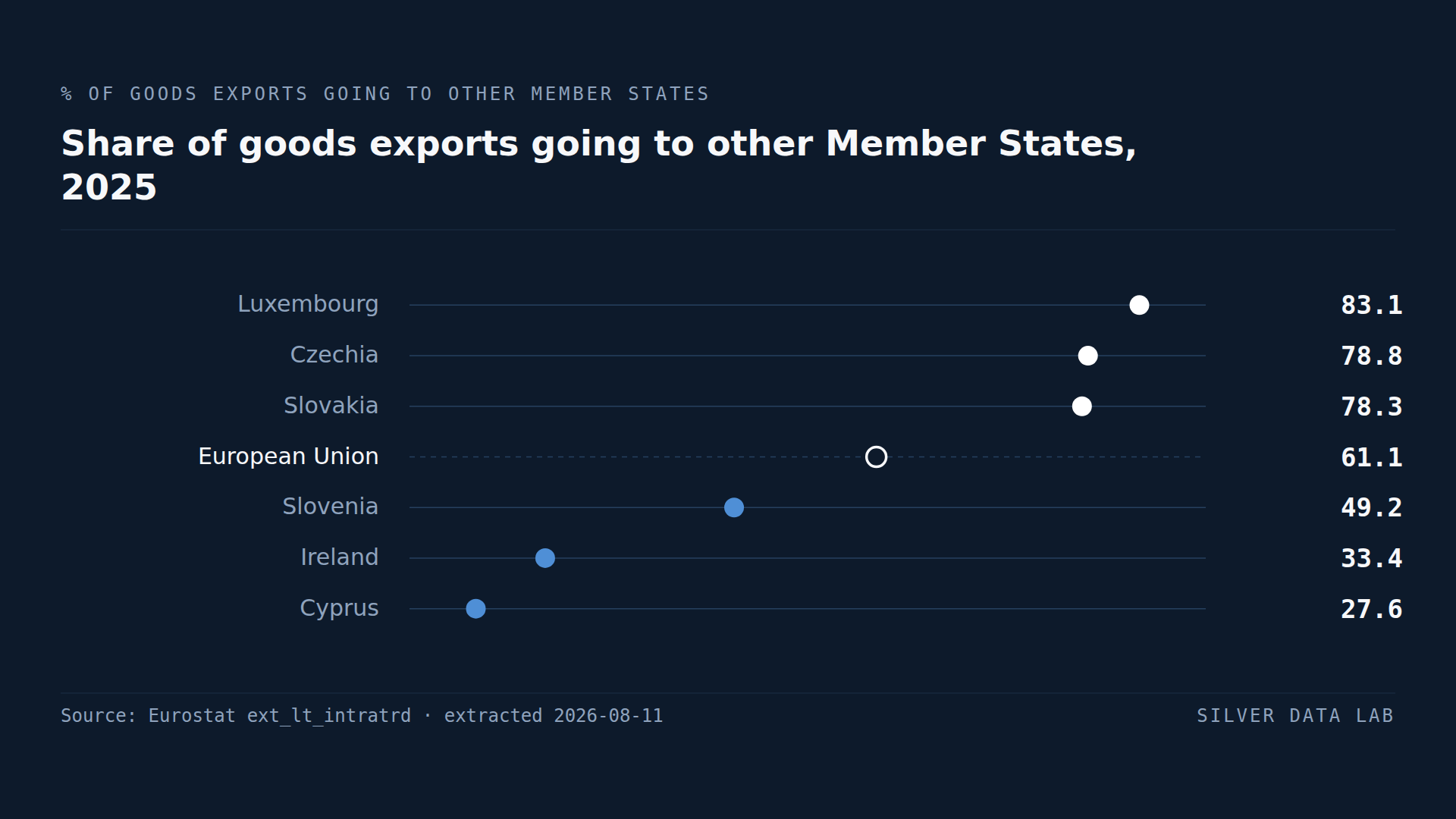
EU Countries Sell 61.1% of Their Goods Exports to Each Other
61.1% of the goods exported by EU Member States in 2025 went to other Member States.