More Than a Third of Dutch Adults Do Voluntary Work
Silver Data Lab Research Desk · Statistical analysis · Published on 27 April 2026
- Data source
- Eurostat
- Reference period
- 2022
- Last updated
- 11 October 2026
Re-checked against the source on 25 September 2026. No value in its datasets has moved between the snapshots we hold. Every revision we have observed →
Key estimates
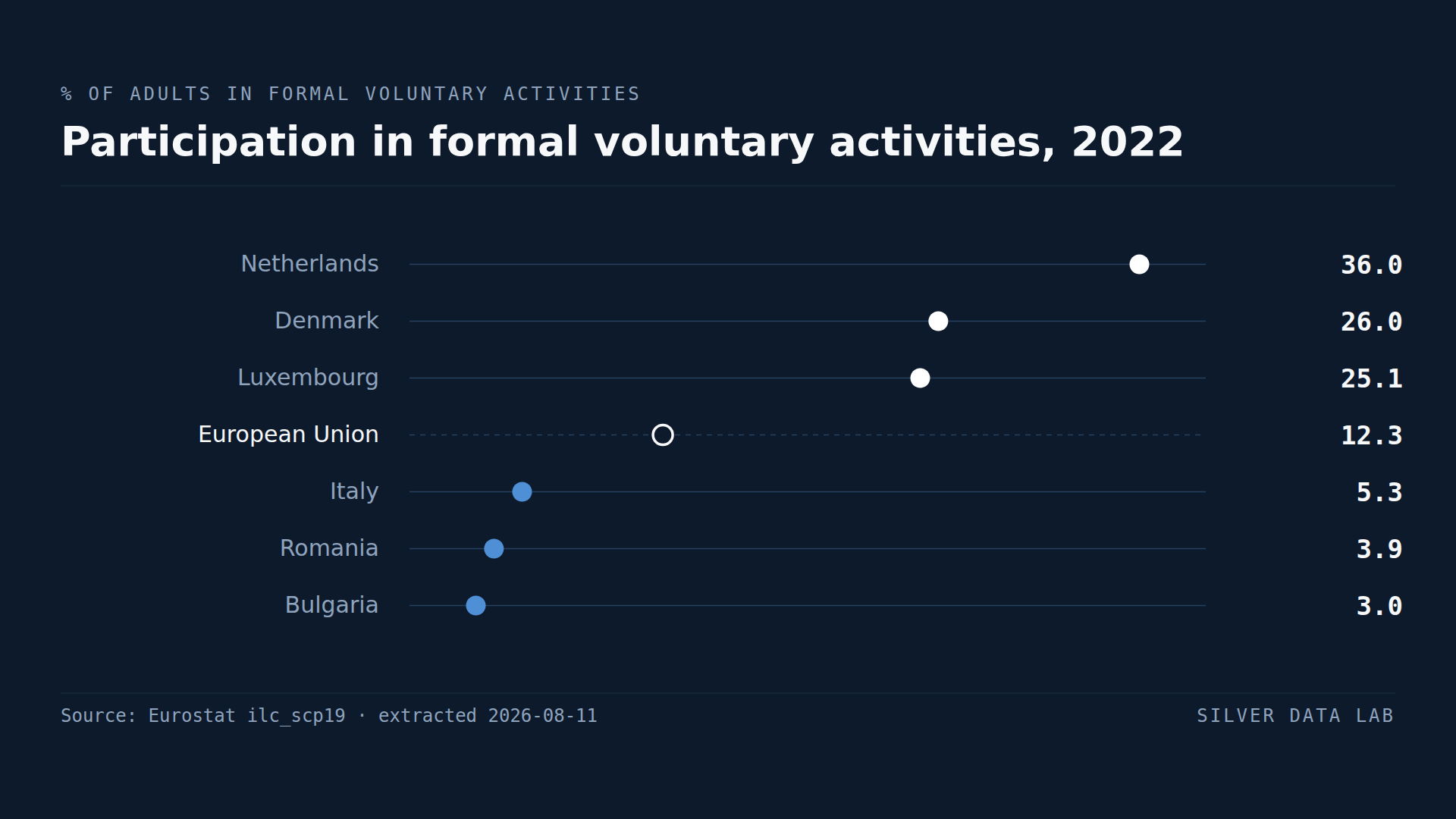
- 12.3% of EU adults took part in formal voluntary activities in 2022.
- The Netherlands records 36.0%, more than one adult in three.
- Bulgaria records 3.0%, Romania 3.9% and Italy 5.3%.
- The Dutch rate is twelve times the Bulgarian one.
- Ten of the twenty-six Member States with data are above the EU rate, and sixteen below it.
- The EU rate was 18.9% in 2015, the module's only other wave, so it has lost about a third of its level.
Organised unpaid work
Formal voluntary activity means unpaid work carried out through an organisation: a charity, a sports club, a religious body, a rescue service. It excludes helping a neighbour directly, which is counted separately as informal help.
Across the EU in 2022, 12.3% of adults took part. Roughly one in eight.
A north-west to south-east gradient
The Netherlands records 36.0%, far ahead of Denmark at 26.0%, Luxembourg at 25.1%, Finland at 23.9% and Sweden at 22.1%.
Slovenia at 20.7% and Ireland at 20.5% follow, then Austria at 19.7%.
At the other end, Bulgaria records 3.0%, Romania 3.9%, Italy 5.3%, Hungary 5.8% and Latvia 6.2%.
The gradient runs from the north-west to the south-east with few exceptions, and Slovenia at sixth is the clearest of those exceptions.
Italy is the case worth naming
Italy records 5.3%, third from the bottom of the Union — below Poland, Greece, Portugal and Slovakia, and a seventh of the Dutch rate.
It was not there in 2015. On the same 26 Member States, Italy ranked fifteenth that year at 12.0% — mid-table, and almost exactly where the Union as a whole sits now. Between the two waves it lost 6.7 points, more than half its rate, and nine places.
That is not what the country's reputation for civic and religious association would predict, and it is not explained by income: Italy's GDP per capita is close to the EU average and well above every Member State ranked below it.
One partial explanation is definitional. This indicator counts activity organised through a formal body, and a country where mutual help runs through family and neighbourhood networks rather than registered organisations will record less of it while doing no less of it. Eurostat measures informal help separately for exactly this reason, and that series is not used here.
Whether that accounts for the Italian figure is not something this extraction can settle. It is a caution against reading the ranking as a measure of how much people help one another.
What the ranking is evidence about
Volunteering rates of this kind are usually taken as an indicator of civic infrastructure: whether a country has a dense layer of organisations that people can join, and whether joining them is a normal thing to do.
Read that way, the ranking describes the organisational landscape more than it describes generosity. The Netherlands does not have twelve times Bulgaria's supply of people willing to help. It has a very different density of organisations through which help is channelled and recorded.
The one comparison this series supports
The module has run twice, in 2015 and in 2022. Between those two waves the EU rate fell from 18.9% to 12.3%, a loss of 6.6 points and about a third of the level.
The fall is close to universal: 23 of the 26 Member States with a figure in both waves record less formal volunteering in 2022 than in 2015. Cyprus is the one appreciable rise, from 7.2% to 11.3%; Romania and Malta rose by less than a point. The largest falls are all at the top of the 2015 ranking — Sweden down 13.4 points, Denmark 12.7, Luxembourg 11.6, Finland 10.2, Slovenia 9.7 — so the countries that volunteered most are the ones that lost most. The Netherlands ranked first in both waves.
What that fall is cannot be settled from two observations seven years apart. A near-universal drop concentrated in the highest-participation countries is what a shared shock looks like, and the second wave was collected after 2020 and 2021; it is also what a change in how the question travels between waves would look like. This study reports the movement and does not explain it, and the figures remain a pair of snapshots rather than a trend — they should not be read alongside the annual indicators elsewhere on this site.
Participation in formal voluntary activities, 2022
| Country | % of adults aged 16 and over | Gap to EU averagepercentage points, derived |
|---|---|---|
| Netherlands | 36.0 | +23.7 |
| Denmark | 26.0 | +13.7 |
| Luxembourg | 25.1 | +12.8 |
| European Unionaggregate | 12.3e | — |
| Italy | 5.3 | −7.0 |
| Romania | 3.9 | −8.4 |
| Bulgaria | 3.0 | −9.3 |
Flags carried by the source on these values: e estimated
This table as data: CSV · JSON
Every Member State for this indicator+
Members see every Member State for this indicator here, not only the rows the ranking prints. Become a Member
Embed this chart
Paste this code into a page. The frame carries the source and the extraction date, and links back to the study.
What these figures cannot tell you
- Formal activity only
- The indicator counts unpaid work organised through an institution. Helping neighbours, relatives or friends directly is measured by a separate Eurostat series and is excluded here, which may substantially understate mutual help in countries where it runs through informal networks.
- Germany is absent
- Eurostat publishes no value for Germany for 2022: the entry exists and is flagged as too unreliable to release. National comparisons therefore cover 26 Member States against an EU aggregate that includes all 27. The 2015 wave does carry a German figure, which is why the comparison between the two waves is drawn on the 26 with a value in both.
- Two waves, not a series
- The module has run in 2015 and 2022 only, so there is one comparison available and no trend. Year-on-year change does not exist, these figures are not comparable with the annual indicators published elsewhere on this site, and the change between the waves cannot be attributed: seven years apart, it mixes any real movement with whatever the second wave's own years and fieldwork contributed.
- What counts as an organisation differs
- Member States apply a common definition to national institutional landscapes that differ considerably. Where the boundary between an organisation and an informal group falls will affect the count.
Frequently asked questions
- How many Europeans volunteer?
- 12.3% of adults aged 16 and over took part in formal voluntary activities in 2022 — roughly one in eight. The measure covers unpaid work organised through an institution, not informal help given directly to others.
- Which EU country volunteers most?
- The Netherlands, at 36.0% of adults in 2022, well ahead of Denmark at 26.0% and Luxembourg at 25.1%.
- Which EU country volunteers least?
- Bulgaria at 3.0%, Romania at 3.9% and Italy at 5.3%. The Dutch rate is twelve times the Bulgarian one.
- Does a low rate mean people help each other less?
- Not necessarily. This indicator counts only help organised through a formal body. In countries where mutual assistance runs through family and neighbourhood networks it is recorded as informal help, which Eurostat measures separately and this study does not use.
Methodological note
Eurostat collects participation in voluntary activities through an EU-SILC ad hoc module. This study uses formal voluntary activities for the population aged 16 and over, all education levels, both sexes.
Values are for 2022, the most recent wave. Germany has no published value for that year, so national comparisons cover 26 Member States; the EU aggregate is as published.
The counts of Member States above and below the EU rate, and the ratio between the highest and lowest, are derived by Silver Data Lab from the published rates.
The 2015 wave of the same module is extracted separately and declared below, and is the source of every figure in the comparison between waves. The count of Member States that fell, the changes in percentage points and Italy's change of rank are derived by Silver Data Lab from the two published waves, on the 26 Member States with a value in both. Ireland's and Poland's 2015 values carry a low-reliability flag and are not quoted here.
Source data
This study draws on 2 datasets from Eurostat. Each can be inspected and re-downloaded from its catalogue, and the filters below are the ones applied.
Persons participating in formal voluntary activities
ilc_scp19
- Filters applied:
- freq=A · isced11=TOTAL · acl00=AC41A · age=Y_GE16 · sex=T · unit=PC · time=2022
- Extracted:
- 2026-08-11
- Source last updated:
- 2026-04-24
Persons participating in formal voluntary activities — 2015 wave
ilc_scp19
- Filters applied:
- freq=A · isced11=TOTAL · acl00=AC41A · age=Y_GE16 · sex=T · unit=PC · time=2015
- Extracted:
- 2026-09-25
- Source last updated:
- 2026-04-24
Download the data
The data the study you have just read is built on, exactly as it was downloaded and archived.
Yours as a Member.
Data downloadable by Members
How to cite
Record the vintage as well as the study: the figures on this page are the ones extracted on the dates below.
Silver Data Lab Research Desk (2026). More Than a Third of Dutch Adults Do Voluntary Work. Silver Data Lab, published 27 April 2026, last updated 11 October 2026. https://www.silverdatalab.com/studies/volunteering-in-the-eu
- Data: Eurostat, Persons participating in formal voluntary activities (ilc_scp19), filters freq=A, isced11=TOTAL, acl00=AC41A, age=Y_GE16, sex=T, unit=PC, time=2022; extracted 2026-08-11; source last updated 2026-04-24. https://doi.org/10.2908/ilc_scp19
- Data: Eurostat, Persons participating in formal voluntary activities — 2015 wave (ilc_scp19), filters freq=A, isced11=TOTAL, acl00=AC41A, age=Y_GE16, sex=T, unit=PC, time=2015; extracted 2026-09-25; source last updated 2026-04-24. https://doi.org/10.2908/ilc_scp19
Silver Data Lab's analysis is licensed CC BY 4.0. The statistics remain their publisher's and keep its terms of reuse.
Ask the research desk
A question about this study — a definition, a filter, a break in the series, what the figures can and cannot support — answered by the desk that made the extraction.
Members can write to the research desk
Studies where the same country leads or trails
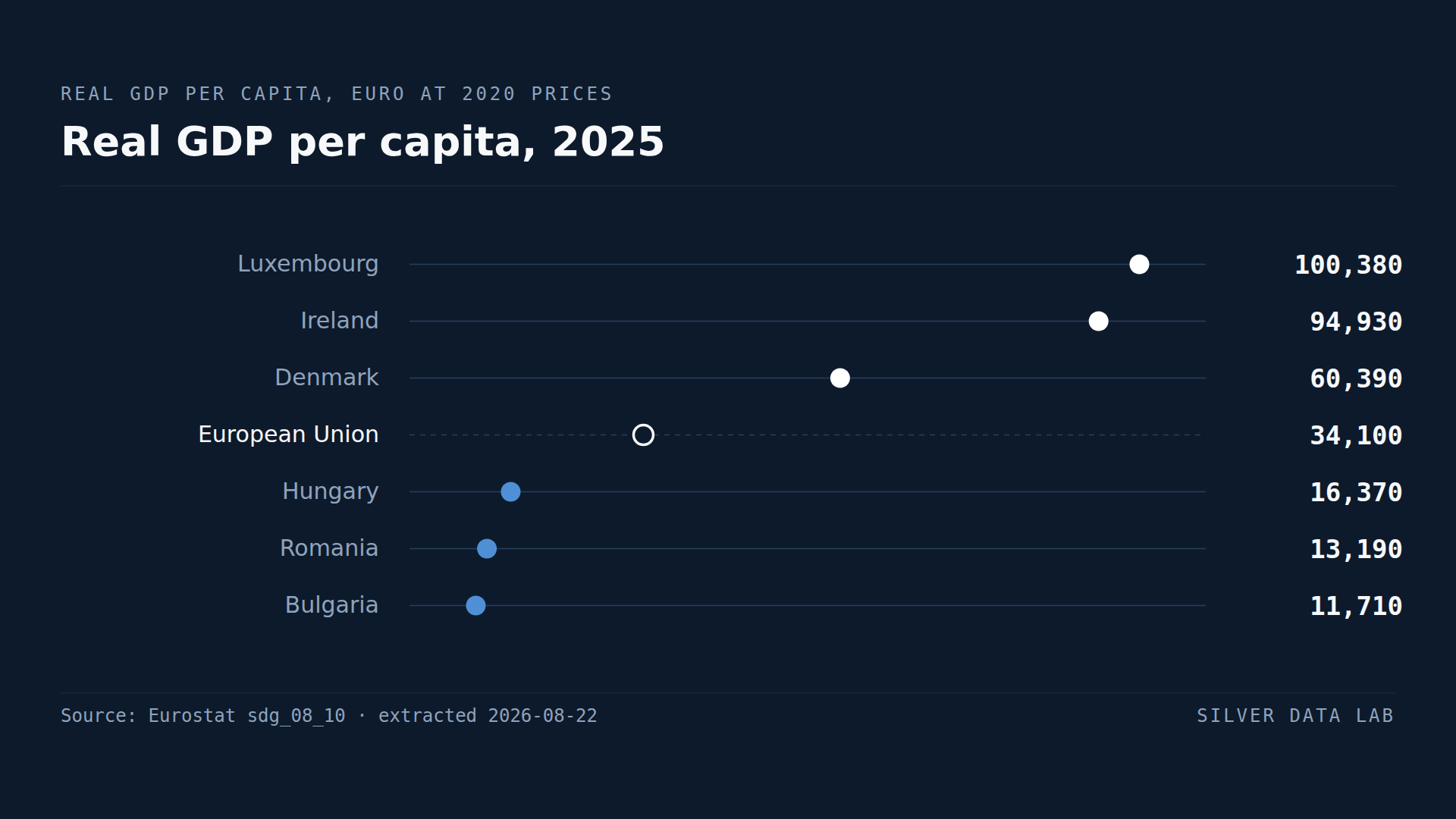
Bulgaria's GDP per Person Is About a Third of the EU Average
EU real GDP per capita was 34,250 euro in 2025, at 2020 prices.
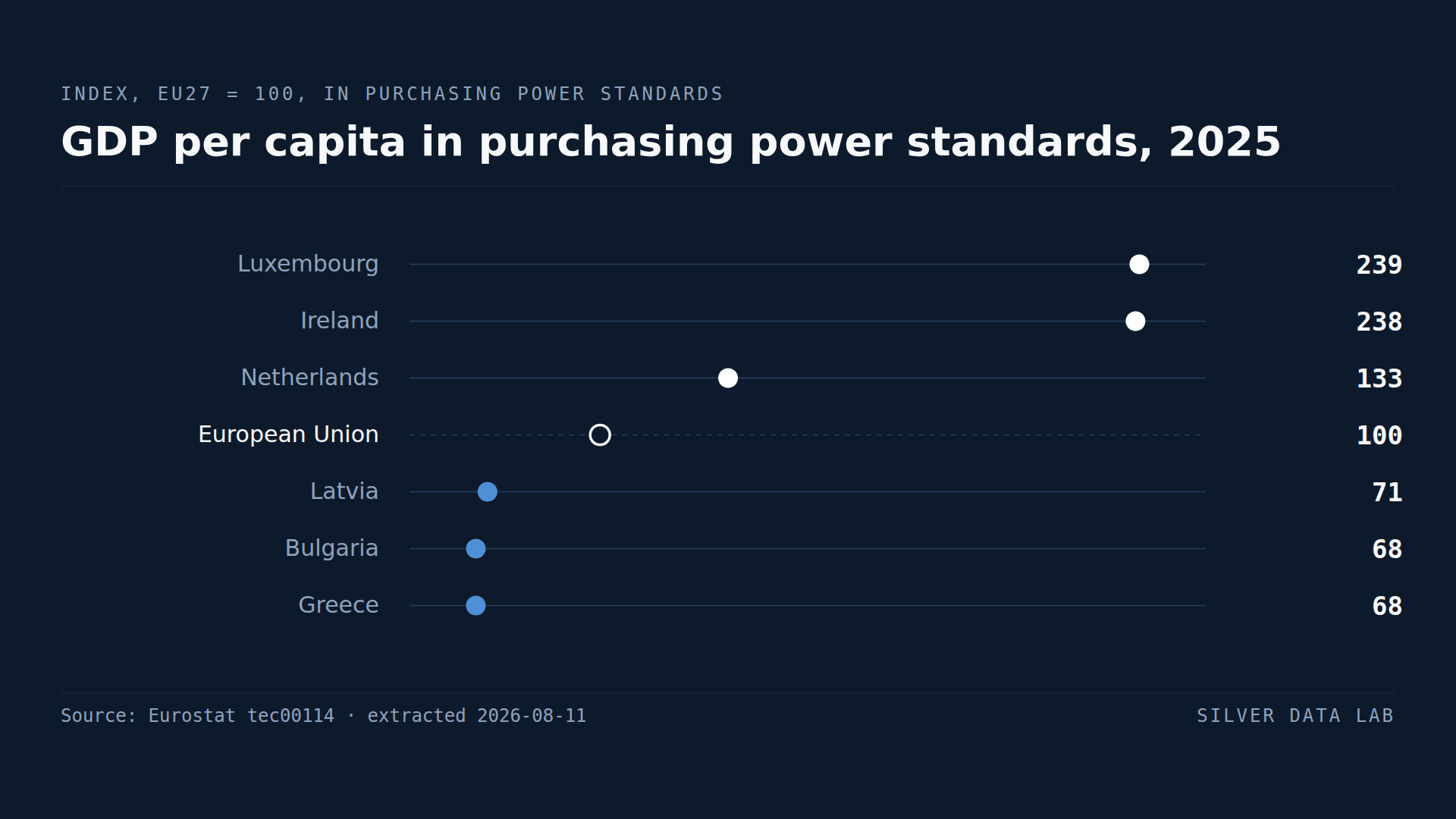
GDP per Head Makes Luxembourg and Ireland Look Richer Than They Are
Luxembourg records 239 and Ireland 238 against an EU average of 100 — more than double the Union's output per head.
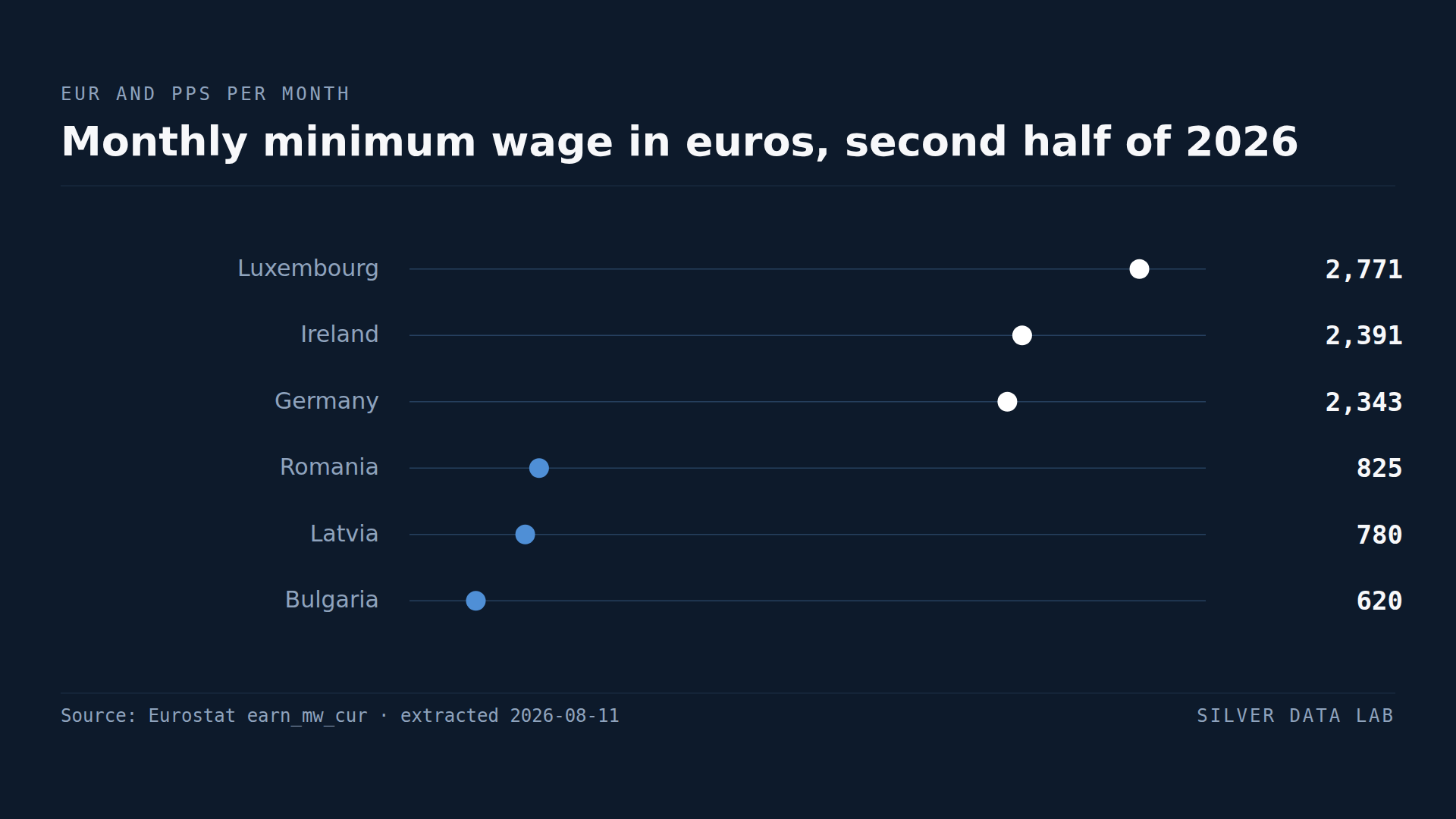
Germany's Legal Minimum Wage Buys More Than Any Other in the EU
22 of the 27 Member States set a statutory minimum wage. Austria, Denmark, Finland, Italy and Sweden do not, leaving pay floors to collective agreements.