Rail Moves One Sixth of the EU's Inland Freight and Almost None of Ireland's
Silver Data Lab Research Desk · Statistical analysis · Published on 17 September 2026
- Data source
- Eurostat
- Reference period
- 2024
- Last updated
- 17 September 2026
Re-checked against the source on 17 September 2026. No value in its datasets has moved between the snapshots we hold. Every revision we have observed →
Key estimates
- Rail carried 16.6% of inland freight across the EU in 2024, measured in tonne-kilometres; road carried 78.2% and inland waterways 5.2%.
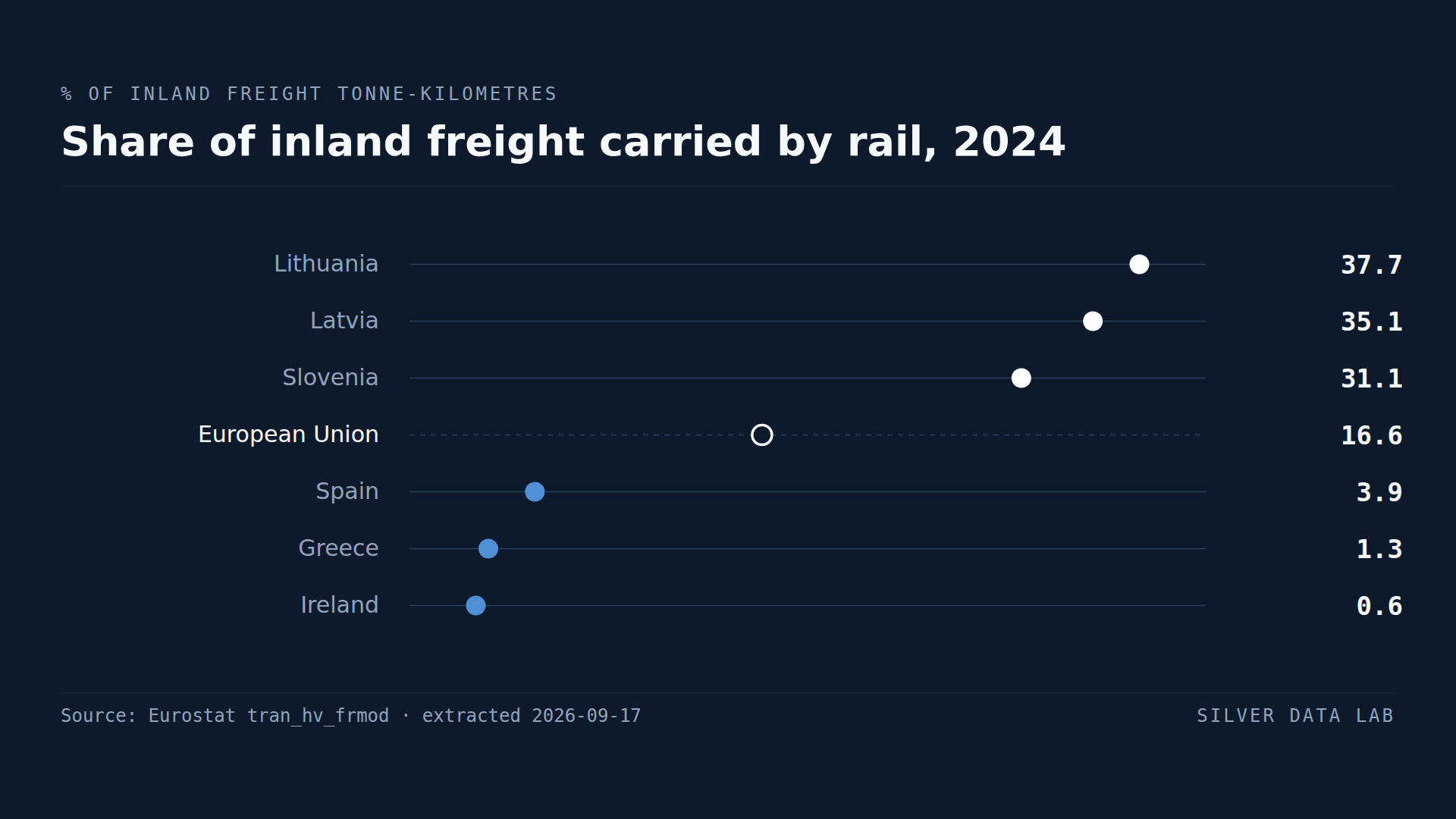
- Lithuania moves 37.7% of its inland freight by rail, Latvia 35.1% and Slovenia 31.1%, the three highest shares in the Union.
- Ireland records 0.6%, Greece 1.3% and Spain 3.9%. Cyprus and Malta have no railway and move everything by road.
- Six Member States move at least 30% of their freight by rail; seven move less than 10%.
- The Netherlands has the lowest rail share on the continent at 5.9%, because 40.4% of its freight travels by inland waterway, the highest share in the EU by a wide margin.
Weight multiplied by distance
The modal split of freight divides everything moved inside a country between road, rail and inland waterways. Its unit is the tonne-kilometre: one tonne carried one kilometre. A lorry taking twenty tonnes across a city and a train taking two thousand tonnes across a country are weighed accordingly, so the measure describes where the heavy, long-distance work is done rather than how many consignments each mode handles.
On that measure, road carried 78.2% of the EU's inland freight in 2024, rail 16.6% and inland waterways 5.2%. Rail's share is, near enough, one tonne-kilometre in six.
Where the railway carries the load
Lithuania records the highest rail share in the Union at 37.7%, followed by Latvia at 35.1%, Slovenia at 31.1%, Austria at 30.3%, Slovakia at 30.1% and Sweden at 30.0%. Six Member States move at least 30% of their inland freight by rail.
Hungary at 26.2%, Croatia at 24.3%, Poland at 23.6%, Finland at 23.3%, Czechia at 21.3%, Romania at 21.2%, Germany at 20.3% and Bulgaria at 18.0% complete the group above the EU figure: fourteen Member States in all.
Two things, in part, hold that group together. The Baltic states and much of central Europe inherited dense railway networks built for bulk freight, and their geography puts them on transit corridors between larger economies. Austria and Sweden are the other case: long distances or Alpine crossings, and policy that has kept freight on rails. The two explanations arrive at similar shares from very different starting points.
Where the road has almost everything
Ireland moves 0.6% of its inland freight by rail and 99.4% by road. Greece records 1.3% and 98.7%, Spain 3.9% and 96.1%, Denmark 7.8% and 92.2%. Cyprus and Malta have no railway at all, so their inland freight is road freight by definition: 100.0%.
Six Member States therefore move at least 90% of their inland freight by road, and eleven move at least 85%: Italy at 88.4%, France at 88.3%, Portugal at 86.3%, Luxembourg at 85.6% and Estonia at 85.4% join the six. Seven Member States have a rail share below 10%, three of them below 5%.
France and Italy are the notable members of that list. Both operate large railway networks, and both are known for their passenger trains. For freight the picture is different: 9.8% in France and 11.6% in Italy, each below the EU figure and closer to Denmark than to Germany.
The water route
Inland waterways carry 5.2% of EU freight, but that average is made almost entirely by a handful of countries. The Netherlands moves 40.4% of its inland freight by water, the highest share of any mode other than road anywhere in the Union. Romania records 23.4% and Bulgaria 21.9%, both on the Danube. Belgium follows at 11.0%, Luxembourg at 8.0% and Germany at 7.0%.
Thirteen Member States report any waterway freight at all; in the other fourteen the mode does not exist or carries nothing measurable.
This is what explains the Dutch position in the rail ranking. At 5.9% the Netherlands sits between Luxembourg and Spain, which would be surprising for the country of Rotterdam, Europe's largest seaport, if rail were the only alternative to the road. It is not: the barge is, and it takes two fifths of everything. The Dutch road share of 53.7% is the lowest in the EU, with Romania at 55.4% the only other Member State where road carries less than 60%.
What the split leaves out
The indicator covers the three inland modes and nothing else. Sea and air freight are outside it, as are pipelines. A country whose exports leave by ship is measured here only on the leg between the factory and the port, which shortens the distance the road mode is credited with and flatters no mode in particular. For an island Member State the effect is that the entire international leg vanishes from the count.
Share of inland freight carried by rail, 2024
| Country | % of tonne-kilometres | Gap to EU averagepercentage points, derived |
|---|---|---|
| Lithuania | 37.7 | +21.1 |
| Latvia | 35.1 | +18.5 |
| Slovenia | 31.1 | +14.5 |
| European Unionaggregate | 16.6e | — |
| Spain | 3.9 | −12.7 |
| Greece | 1.3 | −15.3 |
| Ireland | 0.6 | −16.0 |
Flags carried by the source on these values: e estimated
This table as data: CSV · JSON
Every Member State for this indicator+
Members see every Member State for this indicator here, not only the rows the ranking prints. Become a Member
Embed this chart
Paste this code into a page. The frame carries the source and the extraction date, and links back to the study.
Share of inland freight carried by inland waterways, 2024
| Country | % of tonne-kilometres | Gap to EU averagepercentage points, derived |
|---|---|---|
| Netherlands | 40.4 | +35.2 |
| Romania | 23.4 | +18.2 |
| Bulgaria | 21.9 | +16.7 |
| Belgium | 11.0 | +5.8 |
| Luxembourg | 8.0 | +2.8 |
| Germany | 7.0 | +1.8 |
| European Unionaggregate | 5.2e | — |
Flags carried by the source on these values: e estimated
This table as data: CSV · JSON
Every Member State for this indicator+
Members see every Member State for this indicator here, not only the rows the ranking prints. Become a Member
Embed this chart
Paste this code into a page. The frame carries the source and the extraction date, and links back to the study.
What these figures cannot tell you
- Tonne-kilometres, not tonnes
- A mode's share is its weight multiplied by distance. Rail and barges specialise in heavy loads over long routes, so their shares are larger here than they would be in a count of consignments or of tonnes loaded, and a country with short internal distances scores low on rail for reasons of geography as much as policy.
- Road freight is modelled onto the territory
- Rail and waterway performance are reported by each country for movements on its own territory. Road freight is collected by the nationality of the haulier, and Eurostat redistributes it onto the territories crossed using a modelled itinerary. The road share is therefore an estimate in a way the other two are not.
- Inland modes only
- Sea, air and pipeline transport are excluded. For an island Member State the international leg of every journey disappears from the count, and for a country with a major seaport the maritime side of the port is invisible here while the barge and rail connections behind it are not.
- Two countries have no rail series, and two figures are estimates
- Cyprus and Malta have no railway network and appear in the source with a road share of 100.0% and no rail value; they are not recorded as zero. The EU aggregate and Belgium's three shares are flagged by Eurostat as estimated.
Frequently asked questions
- How much EU freight goes by rail?
- 16.6% of inland freight tonne-kilometres in 2024, against 78.2% by road and 5.2% by inland waterway. The measure weighs each consignment by the distance it travels, so it describes the share of heavy, long-distance work rather than the share of deliveries.
- Which EU country moves the most freight by rail?
- Lithuania, at 37.7% of inland tonne-kilometres in 2024, followed by Latvia at 35.1% and Slovenia at 31.1%. Austria, Slovakia and Sweden also reach 30%.
- Which EU countries barely use rail for freight?
- Ireland at 0.6%, Greece at 1.3% and Spain at 3.9%. Cyprus and Malta have no railway, so all of their inland freight moves by road. Seven Member States in total have a rail share below 10%.
- Why is the Dutch rail share so low?
- Because barges carry 40.4% of Dutch inland freight, the highest waterway share in the EU. Rail takes 5.9% and road 53.7%, the lowest road share of any Member State. The alternative to the lorry in the Netherlands is the canal rather than the railway.
Methodological note
Eurostat publishes the modal split of inland freight transport as the share of road, rail and inland waterways in total inland tonne-kilometres, following the territoriality principle: only transport performed inside the reporting country counts, whichever country the vehicle or vessel belongs to. Road freight, which Member States report by the nationality of the haulier, is territorialised by Eurostat using a modelled itinerary before the shares are computed.
Values are for 2024 and cover all 27 Member States for road, 25 for rail and 13 for inland waterways; a mode absent from a country is absent from the source rather than recorded at zero. The three shares of a country sum to 100.
The counts of Member States above and below given thresholds, the description of rail's share as one sixth and the comparison with the passenger figures on this site are made by Silver Data Lab from the published shares. Nothing else is computed.
Source data
The underlying series can be inspected and re-downloaded from the Eurostat data browser. The filters below are the ones applied.
Modal split of inland freight transport
tran_hv_frmod
- Filters applied:
- freq=A · tra_mode=RAIL, ROAD, IWW · unit=PC · time=2024
- Extracted:
- 2026-09-17
- Source last updated:
- 2026-03-04
Download the data
The data the study you have just read is built on, exactly as it was downloaded and archived.
Yours as a Member.
Data downloadable by Members
How to cite
Record the vintage as well as the study: the figures on this page are the ones extracted on the dates below.
Silver Data Lab Research Desk (2026). Rail Moves One Sixth of the EU's Inland Freight and Almost None of Ireland's. Silver Data Lab, published 17 September 2026, last updated 17 September 2026. https://www.silverdatalab.com/studies/rail-freight-in-the-eu
- Data: Eurostat, Modal split of inland freight transport (tran_hv_frmod), filters freq=A, tra_mode=RAIL, ROAD, IWW, unit=PC, time=2024; extracted 2026-09-17; source last updated 2026-03-04. https://doi.org/10.2908/tran_hv_frmod
Silver Data Lab's analysis is licensed CC BY 4.0. The statistics remain their publisher's and keep its terms of reuse.
Ask the research desk
A question about this study — a definition, a filter, a break in the series, what the figures can and cannot support — answered by the desk that made the extraction.
Members can write to the research desk
Studies where the same country leads or trails
Ireland Sends Abroad Income Worth 31% of Its Economy Every Year
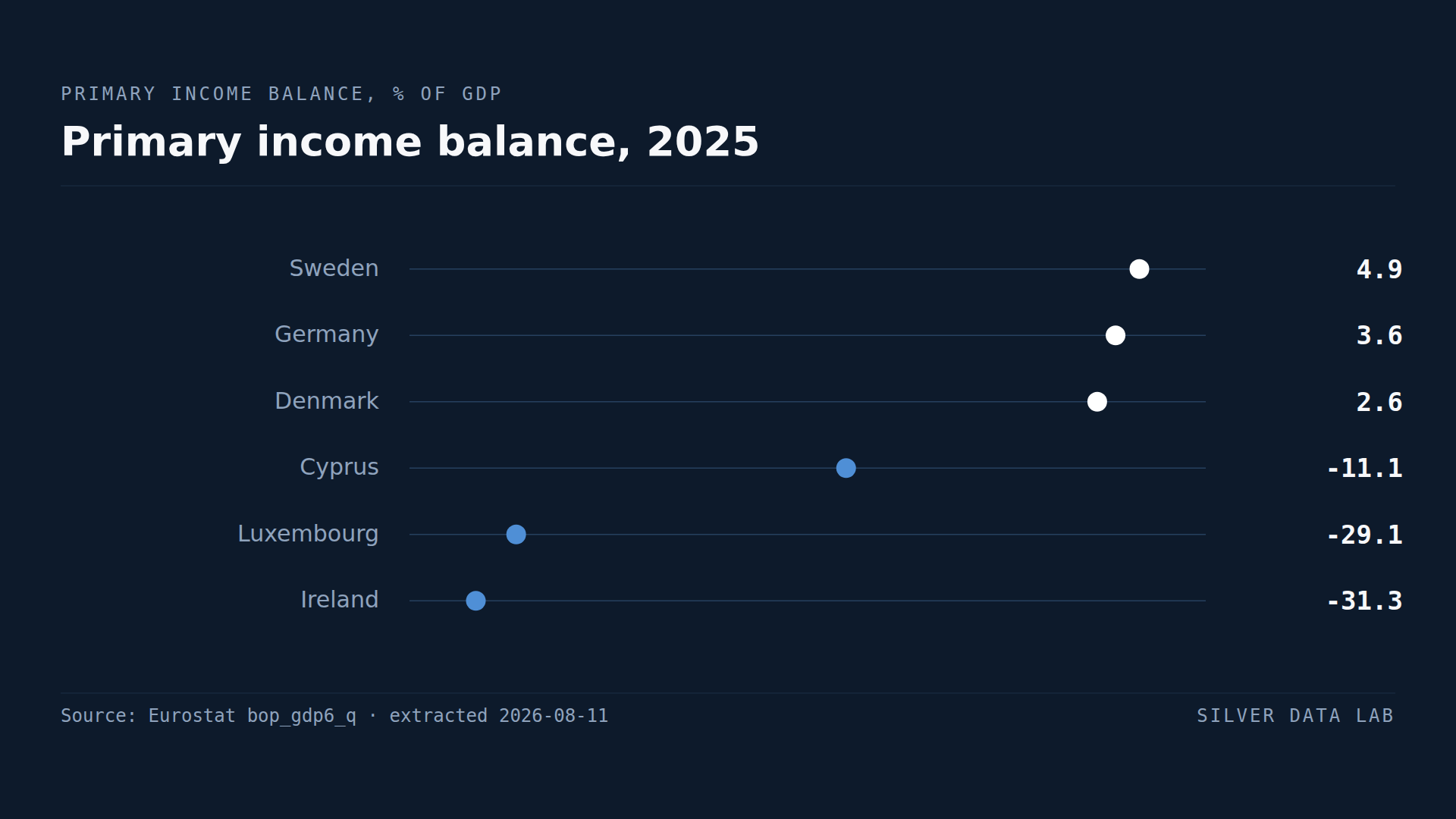
Ireland's net primary income outflow was 31.3% of GDP in 2025 — the largest in the Union.
Cars Cover Seven in Ten Kilometres of Land Travel in Europe
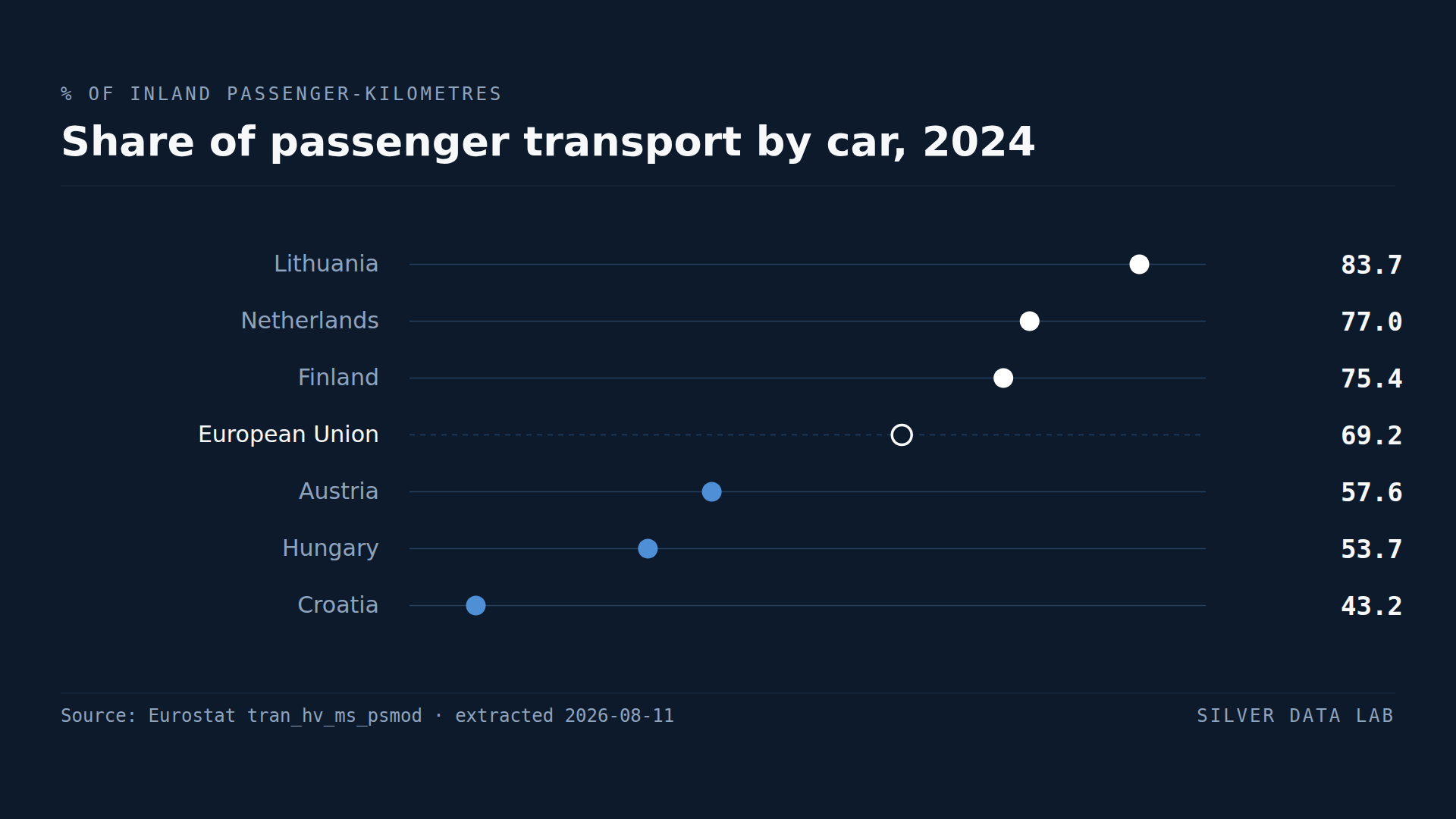
Cars accounted for 69.2% of inland passenger transport across the EU in 2024, measured in passenger-kilometres.