One Greek in Nine Went Without Medical Care They Needed
Silver Data Lab Research Desk · Statistical analysis · Published on 30 July 2026
- Data source
- Eurostat
- Reference period
- 2025
- Last updated
- 14 October 2026
Re-checked against the source on 21 October 2026. 2 values in its datasets moved between snapshots; none is a figure stated on this page. Every revision we have observed →
Key estimates
- 2.4% of Europeans aged 16 and over reported an unmet need for medical examination in 2025.
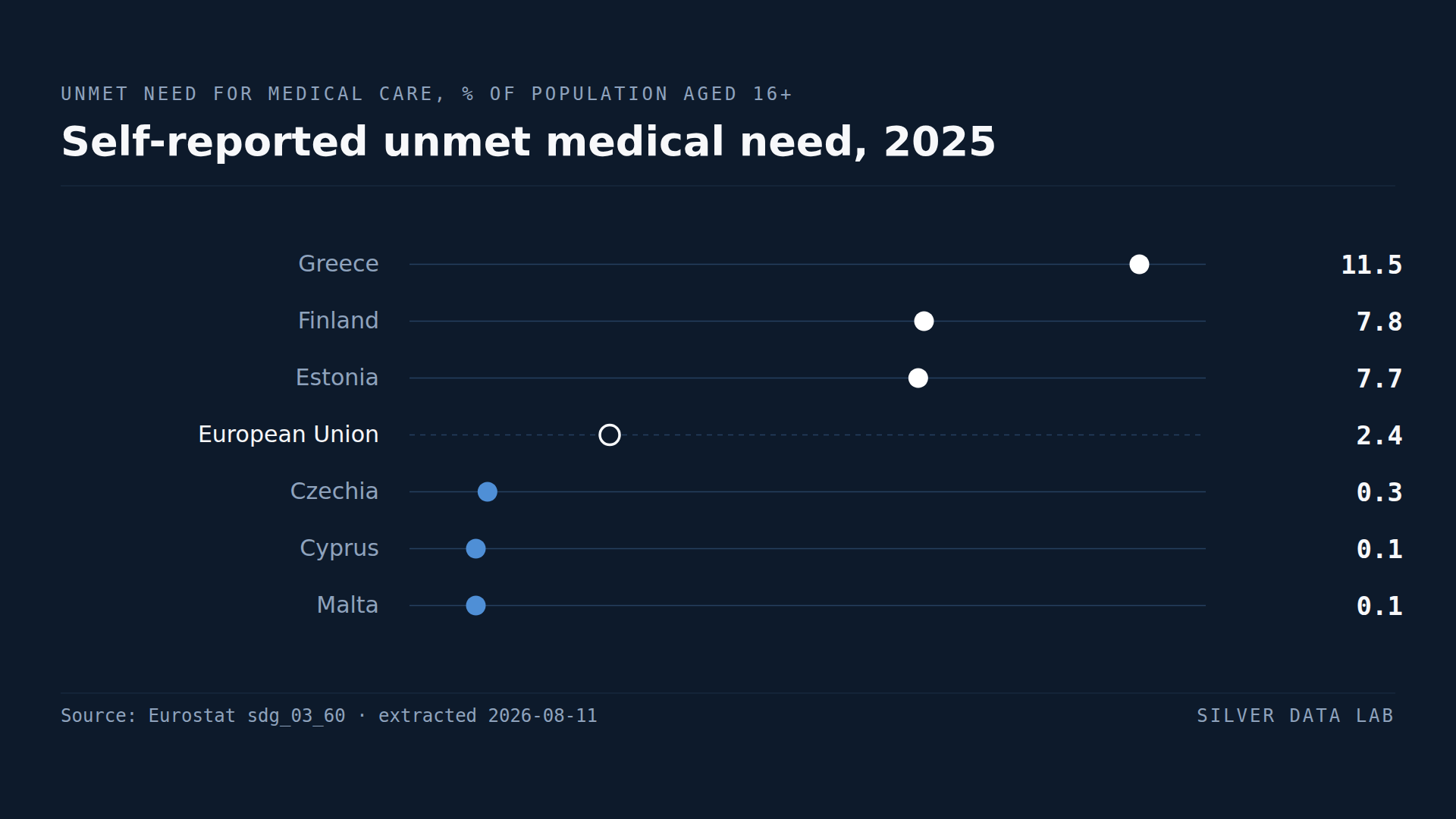
- Greece records 11.5%, Finland 7.8%, Estonia 7.7% and Latvia 7.6%.
- Malta and Cyprus record 0.1% and Czechia 0.3%.
- The measure counts three reasons only: cost, distance and waiting time.
- Finland and Estonia are high-income Member States near the top: 7.3 of Finland's 7.8 points are waiting lists, not cost.
- Of Greece's 11.5 points, 8.8 are people who could not afford the care and 2.0 are waiting lists.
Care needed and not received
Respondents are asked whether there was a time in the previous twelve months when they needed a medical examination or treatment and did not receive it, and if so why. This indicator counts three reasons: they could not afford it, it was too far to travel, or the waiting list was too long.
Reasons such as fear of the doctor or wanting to wait and see are excluded, which is what makes the measure one of access rather than of choice.
Across the EU in 2025, 2.4% reported an unmet need on those grounds.
Greece
Greece records 11.5%, more than four times the EU figure and roughly one person in nine.
Greece has held the Union's highest rate only since 2024: Estonia held it in every year from 2015 to 2023, with Greece second each time. The Greek rate itself was 6.4% in 2021 and has risen to 11.5% since.
It sits alongside everything else this site records about Greece: the second-lowest life satisfaction in the Union, behind Bulgaria, the highest housing cost overburden, the most negative external investment position. Greece is the Member State whose crisis is most visible across unrelated indicators, fifteen years after it began.
Finland, and why the ranking is not about money
Finland records 7.8% and Estonia 7.7%, second and third.
Finland is among the Union's wealthiest Member States, has universal health coverage and records the highest life satisfaction in the EU. It also has the third-lowest number of healthy life years, which the quality of life study on this site reports.
Finnish unmet need is a waiting time problem rather than an affordability one, and the survey says so directly once each total is split by the reason the respondent gave. Of Finland's 7.8 points, 7.3 are waiting lists and 0.4 is cost.
Greece is the mirror image on the same split: 8.8 of its 11.5 points are people who could not afford the care, and 2.0 are waiting lists. Access to non-urgent specialist care in Finland involves queues, and a respondent who waited too long and gave up is counted in the headline figure in exactly the same way as someone in Greece who could not pay.
That is the indicator's central ambiguity, and it means the ranking cannot be read as a ranking of health system funding. Three quite different failures — cost, distance and delay — are added together into one number.
The very low figures
Malta and Cyprus record 0.1%, Czechia 0.3%, the Netherlands 0.5% and Austria 0.9%.
Rates this low are worth treating carefully. A figure of 0.1% means roughly one respondent in a thousand, which is at the limit of what a household survey can measure reliably.
They also depend on expectations. Someone who does not expect to receive a particular treatment may not report it as an unmet need, so a population accustomed to limited provision can record a low rate. Self-reported access measures are affected by what people think they are entitled to, and that is not constant across the Union.
Self-reported unmet medical need, 2025
| Country | % of population aged 16 and over | Gap to EU averagepercentage points, derived |
|---|---|---|
| Greece | 11.5 | +9.1 |
| Finland | 7.8 | +5.4 |
| Estonia | 7.7 | +5.3 |
| European Unionaggregate | 2.4 | — |
| Czechia | 0.3 | −2.1 |
| Cyprus | 0.1 | −2.3 |
| Malta | 0.1 | −2.3 |
This table as data: CSV · JSON
Every Member State for this indicator+
Members see every Member State for this indicator here, not only the rows the ranking prints. Become a Member
Embed this chart
Paste this code into a page. The frame carries the source and the extraction date, and links back to the study.
What these figures cannot tell you
- Three different failures in one number
- The ranking on this page is the combined indicator, in which cost, distance and waiting time are added together. A country with queues and a country where people cannot pay record the same headline figure, and the policy response to each is entirely different. The split by reason is published separately and is declared here as a second source, because Finland and Greece sit second and first for opposite reasons.
- Self-reported, and shaped by expectations
- Whether someone describes an experience as an unmet need depends on what they expected to receive. Populations accustomed to limited provision may report less unmet need than their access would justify.
- Very low rates are at the limit of measurement
- Figures around 0.1% correspond to roughly one respondent in a thousand and carry wide relative uncertainty. Differences among the lowest-ranked Member States should not be treated as meaningful.
- Medical examination only
- The indicator covers medical examination and treatment. Unmet need for dental care is measured separately and is substantially more common across the Union.
Frequently asked questions
- How many Europeans go without needed medical care?
- 2.4% of people aged 16 and over reported an unmet need for medical examination in 2025, counting only needs unmet because of cost, distance or waiting time.
- Which EU country has the most unmet medical need?
- Greece, at 11.5% in 2025 — roughly one person in nine, and more than four times the EU figure. It has held the Union's highest rate only since 2024: Estonia was highest in every year from 2015 to 2023.
- Why does Finland rank second?
- Because the indicator counts waiting time alongside cost. Finland is among the Union's wealthiest Member States with universal coverage, and of its 7.8 points 7.3 are waiting lists against 0.4 for cost — queues for non-urgent specialist care rather than people unable to pay.
- Which countries report the least unmet need?
- Malta and Cyprus at 0.1% and Czechia at 0.3%. Rates that low are at the limit of what a household survey can measure, and self-reported access also depends on what people expect to receive.
Methodological note
Eurostat publishes self-reported unmet need for medical examination from EU-SILC. This study uses the population aged 16 and over, both sexes, all income groups, with unmet need attributed to cost, distance or waiting time.
Values are for 2025 and cover all 27 Member States.
The split of each total between cost, distance and waiting time comes from a second extraction of the same survey, declared below, in which the three reasons are published separately. Its combined column reproduces the headline values used for the ranking, which is the check that the two extractions describe the same population; the three reasons are each rounded to one decimal and therefore need not add exactly to it.
The whole published series, back to 2008, is declared below as a third source and archived with the other two. Which Member State recorded the highest rate in which year, and the Greek rate in 2021, are read from it; its 2025 column reproduces the single-year extraction cell for cell. Levels are compared only within the years since 2021, because the series steps down across the Union at 2017 for reasons the data does not give.
The comparisons with life satisfaction, healthy life years and housing costs draw on companion studies on this site.
Source data
This study draws on 3 datasets from Eurostat. Each can be inspected and re-downloaded from its catalogue, and the filters below are the ones applied.
Self-reported unmet need for medical examination and care
sdg_03_60
- Filters applied:
- freq=A · age=Y_GE16 · sex=T · reason=TXP_TFAR_WLIST · unit=PC · quant_inc=TOTAL · time=2025
- Extracted:
- 2026-10-21
- Source last updated:
- 2026-10-20
Self-reported unmet needs for medical examination by main reason declared
hlth_silc_08
- Filters applied:
- freq=A · unit=PC · quant_inc=TOTAL · reason=TXP, TFAR, WLIST, TXP_TFAR_WLIST · age=Y_GE16 · sex=T · time=2025
- Extracted:
- 2026-10-21
- Source last updated:
- 2026-10-20
Self-reported unmet need for medical examination and care, whole series
sdg_03_60
- Filters applied:
- freq=A · age=Y_GE16 · sex=T · reason=TXP_TFAR_WLIST · unit=PC · quant_inc=TOTAL
- Extracted:
- 2026-10-21
- Source last updated:
- 2026-10-20
Download the data
The data the study you have just read is built on, exactly as it was downloaded and archived.
Yours as a Member.
Data downloadable by Members
How to cite
Record the vintage as well as the study: the figures on this page are the ones extracted on the dates below.
Silver Data Lab Research Desk (2026). One Greek in Nine Went Without Medical Care They Needed. Silver Data Lab, published 30 July 2026, last updated 14 October 2026. https://www.silverdatalab.com/studies/unmet-medical-needs-in-the-eu
- Data: Eurostat, Self-reported unmet need for medical examination and care (sdg_03_60), filters freq=A, age=Y_GE16, sex=T, reason=TXP_TFAR_WLIST, unit=PC, quant_inc=TOTAL, time=2025; extracted 2026-10-21; source last updated 2026-10-20. https://doi.org/10.2908/sdg_03_60
- Data: Eurostat, Self-reported unmet needs for medical examination by main reason declared (hlth_silc_08), filters freq=A, unit=PC, quant_inc=TOTAL, reason=TXP, TFAR, WLIST, TXP_TFAR_WLIST, age=Y_GE16, sex=T, time=2025; extracted 2026-10-21; source last updated 2026-10-20. https://doi.org/10.2908/hlth_silc_08
- Data: Eurostat, Self-reported unmet need for medical examination and care, whole series (sdg_03_60), filters freq=A, age=Y_GE16, sex=T, reason=TXP_TFAR_WLIST, unit=PC, quant_inc=TOTAL; extracted 2026-10-21; source last updated 2026-10-20. https://doi.org/10.2908/sdg_03_60
Silver Data Lab's analysis is licensed CC BY 4.0. The statistics remain their publisher's and keep its terms of reuse.
Ask the research desk
A question about this study — a definition, a filter, a break in the series, what the figures can and cannot support — answered by the desk that made the extraction.
Members can write to the research desk
Studies where the same country leads or trails
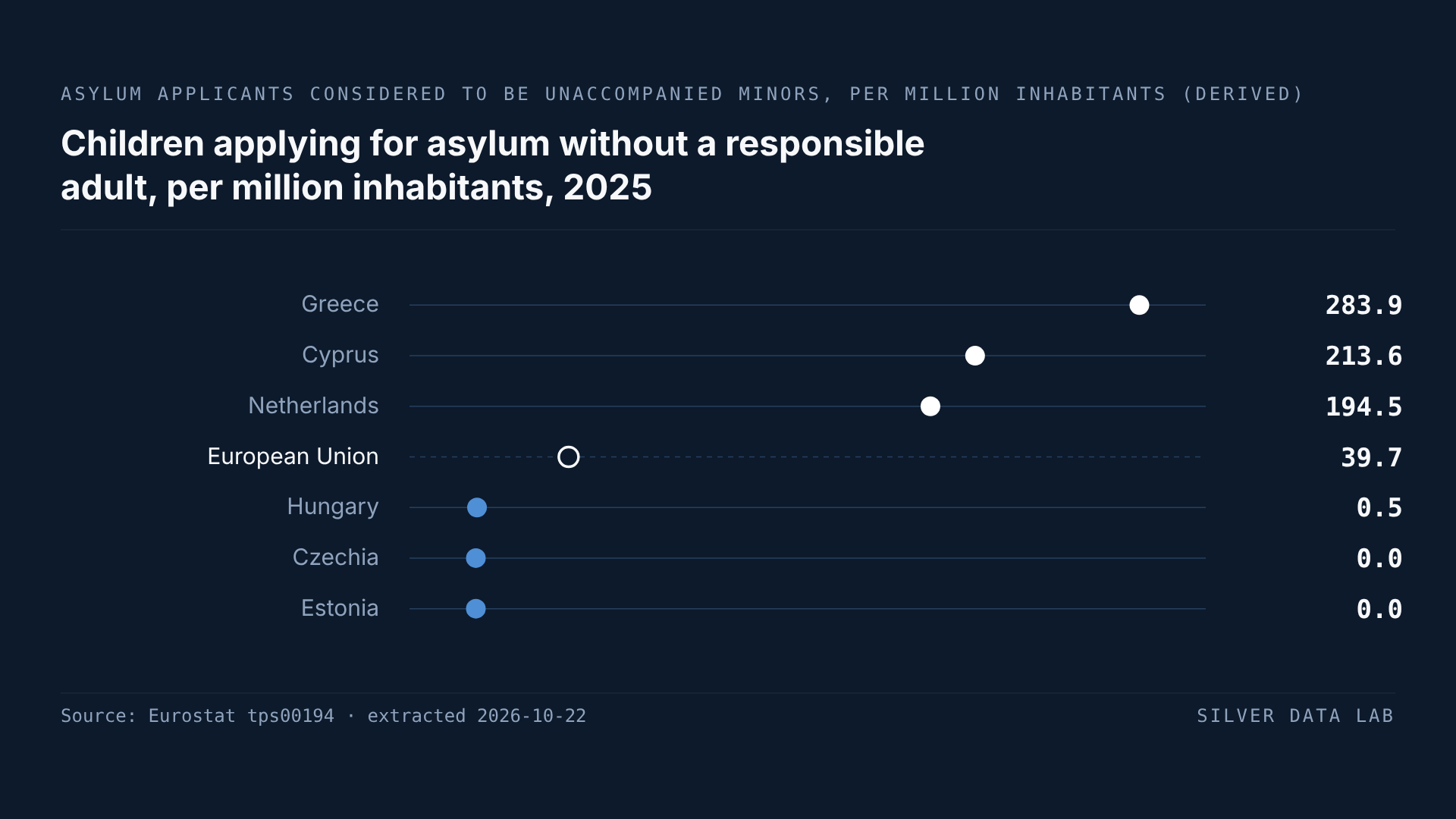
45.9% Fewer Children Sought Asylum Alone in the EU Than a Year Earlier
In 2025, 17,930 children applied for asylum in the EU without a parent or another adult responsible for them, against 33,160 in 2024: a derived fall of 45.9%, to the lowest figure since 2020.
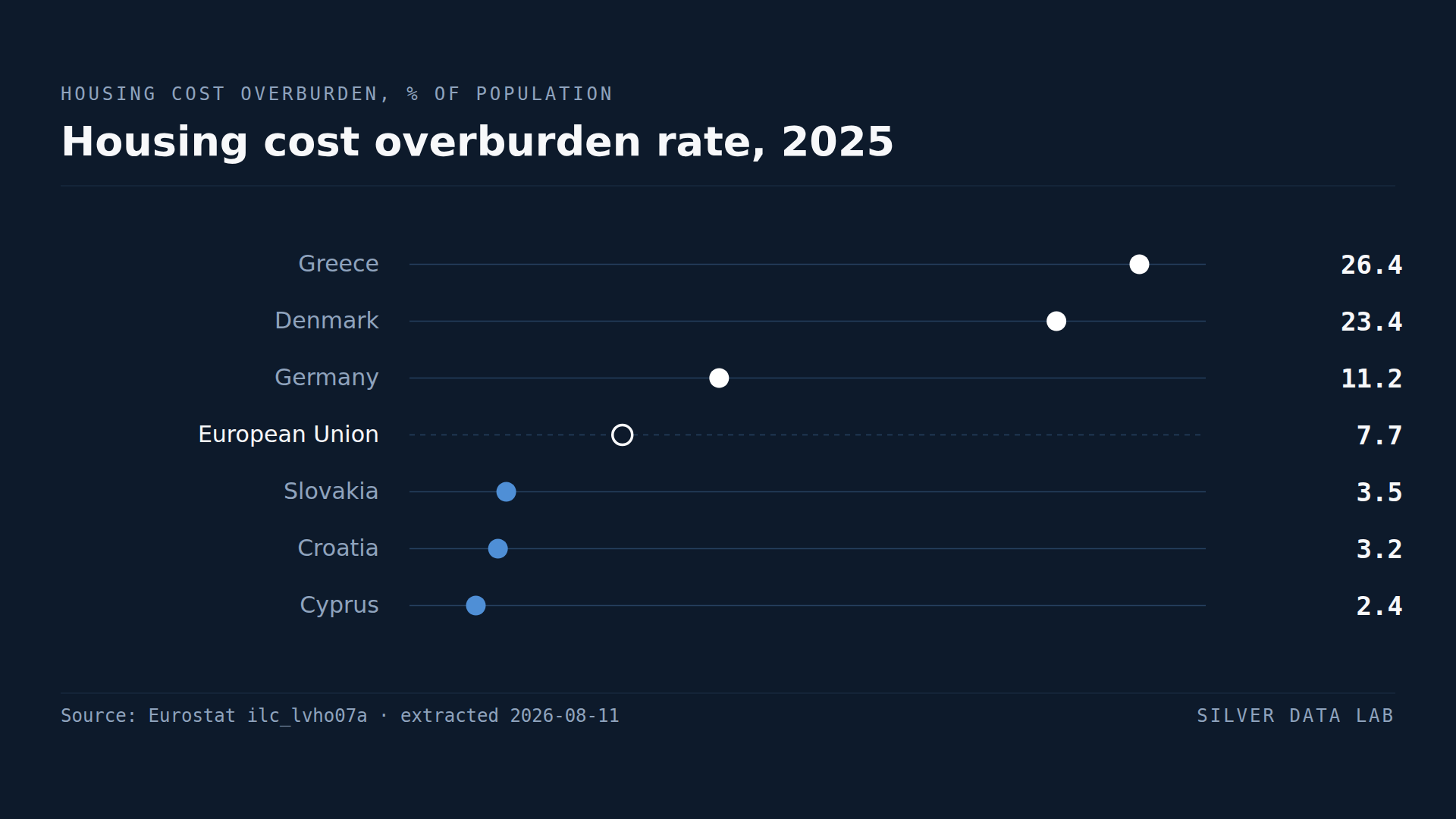
A Quarter of Greeks Spend More Than 40% of Income on Housing
7.7% of the EU population spent more than 40% of disposable income on housing in 2025.
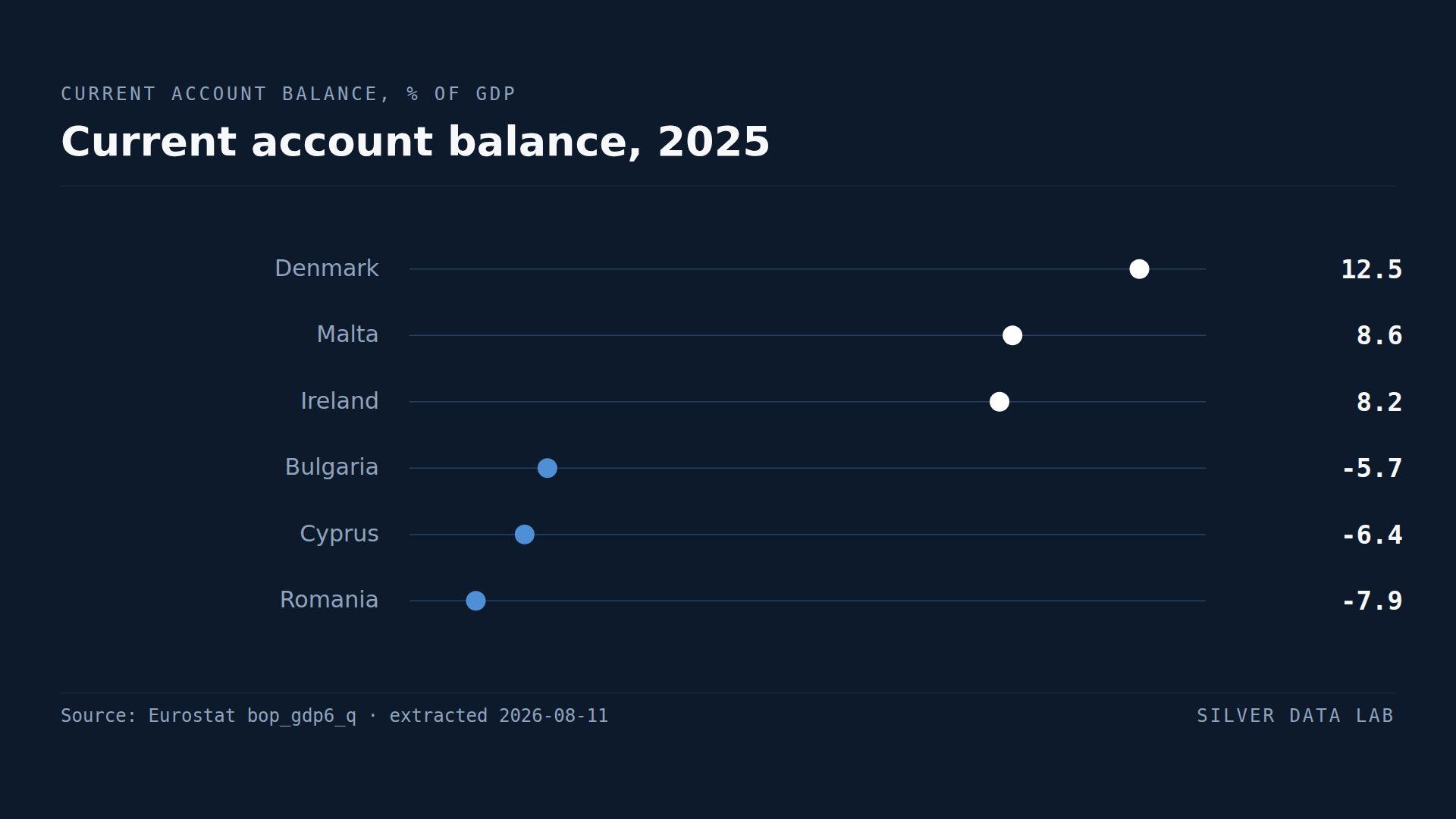
Denmark Has the EU's Biggest Surplus With the World, at 12.3% of GDP
Denmark ran a current account surplus worth 12.3% of GDP in 2025, the largest in the Union.