In the Netherlands, 39.7% of Over-65s Still Live in a Mortgaged Home
Silver Data Lab Research Desk · Statistical analysis · Published on 04 October 2026
This study is open to members only
Its sources, filters and extraction date are declared above, as they are for every study. Sign in to read the analysis in full.
- Data source
- Eurostat
- Reference period
- 2025
- Last updated
- 20 October 2026
Re-checked against the source on 21 October 2026. 16 values in its datasets moved between snapshots, 16 of them figures stated on this page. Every revision we have observed →
Key estimates
- 7.6% of people aged 65 and over in the EU lived in a home with a mortgage or housing loan still outstanding in 2025; 70.1% lived in one owned outright.
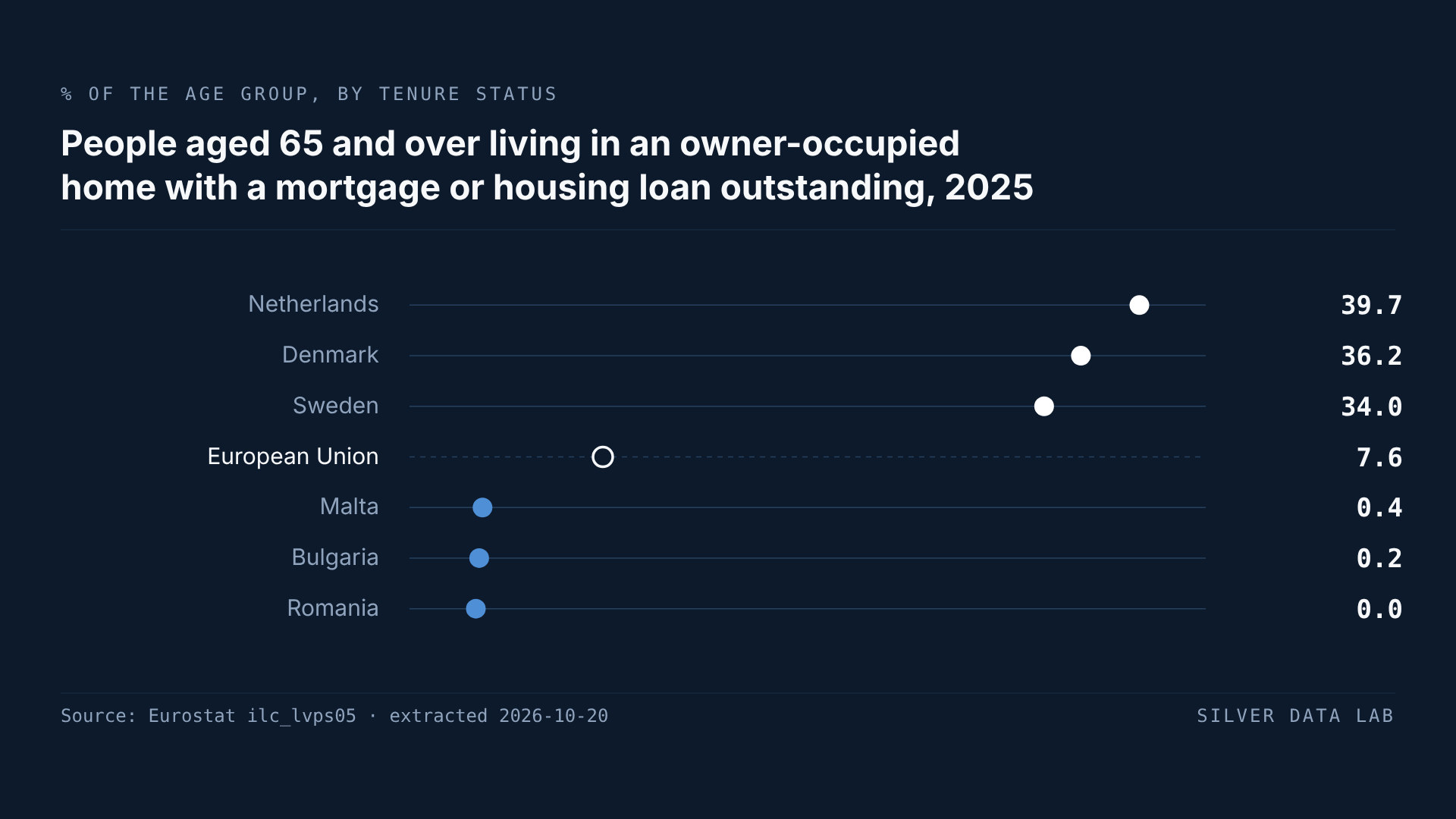
- The Netherlands records 39.7%, Denmark 36.2% and Sweden 34.0%. Germany and Finland follow at 11.5% and 10.4%, and every other Member State is below 8%.
- In the Netherlands and Denmark more over-65s live in a mortgaged home than in one owned outright: 39.7% against 23.5%, and 36.2% against 24.5%.
- In 18 Member States fewer than 5% of over-65s live in a mortgaged home. Romania records 0.0%, Bulgaria 0.2% and Malta 0.4%.
- Across the EU, 54.1% of 25- to 34-year-olds and 77.7% of over-65s live in an owner-occupied home, and the older group is ahead in all 27 Member States.
Owning a home, and still paying for it
For each age group, Eurostat publishes how people are spread across the ways a household can occupy its home: owning it with a mortgage or housing loan still to repay, owning it with nothing left to repay, renting at the market price, or renting at a reduced price or free of charge. Eurostat calls this tenure status. The figures come from EU-SILC, the EU's annual survey of income and living conditions, and describe 2025.
Tenure is recorded for the household, not the individual. Each person is counted under the arrangement of the home they live in, whoever holds the title deed, so a widowed parent living with an adult child's family shares that family's mortgage in this table, and a 30-year-old in the parental home shares the parents' ownership.
Broken down by age, the table shows two things that a single national ownership rate hides. People aged 65 and over are more likely than adults in their late twenties and early thirties to live in an owned home in every Member State. And in most of the Union a home owned after 65 is owned outright, with three clear exceptions.
Older people live in owned homes more often, everywhere
Across the EU, 54.1% of people aged 25 to 34 lived in an owner-occupied home in 2025. From there the share climbs with every ten-year band: 64.5% at 35 to 44, 72.5% at 45 to 54, 75.6% at 55 to 64 and 77.7% from 65 on. The distance between the youngest and the oldest of those groups is 23.6 percentage points, derived from the two published figures.
The over-65s are ahead in all 27 Member States, but the distance varies a great deal. In Finland, 40.2% of 25- to 34-year-olds and 80.1% of over-65s live in an owned home, a difference of 39.9 points and the widest in the Union. Ireland follows at 35.1 points and Germany at 32.3. Germany also has the lowest share for the younger group anywhere in the EU: 24.6% of its 25- to 34-year-olds live in an owner-occupied home, fewer than one in four.
At the narrow end, Slovakia records 92.3% at 25 to 34 and 96.9% at 65 and over, a difference of 4.6 points. Cyprus at 6.9 and Latvia at 7.3 are the next narrowest.
A high figure for young adults is not a buying rate
Because tenure belongs to the household, a young adult who has never bought anything still counts as living in owner-occupied housing while sharing a home the parents own. Where people stay longer in the family home, the figure for the 25-to-34 group rises without any purchase behind it. The three highest figures for that age group, Slovakia's 92.3%, Romania's 87.5% and Croatia's 87.0%, describe where people of that age live, not what they own.
The EU figures carry a trace of the same effect. The share is higher at 18 to 24, at 61.8%, than at 25 to 34, at 54.1%, which is what the measure would show if many of the younger group have not yet left a home their parents own. At 18 to 24 the three lowest shares are Finland's 32.4%, Denmark's 36.4% and Germany's 38.0%.
The mortgage peaks in mid-life and then fades
Across the EU, 24.5% of people aged 25 to 34 live in a home with a mortgage or housing loan outstanding. The share peaks between 35 and 44, at 35.2%, the highest of any adult age band, then falls to 30.1% at 45 to 54, 18.8% at 55 to 64 and 7.6% at 65 and over. By that last age, 70.1% of people in the EU live in a home owned with nothing left to repay.
That curve holds across most of the Union. In 20 of the 27 Member States the mortgaged share is highest between 35 and 44. In Denmark, Germany, Ireland, Portugal and Sweden it peaks a decade later, between 45 and 54. The two remaining countries are Bulgaria, where the share is level at 2.9% at 25 to 34 and at 35 to 44, and Greece, where it is highest at 18 to 24, at 14.3%.
Where the loan outlasts the working life
The Netherlands, Sweden and Denmark break the pattern at its far end. In the Netherlands 39.7% of people aged 65 and over live in a home still carrying a mortgage or housing loan, in Denmark 36.2% and in Sweden 34.0%. Germany comes next at 11.5% and Finland at 10.4%. Every other Member State is below 8%.
In the Netherlands and Denmark the mortgaged home is the more common form of ownership after 65: 39.7% against 23.5% owning outright in the Netherlands, 36.2% against 24.5% in Denmark. No other Member State shows that. In Sweden outright owners remain ahead among over-65s, at 38.6%.
The same three countries head the EU in the two age bands before 65. At 45 to 54 the Netherlands records 68.4% in a mortgaged home, Denmark 60.4% and Sweden 57.1%; at 55 to 64 the Netherlands records 57.3%, Sweden 53.7% and Denmark 50.8%. The Netherlands also has the highest share at 35 to 44, 68.6%. Set beside those figures, the share after 65 reads less as an anomaly than as the last stage of a pattern in which housing loans stay common to the end of working life.
The table records that a loan is outstanding, nothing more. It does not say how large the remaining balance is, whether the loan is being paid down, or whether it will be carried until the home is sold.
Where housing loans are almost absent
At the other end of the ranking, Romania records 0.0% of over-65s in a mortgaged home, Bulgaria 0.2% and Malta 0.4%. In 18 Member States the share is below 5%. The four highest shares of over-65s in a home owned outright are Romania's 97.9%, Croatia's 95.4%, Lithuania's 93.5%, a provisional figure, and Slovakia's 93.3%.
In Romania and Bulgaria the housing loan is close to absent at every age: across their whole populations, 1.1% and 1.7% live in a mortgaged home, and no age group in either country is above 3.0%. In those two countries the life-course curve described above barely exists.
Two different things called ownership
A single ownership rate mixes all these stages together, and in a few countries the mix runs against the life-course pattern. In the Netherlands, 80.2% of children under 18 live in an owner-occupied home, against 63.3% of people aged 65 and over. Denmark, Latvia and, narrowly, Austria are the other Member States where children are more likely than over-65s to live in an owned home; in the remaining 23 the older group leads.
The one word also covers two arrangements that the tenure split keeps apart. The Netherlands and Greece have almost the same overall ownership rate, 68.7% and 69.3%. In the Netherlands 57.9% of the population lives in a mortgaged home and 10.8% in one owned outright; in Greece the figures are 8.9% and 60.4%. Denmark's split, 45.5% and 12.8%, leans the Dutch way, while in 13 Member States, Greece, Romania, Bulgaria and Croatia among them, outright owners outnumber mortgaged ones in every age group. The same ownership rate can describe a country where the home is largely paid for and one where it is largely still being paid for.
People aged 65 and over living in an owner-occupied home with a mortgage or housing loan outstanding, 2025
| Country | % of people aged 65 and over | Gap to EU averagepercentage points, derived |
|---|---|---|
| Netherlands | 39.7 | +32.1 |
| Denmark | 36.2 | +28.6 |
| Sweden | 34.0 | +26.4 |
| European Unionaggregate | 7.6 | — |
| Malta | 0.4 | −7.2 |
| Bulgaria | 0.2 | −7.4 |
| Romania | 0.0 | −7.6 |
This table as data: CSV · JSON
Every Member State for this indicator+
Members see every Member State for this indicator here, not only the rows the ranking prints. Become a Member
Difference in home ownership between people aged 65 and over and people aged 25 to 34, 2025
| Country | percentage points, 65 and over minus 25 to 34 | Gap to EU averagepercentage points, derived |
|---|---|---|
| Finland | 39.9 | +16.3 |
| Ireland | 35.1 | +11.5 |
| Germany | 32.3 | +8.7 |
| European Unionaggregate | 23.6 | — |
| Latvia | 7.3 | −16.3 |
| Cyprus | 6.9 | −16.7 |
| Slovakia | 4.6 | −19.0 |
This table as data: CSV · JSON
Every Member State for this indicator+
Members see every Member State for this indicator here, not only the rows the ranking prints. Become a Member
What these figures cannot tell you
- Tenure belongs to the household
- Every member of a household is counted under the household's tenure. A young adult in the parental home counts as living in owner-occupied housing, and an older person living in a child's mortgaged home counts as living in a mortgaged home. The figures describe where people of each age live, not what they personally own or owe.
- Any outstanding loan counts the same
- The mortgaged category includes every owner household with a mortgage or housing loan still outstanding on the home it lives in, whatever the balance. A loan nearly paid off and one just taken out look identical, so the shares say how widespread housing debt is at each age and nothing about its size.
- Lithuania is provisional and Luxembourg has a break
- Eurostat flags Lithuania's 2025 values as provisional and Luxembourg's as a break in series, which means Luxembourg's 2025 figures are not fully comparable with its earlier years. Neither country appears in the rankings shown here, but both are included in the counts of Member States given in the text, and Lithuania's figure for outright ownership after 65 is quoted there as provisional. Narrow age bands in small Member States also rest on fewer survey respondents than national totals.
- A different table from the overall ownership rate
- Eurostat publishes tenure for the whole population in a separate table, by household type and income, which the site's study of home ownership uses. The two tables do not match exactly for all ages combined, so a figure from one should not be set against a figure from the other. Every value in this study comes from the age table.
Frequently asked questions
- How many older people in the EU still have a mortgage?
- In 2025, 7.6% of people aged 65 and over in the EU lived in a home with a mortgage or housing loan still outstanding, and 70.1% in a home owned outright. The rest were tenants.
- Which EU country has the most over-65s with a mortgage?
- The Netherlands, at 39.7% in 2025, followed by Denmark at 36.2% and Sweden at 34.0%. In the Netherlands and Denmark more over-65s live in a mortgaged home than in one owned outright. Germany is fourth at 11.5%.
- How many young adults in the EU live in an owner-occupied home?
- 54.1% of people aged 25 to 34 in 2025, against 77.7% of over-65s. Germany records the lowest share for the younger group, 24.6%. The figure counts young adults living in a home their parents own, so it is not the share who have bought.
- At what age are Europeans most likely to be paying off a home?
- Between 35 and 44: 35.2% of that age group across the EU lived in a home with a mortgage or housing loan outstanding in 2025, the highest of any adult age band. It is the single highest band in 20 of the 27 Member States, and in Bulgaria it is level with 25 to 34; the Netherlands records 68.6% at that age.
Methodological note
Eurostat publishes, from EU-SILC, the distribution of the population of each age group across tenure status: owner with a mortgage or housing loan outstanding, owner with none, tenant at market rent, and tenant at a reduced rent or rent-free. This study uses the three owner categories (all owners, owners with a loan, owners without one) for men and women together, for six adult age bands from 18 to 24 up to 65 and over, for children under 18 and for all ages, in 2025. All 27 Member States are covered; Lithuania's values are provisional and Luxembourg's carry a break in series.
The EU figures are Eurostat's own aggregate and are used as published. Silver Data Lab derived three things from the published shares: the difference in ownership between people aged 65 and over and those aged 25 to 34, by subtraction, for each Member State and the EU; the adult age band in which each Member State's mortgaged share is highest; and the counts of Member States meeting a stated condition, such as a mortgaged share below 5% after 65. Nothing else is computed.
Source data
The underlying series can be inspected and re-downloaded from the Eurostat data browser. The filters below are the ones applied.
Distribution of population by sex, age and tenure status
ilc_lvps05
- Filters applied:
- freq=A · tenure=OWN, OWN_L, OWN_NL · sex=T · age=TOTAL, Y_LT18, Y18-24, Y25-34, Y35-44, Y45-54, Y55-64, Y_GE65 · unit=PC · time=2025
- Extracted:
- 2026-10-21
- Source last updated:
- 2026-10-20
Download the data
The data the study you have just read is built on, exactly as it was downloaded and archived.
Yours as a Member.
Data downloadable by Members
How to cite
Record the vintage as well as the study: the figures on this page are the ones extracted on the dates below.
Silver Data Lab Research Desk (2026). In the Netherlands, 39.7% of Over-65s Still Live in a Mortgaged Home. Silver Data Lab, published 04 October 2026, last updated 20 October 2026. https://www.silverdatalab.com/studies/home-ownership-by-age-in-the-eu
- Data: Eurostat, Distribution of population by sex, age and tenure status (ilc_lvps05), filters freq=A, tenure=OWN, OWN_L, OWN_NL, sex=T, age=TOTAL, Y_LT18, Y18-24, Y25-34, Y35-44, Y45-54, Y55-64, Y_GE65, unit=PC, time=2025; extracted 2026-10-21; source last updated 2026-10-20. https://doi.org/10.2908/ilc_lvps05
Silver Data Lab's analysis is licensed CC BY 4.0. The statistics remain their publisher's and keep its terms of reuse.
Ask the research desk
A question about this study — a definition, a filter, a break in the series, what the figures can and cannot support — answered by the desk that made the extraction.
Members can write to the research desk
Studies where the same country leads or trails
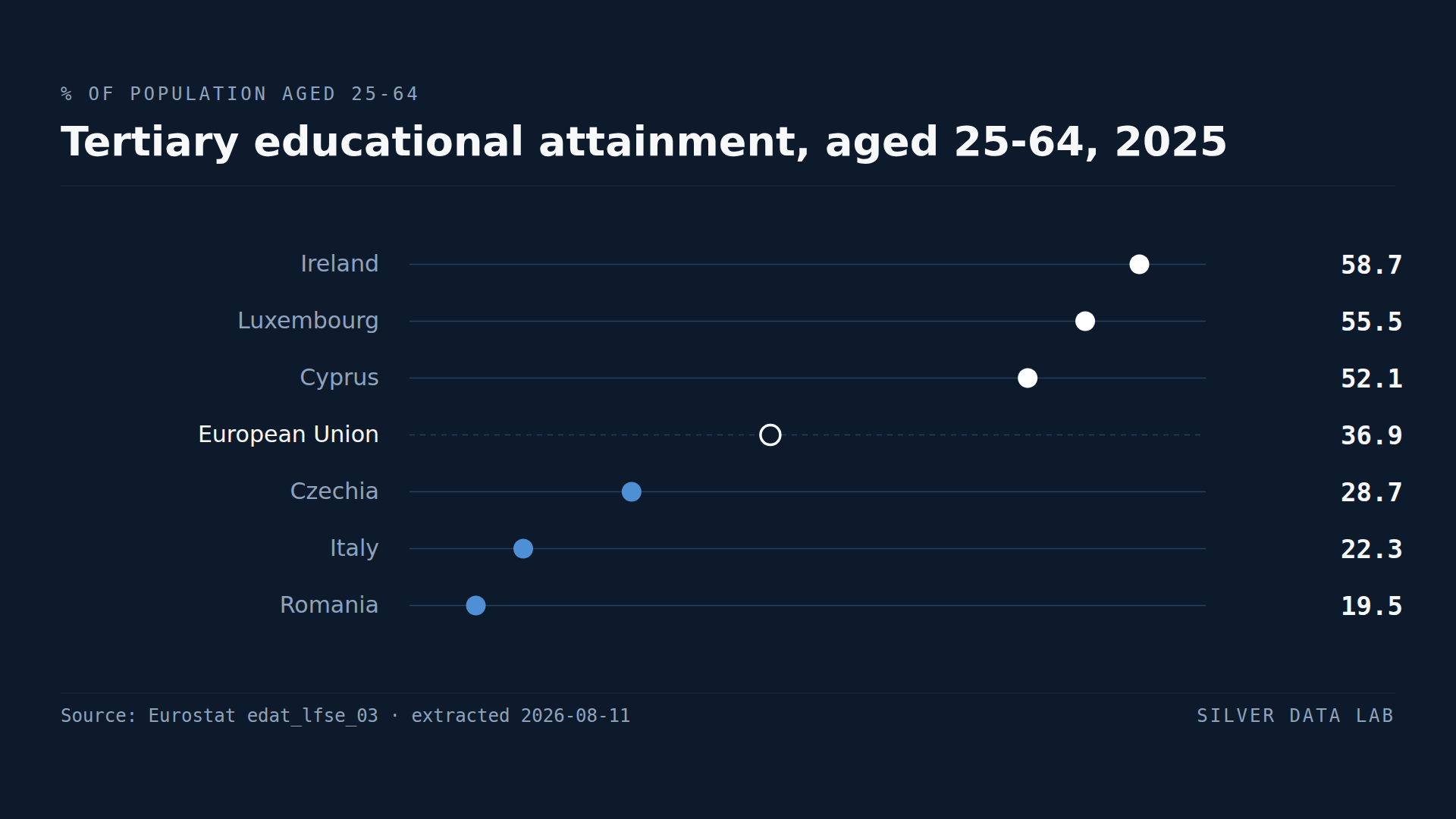
A Degree Is Three Times as Common Among Adults in Ireland as in Romania
36.9% of people aged 25 to 64 in the EU held a tertiary qualification in 2025.
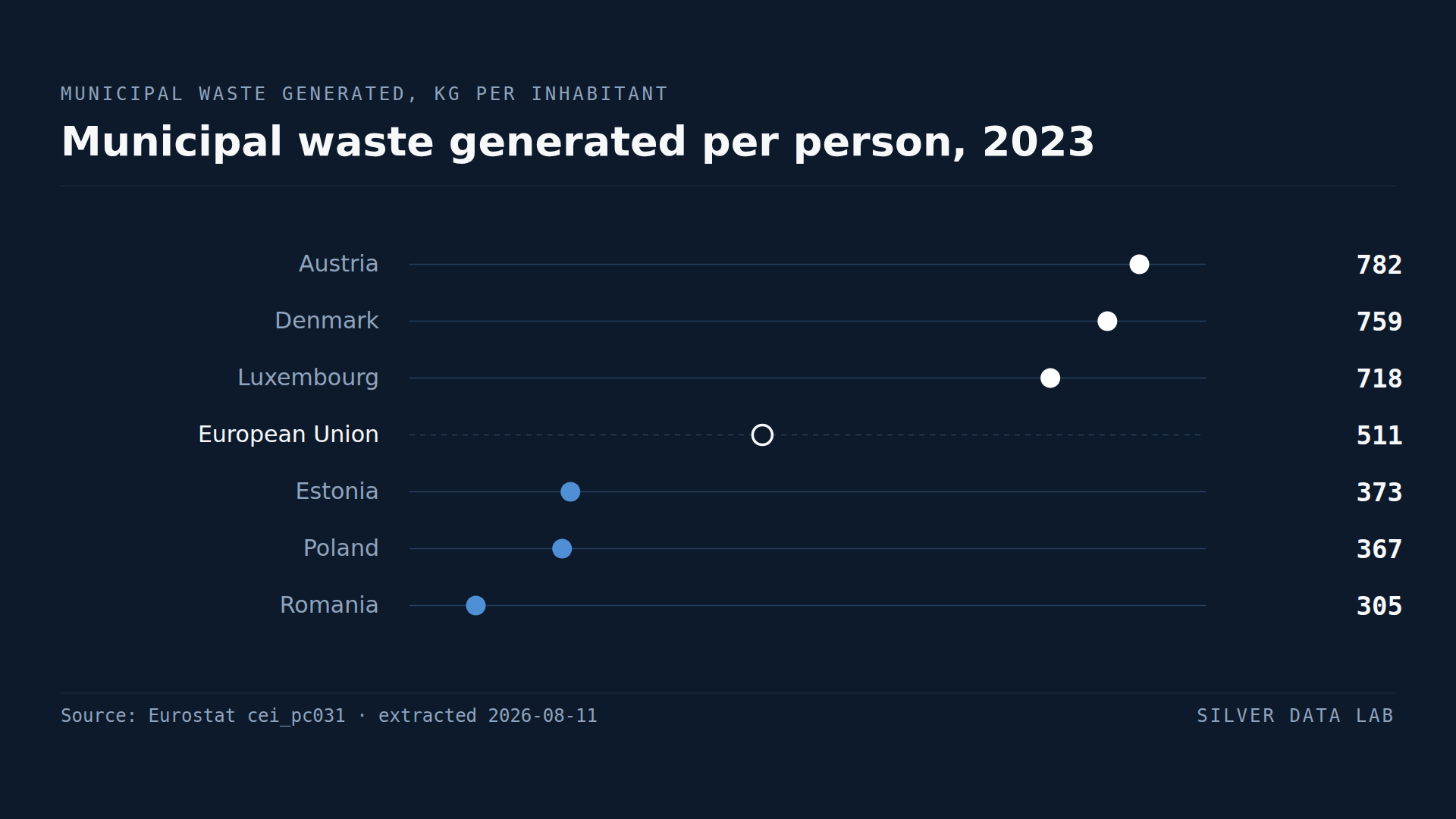
Austria Produces More Rubbish per Person Than Any Other EU Country
The EU generated 510 kg of municipal waste per inhabitant in 2023 — about 1.4 kg per person per day.
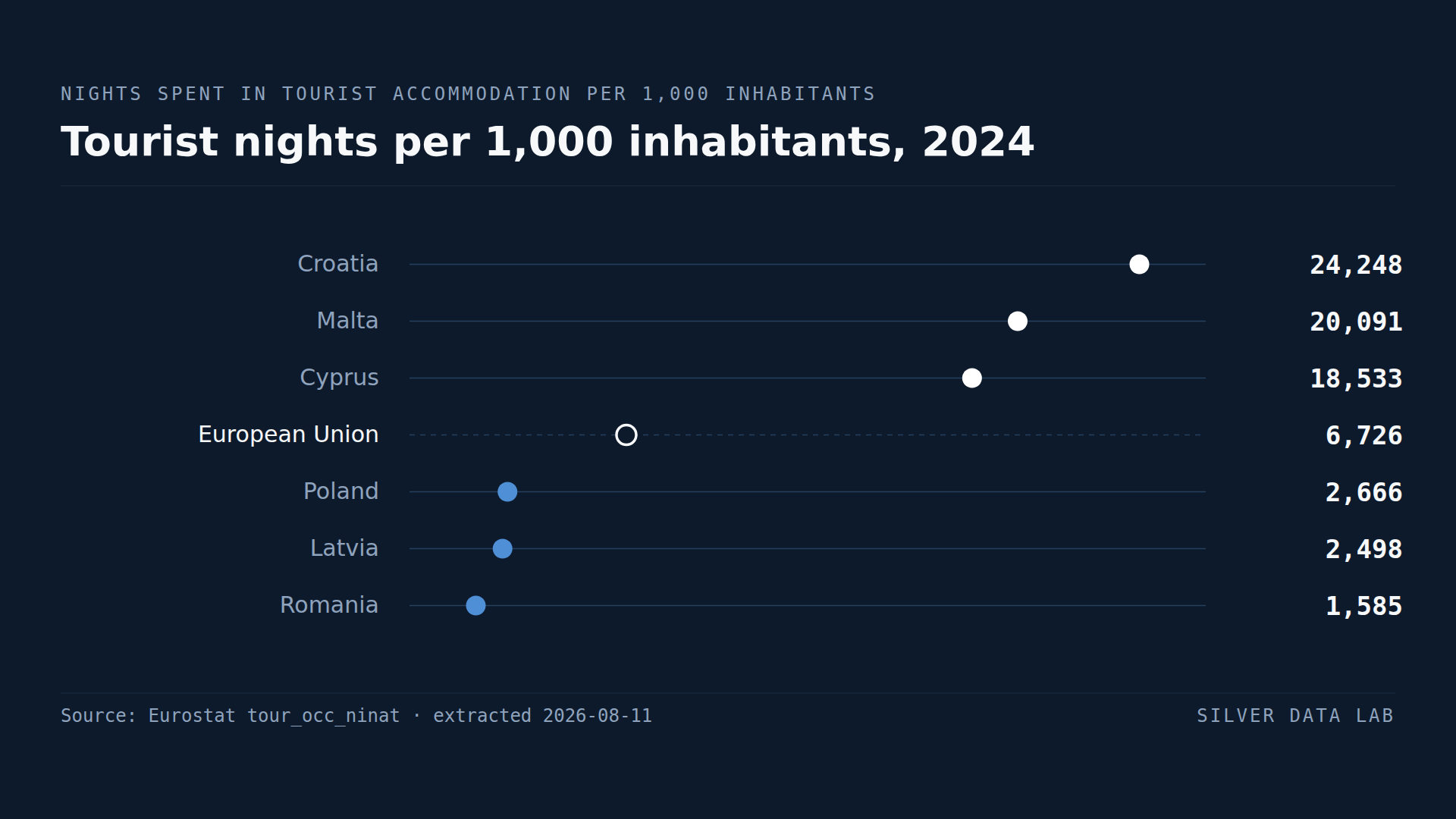
For Its Population, Croatia Has the Most Tourist Overnight Stays in the EU
The EU recorded 6,978 tourist nights per 1,000 inhabitants in 2025, about 7.0 nights per resident.