Poland's Government Sets Aside Just 20 Cents per Person for Farm Research
Silver Data Lab Research Desk · Statistical analysis · Published on 09 August 2026
This study is open to members only
Its sources, filters and extraction date are declared above, as they are for every study. Sign in to read the analysis in full.
- Data source
- Eurostat
- Reference period
- 2025
- Last updated
- 11 October 2026
Re-checked against the source on 26 September 2026. No value in its datasets has moved between the snapshots we hold. Every revision we have observed →
Key estimates
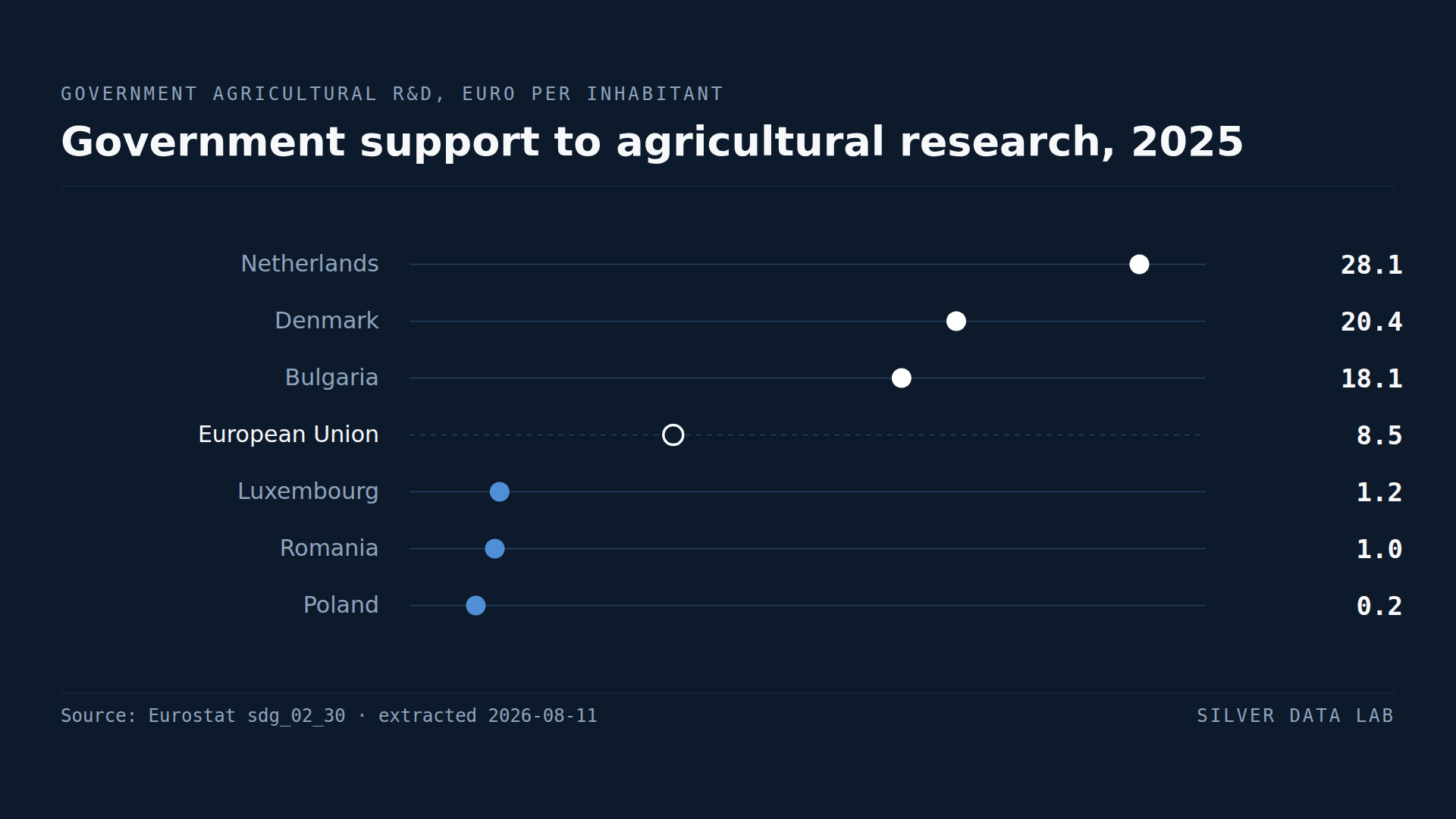
- EU governments budgeted 8.5 euro per inhabitant for agricultural research and development in 2025.
- The Netherlands records 28.1 euro per inhabitant, Denmark 20.4 and Bulgaria 18.1.
- Poland records 0.2 euro — the Dutch figure is 140 times larger.
- Ten Member States are above the EU figure and seventeen below it.
- Bulgaria in third place has the Union's second-lowest agricultural productivity, so the ranking does not follow farm performance.
Public money for farm science
Government budget allocations for research and development are classified by objective, and agriculture is one of them. This indicator reports what each Member State's government budgets for agricultural research, per inhabitant.
For the EU in 2025 the figure was 8.5 euro per person.
The distribution is very uneven and, unusually, does not follow the size of the agricultural sector it is meant to support.
The Netherlands and Denmark
The Netherlands records 28.1 euro per inhabitant and Denmark 20.4.
Both are small countries with intensive, export-oriented agriculture and long-established agricultural research institutions. The Dutch position sits with the rest of what this site records about Dutch farming. The Netherlands produces 39.3 billion euro of agricultural output, sixth in the Union, on a fraction of the land of the five countries above it; it records the third-highest ammonia emissions per hectare, behind only Malta and Cyprus, which are islands with very little farmland; and it now records the highest public research budget per head. Intensity, in the Dutch case, is a deliberately maintained condition rather than an accident of geography.
Bulgaria
Bulgaria records 18.1 euro per inhabitant, third in the Union, ahead of Germany, France and Italy.
This is the entry that prevents a simple reading. Bulgaria has one of the Union's least productive agricultural sectors — 13.3% of its workforce in agriculture producing 2.8% of value added — and one of its highest budget allocations for agricultural research per head.
A high research budget in a low-productivity sector is not a contradiction; it may be a response to exactly that condition. But it does mean this indicator cannot be read as a measure of how advanced a country's agriculture is, because the Member State ranked third would then be misplaced by any other measure.
The bottom
Poland records 0.2 euro per inhabitant, Romania 1.0, Luxembourg 1.2, Slovakia 1.6 and Portugal 2.0.
Poland is the striking case. It is the Union's fifth-largest agricultural producer by output value, with 45.3 billion euro of farm production in 2025 — declared below from the agricultural accounts rather than inferred — and it budgets 0.2 euro per inhabitant for agricultural research, a fortieth of the EU figure and a hundred and fortieth of the Dutch one.
Romania at 1.0 euro is in a comparable position: a large agricultural workforce, substantial output, and minimal public research budget.
What is being measured
These are budget allocations rather than expenditure, and they are government allocations rather than total research spending. Private agricultural research — by seed companies, machinery manufacturers and food processors — is not included, and it is substantial in several of the Member States that rank low here.
That is the main caution attached to this ranking. A country can have a well-funded agricultural research base that this indicator does not see, because the funding is private. What the indicator shows is the choice governments make about how much public money to direct at the problem.
Government support to agricultural research, 2025
| Country | euro per inhabitant | Gap to EU averagederived |
|---|---|---|
| Netherlands | 28.1p | +19.6 |
| Denmark | 20.4 | +11.9 |
| Bulgaria | 18.1 | +9.6 |
| European Unionaggregate | 8.5p | — |
| Luxembourg | 1.2p | −7.3 |
| Romania | 1.0p | −7.5 |
| Poland | 0.2 | −8.3 |
Flags carried by the source on these values: p provisional
This table as data: CSV · JSON
Every Member State for this indicator+
Members see every Member State for this indicator here, not only the rows the ranking prints. Become a Member
What these figures cannot tell you
- Budget allocations, not expenditure
- The series records what governments budget for agricultural research, which may differ from what is ultimately spent. It is an indicator of intention as much as of activity.
- Public funding only
- Private agricultural research by seed, machinery, chemical and food companies is excluded and is substantial in several Member States. A low figure here does not mean a country has little agricultural research.
- Per inhabitant, not per farm or hectare
- Dividing by total population rather than by agricultural area or agricultural workforce favours small countries and penalises those with large rural sectors. It is used for comparability with other public spending measures.
- Classification by objective is imprecise
- Research is assigned to the agricultural objective by national budget authorities. Work spanning food, environment and biotechnology may be classified differently between Member States.
Frequently asked questions
- How much do EU governments spend on agricultural research?
- 8.5 euro per inhabitant in 2025, measured as government budget allocations for research with an agricultural objective. The figure excludes private research spending.
- Which EU country spends the most on farm research?
- The Netherlands, at 28.1 euro per inhabitant in 2025, followed by Denmark at 20.4 and Bulgaria at 18.1. Bulgaria's position is unexpected: it has one of the Union's least productive agricultural sectors and one of its highest public research budgets per head.
- Which EU country spends the least?
- Poland, at 0.2 euro per inhabitant — a fortieth of the EU figure, despite being the Union's fifth-largest agricultural producer by output value. Romania follows at 1.0 euro.
- Does this include all agricultural research?
- No. Only government budget allocations are counted. Research funded by seed companies, machinery manufacturers, chemical firms and food processors is excluded, and it is substantial in several Member States that rank low here.
Methodological note
Eurostat publishes government budget allocations for research and development by socio-economic objective. This study uses the agriculture objective, expressed in euro per inhabitant.
Values are for 2025 and cover all 27 Member States.
The counts of Member States above and below the EU figure, and the ratio between the highest and lowest, are derived by Silver Data Lab. The comparisons with agricultural employment, output and productivity draw on companion studies in the agriculture category, each with its own extraction.
Source data
This study draws on 2 datasets from Eurostat. Each can be inspected and re-downloaded from its catalogue, and the filters below are the ones applied.
Government support to agricultural research and development
sdg_02_30
- Filters applied:
- freq=A · nabs07=NABS08 · unit=EUR_HAB · time=2025
- Extracted:
- 2026-09-26
- Source last updated:
- 2026-09-25
Economic accounts for agriculture — output at basic prices
aact_eaa01
- Filters applied:
- freq=A · am_item=AM160000 · indic_agr=PRD_BP · unit=MIO_EUR · time=2025
- Extracted:
- 2026-08-11
- Source last updated:
- 2026-05-13
Download the data
The data the study you have just read is built on, exactly as it was downloaded and archived.
Yours as a Member.
Data downloadable by Members
How to cite
Record the vintage as well as the study: the figures on this page are the ones extracted on the dates below.
Silver Data Lab Research Desk (2026). Poland's Government Sets Aside Just 20 Cents per Person for Farm Research. Silver Data Lab, published 09 August 2026, last updated 11 October 2026. https://www.silverdatalab.com/studies/agricultural-research-spending-in-the-eu
- Data: Eurostat, Government support to agricultural research and development (sdg_02_30), filters freq=A, nabs07=NABS08, unit=EUR_HAB, time=2025; extracted 2026-09-26; source last updated 2026-09-25. https://doi.org/10.2908/sdg_02_30
- Data: Eurostat, Economic accounts for agriculture — output at basic prices (aact_eaa01), filters freq=A, am_item=AM160000, indic_agr=PRD_BP, unit=MIO_EUR, time=2025; extracted 2026-08-11; source last updated 2026-05-13. https://doi.org/10.2908/aact_eaa01
Silver Data Lab's analysis is licensed CC BY 4.0. The statistics remain their publisher's and keep its terms of reuse.
Ask the research desk
A question about this study — a definition, a filter, a break in the series, what the figures can and cannot support — answered by the desk that made the extraction.
Members can write to the research desk
Other studies on the same dataset
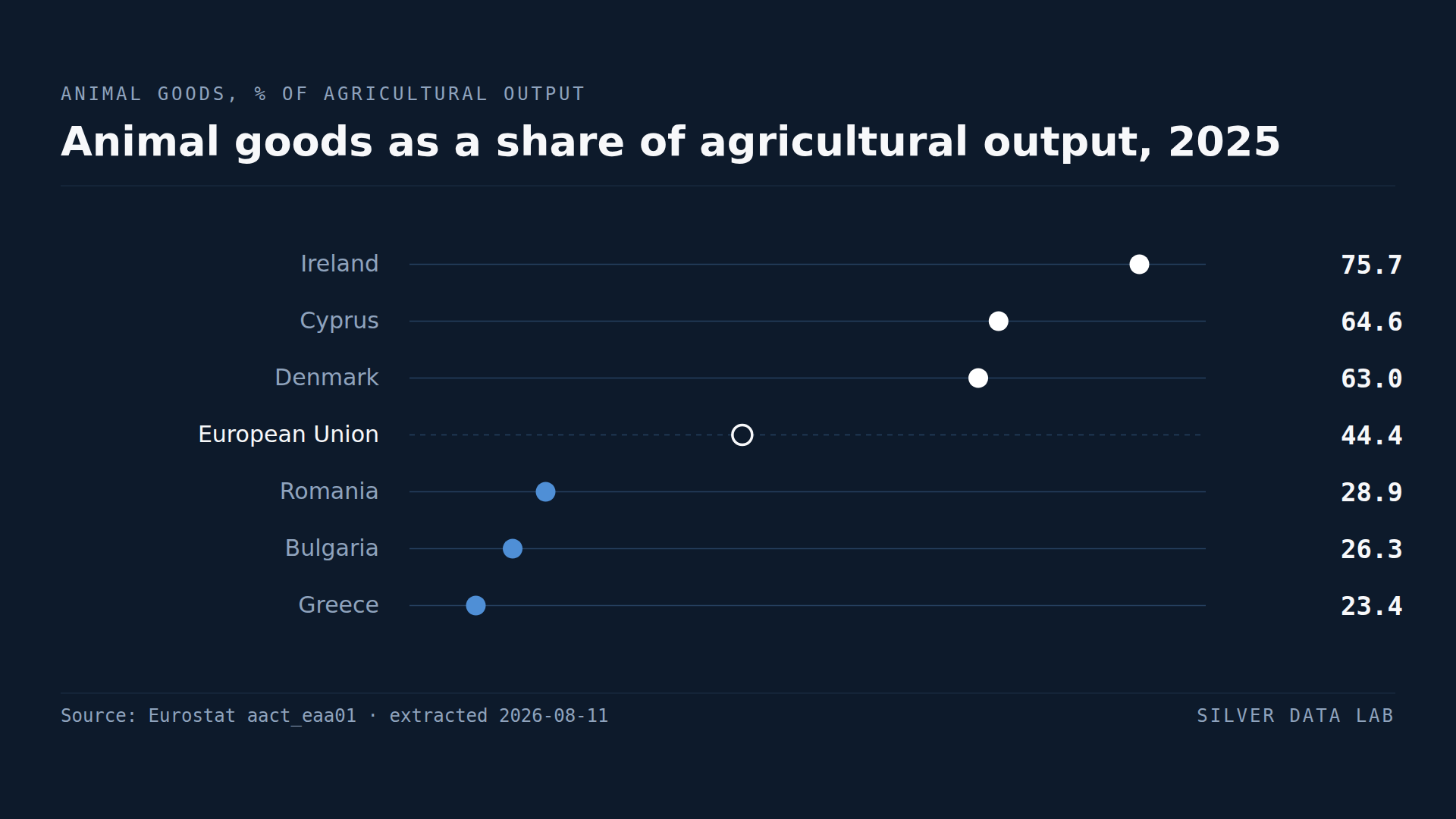
Three Quarters of Irish Farm Output Comes From Animals
Animal goods accounted for 44.4% of EU agricultural output by value in 2025.
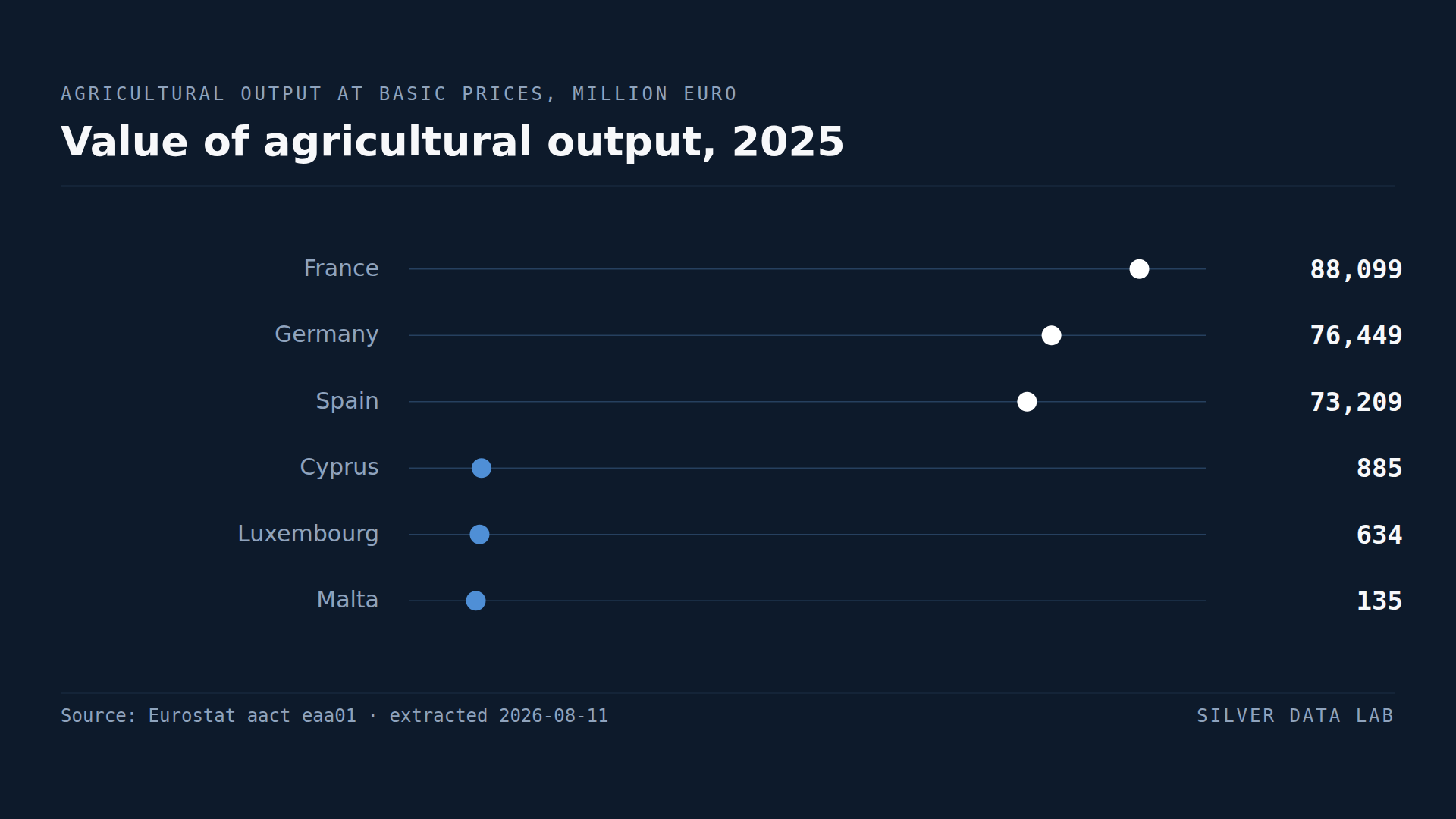
Four Countries Produce More Than Half of the EU's Farm Output
EU agricultural output was worth 541.7 billion euro at basic prices in 2025.
Studies where the same country leads or trails
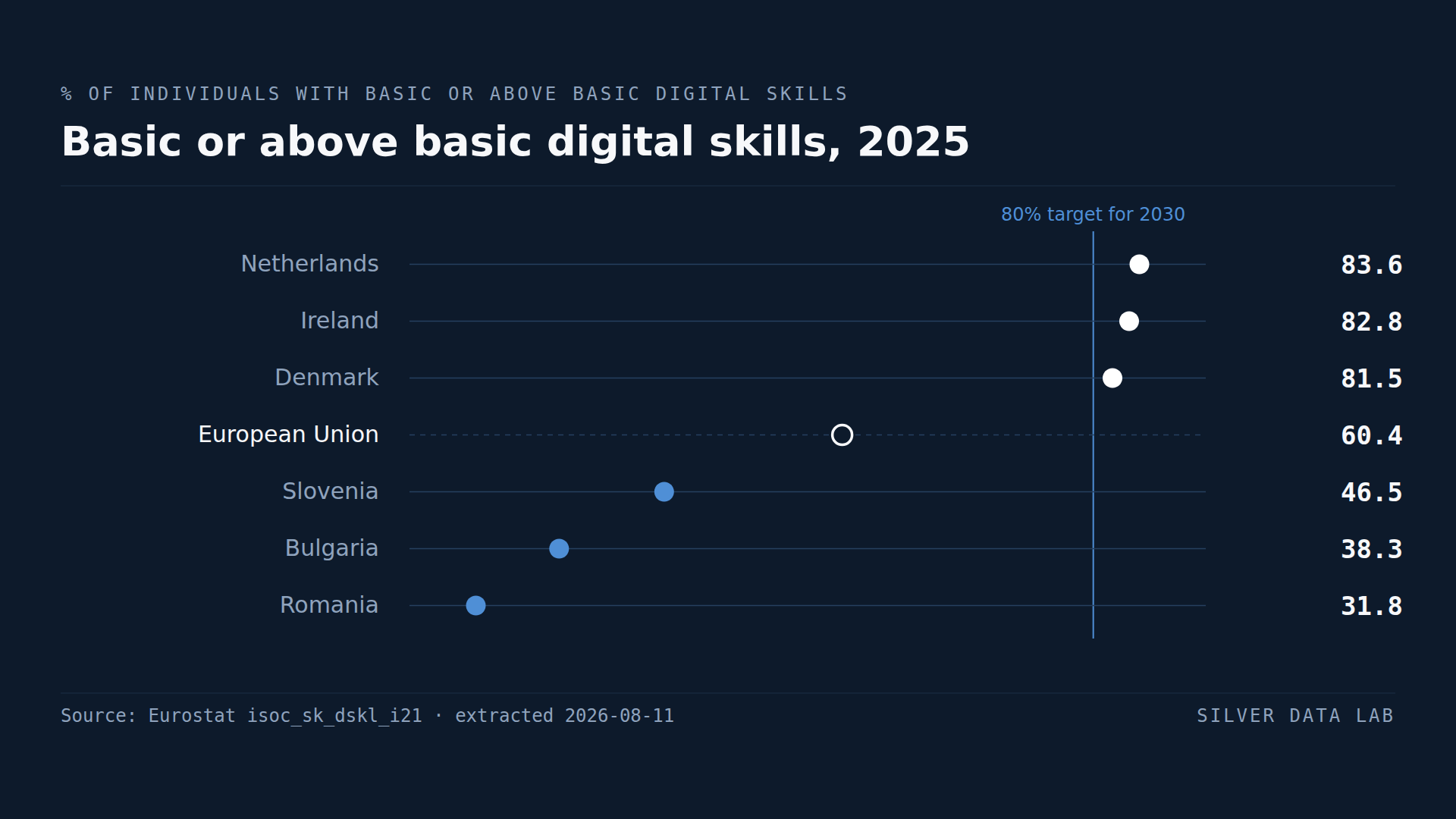
In Four EU Countries, Over 80% of People Have Basic Digital Skills
60.4% of people in the EU had at least basic overall digital skills in 2025, against the 80% the Union targets for 2030.
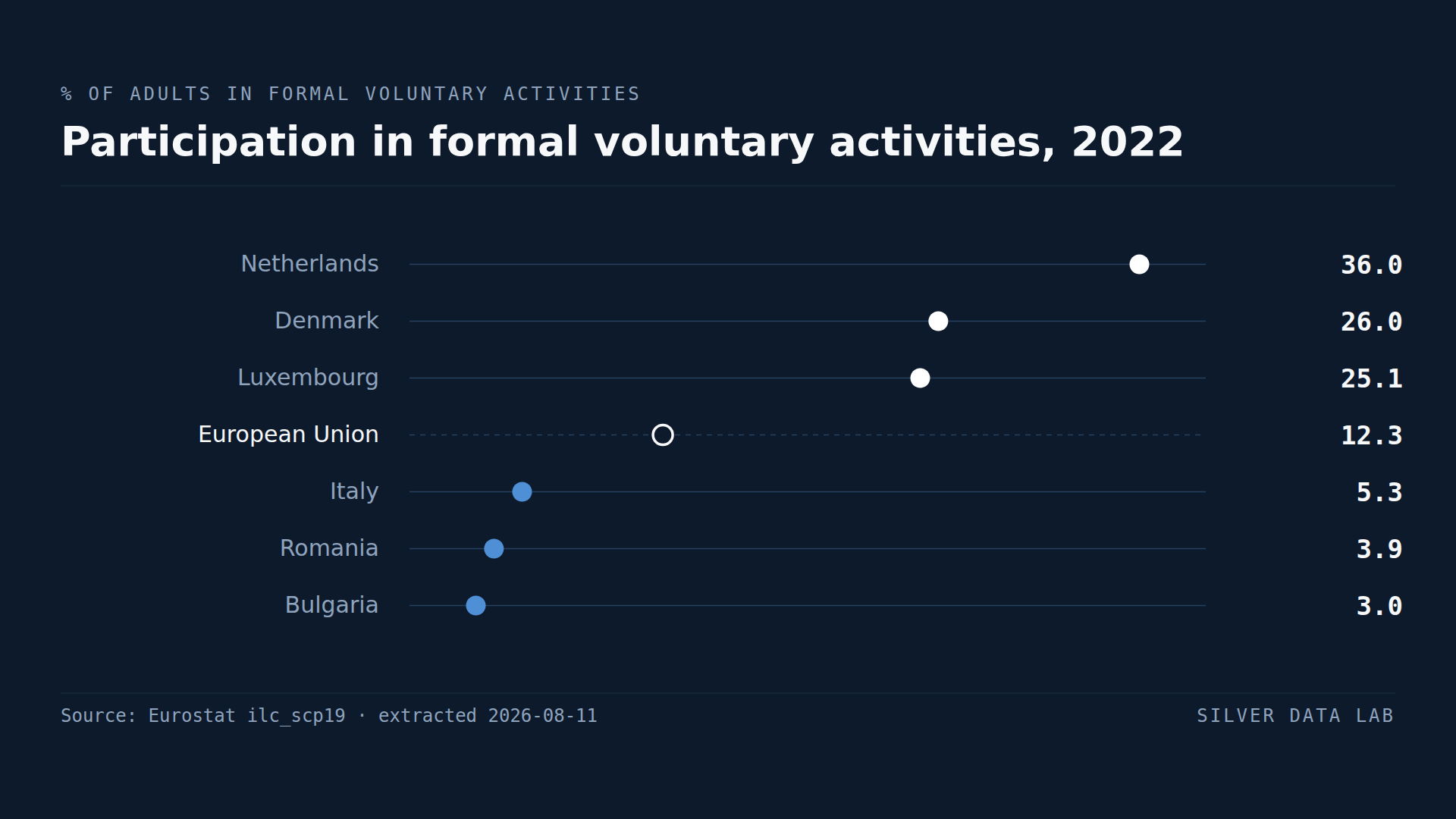
More Than a Third of Dutch Adults Do Voluntary Work
12.3% of EU adults took part in formal voluntary activities in 2022.
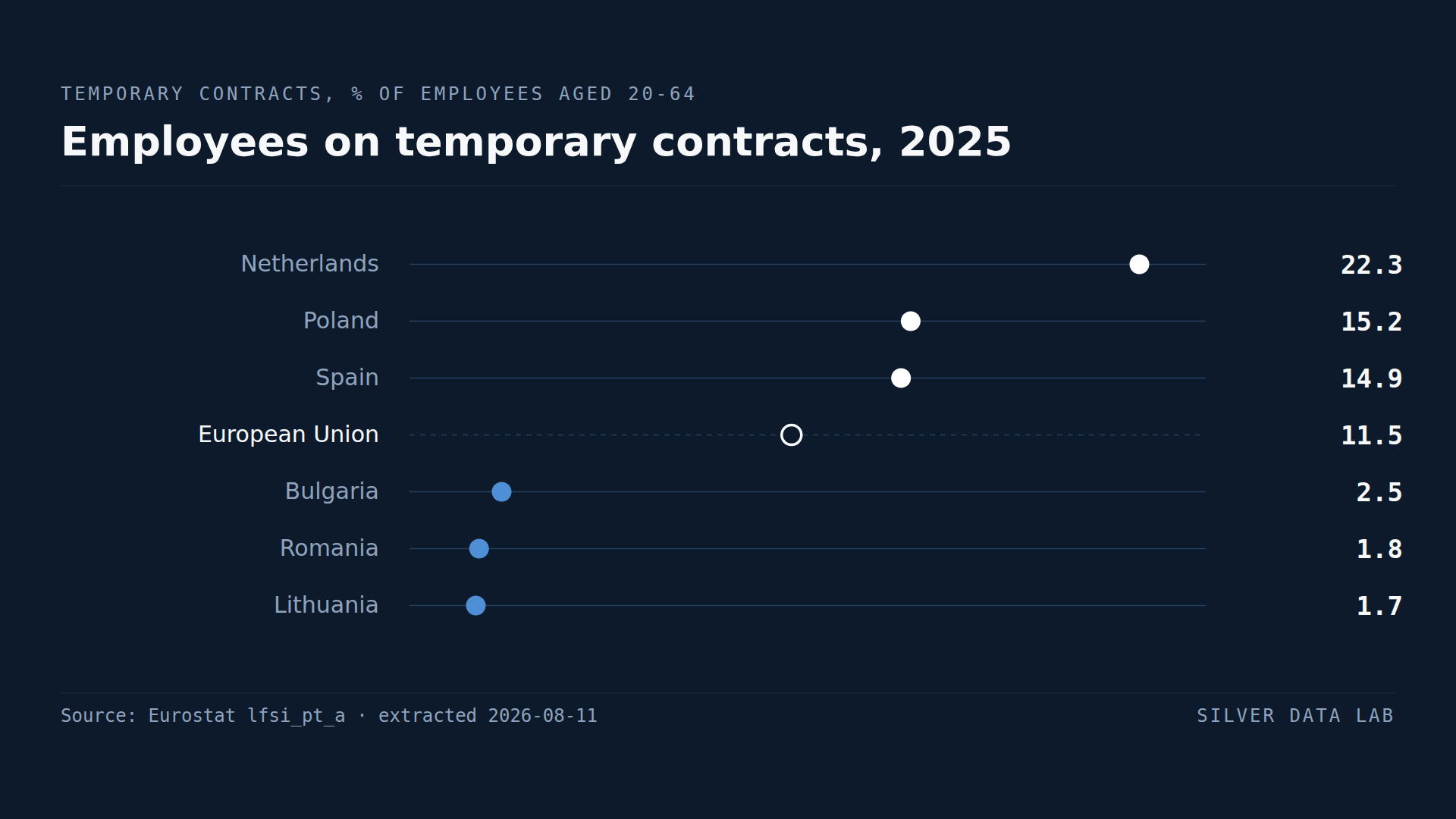
More Than One Dutch Employee in Five Is on a Temporary Contract
11.5% of employees aged 20 to 64 in the EU were on temporary contracts in 2025.