In Four EU Countries, Over 80% of People Have Basic Digital Skills
Silver Data Lab Research Desk · Statistical analysis · Published on 20 April 2026
- Data source
- Eurostat
- Reference period
- 2025
- Last updated
- 18 October 2026
Re-checked against the source on 11 August 2026. No value in its datasets has moved between the snapshots we hold. Every revision we have observed →
Key estimates
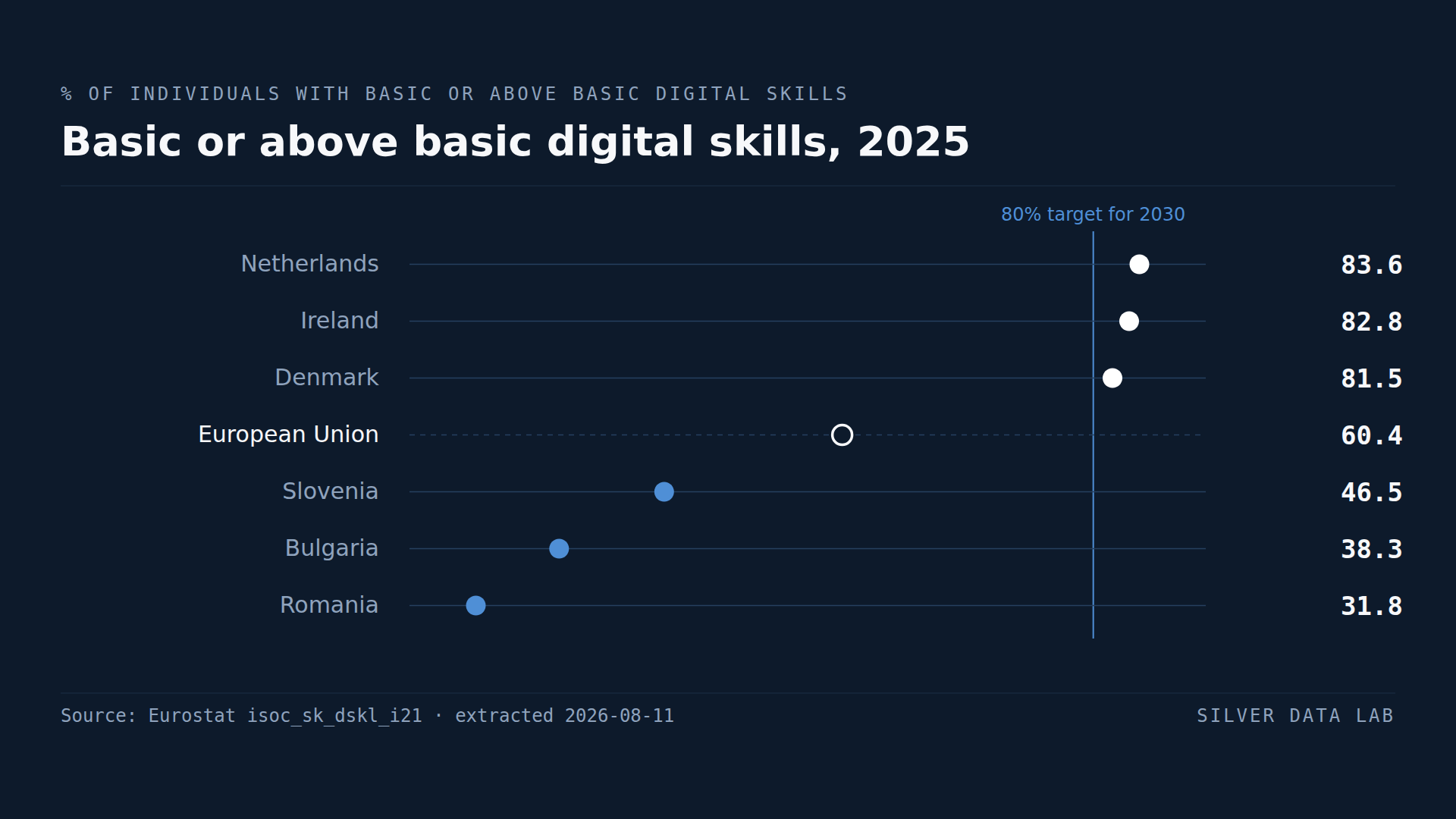
- 60.4% of people in the EU had at least basic overall digital skills in 2025, against the 80% the Union targets for 2030.
- The Netherlands at 83.6%, Ireland at 82.8%, Denmark at 81.5% and Finland at 81.0% are already past the target.
- Romania records 31.8% and Bulgaria 38.3%: fewer than two people in five.
- The 51.8 point spread runs from more than four Dutch adults in five to fewer than one Romanian in three.
- The measure requires competence across five separate skill areas, so it is stricter than it sounds.
A target with four countries already past it and a long tail behind
The European Union aims for 80% of its adult population to have at least basic digital skills by 2030. In 2025 the figure was 60.4%.
Unlike most EU targets, this one already has countries on the far side of it. The Netherlands records 83.6%, Ireland 82.8%, Denmark 81.5% and Finland 81.0%. Four Member States have met a 2030 objective five years early.
The distance behind them is the story.
What the measure actually requires
The indicator is stricter than the phrase basic digital skills suggests. It assesses five separate areas — information and data literacy, communication and collaboration, digital content creation, safety, and problem solving — and counts a person only if they reach at least basic level in all five.
Someone confident with email and online banking but unable to handle privacy settings does not count. That construction is why 60.4% sits below any count of people who simply go online: everyone it counts has used the internet, and using it is not the same as clearing all five bars.
The tail
Romania records 31.8%, the lowest in the Union, and Bulgaria 38.3%. Both are below two people in five.
Above them, Slovenia at 46.5% is the surprise; Latvia at 48.4% is not, sitting almost exactly where its GDP per head would place it. Slovenia's GDP per head is 90 on an index where the EU stands at one hundred, sixteenth of the twenty-seven, and it sits third from bottom on digital skills — below Poland, Greece and Lithuania, all of which are poorer on that measure. Eleven Member States are poorer than Slovenia on that index, and nine of them are more skilled; only Bulgaria and Romania are less.
The two rankings correspond closely across the Union: the wealthier Member States are mostly the more skilled ones, in the one year measured here. What the correspondence does not cover is how far a single country can sit from it, and Slovenia is the case in point: nine places lower on digital skills than on GDP per head.
The size of the spread
The distance between the Netherlands at 83.6% and Romania at 31.8% is 51.8 percentage points, a range this category matches on only one other indicator, online purchasing.
For a Union with a single digital market and a common 2030 objective, a spread of that size means the target is not one target. For the four countries already past it, the remaining question is what comes after 80%. For Romania, reaching 80% by 2030 would mean the share growing to about two and a half times its present level.
Basic or above basic digital skills, 2025
| Country | % of individuals | Gap to EU averagepercentage points, derived |
|---|---|---|
| Netherlands | 83.6 | +23.2 |
| Ireland | 82.8 | +22.4 |
| Denmark | 81.5 | +21.1 |
| European Unionaggregate | 60.4 | — |
| Slovenia | 46.5 | −13.9 |
| Bulgaria | 38.3 | −22.1 |
| Romania | 31.8 | −28.6 |
This table as data: CSV · JSON
Every Member State for this indicator+
Members see every Member State for this indicator here, not only the rows the ranking prints. Become a Member
Embed this chart
Paste this code into a page. The frame carries the source and the extraction date, and links back to the study.
What these figures cannot tell you
- Self-assessment, not a test
- The indicator is built from survey questions about what respondents say they have done, not from a skills examination. It measures reported activity, and cultural differences in how people describe their own competence may affect comparisons between countries.
- All five components must be met
- A person counts only if they reach at least basic level in every one of the five skill areas. Someone strong in four and weak in one is excluded, which makes the headline figure substantially lower than measures of general internet use and means the indicator is sensitive to which component is weakest.
- The framework changed in 2021
- The current measure applies from 2021 onwards and is not comparable with the digital skills series published before it. Trends spanning that break are not available from this dataset.
- The 80% target is a Union-level objective
- The Digital Decade target applies to the EU as a whole rather than to each Member State individually. Comparing national figures against it, as this study does, is a useful benchmark and not a measure of compliance.
Frequently asked questions
- What share of Europeans have basic digital skills?
- 60.4% in 2025, measured across the whole adult population. The EU targets 80% by 2030, and four Member States — the Netherlands, Ireland, Denmark and Finland — are already above it.
- What counts as basic digital skills?
- At least basic competence in all five areas of the EU digital competence framework: information and data literacy, communication and collaboration, digital content creation, safety, and problem solving. Someone who falls short in any one area is not counted.
- Which EU country has the lowest digital skills?
- Romania, at 31.8% in 2025, followed by Bulgaria at 38.3%, Slovenia at 46.5% and Latvia at 48.4%. Slovenia is the exception: eleven Member States have a lower GDP per head and nine of them score higher.
- Why is the digital skills figure lower than internet use?
- Because they measure different thresholds. Internet use records whether someone has been online; this indicator requires demonstrated competence across five distinct skill areas, including safety and problem solving. Being online and clearing all five bars are not the same thing.
Methodological note
The indicator is Eurostat's share of individuals with basic or above basic overall digital skills, which requires at least basic competence in all five component areas of the digital competence framework: information and data literacy, communication and collaboration, digital content creation, safety, and problem solving.
Values are for the total adult population in 2025, the most recent year with complete coverage of the 27 Member States at the extraction date.
The 51.8 point spread, and the factor by which Romania's share would have to grow to reach the target, are derived by Silver Data Lab from the digital skills series. The count of Member States poorer than Slovenia that score above it and the count that score below it, the correspondence between the two rankings and the difference between Slovenia's position on each are derived from both series. GDP per head is Eurostat's volume index of real expenditure per head with the EU set to one hundred, declared as the second source below: it measures output rather than residents' income, as the companion study on that index explains, and twelve of its twenty-seven values for the reference year are provisional, so a position derived from them can move.
Source data
This study draws on 2 datasets from Eurostat. Each can be inspected and re-downloaded from its catalogue, and the filters below are the ones applied.
Individuals' level of digital skills (from 2021 onwards)
isoc_sk_dskl_i21
- Filters applied:
- freq=A · ind_type=IND_TOTAL · indic_is=I_DSK2_BAB · unit=PC_IND · time=2025
- Extracted:
- 2026-08-11
- Source last updated:
- 2026-04-17
GDP per capita in PPS
tec00114
- Filters applied:
- freq=A · indic_ppp=VI_PPS_EU27_2020_HAB · ppp_cat18=GDP · time=2025
- Extracted:
- 2026-08-11
- Source last updated:
- 2026-07-09
Download the data
The data the study you have just read is built on, exactly as it was downloaded and archived.
Yours as a Member.
Data downloadable by Members
How to cite
Record the vintage as well as the study: the figures on this page are the ones extracted on the dates below.
Silver Data Lab Research Desk (2026). In Four EU Countries, Over 80% of People Have Basic Digital Skills. Silver Data Lab, published 20 April 2026, last updated 18 October 2026. https://www.silverdatalab.com/studies/digital-skills-in-the-eu
- Data: Eurostat, Individuals' level of digital skills (from 2021 onwards) (isoc_sk_dskl_i21), filters freq=A, ind_type=IND_TOTAL, indic_is=I_DSK2_BAB, unit=PC_IND, time=2025; extracted 2026-08-11; source last updated 2026-04-17. https://doi.org/10.2908/isoc_sk_dskl_i21
- Data: Eurostat, GDP per capita in PPS (tec00114), filters freq=A, indic_ppp=VI_PPS_EU27_2020_HAB, ppp_cat18=GDP, time=2025; extracted 2026-08-11; source last updated 2026-07-09. https://doi.org/10.2908/tec00114
Silver Data Lab's analysis is licensed CC BY 4.0. The statistics remain their publisher's and keep its terms of reuse.
Ask the research desk
A question about this study — a definition, a filter, a break in the series, what the figures can and cannot support — answered by the desk that made the extraction.
Members can write to the research desk
Other studies on the same dataset
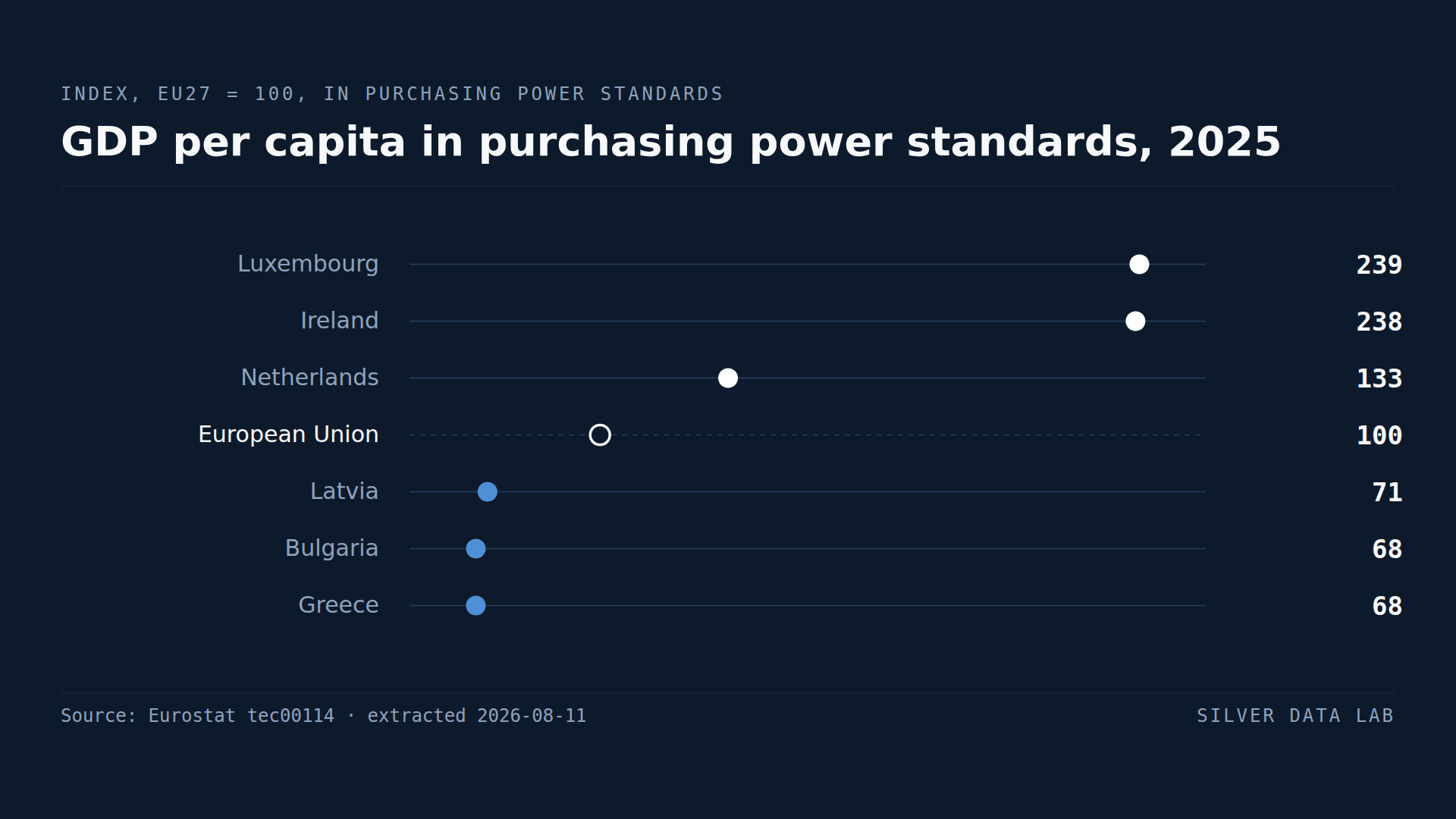
GDP per Head Makes Luxembourg and Ireland Look Richer Than They Are
Luxembourg records 239 and Ireland 238 against an EU average of 100 — more than double the Union's output per head.
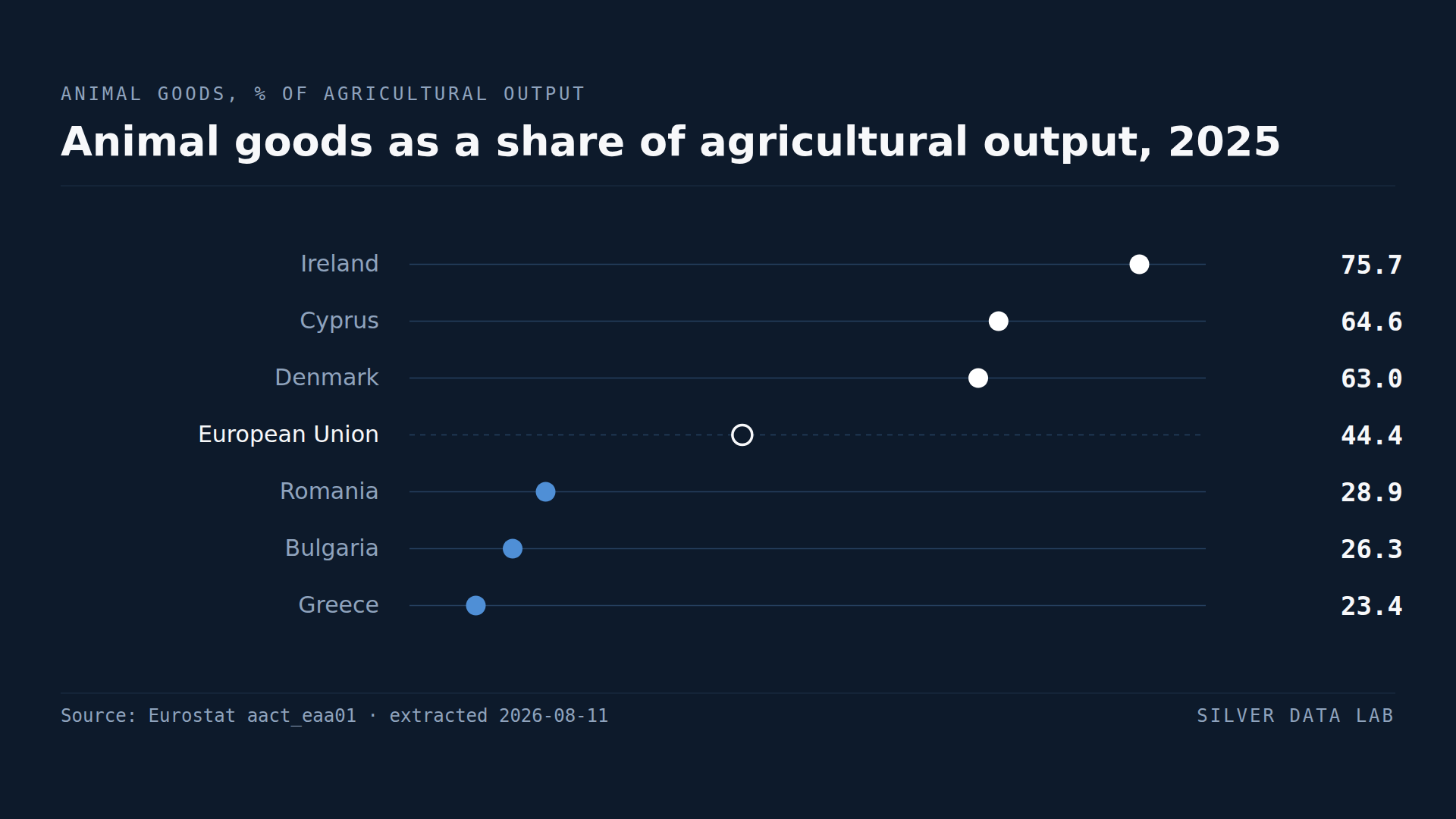
Three Quarters of Irish Farm Output Comes From Animals
Animal goods accounted for 44.4% of EU agricultural output by value in 2025.
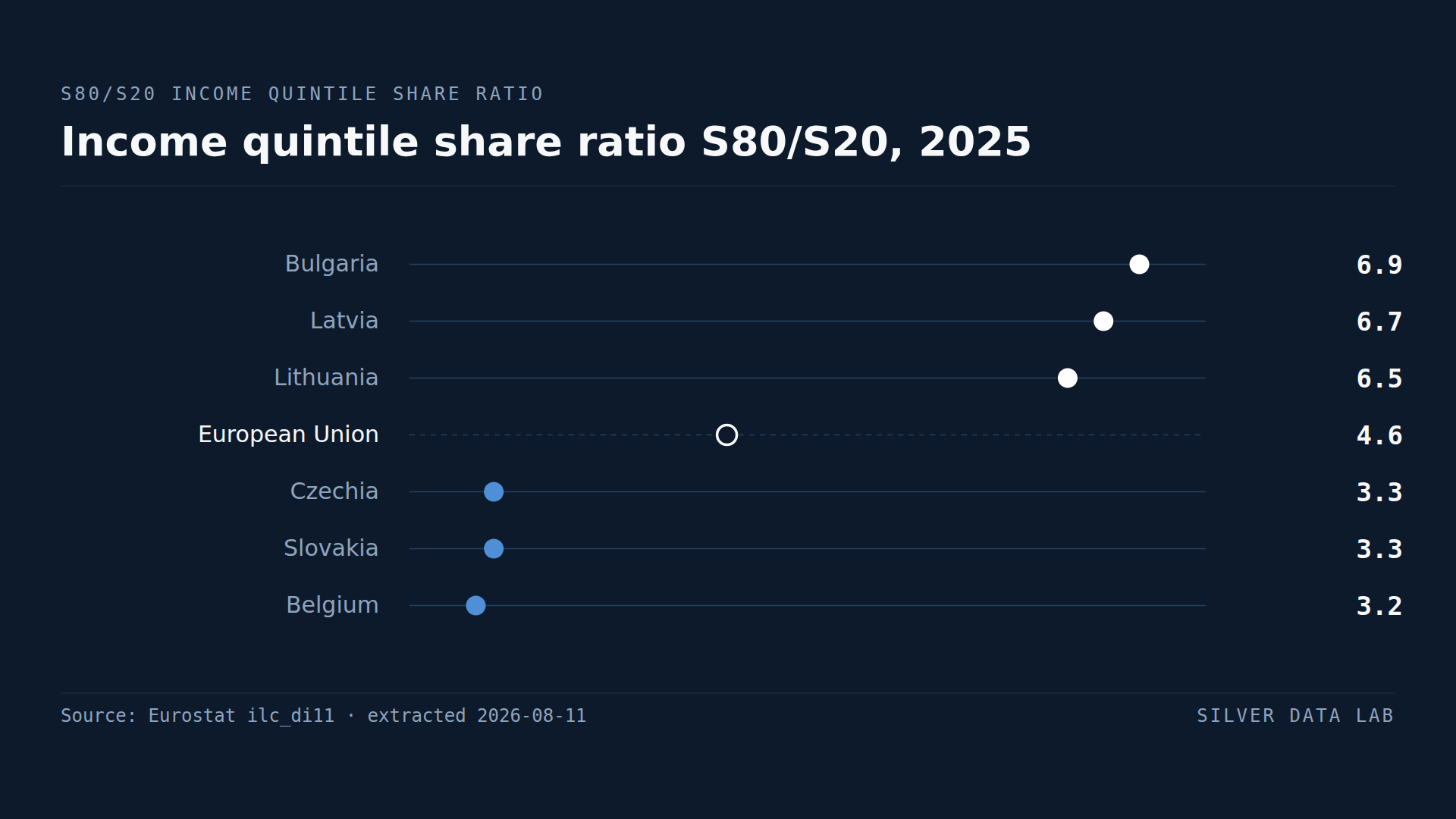
Bulgaria Has the EU's Widest Gap Between Rich and Poor
Across the EU, the richest fifth of the population received 4.6 times the income of the poorest fifth in 2025.
Studies where the same country leads or trails
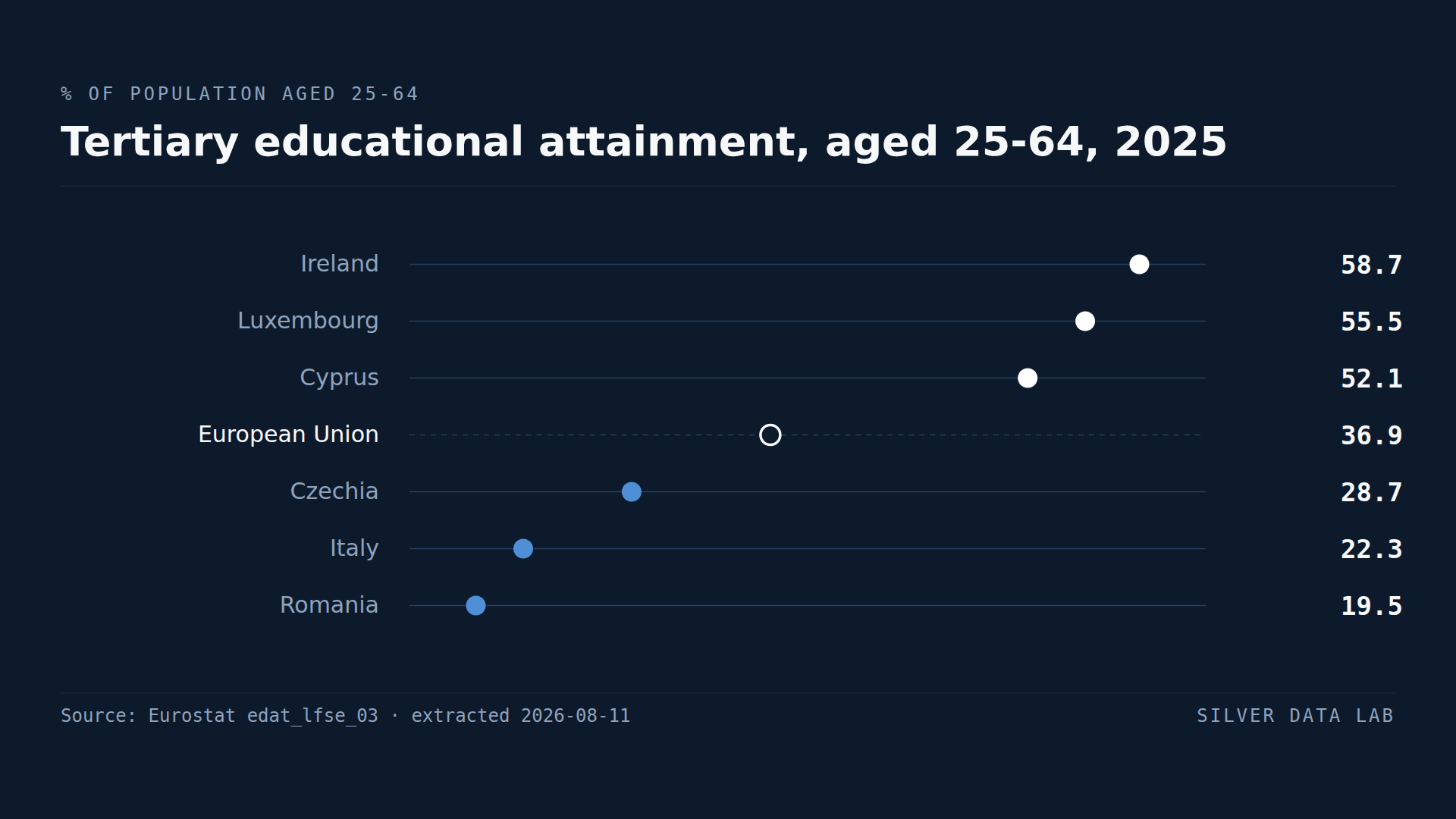
A Degree Is Three Times as Common Among Adults in Ireland as in Romania
36.9% of people aged 25 to 64 in the EU held a tertiary qualification in 2025.
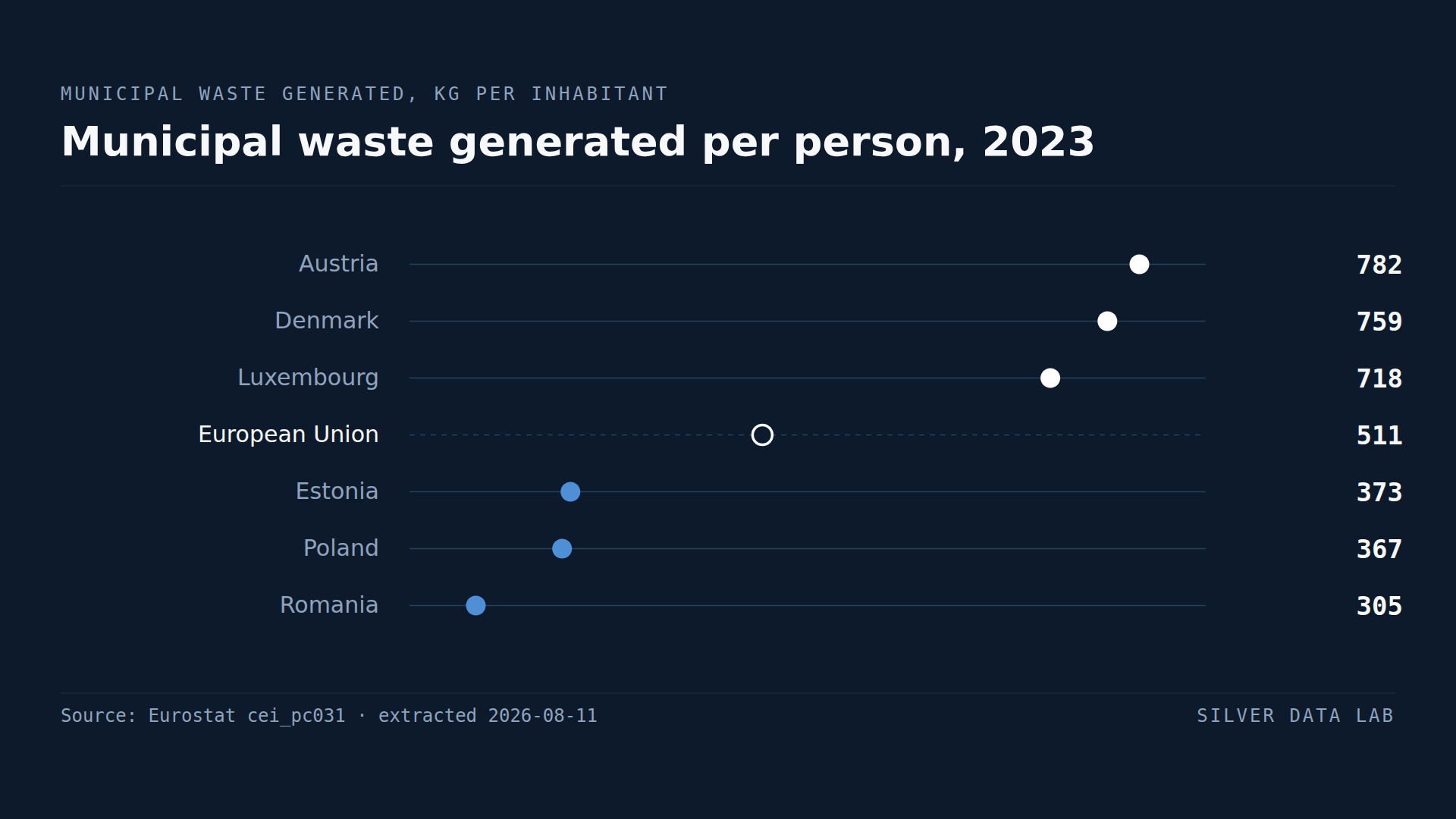
Austria Produces More Rubbish per Person Than Any Other EU Country
The EU generated 510 kg of municipal waste per inhabitant in 2023 — about 1.4 kg per person per day.
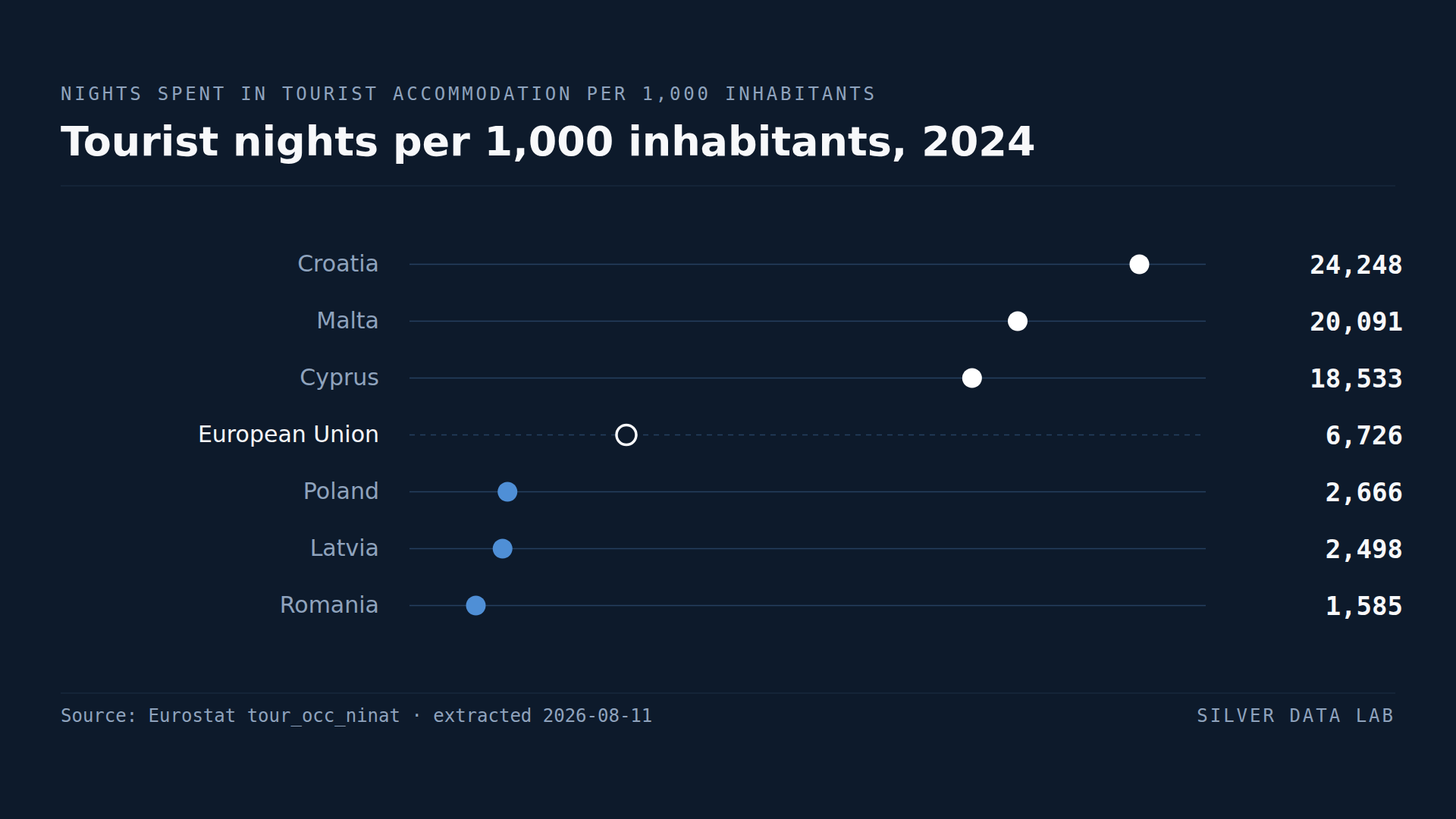
For Its Population, Croatia Has the Most Tourist Overnight Stays in the EU
The EU recorded 6,978 tourist nights per 1,000 inhabitants in 2025, about 7.0 nights per resident.