Only Three EU Countries Hit the Aid Target of 0.7% of National Income
Silver Data Lab Research Desk · Statistical analysis · Published on 15 March 2026
- Data source
- Eurostat
- Reference period
- 2024
- Last updated
- 11 October 2026
Re-checked against the source on 11 August 2026. No value in its datasets has moved between the snapshots we hold. Every revision we have observed →
Key estimates
- EU official development assistance was 0.5% of gross national income in 2024.
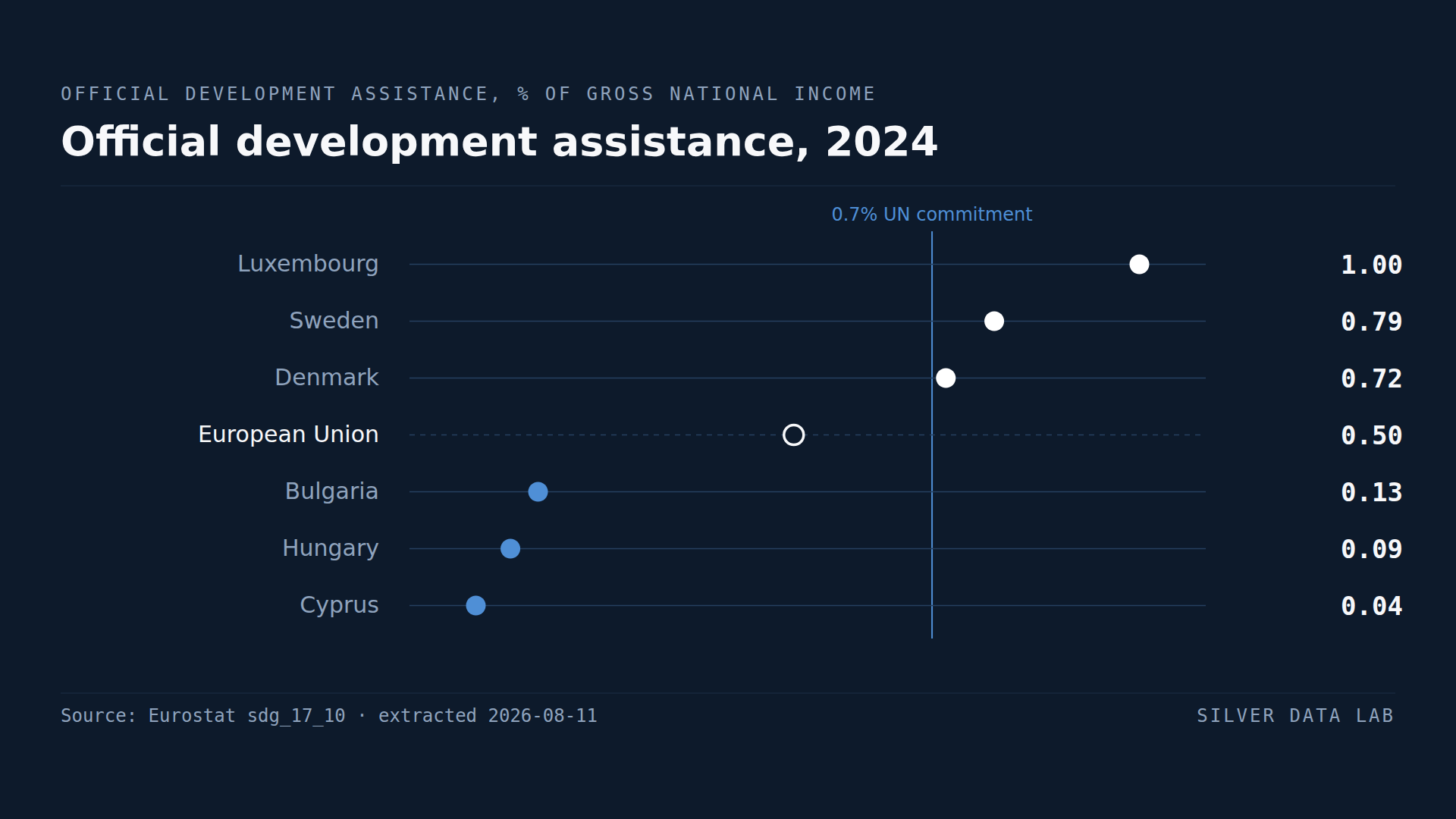
- Luxembourg records 1.00%, Sweden 0.79% and Denmark 0.72% — the three Member States meeting the 0.7% commitment.
- Germany records 0.68%, just below it.
- Cyprus records 0.04%, Hungary 0.09% and Bulgaria 0.13%.
- The 0.7% target dates from a United Nations resolution of 1970 and has been reaffirmed by the EU repeatedly since.
A commitment older than most of the countries keeping it
In 1970 the United Nations General Assembly adopted a target of 0.7% of gross national income for official development assistance from wealthy countries. The European Union has reaffirmed it repeatedly, most recently with a deadline of 2030.
In 2024 the EU as a whole gave 0.5%.
Three Member States meet the target: Luxembourg at 1.00%, Sweden at 0.79% and Denmark at 0.72%. Germany at 0.68% is close enough that a small movement in either direction changes the count.
The Nordic and Benelux pattern
Luxembourg, Sweden and Denmark at the top, with the Netherlands and Germany behind them, is a long-standing grouping in development assistance. All five have maintained comparatively high aid budgets across changes of government over decades, which is unusual for a spending category with no domestic constituency.
Luxembourg at 1.00% is giving half again the international commitment, and its small population means the absolute sum is modest — which is exactly why a percentage of national income is the right unit for this comparison.
The bottom
Cyprus records 0.04%, Hungary 0.09%, Bulgaria 0.13% and Slovakia 0.14%.
These are Member States that acceded to the Union after 2004 and were themselves net recipients of development and cohesion funding within living memory. The commitment applies to them as EU members, and the collective EU target is a collective one; individual national targets differ for newer Member States.
Stating that is necessary for the ranking to be read fairly. A figure of 0.04% against a 0.7% benchmark is a large shortfall, and the benchmark was not designed with these economies in mind.
What the measure includes
Official development assistance is defined by the OECD Development Assistance Committee, and its boundaries are contested in ways that affect the numbers here.
Spending on refugees within a donor country during their first year counts as aid. So does some debt relief, and certain administrative costs. In years of high arrival numbers, in-donor refugee costs have accounted for a substantial share of several European aid budgets — money that is spent domestically and reported as development assistance.
This study reports the figures as published. It does not adjust them, and readers comparing 2024 with earlier years should be aware that the composition of the total has shifted more than the total itself.
Why it belongs in a globalisation category
Development assistance is one of the few economic flows between rich and poor countries that is decided politically rather than by markets.
Every other indicator in this category — imports, income flows, external debt — measures something that happens because firms and investors chose it. This one measures what governments chose, and the range from 1.00% to 0.04% is a range of political decisions rather than of economic circumstances.
Official development assistance, 2024
| Country | % of gross national income | Gap to EU averagepercentage points, derived |
|---|---|---|
| Luxembourg | 1.00 | +0.5 |
| Sweden | 0.79 | +0.3 |
| Denmark | 0.72 | +0.2 |
| European Unionaggregate | 0.50 | — |
| Bulgaria | 0.13 | −0.4 |
| Hungary | 0.09 | −0.4 |
| Cyprus | 0.04 | −0.5 |
This table as data: CSV · JSON
Every Member State for this indicator+
Members see every Member State for this indicator here, not only the rows the ranking prints. Become a Member
Embed this chart
Paste this code into a page. The frame carries the source and the extraction date, and links back to the study.
What these figures cannot tell you
- The definition includes domestic spending
- Costs of hosting refugees in the donor country during their first year count as official development assistance under OECD rules, as do some debt relief and administrative costs. The composition of national totals has shifted substantially in recent years.
- The 0.7% target is a collective EU commitment
- It applies to the Union as a whole, and Member States that acceded after 2004 have different individual reference levels. Comparing every Member State against 0.7%, as this study does, is a benchmark rather than a compliance test.
- Aid quality is not measured
- The indicator counts money, not what it achieves, where it goes or whether it is tied to purchases from the donor. Two countries giving the same share can deliver very different results.
- 2024, not 2025
- Eurostat publishes no 2025 values for this series at the extraction date, so these figures are not comparable with the 2025 readings elsewhere on this site.
Frequently asked questions
- How much aid does the EU give?
- 0.5% of gross national income in 2024, against a commitment of 0.7% that dates from a United Nations resolution in 1970 and has been reaffirmed by the EU repeatedly since.
- Which EU countries meet the 0.7% aid target?
- Three: Luxembourg at 1.00% of gross national income, Sweden at 0.79% and Denmark at 0.72%. Germany at 0.68% is just below it.
- Which EU countries give the least?
- Cyprus at 0.04%, Hungary at 0.09% and Bulgaria at 0.13%. These are Member States that joined after 2004 and were themselves recipients of development and cohesion funding; the 0.7% figure is a collective EU commitment and their individual reference levels differ.
- Does aid spending include money spent at home?
- Partly. Under OECD rules, the cost of hosting refugees in the donor country during their first year counts as official development assistance, as do some debt relief and administrative costs. The composition of national aid totals has changed more in recent years than the totals themselves.
Methodological note
Eurostat publishes official development assistance as a share of gross national income, following the OECD Development Assistance Committee definition, for total ODA to all recipients.
Values are for 2024, the most recent year available at the extraction date, covering all 27 Member States.
The count of Member States meeting the target is derived by Silver Data Lab. The 0.7% figure is a United Nations commitment adopted in 1970 and reaffirmed by the EU, not a Eurostat statistic.
Source data
The underlying series can be inspected and re-downloaded from the Eurostat data browser. The filters below are the ones applied.
Official development assistance as share of gross national income
sdg_17_10
- Filters applied:
- freq=A · partner=ODA · unit=PC_GNI · time=2024
- Extracted:
- 2026-08-11
- Source last updated:
- 2026-03-12
Download the data
The data the study you have just read is built on, exactly as it was downloaded and archived.
Yours as a Member.
Data downloadable by Members
How to cite
Record the vintage as well as the study: the figures on this page are the ones extracted on the dates below.
Silver Data Lab Research Desk (2026). Only Three EU Countries Hit the Aid Target of 0.7% of National Income. Silver Data Lab, published 15 March 2026, last updated 11 October 2026. https://www.silverdatalab.com/studies/development-aid-in-the-eu
- Data: Eurostat, Official development assistance as share of gross national income (sdg_17_10), filters freq=A, partner=ODA, unit=PC_GNI, time=2024; extracted 2026-08-11; source last updated 2026-03-12. https://doi.org/10.2908/sdg_17_10
Silver Data Lab's analysis is licensed CC BY 4.0. The statistics remain their publisher's and keep its terms of reuse.
Ask the research desk
A question about this study — a definition, a filter, a break in the series, what the figures can and cannot support — answered by the desk that made the extraction.
Members can write to the research desk
Studies where the same country leads or trails
A Quarter of Greeks Spend More Than 40% of Income on Housing
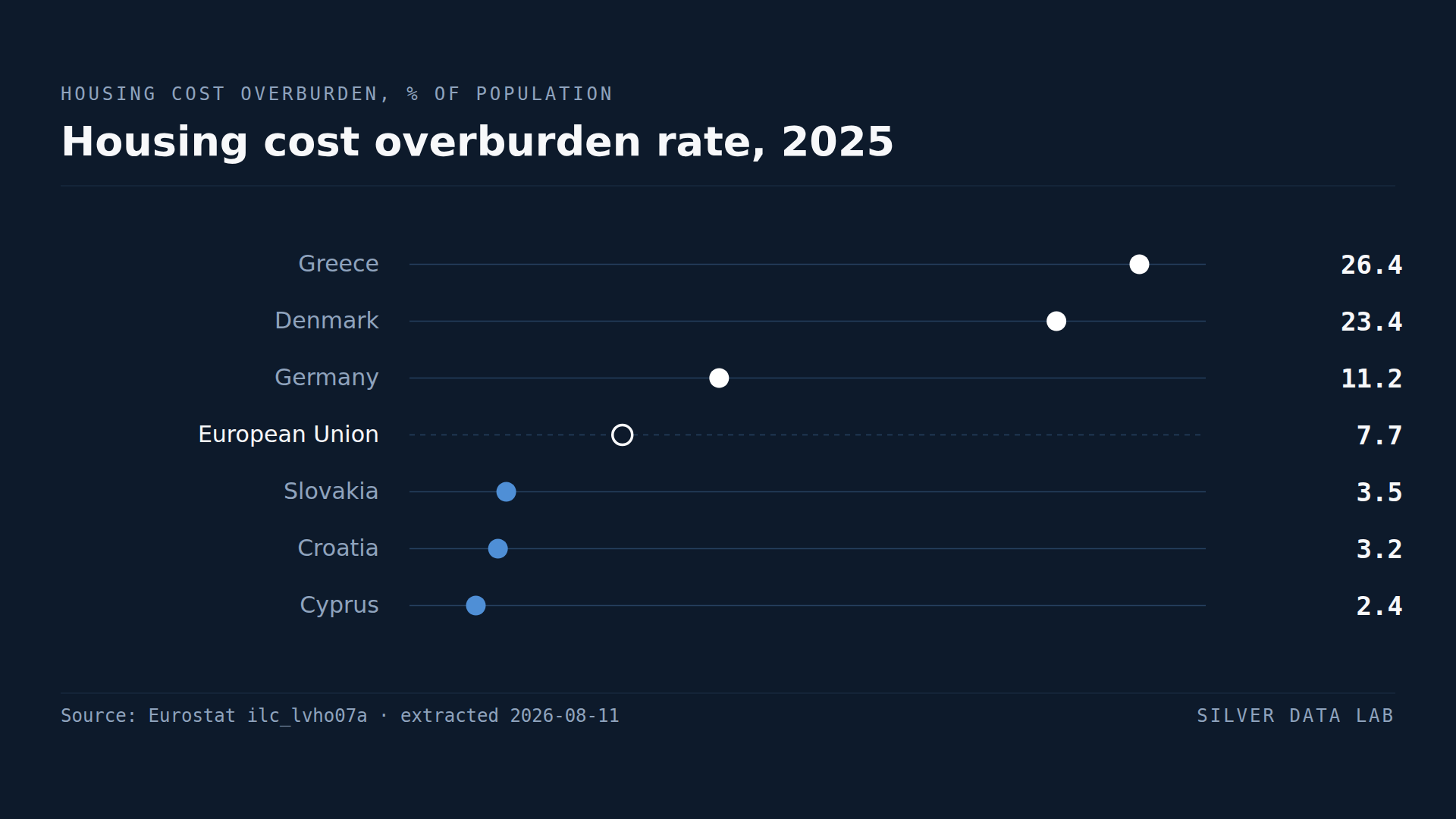
7.7% of the EU population spent more than 40% of disposable income on housing in 2025.
Bulgaria's GDP per Person Is About a Third of the EU Average
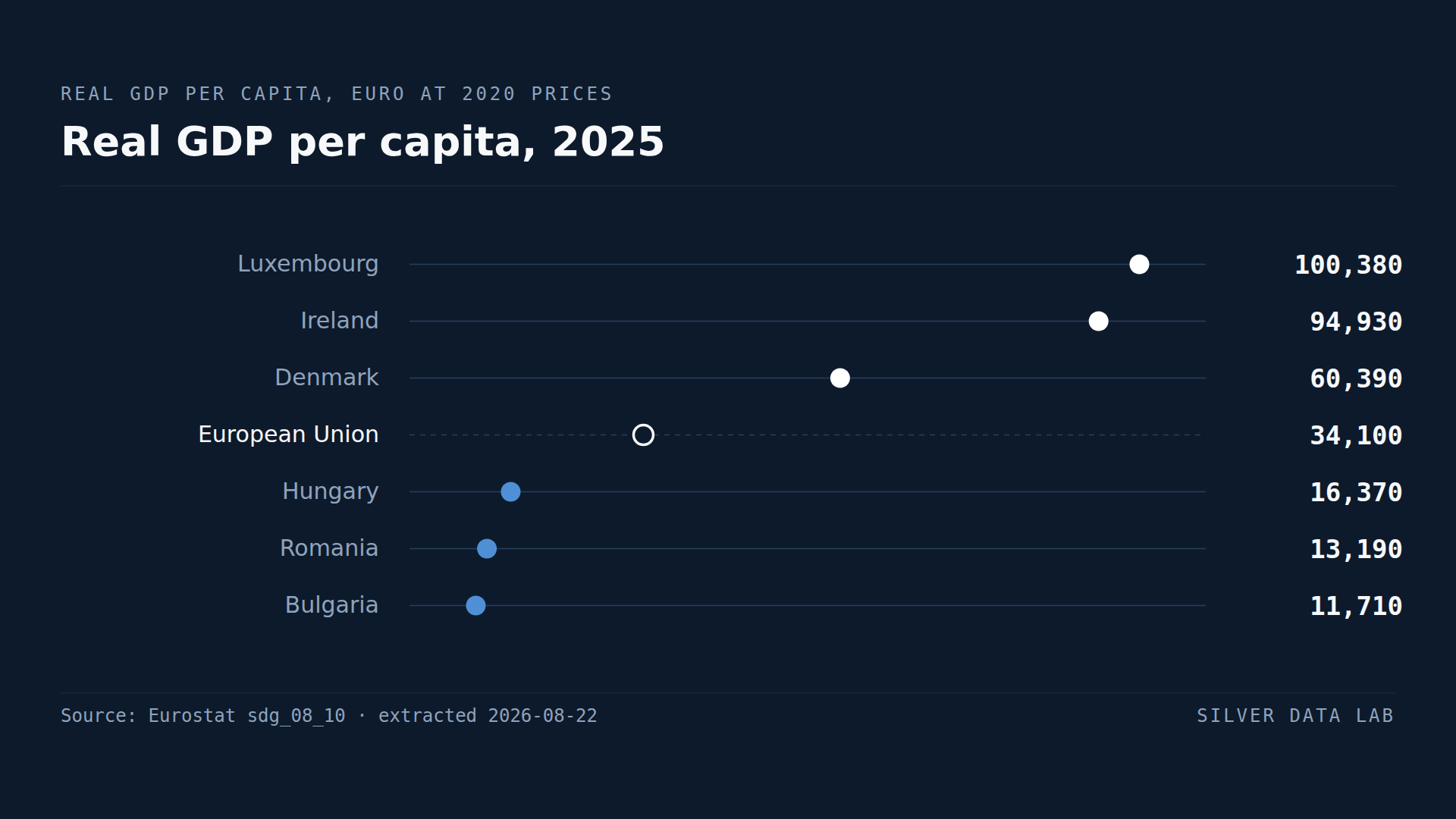
EU real GDP per capita was 34,250 euro in 2025, at 2020 prices.
Denmark Has the EU's Biggest Surplus With the World, at 12.3% of GDP
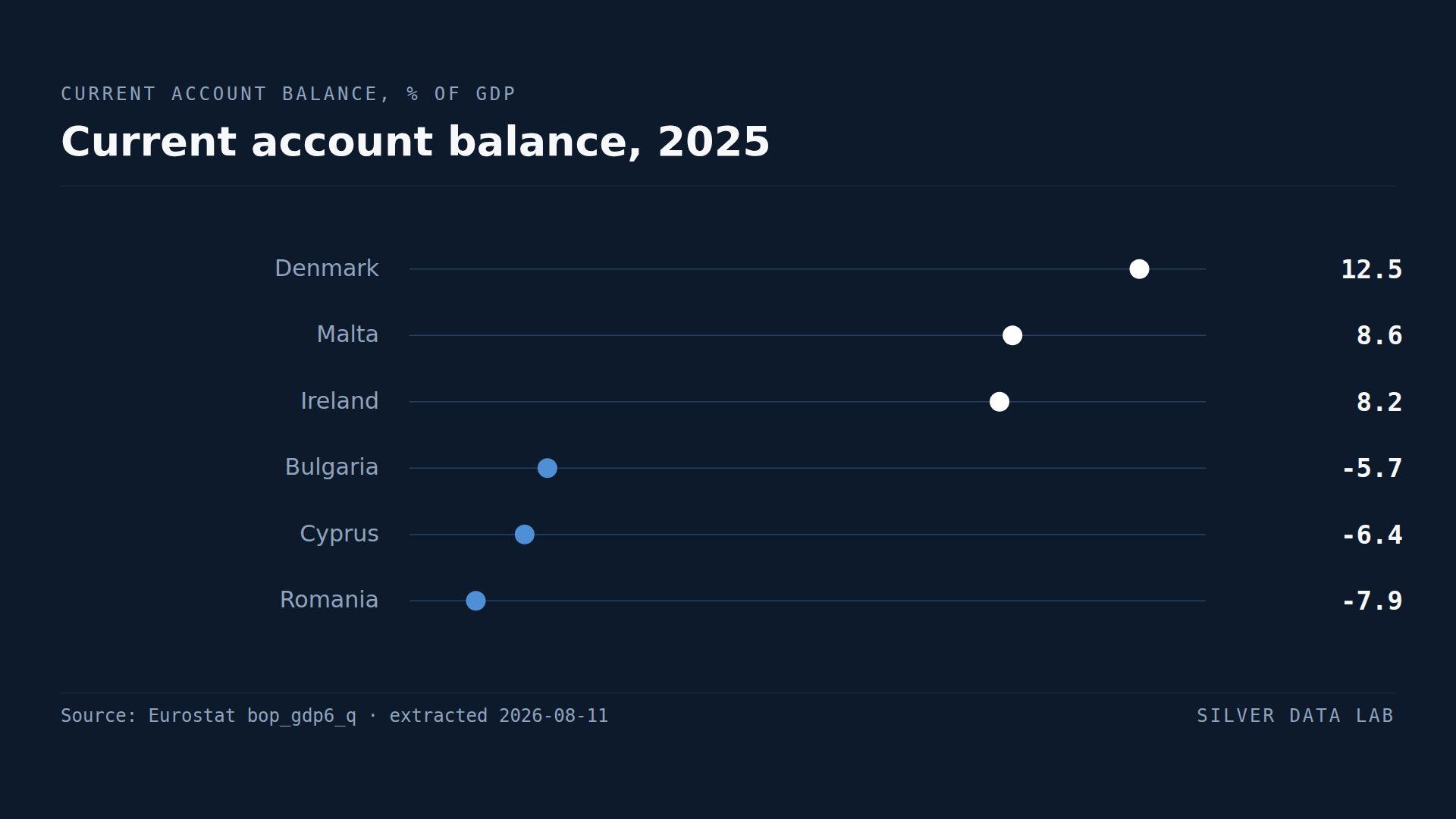
Denmark ran a current account surplus worth 12.3% of GDP in 2025, the largest in the Union.