Nearly Four in Ten Dutch Workers Are Part-Time
Silver Data Lab Research Desk · Statistical analysis · Published on 14 June 2026
- Data source
- Eurostat
- Reference period
- 2025
- Last updated
- 11 October 2026
Re-checked against the source on 13 September 2026. No value in its datasets has moved between the snapshots we hold. Every revision we have observed →
Key estimates
- 17.0% of employed people aged 20 to 64 in the EU worked part-time in 2025.
- The Netherlands records 38.6%, Austria 30.2% and Germany 29.2%.
- Bulgaria records 1.7%, Romania 2.3% and Croatia 2.9%.
- The Dutch rate is nearly 23 times the Bulgarian one — the widest ratio on any labour indicator on this site.
- Involuntary part-time work is 2.5% of EU employment, so most part-time work in the Union is chosen.
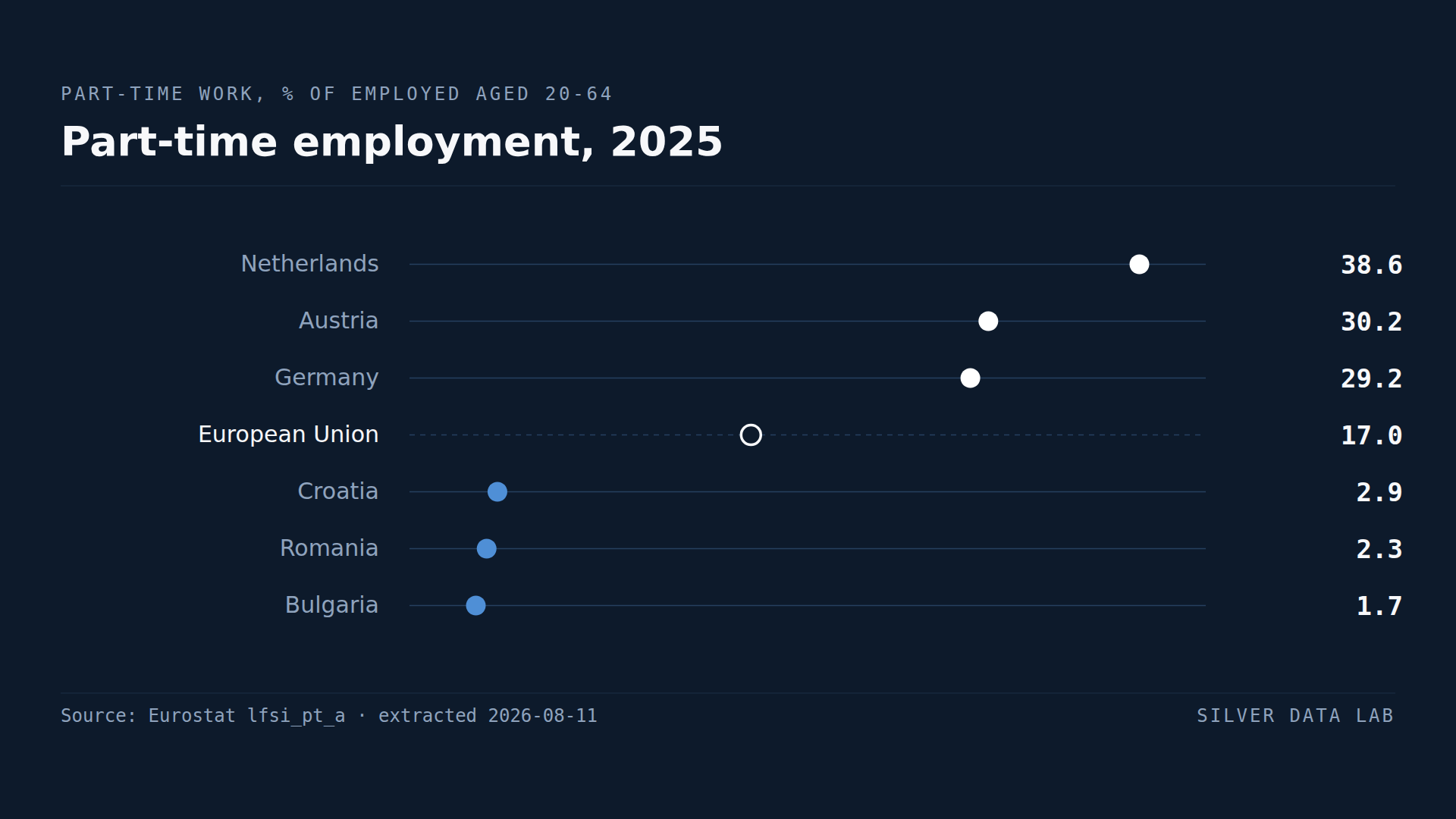
The widest labour market difference in the Union
Part-time work covers anyone whose usual hours are below the full-time norm in their country. Across the EU in 2025, 17.0% of employed people aged 20 to 64 worked part-time.
The national figures span 38.6% to 1.7%: a ratio of nearly 23 to one, and the widest spread this site has recorded on any labour market indicator.
The Dutch case
The Netherlands records 38.6%. Close to two workers in five are part-time, which is not a fringe arrangement but a mainstream way of holding a job.
Austria at 30.2%, Germany at 29.2% and Belgium at 24.3% follow, forming a north-western European group well clear of the rest.
The question a figure like that raises is whether it represents opportunity or constraint, and the same dataset answers it. Involuntary part-time work — people working part-time because they could not find full-time hours — is 4.3% of Dutch employment. Against a part-time rate of 38.6%, that means roughly one Dutch part-time worker in nine would prefer to work more.
The other eight in nine are working part-time by choice.
Spain, and the contrast
Spain records 13.1% part-time work and 5.0% involuntary part-time. Around 38% of Spanish part-time work is not wanted, against 11% in the Netherlands.
The Spanish part-time rate is a third of the Dutch one and its involuntary component is larger in absolute terms. Two countries can be compared on the headline figure and reach opposite conclusions from it.
That is the reason a part-time rate should never be read on its own, and why the involuntary series is quoted alongside it here.
The east
Bulgaria records 1.7%, Romania 2.3%, Croatia 2.9%, Slovakia 4.2% and Hungary 4.6%.
Part-time work is effectively absent from these labour markets. The usual explanation is that wages are low enough that part-time earnings do not support a household, so the arrangement is not viable regardless of whether anyone would prefer it.
Involuntary part-time work in those same five countries is correspondingly small as a share of all employment: 0.4% in Bulgaria, 0.5% in Hungary and Slovakia, 0.9% in Romania and Croatia. Almost nobody is working part-time against their wishes, because almost nobody is working part-time at all.
Measured the way this study measured Spain, though, Romania inverts the picture. Its 0.9% against a part-time rate of 2.3% means 39% of Romanian part-time work is unwanted — the largest share in the Union, ahead of Spain, with Croatia at 31% close behind. The option is largely absent in both countries, and the little of it that exists is disproportionately not chosen.
What the ranking tracks
Part-time rates follow household income levels, the availability of childcare, and whether tax and benefit systems make a second partial income worthwhile. They also follow gender: part-time work across the Union is disproportionately done by women, and the Member States at the top of this ranking are those where a partial return to work after children is the norm.
That connection is why this indicator belongs beside the gender employment gap rather than being read as a measure of job quality on its own.
Part-time employment, 2025
| Country | % of employed aged 20-64 | Gap to EU averagepercentage points, derived |
|---|---|---|
| Netherlands | 38.6 | +21.6 |
| Austria | 30.2 | +13.2 |
| Germany | 29.2 | +12.2 |
| European Unionaggregate | 17.0 | — |
| Croatia | 2.9 | −14.1 |
| Romania | 2.3 | −14.7 |
| Bulgaria | 1.7 | −15.3 |
This table as data: CSV · JSON
Every Member State for this indicator+
Members see every Member State for this indicator here, not only the rows the ranking prints. Become a Member
Embed this chart
Paste this code into a page. The frame carries the source and the extraction date, and links back to the study.
What these figures cannot tell you
- Part-time is defined nationally
- There is no single hours threshold. The classification rests on what counts as full-time in each country's own labour market, which differs, so the comparison is between national norms as much as between hours worked.
- The headline figure says nothing about choice
- A high part-time rate can reflect flexibility or a lack of full-time work. Only the involuntary series distinguishes them, and this study quotes it for that reason; readers should not infer quality from the headline alone.
- Strongly gendered
- Part-time work across the Union is done disproportionately by women, and a national rate is largely determined by women's working patterns. A rate for both sexes combined conceals that, and this study does not break the series down by sex.
- The cross-country comparison with Spain rests on two employment rules
- Eurostat marks the Spanish and French values as departing from the common definition: both still treat employees on temporary lay-off as employed, following the older practice rather than the Regulation that now governs the survey. Inside Spain this matters little to the proportion computed here, because both figures come from the same survey and the same rule; between countries it does, so the Spanish share of unwanted part-time work is a less secure comparison against the Dutch and Romanian ones than the decimals suggest.
- Hours are not measured
- Part-time covers anything from a few hours a week to nearly full-time. Two countries with the same rate can have very different actual hours worked.
Frequently asked questions
- How common is part-time work in the EU?
- 17.0% of employed people aged 20 to 64 worked part-time in 2025. National rates range from 38.6% in the Netherlands to 1.7% in Bulgaria.
- Which EU country has the most part-time work?
- The Netherlands, at 38.6% of employment in 2025 — close to two workers in five. Austria at 30.2% and Germany at 29.2% follow.
- Is part-time work in the EU voluntary?
- Mostly. Involuntary part-time work is 2.5% of EU employment against a part-time rate of 17.0%. The proportion differs sharply by country: roughly one Dutch part-time worker in nine would prefer full-time hours, against nearly two in five in Spain.
- Why is part-time work so rare in eastern Europe?
- Bulgaria records 1.7% and Romania 2.3%. The usual explanation is that wages are low enough that part-time earnings cannot support a household. Involuntary part-time work is also very low in these countries, so the pattern is an absent option rather than people being pushed out of full-time work.
Methodological note
Eurostat publishes part-time employment from the EU labour force survey as a share of total employment, using each country's own definition of full-time work. This study uses the population aged 20 to 64, both sexes.
The involuntary figures quoted alongside come from the underemployed part-time workers series of the same dataset, extracted with the same age, sex and unit filters and declared below as a source of its own.
Values are for 2025 and cover all 27 Member States.
The share of part-time work that is involuntary is computed by Silver Data Lab as the ratio of the two published series and is labelled as derived. Eurostat does not publish that ratio.
Source data
This study draws on 2 datasets from Eurostat. Each can be inspected and re-downloaded from its catalogue, and the filters below are the ones applied.
Part-time employment and temporary contracts
lfsi_pt_a
- Filters applied:
- freq=A · wstatus=EMP_PT · sex=T · age=Y20-64 · unit=PC_EMP · time=2025
- Extracted:
- 2026-09-13
- Source last updated:
- 2026-09-10
Part-time employment and temporary contracts — involuntary part-time
lfsi_pt_a
- Filters applied:
- freq=A · wstatus=UEMP_PT · sex=T · age=Y20-64 · unit=PC_EMP · time=2025
- Extracted:
- 2026-09-11
- Source last updated:
- 2026-09-10
Download the data
The data the study you have just read is built on, exactly as it was downloaded and archived.
Yours as a Member.
Data downloadable by Members
How to cite
Record the vintage as well as the study: the figures on this page are the ones extracted on the dates below.
Silver Data Lab Research Desk (2026). Nearly Four in Ten Dutch Workers Are Part-Time. Silver Data Lab, published 14 June 2026, last updated 11 October 2026. https://www.silverdatalab.com/studies/part-time-work-in-the-eu
- Data: Eurostat, Part-time employment and temporary contracts (lfsi_pt_a), filters freq=A, wstatus=EMP_PT, sex=T, age=Y20-64, unit=PC_EMP, time=2025; extracted 2026-09-13; source last updated 2026-09-10. https://doi.org/10.2908/lfsi_pt_a
- Data: Eurostat, Part-time employment and temporary contracts — involuntary part-time (lfsi_pt_a), filters freq=A, wstatus=UEMP_PT, sex=T, age=Y20-64, unit=PC_EMP, time=2025; extracted 2026-09-11; source last updated 2026-09-10. https://doi.org/10.2908/lfsi_pt_a
Silver Data Lab's analysis is licensed CC BY 4.0. The statistics remain their publisher's and keep its terms of reuse.
Ask the research desk
A question about this study — a definition, a filter, a break in the series, what the figures can and cannot support — answered by the desk that made the extraction.
Members can write to the research desk
Other studies on the same dataset
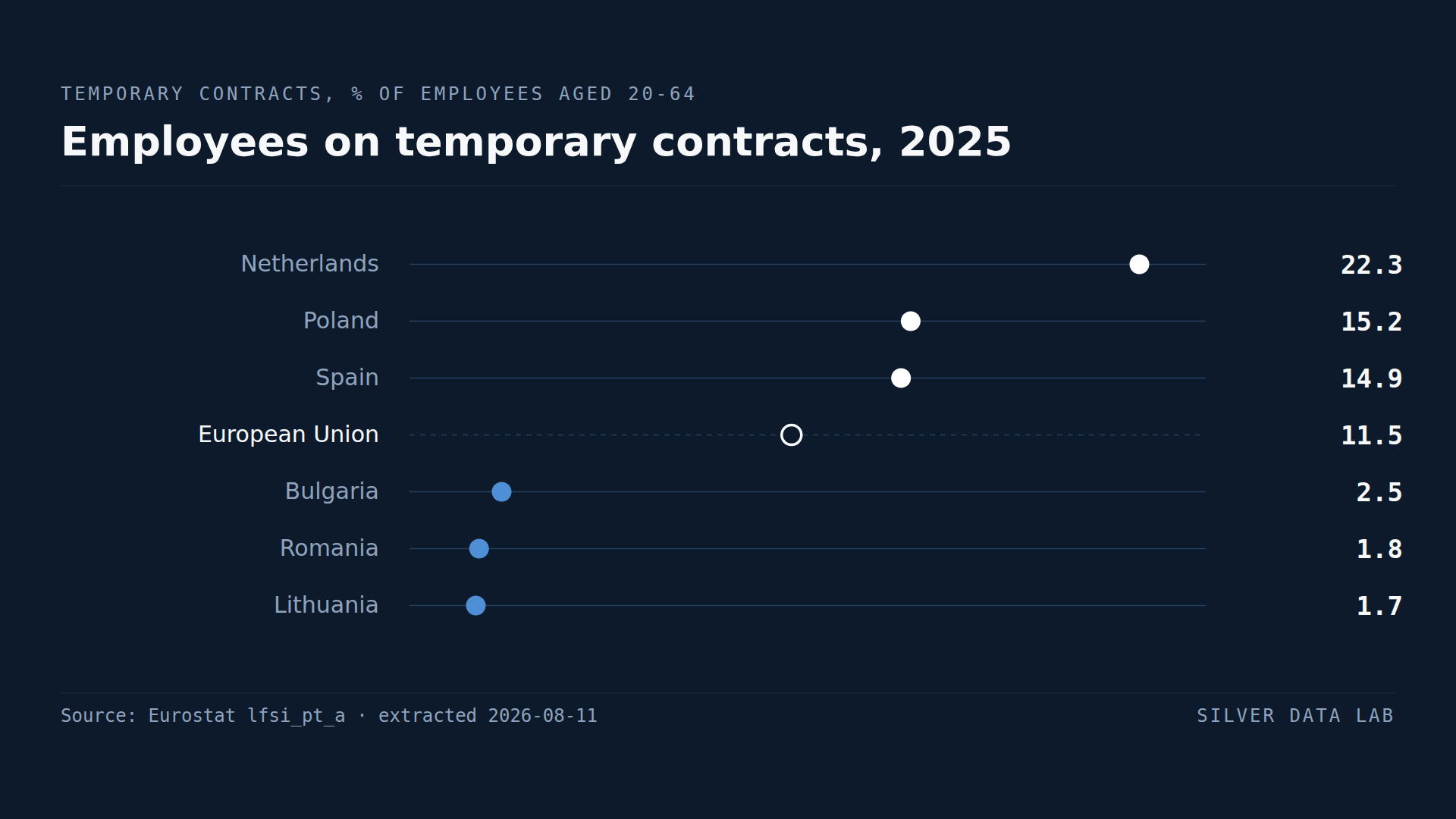
More Than One Dutch Employee in Five Is on a Temporary Contract
11.5% of employees aged 20 to 64 in the EU were on temporary contracts in 2025.
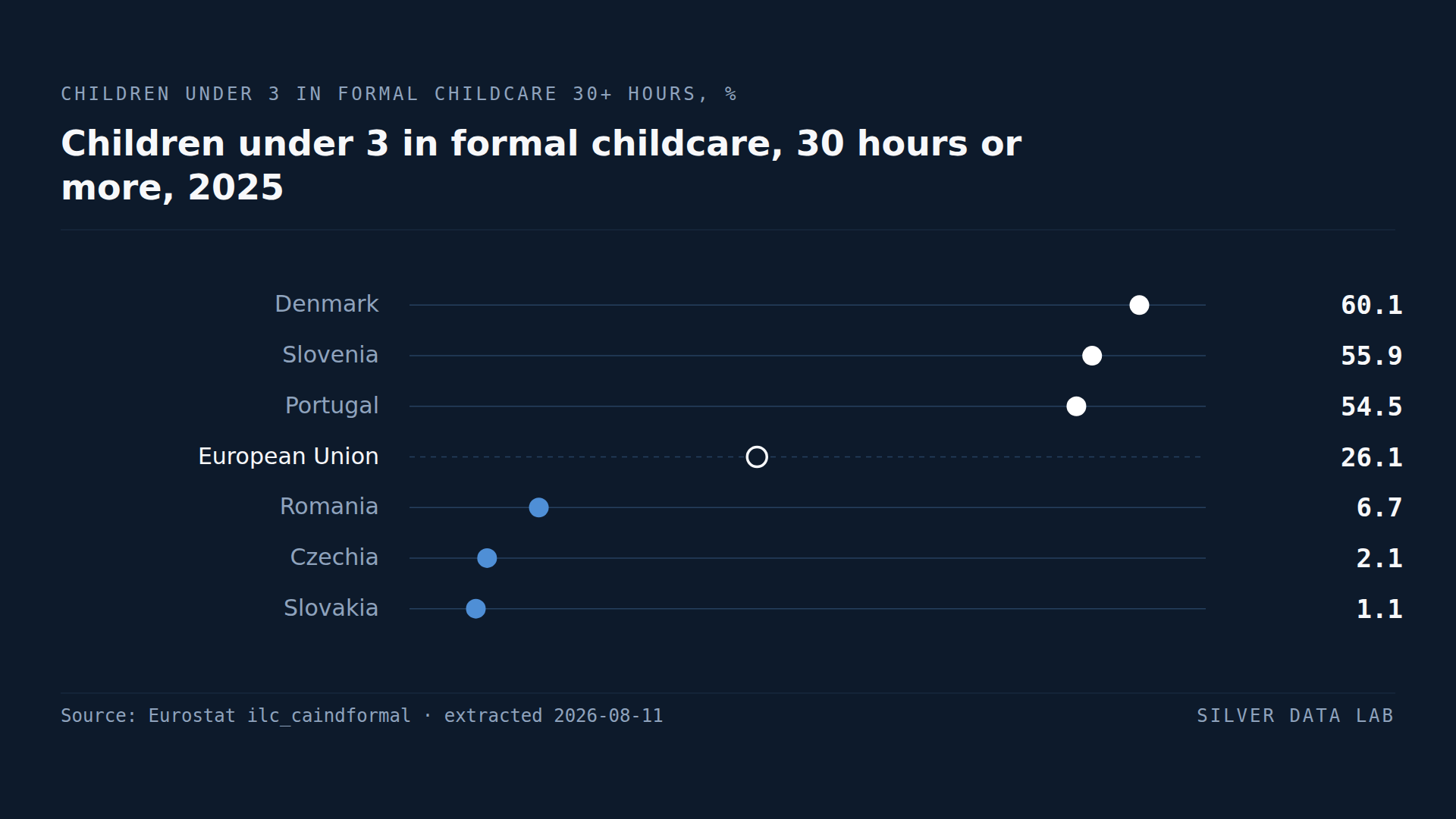
Most Danish Children Under Three Are in Full-Time Childcare
26.1% of EU children under three attended formal childcare for 30 hours a week or more in 2025.
Studies where the same country leads or trails
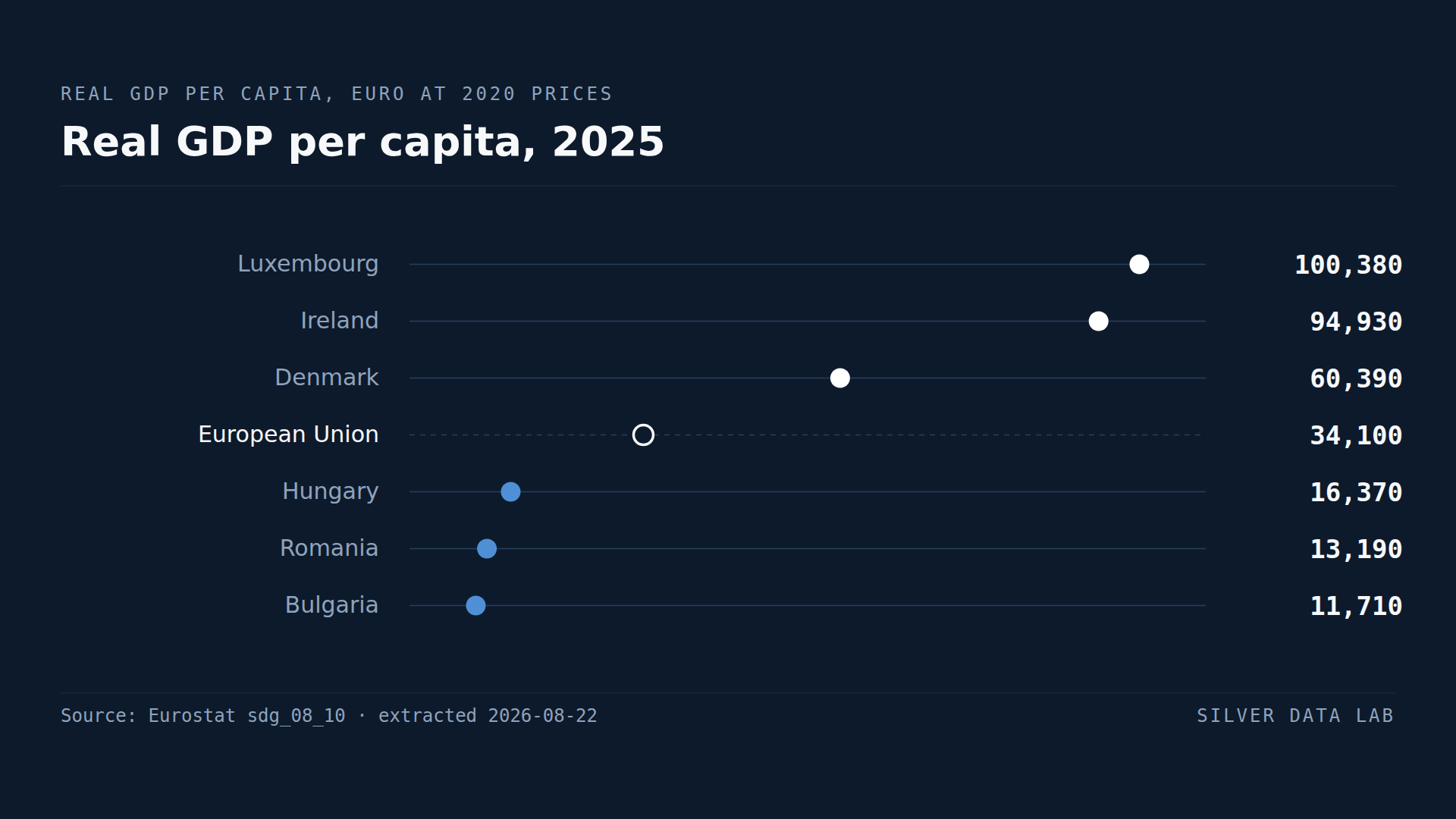
Bulgaria's GDP per Person Is About a Third of the EU Average
EU real GDP per capita was 34,250 euro in 2025, at 2020 prices.
GDP per Head Makes Luxembourg and Ireland Look Richer Than They Are
Luxembourg records 239 and Ireland 238 against an EU average of 100 — more than double the Union's output per head.
Germany's Legal Minimum Wage Buys More Than Any Other in the EU
22 of the 27 Member States set a statutory minimum wage. Austria, Denmark, Finland, Italy and Sweden do not, leaving pay floors to collective agreements.