Most Danish Children Under Three Are in Full-Time Childcare
Silver Data Lab Research Desk · Statistical analysis · Published on 11 July 2026
- Data source
- Eurostat
- Reference period
- 2025
- Last updated
- 18 October 2026
Re-checked against the source on 21 October 2026. No value in its datasets has moved between the snapshots we hold. Every revision we have observed →
Key estimates
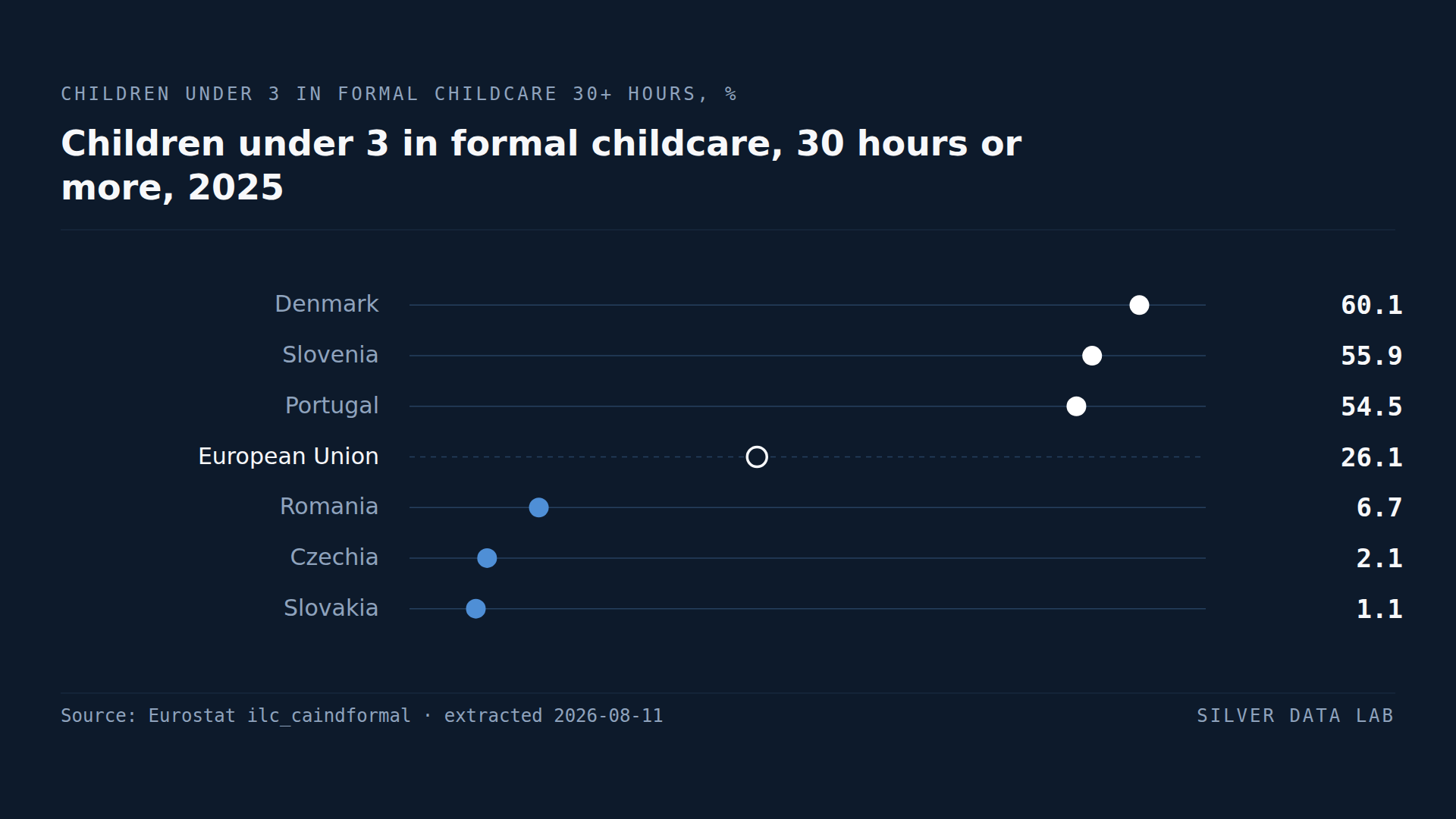
- 26.1% of EU children under three attended formal childcare for 30 hours a week or more in 2025.
- Denmark records 60.1%, Slovenia 55.9% and Portugal 54.5%.
- Slovakia records 1.1%, Czechia 2.1% and Romania 6.7%.
- The Danish rate is 55 times the Slovak one.
- Eleven Member States are above 33% on full-time attendance alone; the EU's 2030 target of 45% counts attendance of any weekly duration.
The measure that sits under the gender employment gap
Formal childcare means care provided by an organised service — a nursery, a crèche, a registered childminder — rather than by relatives. This study uses full-time attendance, 30 hours a week or more, for children under three.
Across the EU in 2025, 26.1% of under-threes were in full-time formal care.
Where the provision exists
Denmark records 60.1%, Slovenia 55.9%, Portugal 54.5% and Luxembourg 44.9%.
Denmark's position reflects a system in which places are effectively guaranteed and heavily subsidised, and in which returning to full-time work before a child's first birthday is ordinary.
Slovenia in second place is the entry that resists an income explanation. It is not among the Union's wealthiest Member States and it provides full-time care to more than half its under-threes — more than the Netherlands, Germany or Austria, all of which are richer.
Portugal at 54.5% is in the same position.
Where it does not
Slovakia records 1.1%, Czechia 2.1% and Romania 6.7%.
In Slovakia and Czechia, full-time formal care for children under three is close to non-existent. Both countries operate long parental leave systems — up to three years — and provision for under-threes is built on the assumption that a parent will be at home.
That is a coherent policy design rather than an absence of one. It has consequences the design does not remove: the parent at home is overwhelmingly the mother, and a three-year absence from employment at the start of a career has effects that persist afterwards.
The Dutch anomaly
The Netherlands records 10.6%, which is startling for a wealthy Member State where women's employment is among the Union's highest.
The explanation is part-time work. The Netherlands has the highest part-time employment rate in the Union at 38.6%, and a parent working three days a week needs three days of childcare, not five. Dutch children are in formal care in large numbers; comparatively few are in it for 30 hours or more.
This is the clearest demonstration that a full-time childcare measure is not a measure of childcare availability. It measures a particular combination of care and working patterns, and the Netherlands has a different combination rather than less care.
The relationship to employment
Across the Union the two measures line up: the Member States where more under-threes attend full-time care tend to have narrower gender employment gaps. The correspondence is derived here from the two extractions, each a single year, so it says nothing about either measure moving over time. At the bottom of this ranking it is looser. Of the ten Member States with the lowest full-time attendance, four have gaps wider than the EU's 9.6 points — Romania's is 18.7 and Czechia's 10.7 — and six have narrower ones, Slovakia among them at 8.7 despite recording the Union's lowest attendance.
The direction of that relationship is not established by this data, and it plausibly runs both ways: care is not provided because mothers are expected to be at home, and mothers stay at home because care is not provided. What the extraction establishes is that the two tend to occur together, not that either follows from the other.
Children under 3 in formal childcare, 30 hours or more, 2025
| Country | % of children under 3 | Gap to EU averagepercentage points, derived |
|---|---|---|
| Denmark | 60.1 | +34.0 |
| Slovenia | 55.9 | +29.8 |
| Portugal | 54.5 | +28.4 |
| European Unionaggregate | 26.1 | — |
| Romania | 6.7 | −19.4 |
| Czechia | 2.1 | −24.0 |
| Slovakia | 1.1 | −25.0 |
This table as data: CSV · JSON
Every Member State for this indicator+
Members see every Member State for this indicator here, not only the rows the ranking prints. Become a Member
Embed this chart
Paste this code into a page. The frame carries the source and the extraction date, and links back to the study.
What these figures cannot tell you
- Full-time attendance only
- This measure counts children in formal care for 30 hours a week or more. A country where most children attend part-time records a low figure while providing widely available care — the Netherlands is the clearest case.
- Formal care only
- Care by grandparents, other relatives or unregistered arrangements is excluded. In Member States where family care is the norm, provision is understated by this measure.
- Long parental leave changes what is being measured
- Where paid leave runs to two or three years, low under-three attendance reflects a different policy design rather than an unmet need. Slovakia and Czechia operate such systems.
- Availability and cost are not separated
- The indicator records attendance, not whether places exist or what they cost. Low attendance can mean no places, unaffordable places, or a preference for care at home, and this data does not distinguish them.
Frequently asked questions
- How many young children in the EU are in childcare?
- 26.1% of children under three attended formal childcare for 30 hours a week or more in 2025. Counting attendance of any weekly duration, the figure is higher; this study measures full-time attendance only.
- Which EU country provides the most childcare?
- Denmark, where 60.1% of under-threes are in full-time formal care, followed by Slovenia at 55.9% and Portugal at 54.5%. Slovenia and Portugal are not among the Union's wealthiest Member States, which rules out a simple income explanation.
- Which EU country provides the least?
- Slovakia at 1.1% and Czechia at 2.1%. Both operate parental leave systems running up to three years, so provision for under-threes is built on the assumption that a parent will be at home.
- Why does the Netherlands score so low?
- Because this measure counts full-time attendance only. The Netherlands has the Union's highest part-time employment rate at 38.6%, and a parent working three days a week needs three days of childcare. Dutch children are in formal care in large numbers, but comparatively few for 30 hours or more.
Methodological note
Eurostat publishes children in formal childcare or education by age group and weekly duration from EU-SILC. This study uses children under three attending for 30 hours a week or more, as a percentage of all children in that age group.
Values are for 2025 and cover all 27 Member States.
The count of Member States above 33%, the ratio between the Danish and Slovak rates, the correspondence between full-time attendance and the gender employment gap, and the split of the ten Member States with the lowest attendance into those above and below the EU gap are derived by Silver Data Lab. The Barcelona targets are EU policy objectives rather than Eurostat statistics, and they count attendance of any weekly duration — the 2022 Council Recommendation sets at least 45% of under-threes in formal care by 2030 — so target compliance cannot be read from the full-time series used here. The gender employment gaps are derived by Silver Data Lab by subtracting the female from the male employment rate, both published by Eurostat for the same year and declared as the second source below. The Dutch part-time employment rate is Eurostat's for the same year, declared as the third source.
Source data
This study draws on 3 datasets from Eurostat. Each can be inspected and re-downloaded from its catalogue, and the filters below are the ones applied.
Children in formal childcare or education by age group and duration
ilc_caindformal
- Filters applied:
- freq=A · age=Y_LT3 · duration=H_GE30 · unit=PC · time=2025
- Extracted:
- 2026-10-21
- Source last updated:
- 2026-10-20
Employment and labour force by sex and age — annual data
lfsi_emp_a
- Filters applied:
- freq=A · indic_em=EMP_LFS · unit=PC_POP · age=Y20-64 · sex=M, F · time=2025
- Extracted:
- 2026-09-11
- Source last updated:
- 2026-09-10
Part-time employment and temporary contracts
lfsi_pt_a
- Filters applied:
- freq=A · wstatus=EMP_PT · sex=T · age=Y20-64 · unit=PC_EMP · time=2025
- Extracted:
- 2026-09-13
- Source last updated:
- 2026-09-10
Download the data
The data the study you have just read is built on, exactly as it was downloaded and archived.
Yours as a Member.
Data downloadable by Members
How to cite
Record the vintage as well as the study: the figures on this page are the ones extracted on the dates below.
Silver Data Lab Research Desk (2026). Most Danish Children Under Three Are in Full-Time Childcare. Silver Data Lab, published 11 July 2026, last updated 18 October 2026. https://www.silverdatalab.com/studies/childcare-in-the-eu
- Data: Eurostat, Children in formal childcare or education by age group and duration (ilc_caindformal), filters freq=A, age=Y_LT3, duration=H_GE30, unit=PC, time=2025; extracted 2026-10-21; source last updated 2026-10-20. https://doi.org/10.2908/ilc_caindformal
- Data: Eurostat, Employment and labour force by sex and age — annual data (lfsi_emp_a), filters freq=A, indic_em=EMP_LFS, unit=PC_POP, age=Y20-64, sex=M, F, time=2025; extracted 2026-09-11; source last updated 2026-09-10. https://doi.org/10.2908/lfsi_emp_a
- Data: Eurostat, Part-time employment and temporary contracts (lfsi_pt_a), filters freq=A, wstatus=EMP_PT, sex=T, age=Y20-64, unit=PC_EMP, time=2025; extracted 2026-09-13; source last updated 2026-09-10. https://doi.org/10.2908/lfsi_pt_a
Silver Data Lab's analysis is licensed CC BY 4.0. The statistics remain their publisher's and keep its terms of reuse.
Ask the research desk
A question about this study — a definition, a filter, a break in the series, what the figures can and cannot support — answered by the desk that made the extraction.
Members can write to the research desk
Other studies on the same dataset
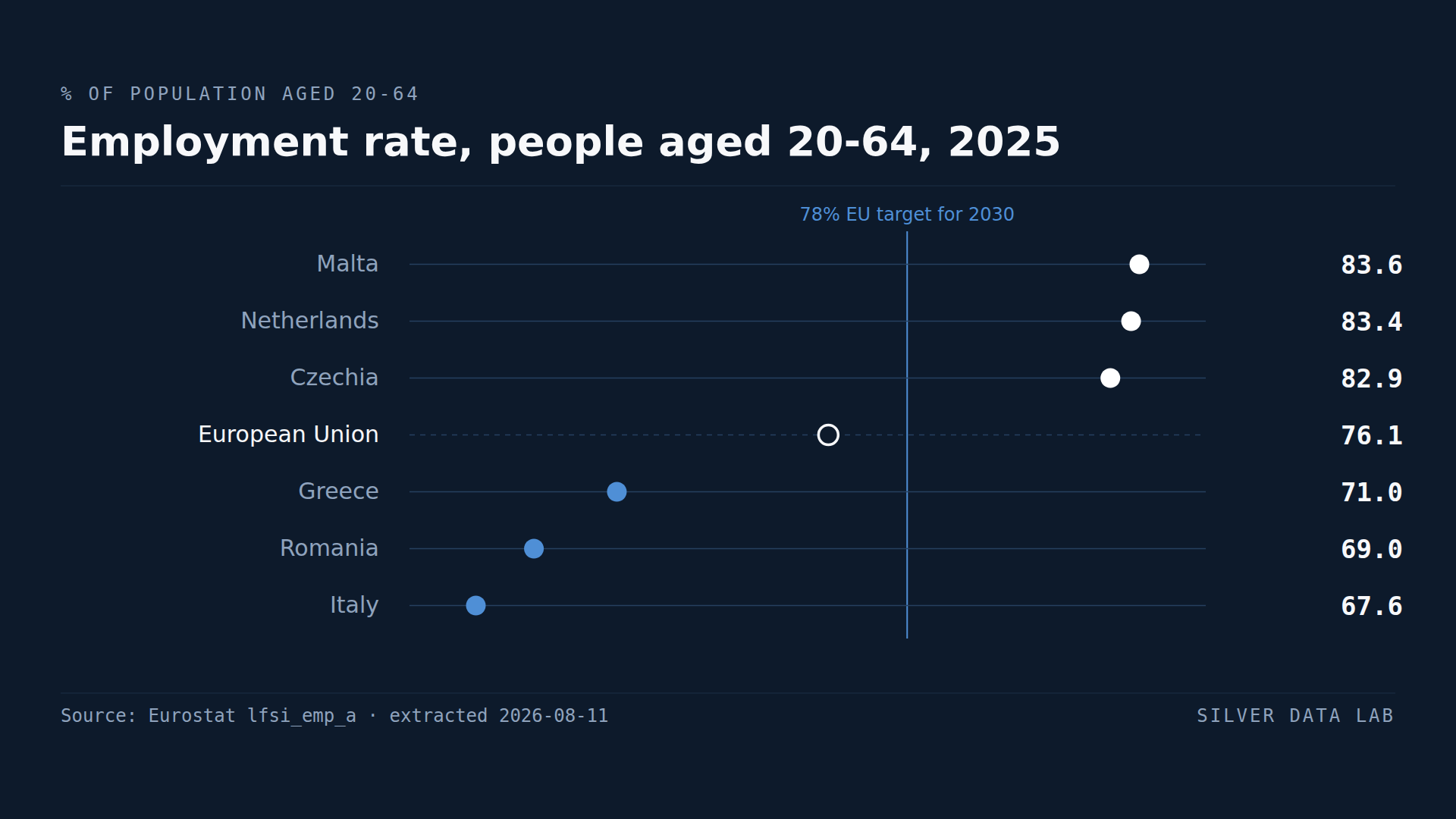
Employment Rates Vary Far More Between EU Regions Than Between Countries
76.1% of people aged 20 to 64 were in employment across the EU in 2025, or 197.8 million people — the highest reading since the series began in 2009.
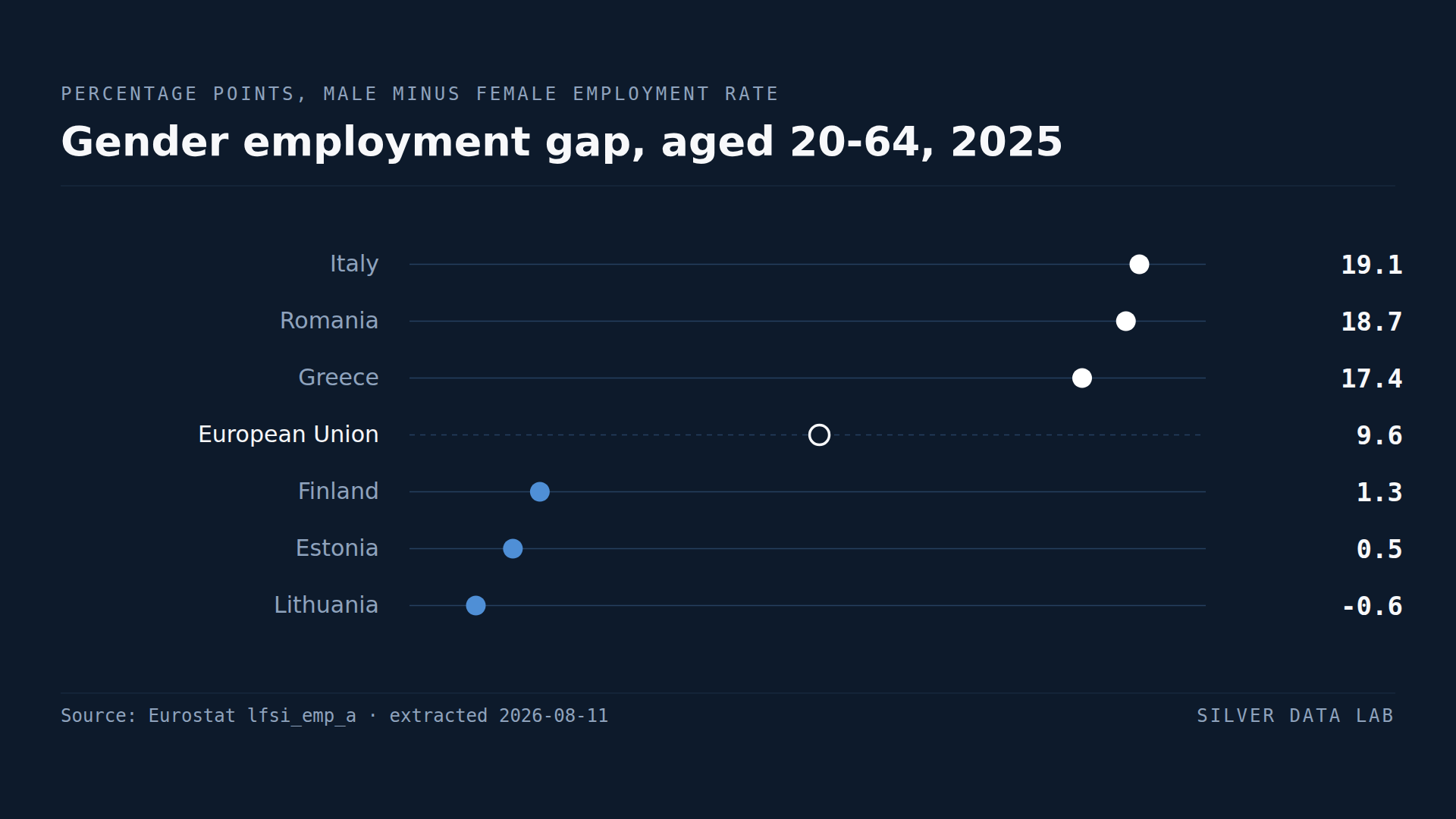
Lithuania Is the Only EU Country Where Women's Employment Exceeds Men's
Male employment exceeded female employment by 9.6 percentage points across the EU in 2025.
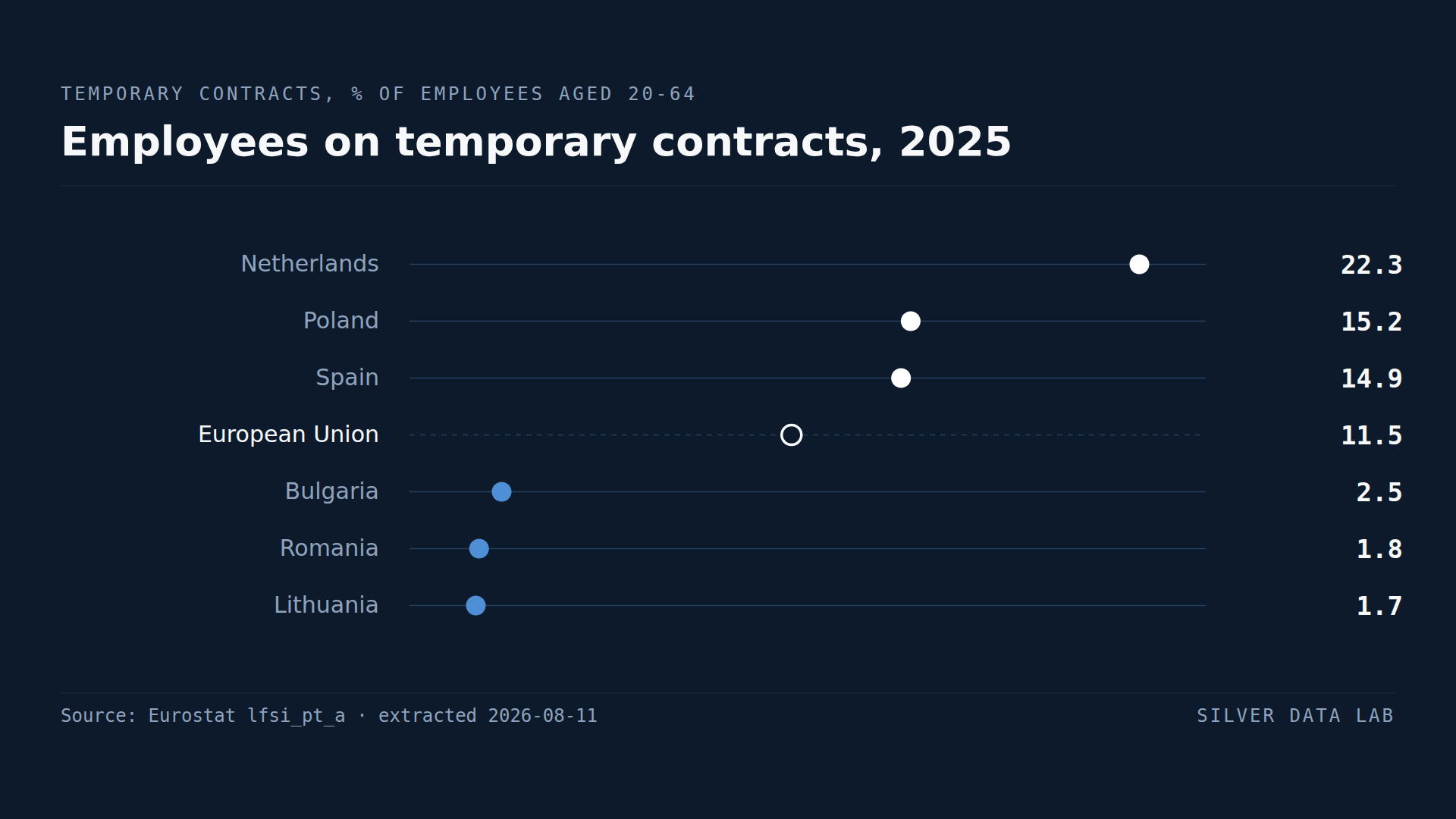
More Than One Dutch Employee in Five Is on a Temporary Contract
11.5% of employees aged 20 to 64 in the EU were on temporary contracts in 2025.
Studies where the same country leads or trails
Denmark Has the EU's Biggest Surplus With the World, at 12.3% of GDP
Denmark ran a current account surplus worth 12.3% of GDP in 2025, the largest in the Union.
EU Industrial Output Is Where It Was Four Years Ago
EU industrial production in 2025 stood at 100.4 against a 2021 base of 100 — output is essentially unchanged after four years.
Non-EU Immigrants Are Less Likely to Be in Work Than the Native-Born
68.6% of people aged 20 to 64 born outside the EU were in employment in 2025, against 77.2% of those born in the country where they live: a gap of 8.6 points, derived from the two published rates.