Two EU Countries Have No Railway at All
Silver Data Lab Research Desk · Statistical analysis · Published on 26 July 2026
- Data source
- Eurostat
- Reference period
- 2024
- Last updated
- 12 October 2026
Re-checked against the source on 12 October 2026. No value in its datasets has moved between the snapshots we hold. Every revision we have observed →
Key estimates
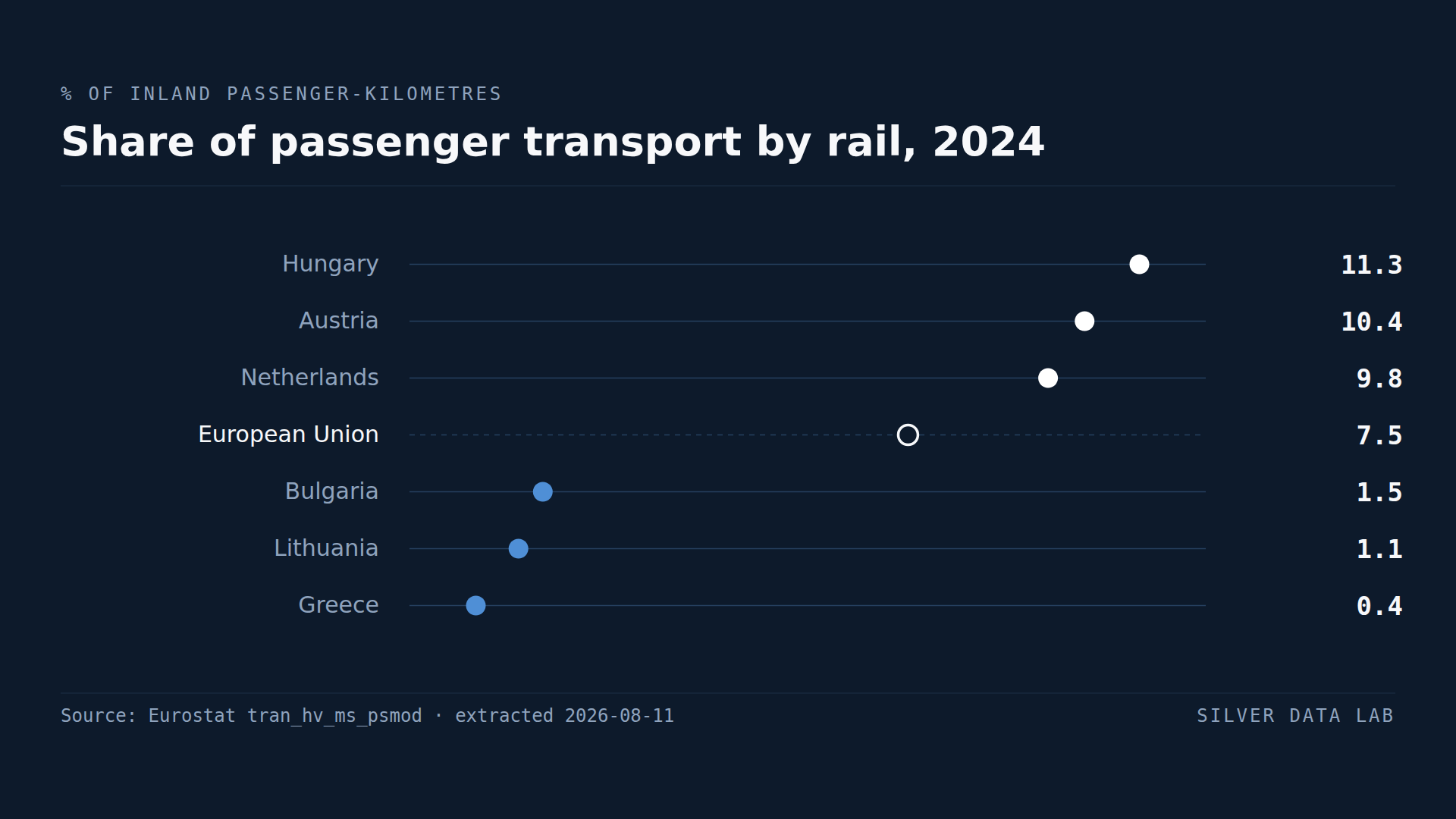
- Trains carried 7.5% of EU passenger-kilometres in 2024, on a measure that counts flights and ferries alongside cars, buses and trains.
- Hungary records the highest share at 11.3%, followed by Austria at 10.4% and the Netherlands at 9.8%.
- Greece records 0.4%, Lithuania 1.1% and Bulgaria 1.5%.
- Cyprus and Malta appear nowhere in the ranking: neither has a railway network.
- No Member State carries more than an eighth of its passenger transport by rail.
A mode that carries less than a tenth of European travel
Rail occupies a large share of European transport policy and a small share of European transport. Across the EU in 2024, trains carried 7.5% of passenger-kilometres on the measure used here, which counts flights and ferries alongside cars, buses and trains.
The highest national figure in the Union is 11.3%. There is no Member State where rail approaches the role that cars occupy, and none where it carries even an eighth of passenger distance.
Where rail does best
Hungary records 11.3%, Austria 10.4%, the Netherlands 9.8%, and Germany, France and Sweden 9.4% each.
Hungary at the top is the finding worth stating carefully. It is not among the Union's wealthiest Member States, and it has a dense inherited network with heavily used commuter services around Budapest. Austria's position rests on a similar structure. Rail share tracks network density and settlement pattern more closely than it tracks income.
Where rail is marginal
Greece records 0.4%, meaning rail carries one passenger-kilometre in every two hundred and fifty. Lithuania records 1.1%, Bulgaria 1.5% and Estonia 2.0%.
Greece is the case that resists a single explanation. Its geography is difficult for rail and much of its domestic long-distance travel is by sea or air — and on this measure those journeys are counted in the denominator, which is part of why the Greek share is as low as it is. It is not the whole of it: with air and sea taken out Greece still records the lowest share in the Union, 0.6%, and it stays low against comparable Mediterranean countries, Portugal at 3.8% and Italy at 6.2%.
The two countries that are not in this ranking
Cyprus and Malta do not appear at all. Neither has a railway network, so there is no share to report.
Their absence is a fact about those countries rather than a gap in the data, and a chart of European rail use showing twenty-seven bars would be showing two that cannot exist. The ranking here covers the 25 Member States that have railways.
Share of passenger transport by rail, 2024
| Country | % of passenger-kilometres | Gap to EU averagepercentage points, derived |
|---|---|---|
| Hungary | 11.3ep | +3.8 |
| Austria | 10.4e | +2.9 |
| Netherlands | 9.8e | +2.3 |
| European Unionaggregate | 7.5be | — |
| Bulgaria | 1.5e | −6.0 |
| Lithuania | 1.1e | −6.4 |
| Greece | 0.4e | −7.1 |
Flags carried by the source on these values: be break in time series, estimated · e estimated · ep estimated, provisional
This table as data: CSV · JSON
Every Member State for this indicator+
Members see every Member State for this indicator here, not only the rows the ranking prints. Become a Member
Embed this chart
Paste this code into a page. The frame carries the source and the extraction date, and links back to the study.
What these figures cannot tell you
- Two Member States have no railway
- Cyprus and Malta have no rail network and are absent from this indicator entirely. They are excluded rather than shown at zero, because zero would imply a network carrying no passengers.
- Passenger-kilometres, not journeys
- Rail's share is measured in distance. A country with heavy short-distance commuter rail and long-distance driving will show a lower rail share than its number of rail trips suggests.
- Urban rail is treated inconsistently
- Metro, tram and light rail systems are not always included in national rail reporting, and practice differs between Member States. This affects countries with large urban networks more than others.
- Air and sea are counted in the total
- The table used here divides rail by all passenger-kilometres, flights and ferries included, so a Member State where much domestic travel is by air or sea records a lower rail share than it would on the inland modes alone. Eurostat publishes both, and the EU reads 7.5% here against 8.9% with air and sea taken out. Hungary is the highest and Greece the lowest on either basis; the third place from the top changes hands.
Frequently asked questions
- What share of EU travel is by train?
- 7.5% of all passenger-kilometres in 2024, with air and sea travel counted in the total. No Member State carries more than 11.3% of its passenger distance by rail.
- Which EU country uses trains the most?
- Hungary, at 11.3% of all passenger-kilometres in 2024, ahead of Austria at 10.4% and the Netherlands at 9.8%. Rail share tracks network density and settlement patterns more closely than income.
- Which EU countries have no railway?
- Cyprus and Malta. Neither has a rail network, so neither appears in this indicator. They are excluded from the ranking rather than shown at zero.
- Which EU country uses trains the least?
- Of those with a railway, Greece, at 0.4% of all passenger-kilometres in 2024 — roughly one passenger-kilometre in 250. Lithuania follows at 1.1% and Bulgaria at 1.5%.
Methodological note
Modal split is published by Eurostat as the share of each mode in total passenger transport, measured in passenger-kilometres. This study uses the train share from the table that covers air, sea and inland transport together, so flights and ferries are counted in the denominator alongside cars, buses and trains. Eurostat publishes a second table restricted to the inland modes; the EU and Greek figures quoted from it come from its own extraction, declared below.
Values are for 2024. Twenty-five Member States report: Cyprus and Malta have no railway network and are absent from the source rather than recorded at zero.
The EU aggregate of 7.5% is Eurostat's own figure, computed across the countries that report.
Source data
This study draws on 2 datasets from Eurostat. Each can be inspected and re-downloaded from its catalogue, and the filters below are the ones applied.
Modal split of air, sea and inland passenger transport
tran_hv_ms_psmod
- Filters applied:
- freq=A · vehicle=TRN · unit=PC · time=2024
- Extracted:
- 2026-08-27
- Source last updated:
- 2026-08-26
Modal split of inland passenger transport
tran_hv_psmod
- Filters applied:
- freq=A · vehicle=TRN · unit=PC · time=2024
- Extracted:
- 2026-10-12
- Source last updated:
- 2026-08-26
Download the data
The data the study you have just read is built on, exactly as it was downloaded and archived.
Yours as a Member.
Data downloadable by Members
How to cite
Record the vintage as well as the study: the figures on this page are the ones extracted on the dates below.
Silver Data Lab Research Desk (2026). Two EU Countries Have No Railway at All. Silver Data Lab, published 26 July 2026, last updated 12 October 2026. https://www.silverdatalab.com/studies/rail-travel-in-the-eu
- Data: Eurostat, Modal split of air, sea and inland passenger transport (tran_hv_ms_psmod), filters freq=A, vehicle=TRN, unit=PC, time=2024; extracted 2026-08-27; source last updated 2026-08-26. https://doi.org/10.2908/tran_hv_ms_psmod
- Data: Eurostat, Modal split of inland passenger transport (tran_hv_psmod), filters freq=A, vehicle=TRN, unit=PC, time=2024; extracted 2026-10-12; source last updated 2026-08-26. https://doi.org/10.2908/tran_hv_psmod
Silver Data Lab's analysis is licensed CC BY 4.0. The statistics remain their publisher's and keep its terms of reuse.
Ask the research desk
A question about this study — a definition, a filter, a break in the series, what the figures can and cannot support — answered by the desk that made the extraction.
Members can write to the research desk
Other studies on the same dataset
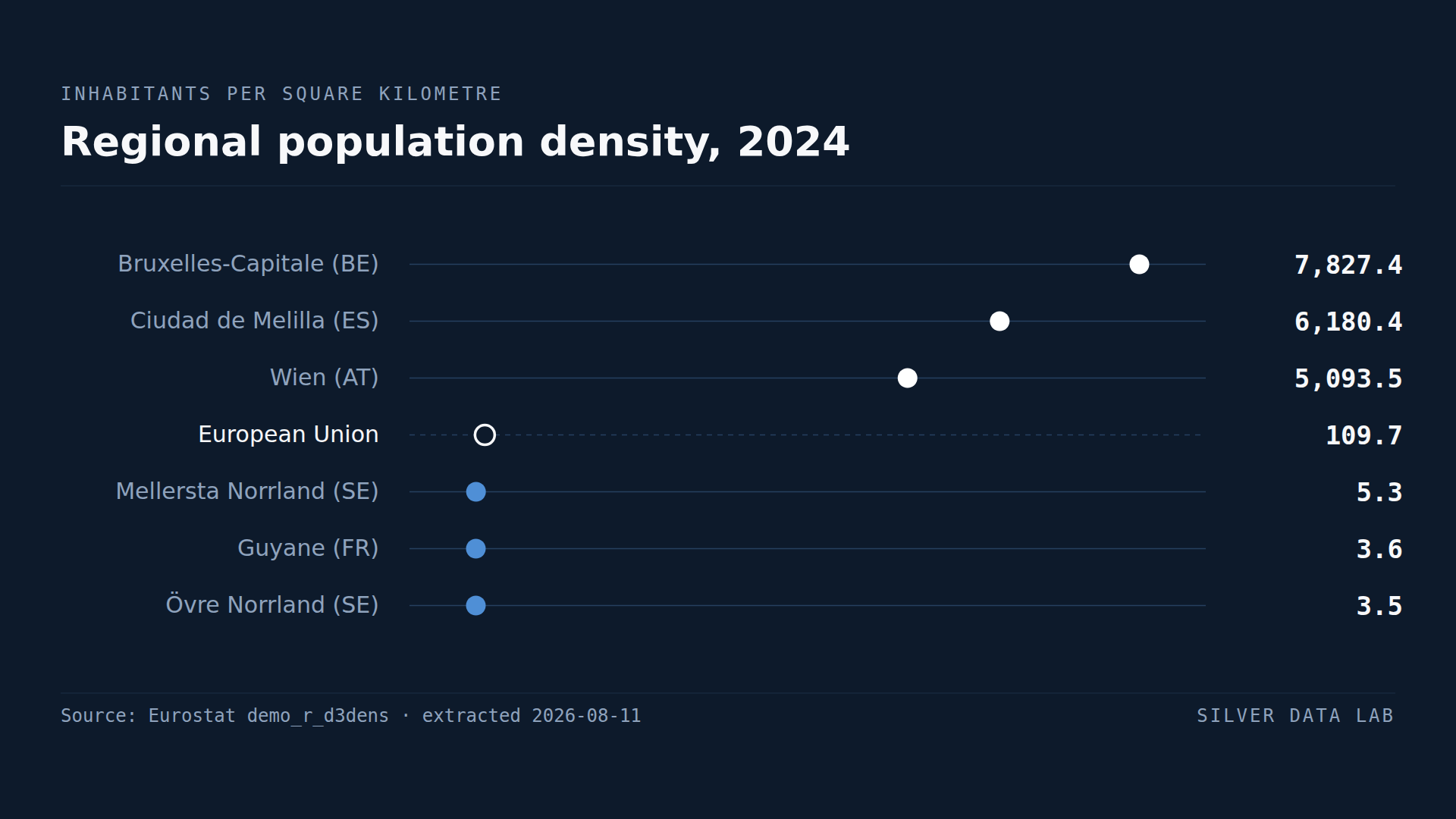
Brussels Is 2,200 Times More Crowded Than Northern Sweden
The EU averages 109.7 inhabitants per square kilometre.
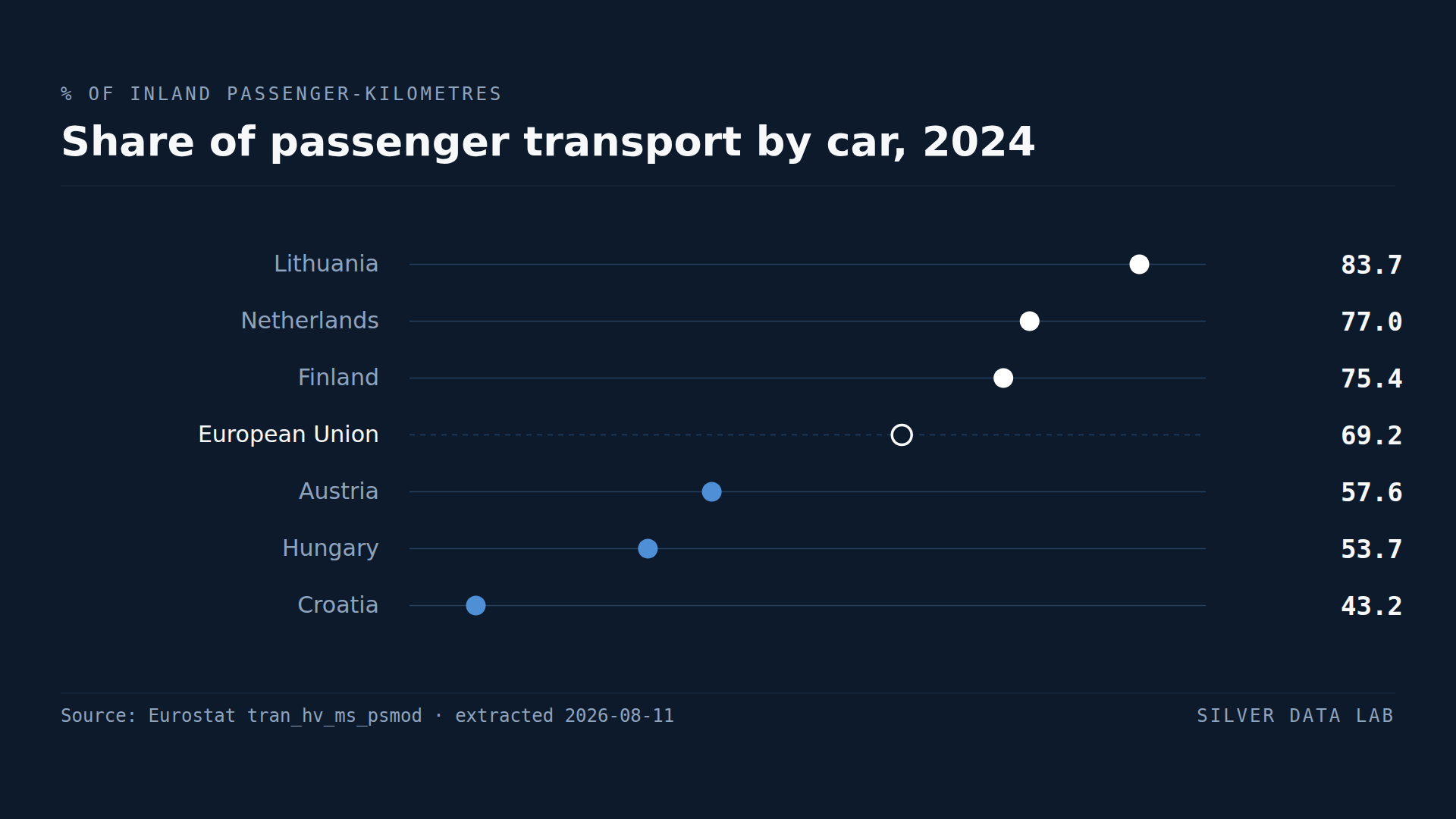
EU Travellers Cover Seven in Ten Kilometres by Car Rather Than Bus or Train
Cars accounted for 69.2% of EU passenger-kilometres in 2024, on a measure that counts flights and ferries alongside cars, buses and trains.
Studies where the same country leads or trails
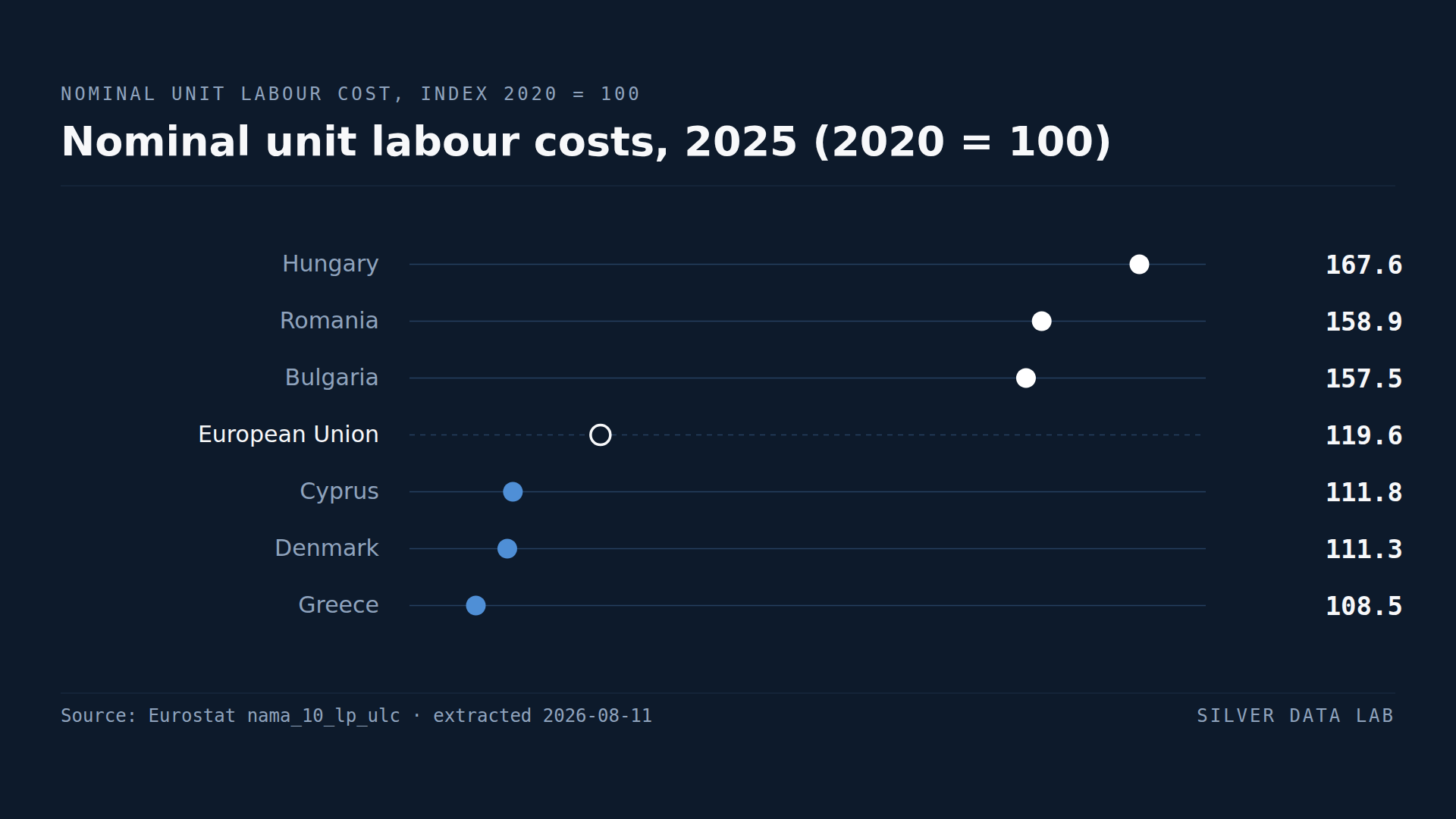
Hungary's Labour Cost per Unit of Output Rose by Over Half in Five Years
EU unit labour costs in 2025 stood at 119.1 against a 2020 base of 100 — 19.1% higher in five years.
In One Year, House Prices Rose 18.3% in Hungary and Fell in Finland
House prices across the EU rose 5.5% on annual average in 2025.
In Two EU Countries, Households Spend More Than They Earn
EU households saved 14.5% of their gross disposable income in 2024.