Sweden's Youth Unemployment Is Higher Than Greece's
Silver Data Lab Research Desk · Statistical analysis · Published on 14 June 2026
- Data source
- Eurostat
- Reference period
- 2025
- Last updated
- 16 October 2026
Re-checked against the source on 16 October 2026. 18 values in its datasets moved between snapshots; none is a figure stated on this page. Every revision we have observed →
Key estimates
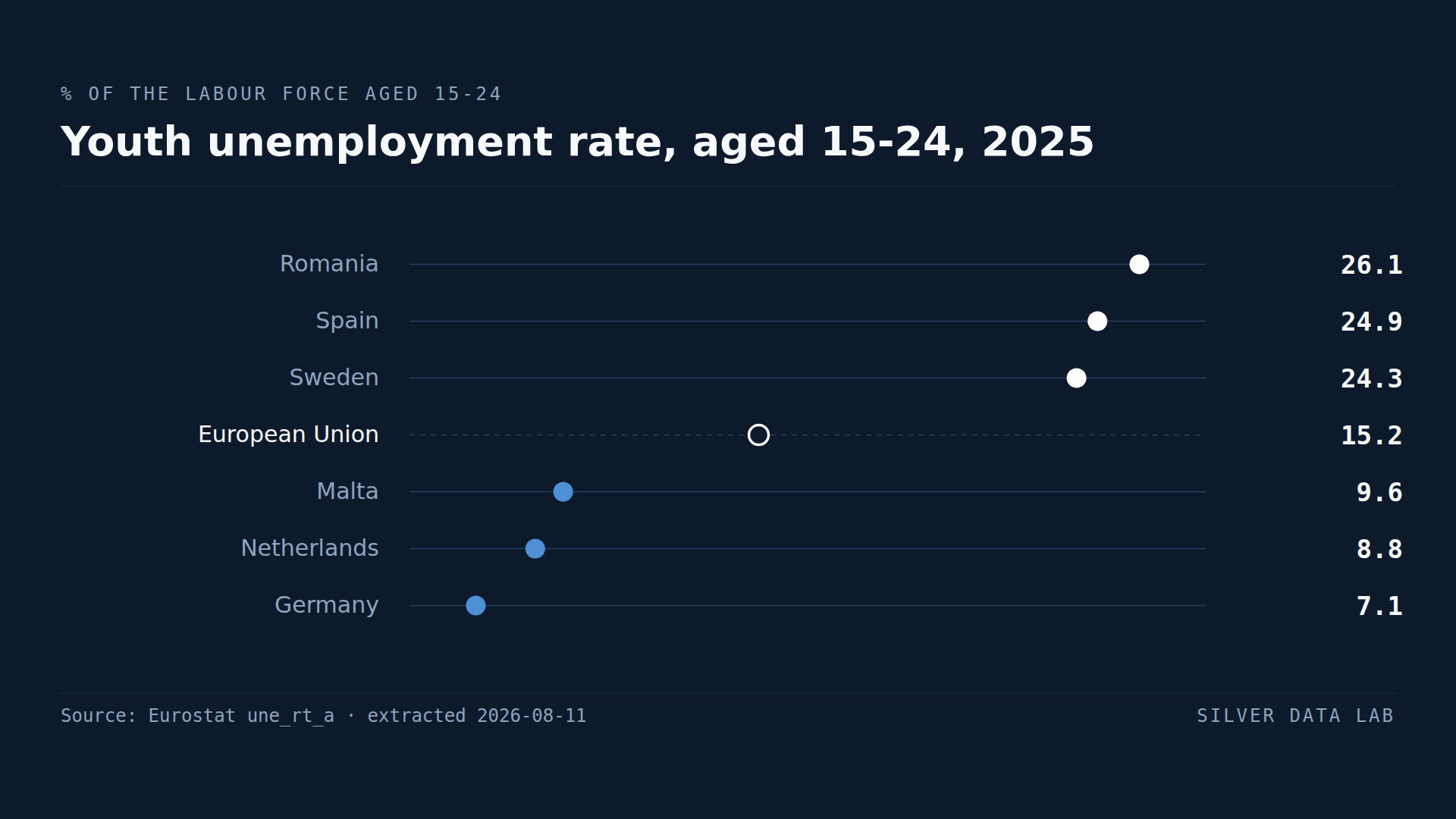
- 15.2% of the EU labour force aged 15 to 24 was unemployed in 2025.
- Romania records 26.1%, Spain 24.9% and Sweden 24.3%.
- Germany records 7.1%, the Netherlands 8.8% and Malta 9.6%.
- Sweden's third place is not a small denominator: measured against the whole age group Sweden is first in the Union at 13.9%, against 6.2% for the EU.
- The two measures also use different age bands: unemployment 15 to 24, NEET 15 to 29.
The most misread statistic in European labour data
Youth unemployment is quoted more often than almost any other European figure and understood less often than most. Across the EU it stood at 15.2% in 2025.
The number that follows is not what most readers assume it to be. It does not mean that 15.2% of young Europeans are unemployed. It means that 15.2% of young Europeans who are in the labour force are unemployed — and most young Europeans are not in the labour force, because they are studying.
The Swedish case
Sweden records 24.3%, the third-highest youth unemployment rate in the European Union, above Greece at 19.1% and Italy at 20.6%.
Sweden also records a NEET rate of 5.9%, the second lowest in the Union, on a measure that counts young people not working and not studying as a share of the whole population.
Both figures are correct, and what reconciles them is who is counted rather than how large the denominator is. Taking the labour force out of the denominator does not move Sweden down. Eurostat publishes the same count against the whole age group, as the youth unemployment ratio — unemployed 15 to 24 year olds as a percentage of the total population of that age — and on that measure Sweden is first in the Union at 13.9% against 6.2% for the EU, while Greece and Italy fall to 4.6% each. Nor is the Swedish youth labour force small: 57.2% of Swedes aged 15 to 24 are in it, the fourth highest share in the Union against an EU figure of 40.7%. What is distinctive is who those young people are. They are largely students, and a student looking for a Saturday job and not finding one is unemployed by the international definition while remaining in education — counted as unemployed, and not counted as NEET.
Romania at the top is a different situation: a high unemployment rate alongside the Union's highest NEET rate at 19.2%. There the two measures agree, and the problem they describe is real. On the population denominator Romania falls to 6.2%, the EU figure itself, which is the arithmetic of a youth labour force of 23.8%, the third smallest in the Union — the small-denominator case the Swedish figure is usually mistaken for.
Where the two measures agree and where they do not
Germany at 7.1% has a NEET rate of 9.5%. It is one of only two Member States whose NEET rate is the higher of the two figures; Bulgaria, at 13.1% against 13.8%, is the other.
Sweden is the clearest divergence in the Union on either way of putting it: 18.4 percentage points separate its two rates, and one is more than four times the other. Spain comes next on the difference, at 24.9% unemployment against 11.5% NEET, and Portugal next on the multiple, at 19.5% against 8.0% — a factor of 2.4.
Reading the two together is not optional for this indicator. A youth unemployment rate quoted alone, without the share of young people actually in the labour force, does not support the conclusions usually drawn from it.
Youth unemployment rate, aged 15-24, 2025
| Country | % of the labour force aged 15-24 | Gap to EU averagepercentage points, derived |
|---|---|---|
| Romania | 26.1 | +10.9 |
| Spain | 24.9d | +9.7 |
| Sweden | 24.3 | +9.1 |
| European Unionaggregate | 15.2 | — |
| Malta | 9.6 | −5.6 |
| Netherlands | 8.8 | −6.4 |
| Germany | 7.1 | −8.1 |
Flags carried by the source on these values: d definition differs
This table as data: CSV · JSON
Every Member State for this indicator+
Members see every Member State for this indicator here, not only the rows the ranking prints. Become a Member
Embed this chart
Paste this code into a page. The frame carries the source and the extraction date, and links back to the study.
What these figures cannot tell you
- The denominator is the labour force, not the population
- Students are excluded from the denominator unless they are also working or seeking work. In countries where most young people study, the rate describes a small and unrepresentative group.
- A 15 to 24 age band
- The band includes people still at school. Countries where education continues to 18 or 19 have very few labour force participants at the young end, which makes their rates volatile.
- Part-time job seeking counts
- A student seeking a few hours of weekend work and an adult seeking full-time employment are both counted as unemployed, without distinction of intensity.
- Luxembourg is absent
- Eurostat publishes no youth unemployment rate for Luxembourg for 2025 — the cell carries a low-reliability flag and no value — so every comparison here rests on 26 Member States. Its 2024 rate was 21.6%, which is not quoted beside the 2025 figures: the two years are not interchangeable and this study does not mix them.
- The NEET comparison shifts the age band as well as the denominator
- Unemployment here is measured on 15 to 24 year olds; the NEET rate quoted beside it is published on 15 to 29 year olds. The 25 to 29 year olds the wider band takes in are in a different position from the teenagers at the young end, so part of every gap between the two rates is that difference and not only the difference in denominator. The youth unemployment ratio quoted here does not have the problem: it is the same 15 to 24 band as the rate, with the whole age group as its denominator.
- Two of the values are on a different definition
- Eurostat flags the Spanish and French 2025 figures with its definition-differs marker, on the rate and on the ratio alike. Spain is the second row of this ranking, where the flag is shown beside the value, and the same 24.9% is quoted in the text, where it is not. France carries the flag too, but no French figure is quoted in this study. Comparisons involving Spain are therefore less secure than the decimals suggest.
Frequently asked questions
- What is youth unemployment in the EU?
- 15.2% of the labour force aged 15 to 24 in 2025. It does not mean 15.2% of young Europeans are unemployed, because most young Europeans are students and are outside the labour force.
- Which EU country has the highest youth unemployment?
- Romania, at 26.1% in 2025, followed by Spain at 24.9% and Sweden at 24.3%.
- Why is Swedish youth unemployment so high?
- Not because the denominator is small: 57.2% of Swedes aged 15 to 24 are in the labour force, the fourth highest share in the Union. It is because of who is in it. They are largely students, and a student who cannot find a Saturday job is unemployed by the international definition while still being in education. The same students are not NEET, which is why Sweden's NEET rate is the second lowest in the Union at 5.9% while Sweden is first on unemployment measured against the whole age group.
- Which measure should be used for young people?
- For how many young people are disengaged, the NEET rate, because its denominator is the whole population. Youth unemployment is informative about the labour market young jobseekers face, provided the size of that group is quoted alongside it.
Methodological note
The youth unemployment rate is published by Eurostat as unemployed people aged 15 to 24 as a percentage of the labour force in that age band, following the international definition of unemployment: without work, available to start within two weeks, and actively seeking.
Values are for 2025. Luxembourg has no published value for that year, so the ranking and the comparisons here cover 26 Member States, while the EU figure is as published and includes all 27.
The same dataset publishes the identical count against the whole 15 to 24 population, which Eurostat calls the youth unemployment ratio, and the activity rate that reconciles the two is published in a companion table; both are declared below and archived. Eurostat's own observation flags are read from those extractions: the Spanish and French 2025 values depart from the common definition, and the Luxembourg cell carries a low-reliability flag and no value.
The NEET comparisons draw on the companion study in this category, which differs in two ways at once: it uses the whole population as its denominator rather than the labour force, and it is published on the 15 to 29 age band rather than 15 to 24. The two are presented side by side and never combined.
The differences and ratios between the two rates, and the ranks quoted on the ratio and on the activity rate, are derived by Silver Data Lab from the published values. Eurostat does not publish them.
Source data
This study draws on 4 datasets from Eurostat. Each can be inspected and re-downloaded from its catalogue, and the filters below are the ones applied.
Unemployment by sex and age — annual data
une_rt_a
- Filters applied:
- freq=A · age=Y15-24 · sex=T · unit=PC_ACT
- Extracted:
- 2026-09-11
- Source last updated:
- 2026-09-10
Unemployment by sex and age — annual data
une_rt_a
- Filters applied:
- freq=A · age=Y15-24 · sex=T · unit=PC_POP
- Extracted:
- 2026-10-16
- Source last updated:
- 2026-09-10
Employment and labour force by sex and age — annual data
lfsi_emp_a
- Filters applied:
- freq=A · indic_em=ACT · age=Y15-24 · sex=T · unit=PC_POP
- Extracted:
- 2026-10-16
- Source last updated:
- 2026-09-10
Young people neither in employment nor in education and training
edat_lfse_20
- Filters applied:
- freq=A · sex=T · age=Y15-29 · training=NO_FE_NO_NFE · wstatus=NEMP · unit=PC · time=2025
- Extracted:
- 2026-09-11
- Source last updated:
- 2026-09-10
Download the data
The data the study you have just read is built on, exactly as it was downloaded and archived.
Yours as a Member.
Data downloadable by Members
How to cite
Record the vintage as well as the study: the figures on this page are the ones extracted on the dates below.
Silver Data Lab Research Desk (2026). Sweden's Youth Unemployment Is Higher Than Greece's. Silver Data Lab, published 14 June 2026, last updated 16 October 2026. https://www.silverdatalab.com/studies/youth-unemployment-in-the-eu
- Data: Eurostat, Unemployment by sex and age — annual data (une_rt_a), filters freq=A, age=Y15-24, sex=T, unit=PC_ACT; extracted 2026-09-11; source last updated 2026-09-10. https://doi.org/10.2908/une_rt_a
- Data: Eurostat, Unemployment by sex and age — annual data (une_rt_a), filters freq=A, age=Y15-24, sex=T, unit=PC_POP; extracted 2026-10-16; source last updated 2026-09-10. https://doi.org/10.2908/une_rt_a
- Data: Eurostat, Employment and labour force by sex and age — annual data (lfsi_emp_a), filters freq=A, indic_em=ACT, age=Y15-24, sex=T, unit=PC_POP; extracted 2026-10-16; source last updated 2026-09-10. https://doi.org/10.2908/lfsi_emp_a
- Data: Eurostat, Young people neither in employment nor in education and training (edat_lfse_20), filters freq=A, sex=T, age=Y15-29, training=NO_FE_NO_NFE, wstatus=NEMP, unit=PC, time=2025; extracted 2026-09-11; source last updated 2026-09-10. https://doi.org/10.2908/edat_lfse_20
Silver Data Lab's analysis is licensed CC BY 4.0. The statistics remain their publisher's and keep its terms of reuse.
Ask the research desk
A question about this study — a definition, a filter, a break in the series, what the figures can and cannot support — answered by the desk that made the extraction.
Members can write to the research desk
Other studies on the same dataset
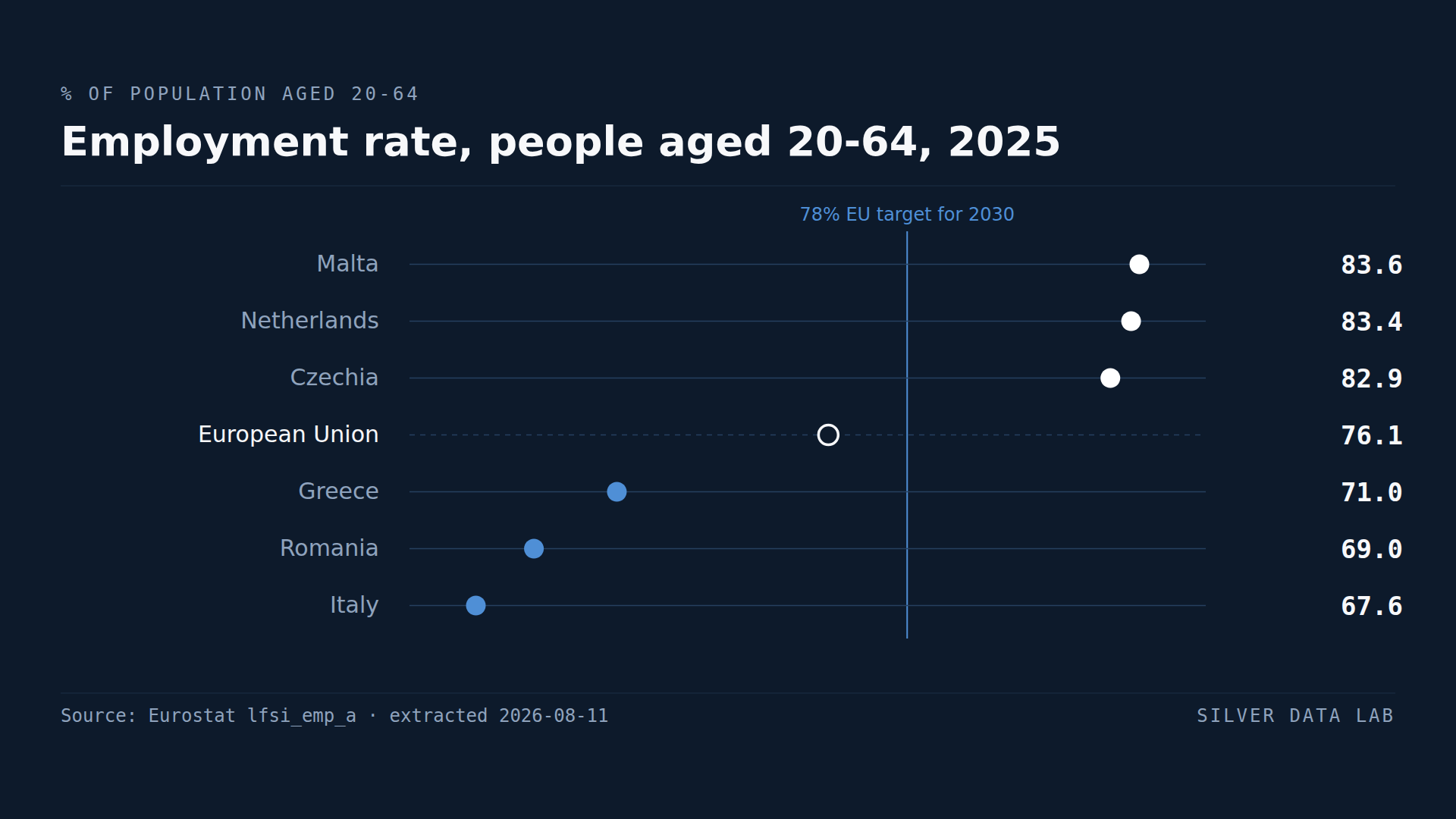
Employment Rates Vary Far More Between EU Regions Than Between Countries
76.1% of people aged 20 to 64 were in employment across the EU in 2025, or 197.8 million people — the highest reading since the series began in 2009.
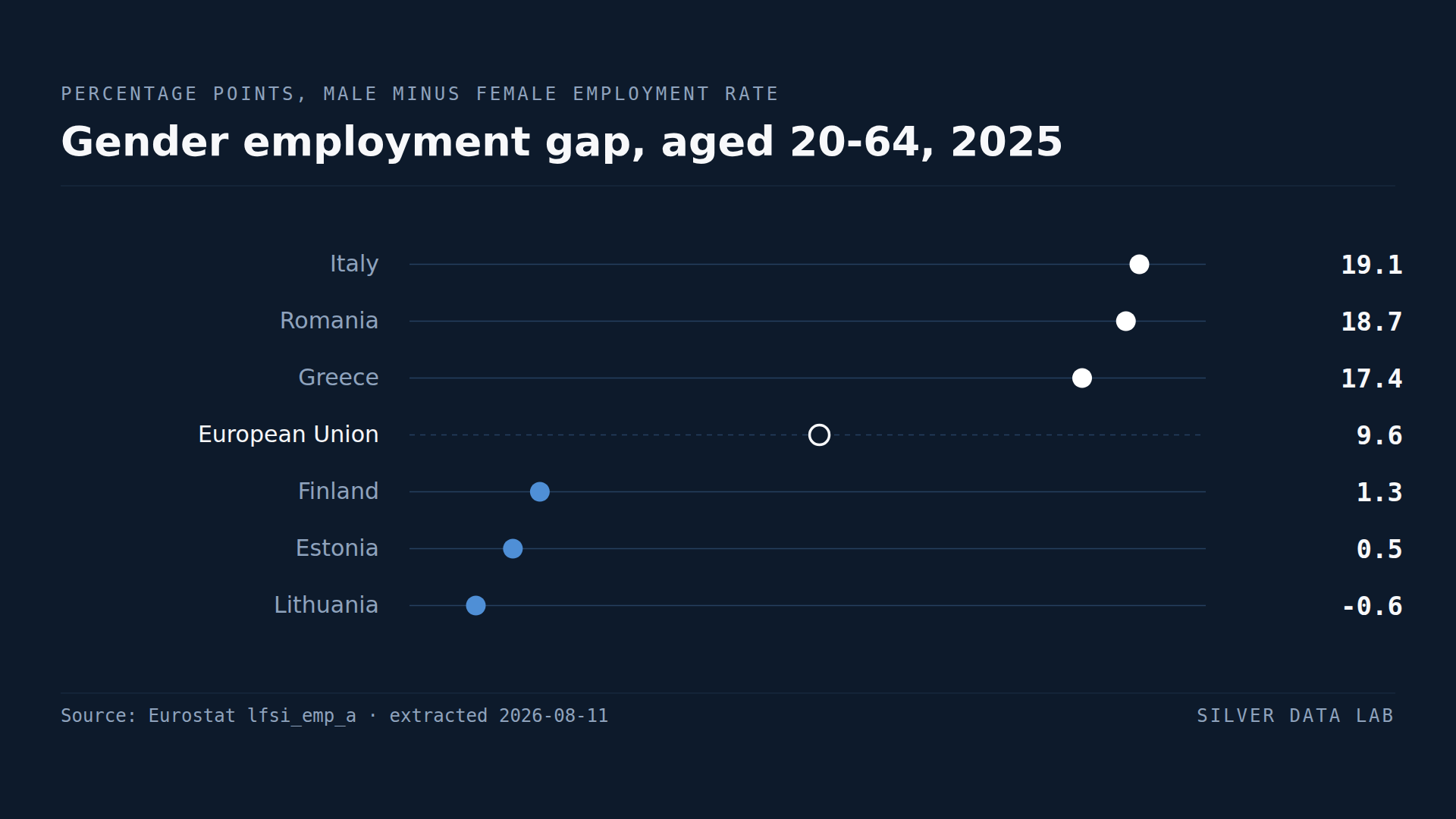
Lithuania Is the Only EU Country Where Women's Employment Exceeds Men's
Male employment exceeded female employment by 9.6 percentage points across the EU in 2025.
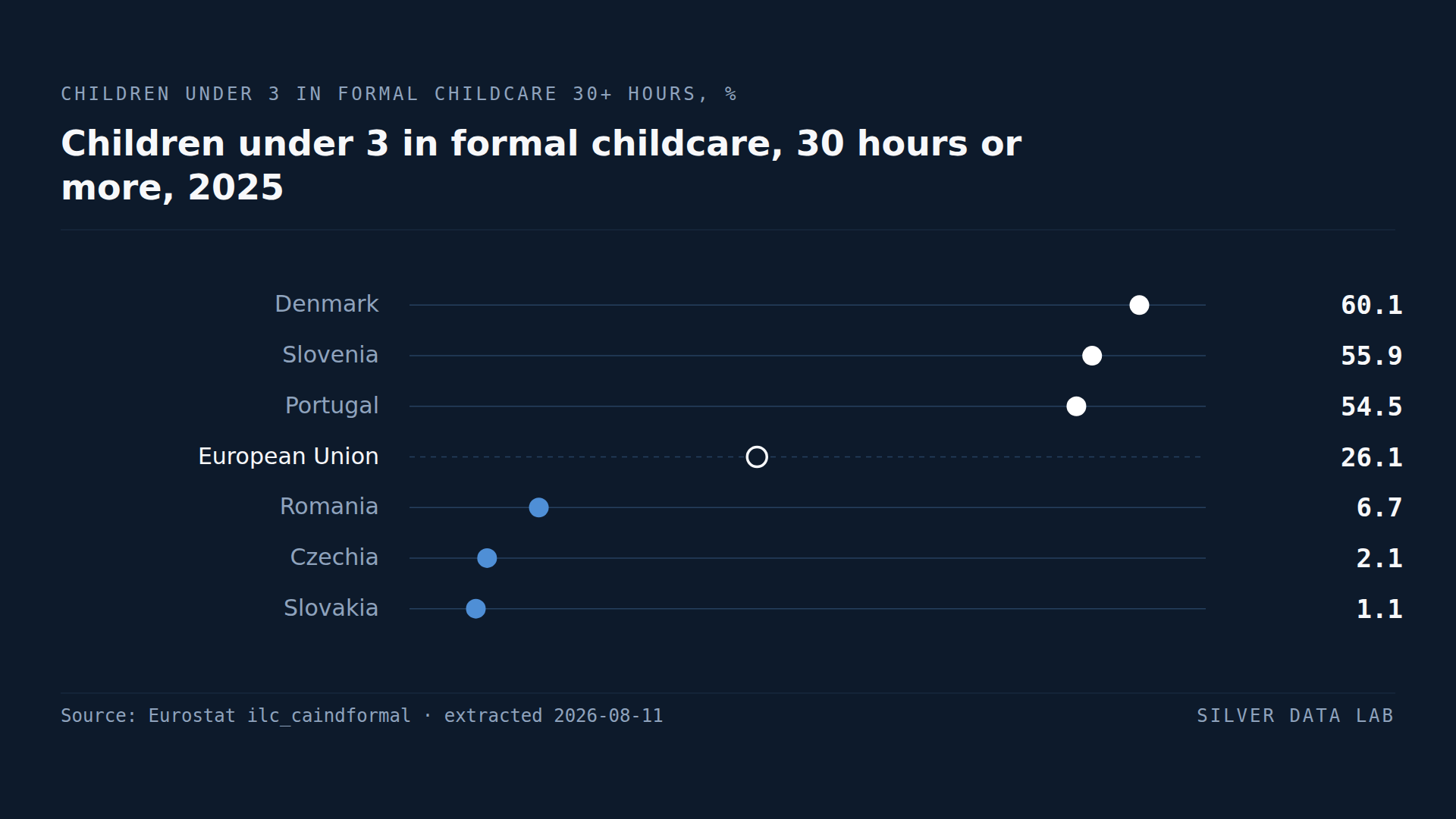
Most Danish Children Under Three Are in Full-Time Childcare
26.1% of EU children under three attended formal childcare for 30 hours a week or more in 2025.
Studies where the same country leads or trails
Food Prices Rose 6.7% in Romania and Not at All in Cyprus
Food prices in the EU rose 2.8% on average in 2025.
Germany Has the EU's Second-Worst School Dropout Rate
9.1% of people aged 18 to 24 in the EU had left education with at most lower secondary schooling in 2025.
Germany Is the Only EU Country Where Most People Do Not Own Their Home
68.5% of the EU population lived in a home owned by their household in 2025.